THE SHORT ANSWER
A DMV can usually tell you only what its own file holds: the title it issued, the registration, a recorded lien and any brand it applied. It offers the public no search box and no accident history. A VIN check pulls records from many sources instead, including title brands, damage, odometer readings, salvage and auction history, theft and recalls. Start with the free preview, then buy one report if the car still looks right.
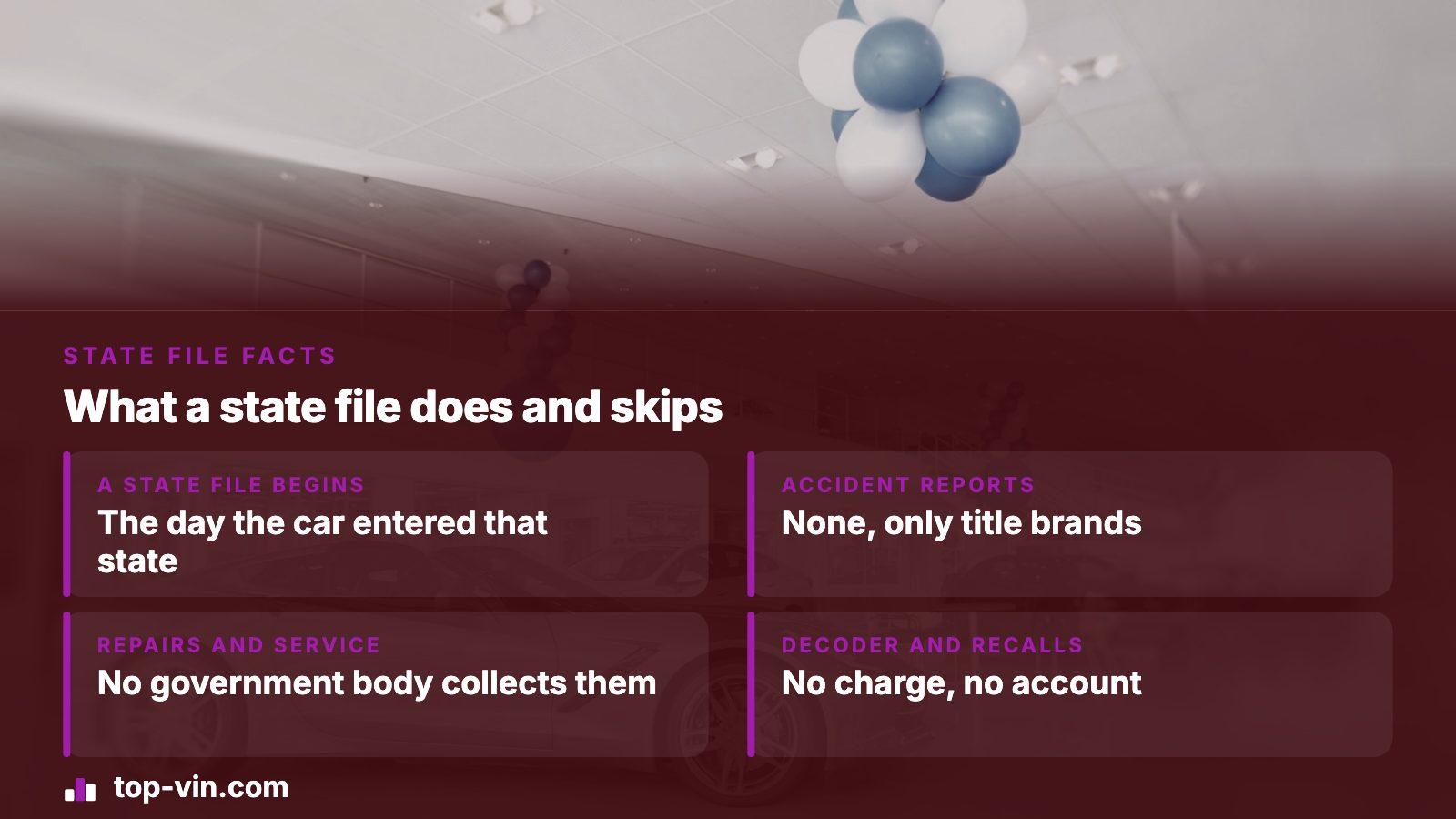
- A state file begins
- The day the car entered that state
- Accident reports at a DMV
- None, only title brands
- Federal decoder and recalls
- No charge, no account
- TopVIN check
- Free preview, then one payment
What a DMV can and cannot tell you about a VIN
Picture a used crossover you are about to buy. Ask the state that titled it about the VIN and you get an administrative answer: is there a title, is the registration current, is a lender listed, did the state brand the title. Some states post that as a status page. Many post nothing, and the only route is a records request.
- Every event from before the car crossed into that state
- Brands another state applied and never passed on
- Repairs and service, which no government body collects
- The owner's identity, for a member of the public
Those four items stay outside a state's file. The state is the right door for one document or one lien, and the wrong door for a history.
Which check answers which question
Head terms like DMV VIN check, VIN lookup and vehicle history all blur together in search results. Sorted by the question each one answers, the choice gets easier.
| Your question | Where it is answered | Cost |
|---|---|---|
| Are the title and registration in order? | The state's status page or records office | Set by the state |
| What was it built as, and is a recall open? | The federal decoder and recall lookup | No charge |
| Was it branded or written off in any state? | National title records, via an approved provider | Set by the provider |
| What do damage, mileage, auction, theft and lien entries say together? | A history report such as TopVIN's | Free preview, then one payment |
Run the no-charge rows first. Then pick the paid row that matches whatever question is still open.
What a TopVIN report adds to the state file
A report is compiled from many sources, so it travels with the car across state lines and records events that no motor vehicle office hears about. TopVIN's covers:
- Branded titles and the accident or damage records behind them
- Mileage readings logged over the years
- Salvage and auction records, photographed where possible
- Liens, impounds and theft entries
- Open recalls and insurer records
- Ownership and use type, along with market value and factory specs
Each line reflects what a source reported. A quiet report means nothing bad was filed, which is encouraging but not proof, so pair it with a test drive and a mechanic's look.
Finding the VIN and running the check
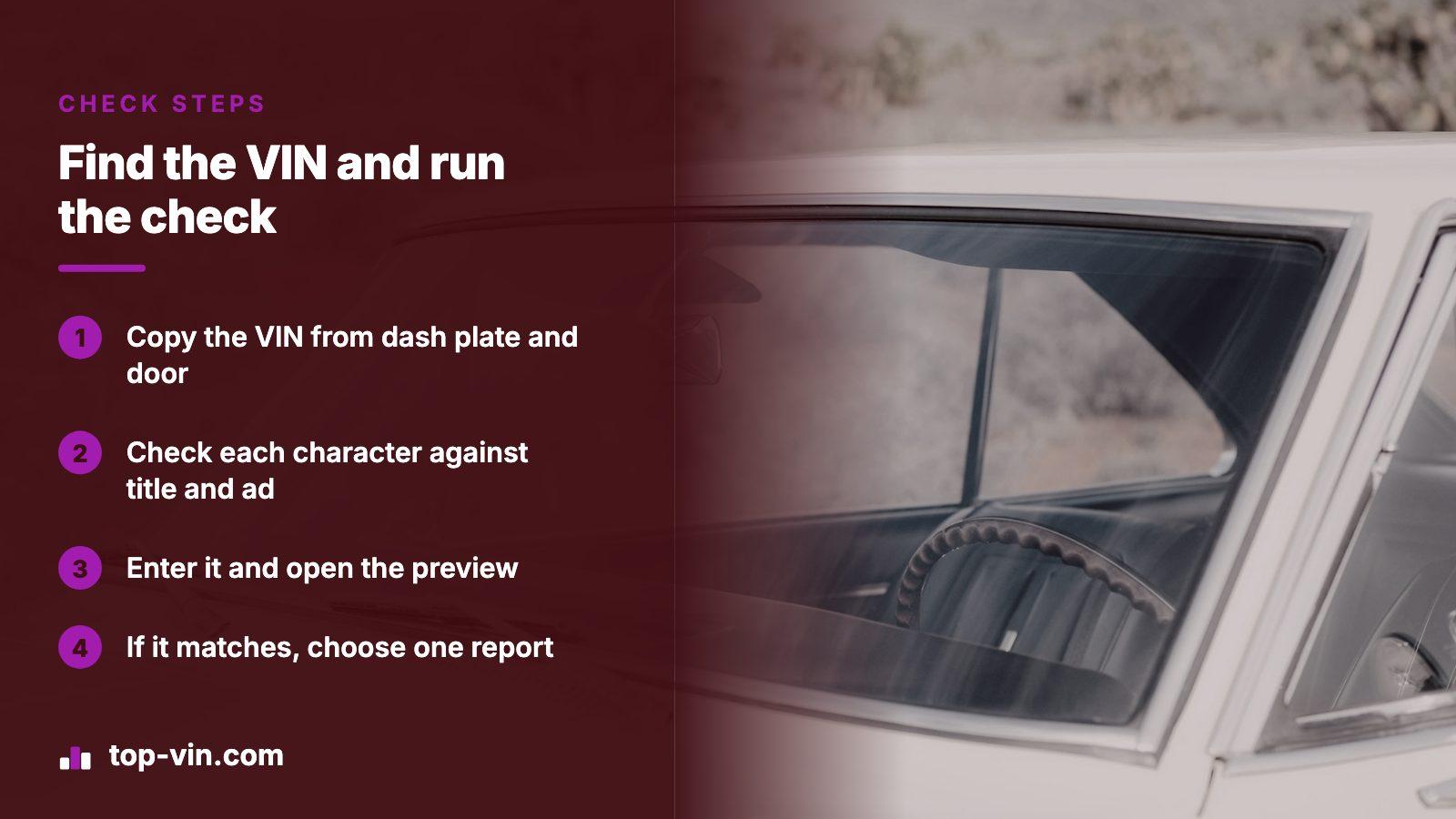
Begin with the 17-character number stamped on the vehicle, and only afterwards compare it with the ad. The standard spots are the dashboard plate seen through the windshield on the driver's side, the label on the driver's door frame, and the paperwork: title, registration or insurance card.
- Copy the VIN from the dash plate, then again from the door label. A mismatch means a conversation with the seller before anything else.
- Check every character against the title and the ad.
- Type them into the box on this page and open the free preview.
- When the preview lines up with the car as advertised, pick one report, or a pack of 3, 5 or 10 for a shortlist.
Red flags worth stopping on
These entries change what a careful buyer does next.
| Entry | Reading it | Your move |
|---|---|---|
| Branded title | Damage or a loss reached the title record, a far higher bar than an ordinary repair | Ask for repair papers and get the structure inspected before talking price |
| Mileage that drops | A rollback or a recording error | Walk away unless the seller can document it |
| Several titling states | Each state records only what arrived with the car, so a brand can vanish in transit | Read the full timeline rather than the latest line |
| Lien or impound | A lender or a tow yard may still have a claim | Insist on a written release before payment |
| Auction photos | The car's condition at an earlier sale | Compare them with the panels and paint on the lot |
| Open recall | A safety repair is outstanding | Book it with a dealer for that brand; remedies are normally free |
Why a state office holds so little
The law explains the forms. Section 2721 of Title 18 closes personal details in motor vehicle records to the public, with exceptions for listed uses, one of which covers vehicle safety and theft. That is how a state can publish a title or lien indicator about a vehicle while refusing an owner lookup. Someone vetting a private seller is not on the list.
Structure explains the gaps. More than fifty agencies title and register vehicles, each with its own files. None collects service records, and nobody sends them minor collisions, so damage appears only after it becomes a brand. A clean state file can sit on a car that was rebuilt after a crash two states away.
Spotting a fake lookup
A site that promises the owner's name from a VIN is making an empty claim. Federal privacy rules keep that detail out of public lookups.
The in-person meaning of a DMV VIN check
Clerks and sellers sometimes say the DMV must check the VIN and mean a physical inspection. Someone approved by the state looks at the number on the vehicle, matches it to the paperwork and signs off. States call for this in particular cases, including cars arriving from another state and rebuilt vehicles returning to the road.
It belongs to registration, not to buying. It confirms paper matches metal and says nothing about the car's past. Each state sets its own fees and decides who may sign.
Price and next steps
The decoder and the recall lookup carry no charge, and neither does the TopVIN preview. Paying for the report is a one-time event with nothing recurring, and current amounts for one report and for the packs are on the pricing page. A state records request adds the state's fee, and a federal title provider adds its own.
With several cars on a shortlist, a pack lets you check every VIN before you burn a weekend on test drives.
Before you drive out
Open the preview and the recall lookup, read the seller's title, then buy the report if the car still fits. Save the state's own record for the day you need one particular document.
Where this information comes from
- NHTSA: vPIC VIN decoding API — The federal decoder that returns a vehicle's factory build from its VIN at no charge.
- 18 U.S.C. 2721: Prohibition on release of personal information — The statute behind the limits on what a state may release from a motor vehicle record, and the list of permitted uses.
- NMVTIS: National Motor Vehicle Title Information System — The federal title history system whose records cross state lines, and where approved providers are listed.
- NHTSA: Recalls — The federal lookup for open safety recalls by VIN.
Sources and photos: Facts checked against the sources above in November 2026. Photos by Masjid MABA, Wesley Tingey and Richard R on Unsplash; diagrams by TopVIN.
Keep reading
- Motor vehicle records: what a car buyer can see, and what stays closedWho may lawfully obtain a state record, and how to request your own.
- VIN verification: the four checks people mean and what each provesThe in-person inspection that shares the name, and what the inspector checks.
- Vehicle registration lookup: what it shows and which check to addThe registration side of the same state file.
- Sample reportSee what a full report looks like before you run one.
Frequently asked questions
Can I run a VIN check through the DMV?
Seldom as a search. Most states handle a records request that carries a fee and needs an allowed reason, and a few publish a narrow status page. For a purchase, a history report reaches further, since it follows the car across states instead of stopping at one agency's file.
Is there a free DMV VIN check?
Not for history. The federal decoder and recall lookup carry no charge, and some states post a status page, but no government office gives away a full vehicle record. The TopVIN preview is free and the report after it is one payment, so you can look before deciding.
Does a DMV VIN check show accidents?
Only indirectly. A state file holds titles, registrations, liens and brands, and ordinary collisions never reach it. A repaired crash leaves no line unless it produced a brand. Accident and damage records come from other sources, which a history report gathers by VIN.
Can the DMV tell me who the owner is?
Not to a private buyer. Federal law closes personal details in these records except for listed uses, and a shopper wondering about a stranger's car does not qualify. A state can describe the vehicle without describing the person. To vet a seller, match the name on the title to their photo ID.
Is a VIN check the same as a VIN verification?
No. A check searches records by VIN and can be done on your phone. A verification is a physical inspection by someone the state approves, who matches the number on the car to its papers, typically when registering a rebuilt or out-of-state vehicle. One informs the purchase; the other belongs to registration.
Now check the car itself
The guide explains what to look for. The report shows what this VIN has on record.