
THE SHORT ANSWER
A motor vehicle record is any file a state DMV keeps on a permit, title, registration or ID card. A buyer can see a car's title status and recorded liens through some state tools, and brands through the federal title system, but federal privacy law keeps owner names closed. Repairs, most damage detail and auction photos sit outside these files, so pair them with a VIN history report.
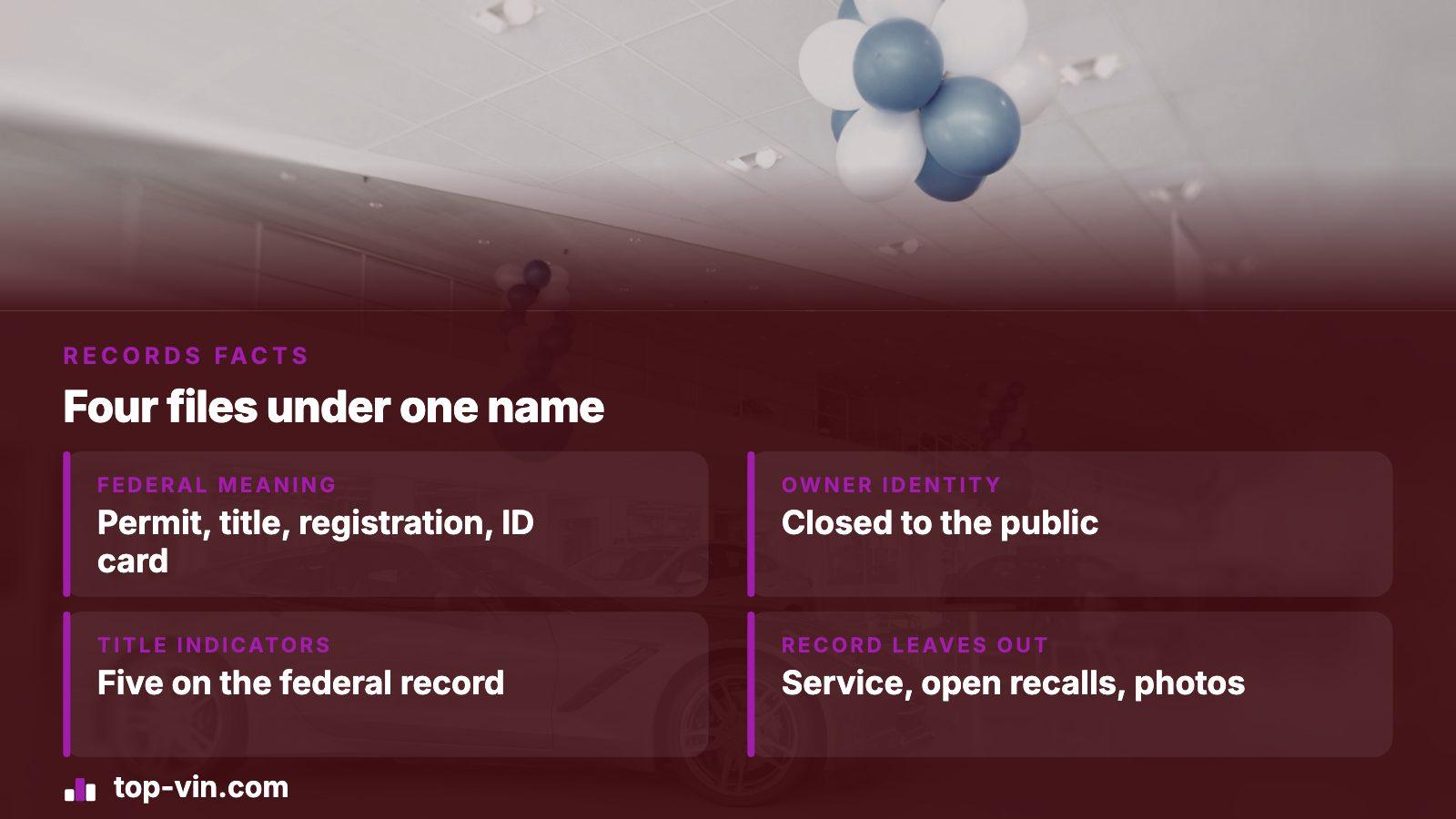
- Federal meaning
- Permit, title, registration, ID card
- Owner identity
- Closed to the public
- Federal title indicators
- Five
- TopVIN check
- Free preview, then one payment
Four kinds of file under one name, and the two about the car
Federal law gives the phrase a wider meaning than most searchers expect. A motor vehicle record is any file a department of motor vehicles issues about an operator's permit, a title, a registration or an identification card. Two of those four belong to the person at the wheel. The other two belong to the car.
That split decides what you request. A driver checking an insurance rate wants the driver side, usually called a driving record or abstract. A shopper eyeing a used Camry from a private seller wants the vehicle side: the title's standing, a lender's claim, any brand a state attached.
Match the question to the record that answers it
Head terms such as motor vehicle records, DMV record and VIN check blur together. Sorted by what a buyer is trying to learn, each one has a different home.
| Buyer's question | Where it lives | Who can ask |
|---|---|---|
| Is the title issued, and is a lender listed? | A state title and lien tool, where one is posted | Buyers holding the VIN |
| Did any state brand it salvage, flood or junk? | The federal title system, sold through approved providers | Any buyer, for a small fee |
| Is a safety recall open? | NHTSA's lookup by VIN | Anyone, no request needed |
| Do damage, mileage, auction, lien and theft entries agree? | A history report such as TopVIN's | Anyone; free preview, then one payment |
| Who owned it, and where do they live? | Withheld by federal law | Only users with a permitted purpose |
Run the rows that cost nothing first. Then spend money on whichever question is still open.
What a state title tool actually returns
New York's DMV publishes a clear example. A visitor enters the VIN, model year and make, and the page reports when the title was printed, the count of recorded liens, plus each lender's name and address. The state says the tool displays no personal information about the owner or registrant.
That is a narrow answer, and a useful one. A recorded lien tells you a lender could still be owed money on the car, whatever the seller says. The same page adds that mailed titles can take as long as 45 days to show up, which matters when a seller says the paper is still on its way.
One state's file
A state tool reports what that state holds today. A car first titled somewhere else may need a federal title check or a history report beside it.
The federal title record and its five indicators
The federal title database known as NMVTIS belongs to the Justice Department and has been operated since 1992 by AAMVA, a nonprofit that represents officials who administer motor vehicle law in the United States and Canada. Because it keeps brand history from any state, it answers a question no single state file can. Its consumer page says a report covers five indicators only:
- Whether the title is current, and when it was last issued
- Brand labels such as salvage, junk or flood
- An odometer reading, useful for spotting inconsistencies
- Whether an insurer ever declared the car a total loss
- Whether the car carries a salvage history
The program calls its report intentionally concise and says a clean one is good news, not a sign of missing data. Some businesses on the government's provider list serve dealerships only, so confirm a provider sells to consumers before you pay.
Why the owner's name never comes with the file
The Driver's Privacy Protection Act, at Section 2721 of Title 18, begins with a ban. A state motor vehicle agency cannot knowingly hand over personal details from its files unless the request fits a listed use. The list favors institutions: courts and agencies, insurers handling claims or pricing a policy, towing notices, licensed investigators with a permitted purpose, and requesters holding written consent.
Section 2725 defines personal information as data that identifies a person, such as a name, address, phone number, photograph or Social Security number. The definition leaves out information about accidents and driving violations, and the five-digit ZIP code. A buyer vetting a private seller is not on the permitted list, and paying a website changes nothing.
A claim worth testing
A site selling a stranger's address from a VIN must be an authorized recipient, and a recipient that resells generally has to keep records for 5 years naming each buyer and purpose. Ask how it manages that.
The driver side, and the one record you should read yourself
A used-car buyer has no use for the seller's driving record, and no right to it. Your own is another matter. Insurers are named in the federal list for rating and underwriting, so the file behind your next quote is one you can request from your state first.
- Find the request page on your state DMV's own site, not on a directory.
- Decide whether you need a certified copy. A court or employer may insist, and the fee is set by the state.
- Expect to prove your identity.
- Read the dates as closely as the entries, since items age off on a schedule that differs by state.
- Dispute errors through the agency that holds the file.
What these records leave out about the car
Even the federal record is narrow on purpose. Its operators say it skips repair histories and recall details, along with upkeep records that a private company might supply. Texas agrees: it says a private history report usually carries service and repair records, and it still suggests hiring a mechanic.
- Service and repair entries, unless a private source supplies them
- Open recalls, which live in NHTSA's lookup
- Photos from an earlier auction or salvage sale, which are not among the five indicators
- The identity of anyone who owned the car
NICB's VIN search costs nothing and includes flood damage among other data, so it earns a place in the routine.
A sensible order for checking a car you want to buy
- Match the VIN on the car against the title and registration card, character by character.
- Use the state's title or lien tool if one exists, and make the seller clear any lien before you pay.
- Check NHTSA's recall lookup, then NICB's VIN search. Neither charges a fee.
- Open the TopVIN preview with the same VIN. If it fits the car, buy one report, or a larger pack when your shortlist is long.
- Have a mechanic inspect the car, and ask whoever did the work for maintenance records.
A TopVIN report reads what the state files and the federal record split between them: title brands, mileage readings, any salvage or auction sale with photos, and lien or impound entries. Nothing renews after the single payment, and current options are on the pricing page.
When the file and the story disagree
If a seller calls the title clean and a brand turns up in any state, believe the record. Ask for repair papers before you discuss price.

Where this information comes from
- 18 U.S.C. 2721: release and use of personal information — the ban on release, the permitted uses and the record-keeping rule for resellers
- 18 U.S.C. 2725: definitions — what counts as a motor vehicle record and as personal information
- NMVTIS: understanding a vehicle history report — the five indicators and what the federal report leaves out
- NMVTIS: about the program — who runs the federal title system and since when
- NMVTIS: used car buying tips — inspection, maintenance records and the free NICB search
- Texas DMV: title check, look before you buy — what a multi-state title check shows and how it differs from a full history
- New York DMV: check a title or lien status — an example of a state tool that lists liens and withholds owner details
Sources and photos: Facts checked against the sources above in November 2026. Photos by Carrie Allen www.carrieallen.com, Jakub Żerdzicki and Richard R on Unsplash; diagrams by TopVIN.
Keep reading
- DMV VIN check compared: what the state shows and what to run beside itWhat a state office can tell you about a VIN, and what to run beside it
- Vehicle registration lookup: what it shows and which check to addThe registration side of a vehicle record, and what its statuses mean
- Previous owners by VIN: what a check shows and what it can'tWhy a title timeline is available and owner names are not
- Insurance lookup by VIN: which checks answer it and which do notHow insurers use these files, and what the public cannot pull
Frequently asked questions
What are motor vehicle records?
They are the files a state DMV issues for operator's permits, titles, registrations and ID cards. The driver side holds license status and violations. The vehicle side holds title and registration facts, often a lender and any brand the state applied. Both sit under the same federal privacy rules for release.
Can I look up a car's motor vehicle record by VIN?
Sometimes. Some states post a title or lien tool, and New York's takes a VIN, model year and make. Where none exists, you request the record from the DMV or buy title data from an approved federal provider. Either way owner details are withheld, so the VIN tells you about the car, not the person.
How is a motor vehicle record different from a vehicle history report?
No. A state record describes one agency's paperwork. A history report is compiled from several sources, such as title data, mileage readings, salvage and auction sales, liens and recalls. Most buyers want both: the state tool for the title and lender, and a report for everything that happened elsewhere.
Can I see who owned a car before me?
Not by name. Federal law closes that detail to the public, and a report shows dated title events with states and mileage instead. How long each stretch lasted, and whether the mileage kept climbing, tells a buyer more than a name would.
Does a clean motor vehicle record make a car a safe purchase?
Only that the sources reported nothing bad, which is good news. The federal program itself calls a clean report a good thing. Repair quality, wear and unreported damage never reach these files, so a clean result still calls for a test drive and a mechanic's inspection.
Now check the car itself
The guide explains what to look for. The report shows what this VIN has on record.