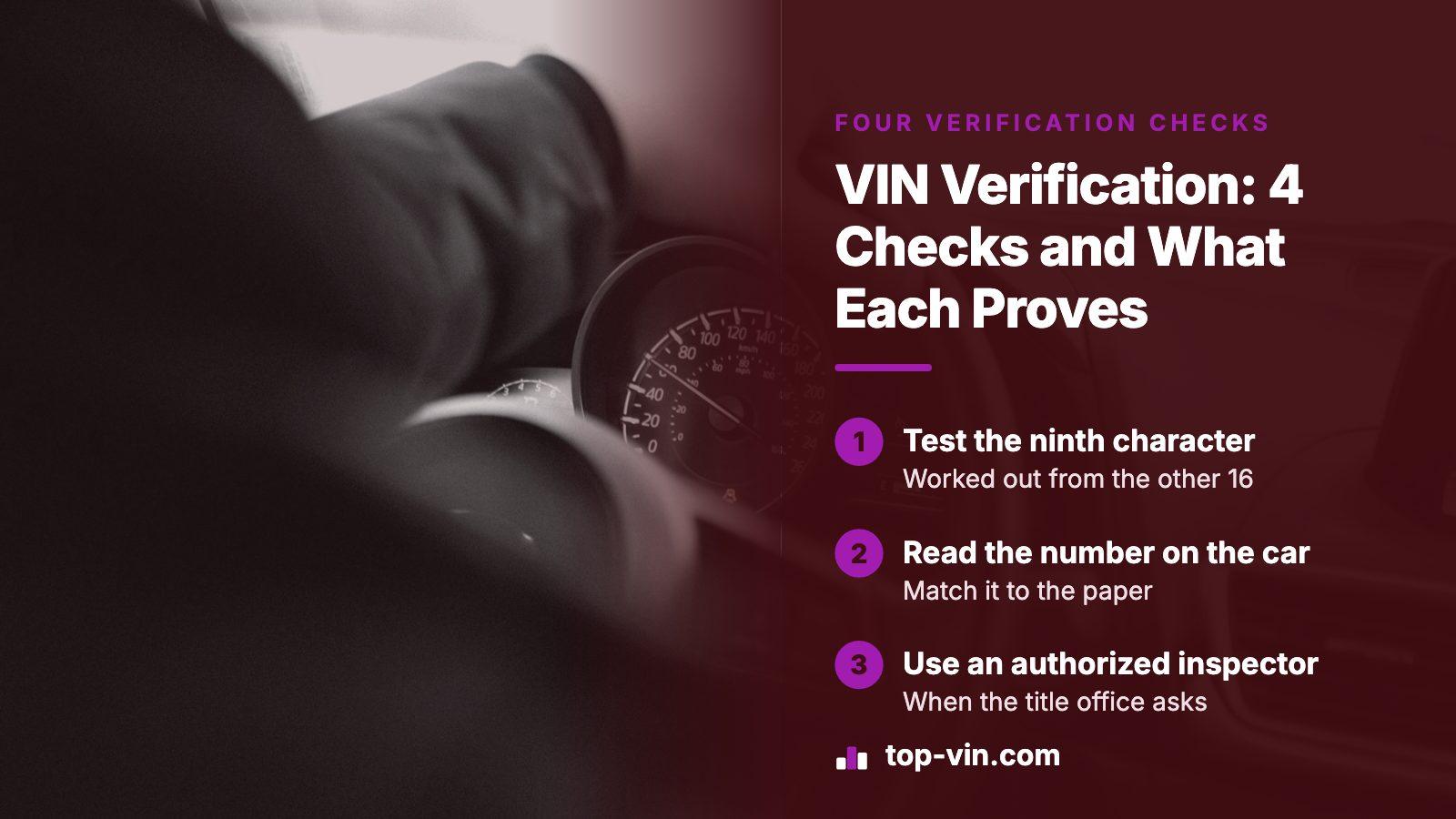
THE SHORT ANSWER
Verifying a VIN means confirming that the 17-character number is well formed, that it appears on the car where federal rules put it, that it agrees with the title, and that the records behind it are clean. A state inspection covers the matching step only. A decoder covers the format only, and a history check covers the records only. No single step proves the car is what the seller says.
- Check digit
- Position nine, worked out from the other 16 characters
- Letters never used
- I, O and Q
- Readable from
- Outside the car, through the glass, in daylight
- State inspector
- Someone the state authorizes, never the buyer or the seller
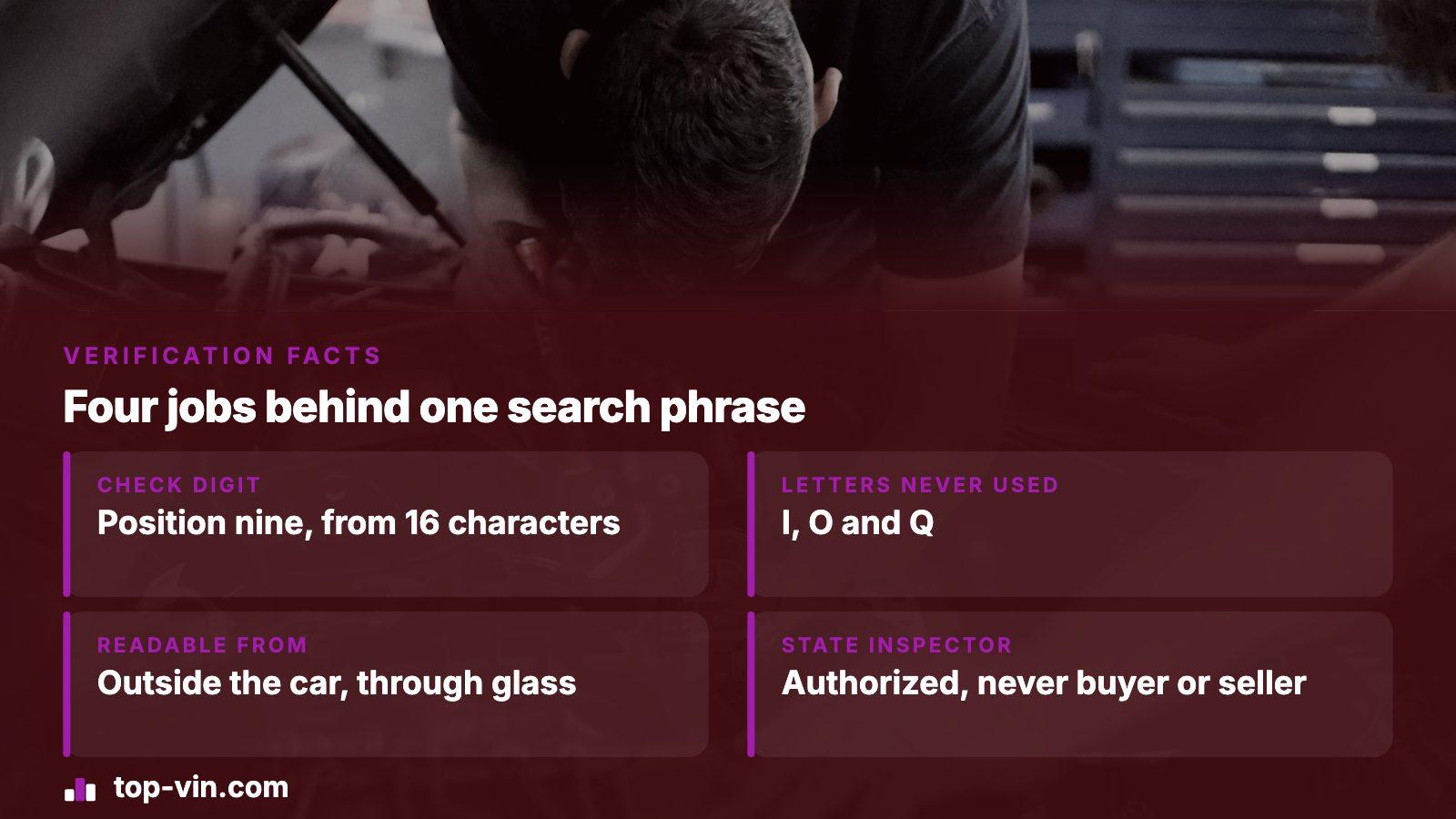
Four jobs hiding behind one search phrase
People type the same two words and want different things. A title counter wants a signed form, while a buyer with a listing open wants to know whether the number is real. The table sorts the jobs by who does the work and what a pass proves.
| Job | Who does it | A pass proves | It cannot prove |
|---|---|---|---|
| State inspection | A person the state authorizes, standing at the car | The number on the vehicle matches the ownership papers | Anything about accidents, liens or condition |
| Format test | You or a decoder, on a screen | The characters are allowed and the check digit works out | That a real car carries the number |
| Match at the car | You, with the title and the listing in hand | The number reads the same everywhere it should appear | That the title itself is clean |
| Records search | A history report queried by the number | What agencies, insurers and salvage yards filed | That a plate was never swapped |
The inspection a title office may require
The inspection is the formal version. A person the state authorizes looks at the vehicle, reads the number on it and compares it with the ownership papers you bring. You cannot do it for your own car, and neither can the seller, since a signature only counts when the signer gains nothing from the answer.
Which cars need one depends on the state, and no national rule decides it. Common triggers are a car titled elsewhere before, a rebuilt or reconstructed vehicle, a number recorded wrongly on earlier paperwork, and an import registered for the first time. Ask the titling office before you book. The VIN inspection guide on this site has state examples.
Testing the number itself with the ninth character
Federal rules set aside position nine of a modern VIN for a check digit, a character calculated from the other sixteen. A mistyped number usually fails that arithmetic. The rule that defines it, 49 CFR 565.15, lets you run the sum by hand:
- Swap each letter for its table value: A through H become 1 through 8, J through N become 1 through 5, P is 7, R is 9, and S through Z run from 2 to 9. Digits stay as they are.
- Multiply each position by a weight. Weights step down from 8 to 2 across positions one to seven, position eight carries 10, position nine carries none, and positions 10 to 17 step down from 9 to 2.
- Add up the products, divide by 11 and keep the remainder.
- That remainder is the check digit, written as the letter X when it comes to 10. Compare it with position nine.
The rule's own worked example adds up to 411, which leaves a remainder of 4, so its ninth character is a 4.
What NHTSA's decoder confirms and what it leaves open
NHTSA's public decoder does the arithmetic for you. A sample Honda Accord number came back with a message saying the ninth-position check digit was correct. Altering the final character of that number produced error code 1, a note that the check digit failed the calculation, and no suggested fix. That makes it a quick way to catch a typo copied from a listing.
A clean result has limits. The decoder reads build data that manufacturers submit to NHTSA, so it describes what a number was assigned to, not the car in the driveway. Compare the year, make and body style it returns with the ad before booking a viewing.
A valid number is not a genuine car
Cloning dresses a stolen vehicle in the identity of a lookalike that shares its brand, model and model year. A format test and a decoder both pass that number, which is why the steps after this one still matter.
Reading the number on the car and matching it to paper
Federal rules put the number where an ordinary person can read it: inside the cabin, legible through the glass in daylight to a person with 20/20 sight standing just outside the driver's side of the windshield. Each character is at least 4 mm tall. Then work through four steps:
- Read the number from outside the glass, with permits and toll tags moved aside, and copy it one character at a time.
- Locate the certification label beside the driver's seat, usually on the door frame. It is attached so that removing it destroys or defaces it, so a swapped or peeled label stands out.
- Hold both readings against the listing and against the title the seller shows you. All three must agree.
- Treat a letter that looks like O, I or Q as a misreading. None appears in a compliant number, so a round O is a zero.
If the two locations disagree, or a number is covered, cut or unreadable, stop there. The mismatch is the finding.
Verifying what the number's history says
Neither the arithmetic nor the metal can show a title brand. That lives in records. The federal title system, NMVTIS, keeps five things on a car: the state where the title currently sits and its latest date, any brands applied, the odometer reading on file, a total-loss determination and salvage-yard handling. State title offices, insurers, junk and salvage yards and recyclers supply the data under a federal reporting duty.
A clean entry is a good sign and not a guarantee. The Justice Department's consumer page warns of false negatives, since not every state and reporting entity is connected yet. Repair, recall and maintenance data sit with private providers.
A TopVIN preview fits here. Entering the number costs nothing, and the preview tells you what is on file before you spend a Saturday driving to the car. If you go on to the full report, you pay once, no subscription follows, and the pricing page has the options.
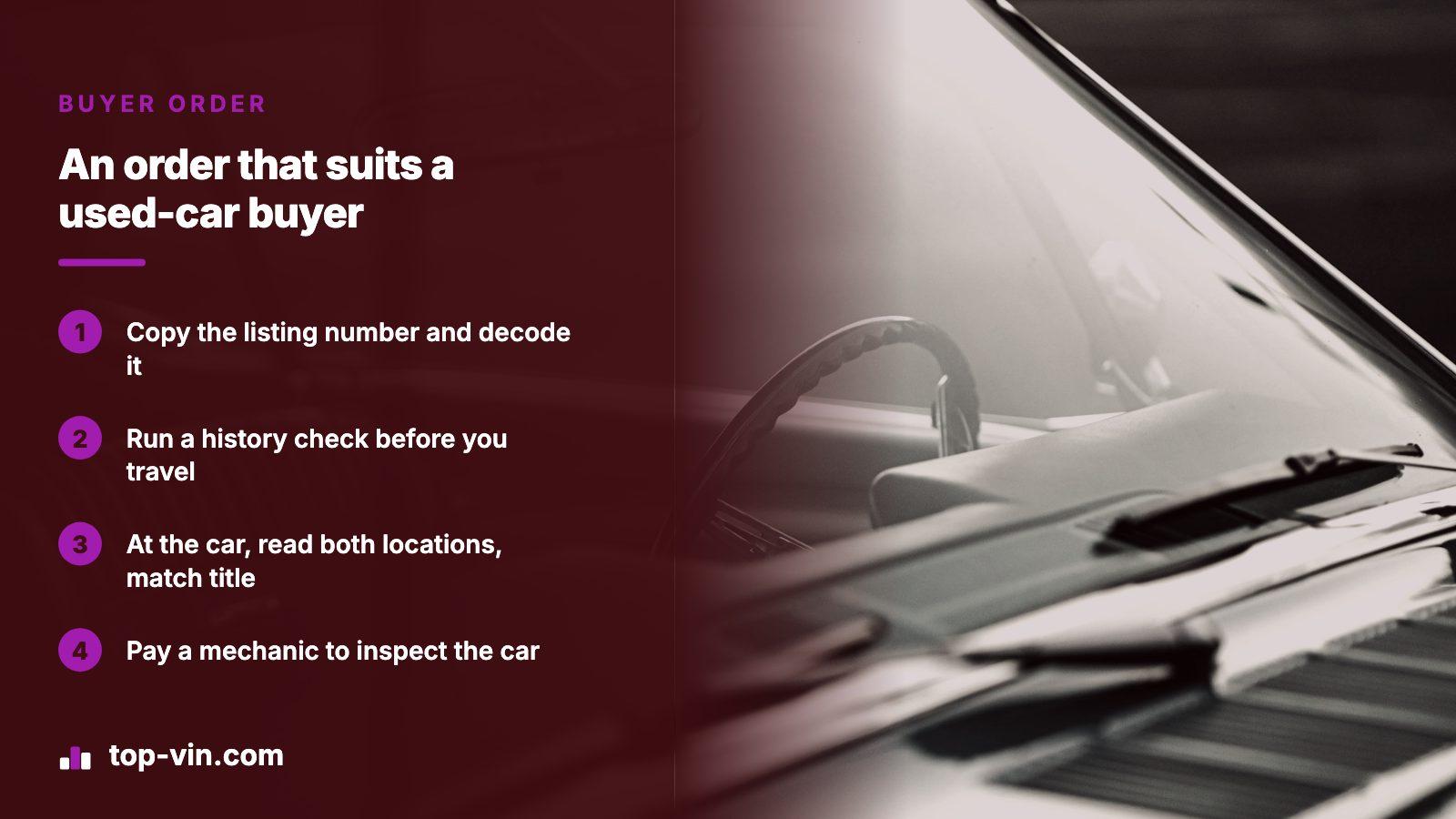
An order that suits a used-car buyer
- Copy the number from the listing and decode it. Confirm the year, make and body match the ad and that the check digit works.
- Run a history check before you travel. A brand or a total-loss entry ends the trip early.
- At the car, read both locations and match them to the title in the seller's hand.
- Ask the titling office whether an inspection applies to a car like this one.
- Pay an independent mechanic to inspect it, and have the written report list the VIN.
FTC buying advice puts it plainly: a history report cannot stand in for a mechanic's inspection, because it tends to list accidents and flood damage rather than worn parts.
When the numbers do not agree
Treat a disagreement as information about the car, not a clerical slip to fix at the counter. Two numbers that should match and do not mean one was altered or the papers describe another vehicle. Pause the purchase, hold back any deposit and ask for the seller's explanation in writing.
A covered or scratched number is a milder case. Clear the glass or ask the seller to remove whatever hides it, then look again. A plate that looks cut, lifted or fixed with odd rivets means walk away.
When the numbers match but something still feels off, request the state's full title record, which holds more than the federal system does.
Where this information comes from
- eCFR: 49 CFR 565.13, VIN requirements — length, check digit position, readability through the glass, permitted characters
- eCFR: 49 CFR 565.15, check digit calculation — letter values, position weights, the divide-by-11 step and the worked example
- eCFR: 49 CFR 567.4, certification label — where the door label sits and why it cannot be removed intact
- NHTSA: vPIC API — the decoder reads manufacturer-submitted data; check-digit result tested on a sample number
- NMVTIS: Understanding an NMVTIS vehicle history report — the five indicators, who reports and what a clean report does not cover
- NMVTIS: Consumer information — how cloning works and why a clean report can be a false negative
- FTC: Buying a used car from a dealer — history report versus independent inspection, and the written mechanic's report
Sources and photos: Facts checked against the sources above in November 2026. Photos by Miles Loewen, Dylan Michaud and Mustafa Sheikhmouss on Unsplash; diagrams by TopVIN.
Keep reading
- VIN inspection: what the inspector checks and what a VIN check addsState-by-state detail on who signs the inspection, and what it costs
- VIN check digit: how the ninth character is worked out and what it provesA closer look at the ninth character and the math behind it
- VIN cloning: why a VIN check can pass a stolen car and what catches itHow a genuine-looking number ends up on the wrong car
- How to read a VIN: a left-to-right walkthrough with a worked decodeWhat each position of the number tells you once it passes
Frequently asked questions
What does VIN verification mean?
It depends on who is asking. For a state it is an in-person inspection that matches the number on a vehicle to its title. For a buyer online it usually means testing that the number is valid and reading the records filed under it. The jobs are separate, and neither replaces the other.
Can I verify a VIN online?
You can test the format and check digit, decode the build details and read the records, all from a screen. A state inspection cannot be done that way, since it exists so that a person can see the vehicle.
How do I know if a VIN is valid?
Count 17 characters, make sure none is an I, O or Q, and test position nine with the arithmetic or NHTSA's decoder. A failure points to a typo or a bad number. A pass means the number is well formed, nothing more.
Who can verify my VIN for a title?
Whoever your state names, which commonly includes its motor vehicle staff and police and, in some states, licensed dealers or private verifiers. Never you and never the seller. Ask your titling office for its list and any fee.
Does a clean VIN verification mean the car is safe to buy?
No. An inspection matches the metal to the paper, a decoder checks format and a history report covers filed records. None of them tests brakes, frame or engine, so add a mechanic's inspection.
Now check the car itself
The guide explains what to look for. The report shows what this VIN has on record.