THE SHORT ANSWER
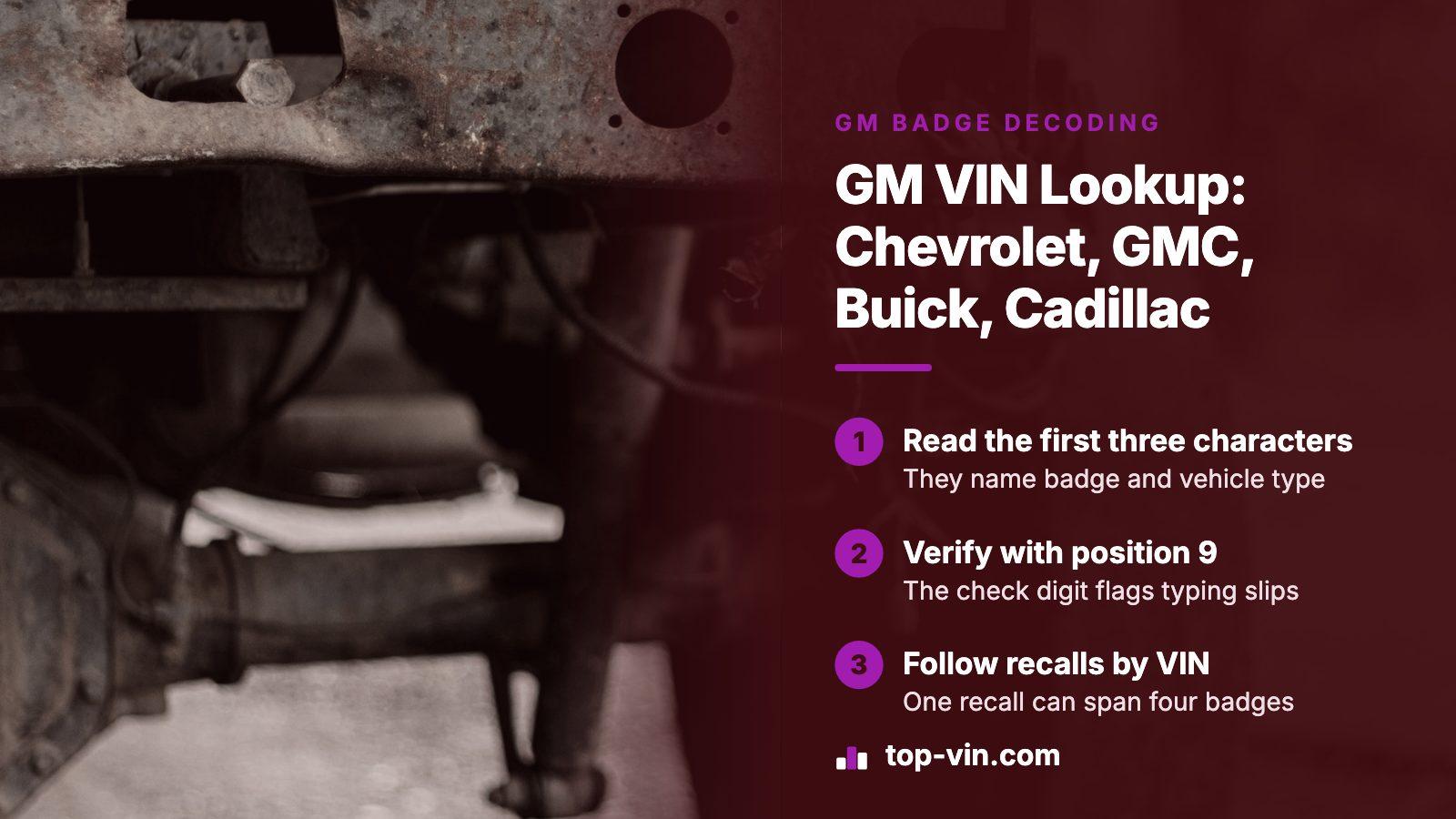
A GM lookup returns three layers for the 17-character number on the windshield corner or the title: the build description GM filed with NHTSA, the history that states and insurers logged afterward, and recalls not yet repaired. Start with the first three characters, which name the badge and the vehicle type. NHTSA's decoder and recall search cost nothing. TopVIN's preview costs nothing either; a full report is bought once, for the one vehicle.
- First three characters
- Name the GM badge and the vehicle type
- Identifiers on file
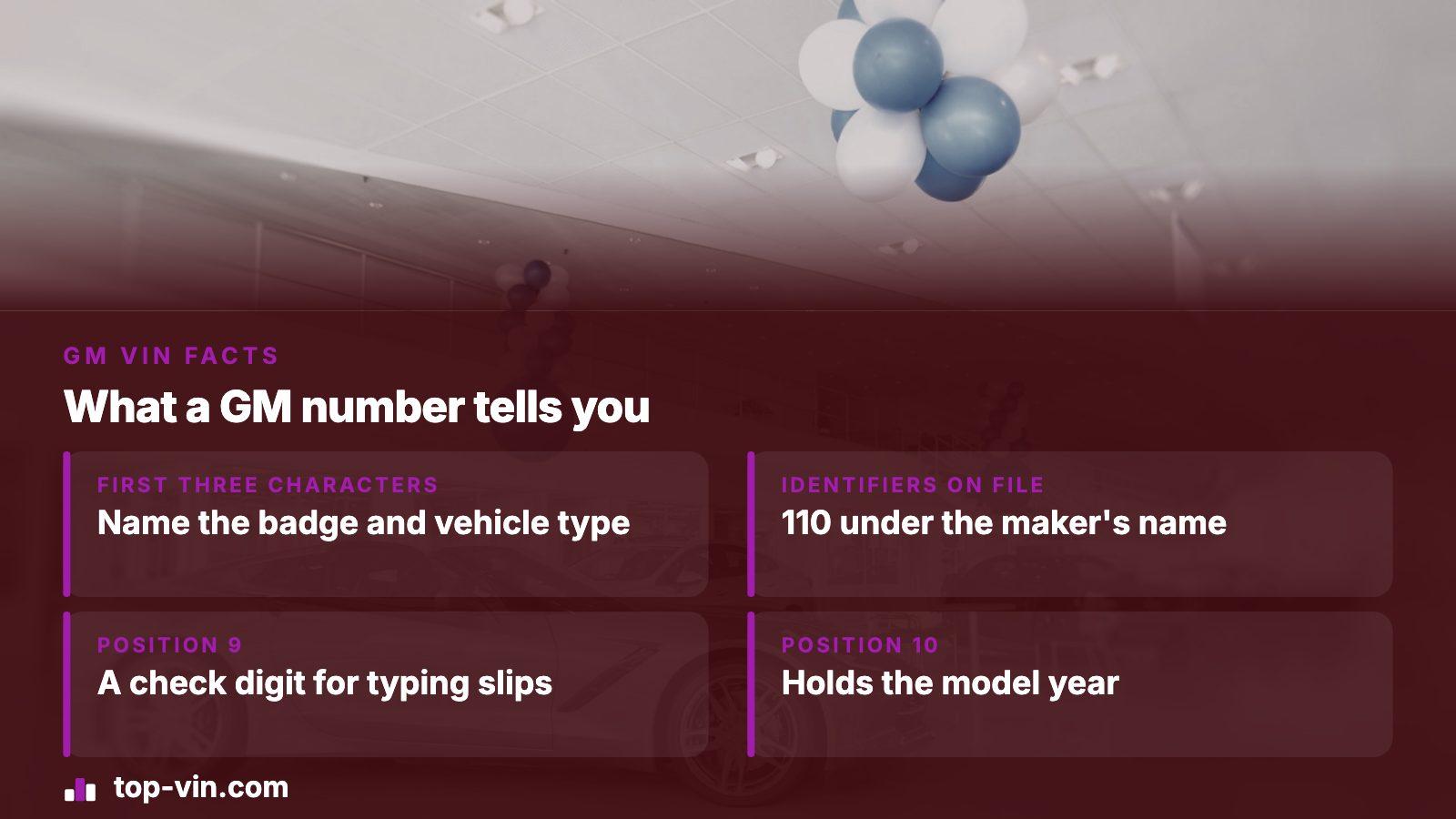
- 110 under the General Motors name at NHTSA
- Position 9
- A check digit that exposes typing slips
- Start
- Free preview, then one payment for the report
Three layers a GM lookup pulls from one number
One VIN sets off three separate retrievals. Keep them apart, because each answers a different question.
- Build: what General Motors reported to NHTSA, such as model year, series, trim, body class, engine and assembly plant. Even a partial pickup VIN came back with most of these, alongside an incomplete-number warning.
- History: title brands from state agencies, odometer entries, and total loss or salvage records. GM supplies none of it. It builds up after the vehicle leaves the plant.
- Recalls: campaigns tied to that exact number, split into repaired and still open.
NHTSA says the decoder shows maker-reported data. Trust the build layer for how the vehicle left the factory, and for nothing past that.
Which GM badge the first three characters name
The first three characters carry the maker and the vehicle type. GM has many of them: a search of NHTSA's register under the General Motors name returns 110 identifiers, 108 filed by General Motors LLC and 2 by Shanghai General Motors. So a single brand can begin with several different codes.
| First three | NHTSA decodes it as | Vehicle type |
|---|---|---|
| 1G1 | Chevrolet | Passenger car |
| 2G1 | Chevrolet | Passenger car |
| 1GC | Chevrolet | Truck |
| 3GN | Chevrolet | Multipurpose passenger vehicle |
| 1GT | GMC | Truck |
| 1GK | GMC | Multipurpose passenger vehicle |
| 1G4 | Buick | Passenger car |
| KL4 | Buick | Multipurpose passenger vehicle |
| 1G6 | Cadillac | Passenger car |
| 1GY | Cadillac | Multipurpose passenger vehicle |
Use the table to test a listing. An ad for a GMC Sierra whose number begins 1GC carries a code NHTSA decodes as a Chevrolet truck. The cause may be a typo, a number lifted from another vehicle or a seller confusing two trucks. Get an explanation before paying.
Copying the 17 characters without a slip
Most failed lookups were mistyped. Federal rules put the number inside the cabin, where someone outside beside the left pillar can read it through the glass by daylight, each character at least 4 mm tall. Your title and the dealer's Buyers Guide print it too, so compare all three.
- Count 17 characters, with no spaces.
- I, O and Q are excluded from every VIN, so a lookalike in that spot is a digit you misread.
- Position 9 is a check digit meant to expose transcription errors. A number that fails the check has a wrong character somewhere.
- Position 10 holds the model year: a K means 2019, an M means 2021 and a P means 2023. On cars and light trucks, a letter in position 7 puts the year in 2010 to 2039, and a digit means 1980 to 2009.
One recall, four badges: why recalls follow the VIN
NHTSA's recall data shows GM campaigns naming several badges at once. A 2021 tire campaign listed Buick, Cadillac, Chevrolet and GMC models, and owners were sent to a separate customer line for each brand. A search by nameplate would miss some of them.
Geography can set the scope too. An air bag inflator campaign for 2007 to 2011 trucks and SUVs covered vehicles first sold, or ever registered, in a list of states called Zone A, with a second list, Zone B, for the earliest years. A used pickup that has crossed state lines can fall inside or outside depending on where it has lived.
One model year can carry many campaigns: NHTSA lists 10 for the 2019 Silverado 1500. A VIN search narrows that to what is still open on the truck in front of you. In both campaigns above, the dealer repair costs the owner nothing.
A branded title and the dealer's service bay
States apply brands such as junk, salvage and flood, and the federal title database keeps the brand history from every state. On a GM truck a brand can matter after the sale as well as at it.
From an NHTSA owner complaint
An owner of a 2011 Silverado 1500 told NHTSA that a recall notice for the air bags had arrived, but the dealer would not do the repair because the title was salvage. A case was opened with GM, and the owner was told to have the brand removed through the DMV. The truck had not failed.
Take it as one owner's report, not policy. It still justifies asking what a brand would do to repair eligibility before you commit. The decoder never shows a brand. Only the history layer does.
Reading a GM result: what to do with each finding
| On the result | What it can mean | Your next move |
|---|---|---|
| Code names a different GM brand | A typo, a swapped number or a different vehicle | Check the number again on the vehicle and the paperwork, then question the seller |
| Salvage, junk or flood brand | A state judged it badly damaged or water-soaked | Get repair records and an inspection before discussing price |
| Total loss, no brand | An insurer wrote it off, and heavy damage generally sits behind that | Find who repaired it and have the work checked |
| Odometer entry above the dash | A rollback, a swapped cluster or a bad entry | Line up the dated readings. Mileage only climbs, so make the seller account for a gap |
| Open recall, remedy not out yet | The campaign exists but the repair is not ready | Get the dealer's timeline in writing and weigh it in the price |
From an NHTSA owner complaint
A buyer who bought a 2011 Silverado 1500 from a dealer told NHTSA the odometer read 115,519 at the time. A history report pulled afterward showed 253,000 miles back in 2019, and the complaint is filed as odometer fraud.
Run before payment, a report shows a gap like that while you can still walk away.
What no GM lookup can promise
The federal title program calls its own report intentionally concise: five indicators, with no repair history, recall data or maintenance entries. Private providers add detail, and the FTC says some can include accident and repair history, yet none sees a cash repair nobody reported. The FTC adds that no report replaces having the vehicle inspected by someone independent.
- Book an inspection with a mechanic you pick. The federal title program strongly encourages one.
- A blank line only means no report was filed. Events can still have happened.
- A seller who refuses an outside inspection has told you something about the seller.
Running it, and what it costs
Go in this order, and drop the vehicle the moment a step fails.
- Read the number off the vehicle and check it against the paperwork and the ad.
- Decode it at NHTSA and check badge, year and engine against the listing.
- Search NHTSA recalls with the same number and note anything open.
- Run NICB's VINCheck for flood damage, theft not recovered and salvage declarations.
- Open the TopVIN preview, and buy the report only for a vehicle that has survived every step so far.
- Hand the findings to a mechanic.
No fee applies to NHTSA's tools or NICB's lookup. A TopVIN preview lays out what was found before any payment. The report is bought once per vehicle, nothing renews, and a pack covers several candidates. Current amounts sit on the pricing page.
Where this information comes from
- NHTSA: VIN decoder (vPIC) — That its data comes from the maker, that partial VINs are accepted and where pre-1981 years stop.
- NHTSA vPIC API: General Motors identifiers — The count of identifiers under the GM name and which badge each one decodes to.
- eCFR: 49 CFR Part 565, VIN requirements — Length, excluded letters, check digit, year codes and where the number must be readable.
- NMVTIS: understanding a vehicle history report — The five indicators a federal title record covers, brand examples and its own statement of limits.
- FTC: used cars — Where open recalls and the insurers' theft, flood and salvage lookup sit, and why a report is no substitute for an inspection.
- NHTSA recall data: Silverado 1500 campaigns — Campaign scope by state, the free dealer remedy and how many campaigns a model year can carry.
- NHTSA owner complaints 11575262 and 11773259 — owner experience, paraphrased
Sources and photos: Facts checked against the sources above in November 2026. Photos by Zoshua Colah, Cole Keister and Richard R on Unsplash; diagrams by TopVIN.
Keep reading
- Specs by VIN compared: what each lookup returns and what it leaves blankWhat the decoder returns for engine, body and trim, and where it stops.
- Old car VIN number lookup: what comes back for an older carHow lookups behave on older vehicles and why pre-1981 numbers are refused.
- Sample reportSee how the sections of a report look before you run your own.
- PricingCurrent report and pack prices, all one-time payments.
Frequently asked questions
How do I look up a GM vehicle by VIN?
Read the 17 characters off the vehicle and enter them. NHTSA's decoder returns the build details GM filed, its recall search lists open campaigns, and a report like TopVIN's adds title brands and odometer entries. Compare badge, year and engine with the listing first; one wrong character can return another vehicle.
Does the VIN show which GM brand built a vehicle?
Yes. The first three characters decode at NHTSA to a badge and a vehicle type. One badge can have several codes, so 1G1 and 2G1 both decode to a Chevrolet passenger car. If the code and the badge in an ad disagree, ask the seller why.
Why does the decoder call my GM VIN incomplete?
Usually because the number had fewer than 17 characters. NHTSA accepts partial numbers and still fills in many build fields, but it flags the result. Recheck the number on the vehicle and the title; records for one specific vehicle need every character.
Do Pontiac, Saturn and Oldsmobile numbers still decode?
NHTSA's register still lists identifiers for them under General Motors LLC: 1G2 for Pontiac cars, 1G8 for Saturn and 1G3 for Oldsmobile. The decoder rejects model years before 1981, and that is where an older-vehicle lookup takes over.
Is a GM vehicle fine to buy after a clean lookup?
A clean result means nothing adverse turned up in the sources searched. The federal title record is brief by design and has no repair history, and no report replaces an inspection. A clean lookup lowers the odds of a hidden brand or rollback, but only an inspection examines the vehicle.
Now check the car itself
The guide explains what to look for. The report shows what this VIN has on record.