THE SHORT ANSWER
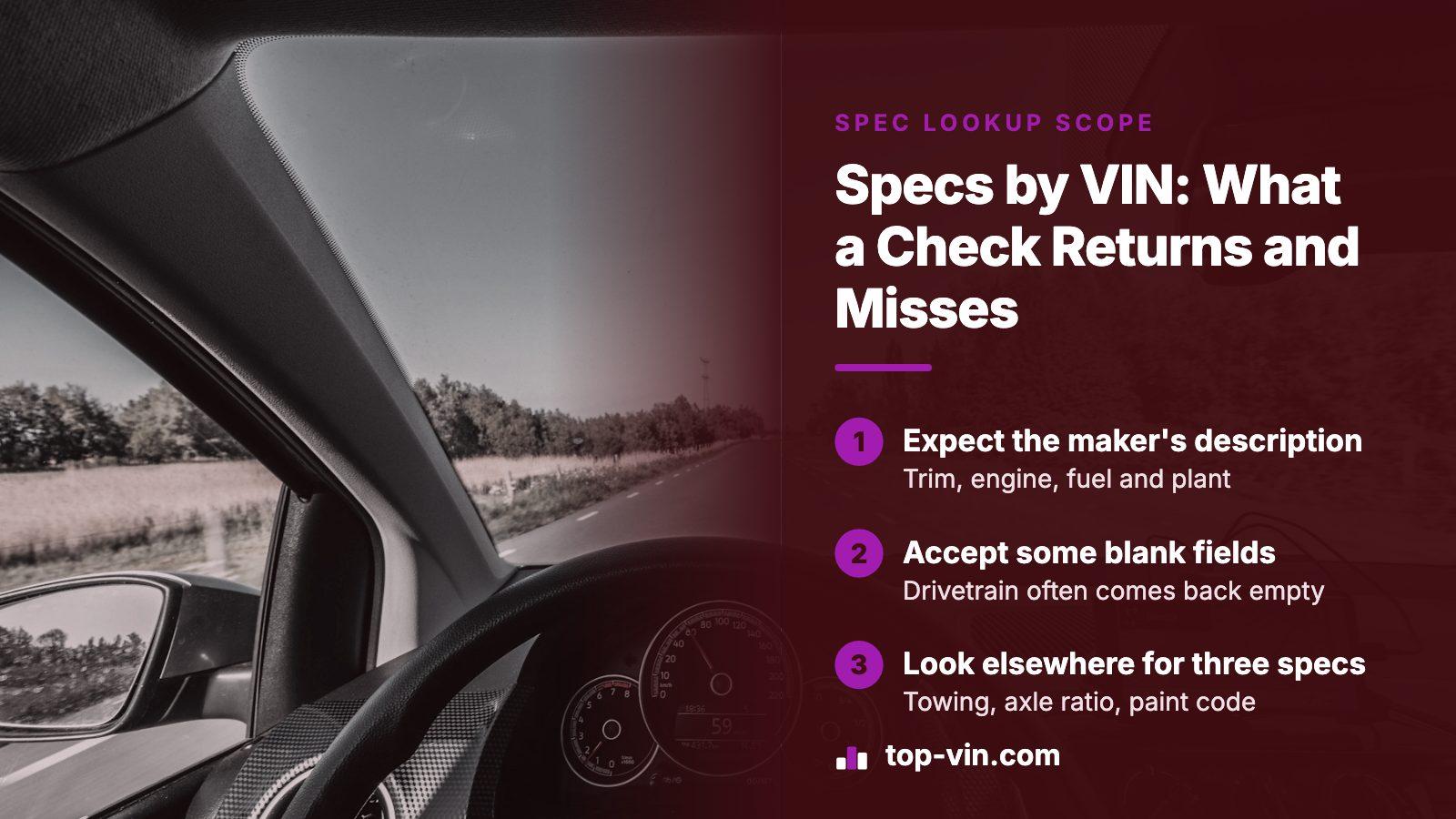
A VIN lookup returns the maker's own description of the vehicle: identity, trim, body style, doors, engine, fuel, where it was built and weight class. Makers often leave drivetrain, transmission, seat count and horsepower blank, and towing capacity, axle ratio and paint code were never encoded at all. The TopVIN preview shows whether the VIN matches your car, and one paid report adds the history.
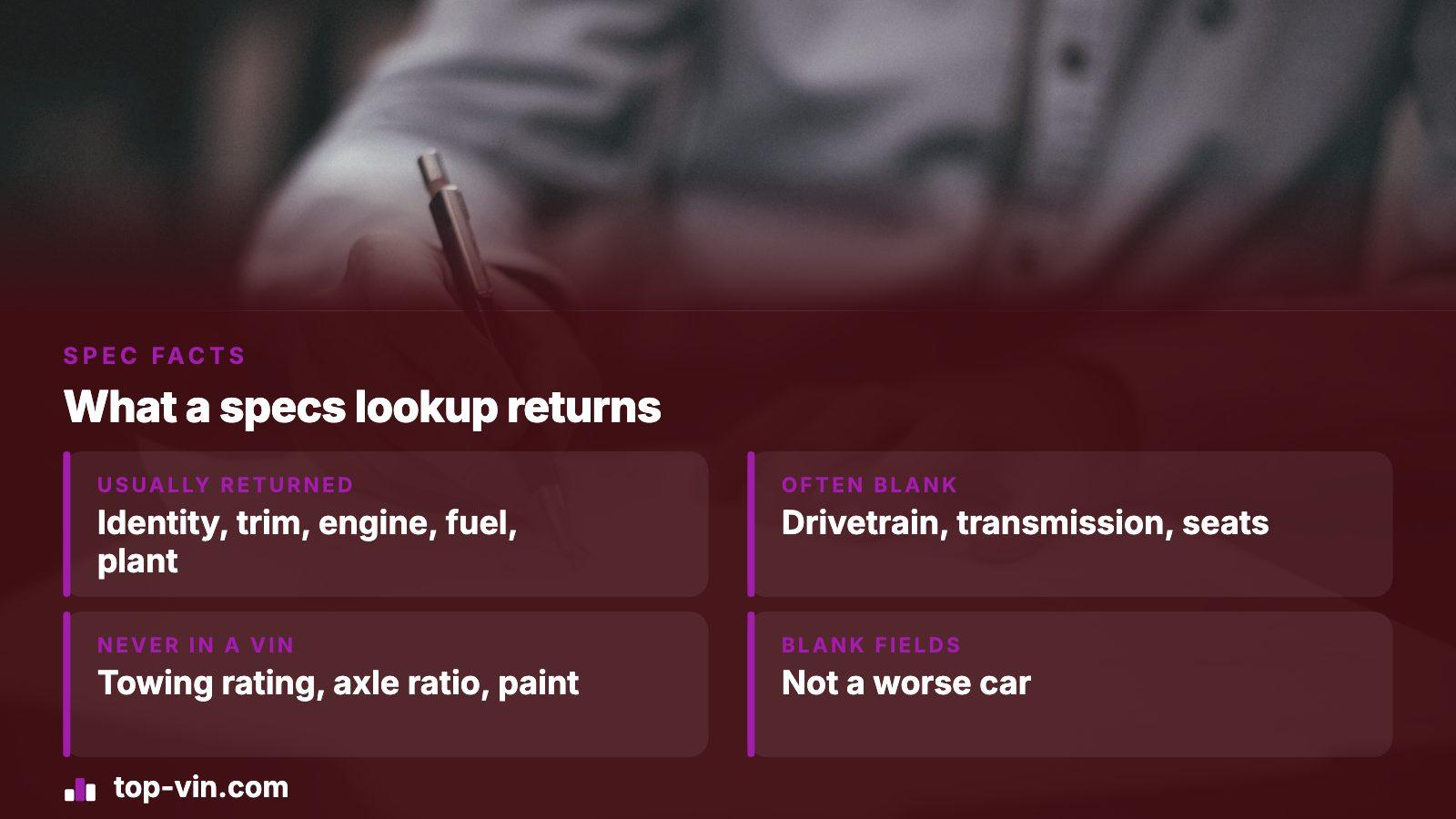
- Usually returned
- Identity, trim, engine, fuel, plant
- Often blank
- Drivetrain, transmission, seats, power
- Never in a VIN
- Towing rating, axle ratio, paint code
- TopVIN check
- Free preview, then one payment
What a specs-by-VIN lookup returns for your car
Every lookup draws on one source: the filing each manufacturer sends to federal regulators explaining what its VINs stand for. Run a VIN through that filing and the factory identity arrives in one piece. You get the make, model and model year, the trim as the maker names it, body class, door count, engine displacement and cylinders, primary fuel, the city where the car was assembled and its weight class.
For a shopper, that set answers the question under most spec searches: is this the car the listing describes? A TopVIN report prints those factory specs beside the history, so one lookup covers the build and what happened afterward.
Which lookup answers which spec question
Head terms like specs by VIN, VIN lookup and VIN check blur together in search results. Sorted by the question each one answers, the choice gets easier. Work down the table and stop when your question is answered.
| The spec you want | Where it lives | Note |
|---|---|---|
| Maker, model, year, trim, engine, fuel, plant | The federal decoder, or the factory specs in a TopVIN report | Reads the maker's own filing |
| Does this VIN match the car in the ad? | The TopVIN preview | Confirms the VIN before you pay |
| Drivetrain, transmission, seat count, horsepower | The decode when the maker filed them, otherwise the build sheet | Blank means unfiled, not absent |
| Tire size, seating and weight ratings | The door placard on the car | Printed for the car as built |
| Towing capacity, axle ratio, paint code | The maker's tow guide, the build sheet, the paint sticker | Never encoded in a VIN |
| Title brands, damage, odometer, liens | A vehicle history report | TopVIN: preview first, then one payment |
Why a spec field can come back blank
The federal database defines 140 fields for a vehicle, and filling them is the maker's job. A 2023 Chevrolet Malibu decoded with 55 populated and 85 empty. The filled ones were the identity items above. The empty ones included drive type, transmission style, seat count, horsepower, wheel size and curb weight, exactly what many shoppers came looking for.
A blank is a gap in the filing, not a statement about the car, and every vehicle has a drivetrain. When a site gives a confident answer where the federal decode is silent, it is likely inferring from the model name. That guess is usually right and sometimes wrong on a rare trim or a change partway through the model year. To separate data from guesswork, run the VIN through two decoders. Where they agree, both are reading the filing.
Cross-shopping: a thin decode is not a worse car
Say you are comparing two cars and one decode comes back sparse while the other looks rich. The pull is to mark the sparse one down. The evidence says otherwise. A 2011 BMW X3 decoded with only 27 fields filled, fewer than half the Malibu's count, yet it reported all-wheel drive and 300 horsepower, the two answers the Chevrolet left blank.
| What came back | Malibu, 2023 | X3, 2011 |
|---|---|---|
| Populated, of 140 | 55 | 27 |
| Drive type | Blank | All-wheel drive |
| Horsepower | Blank | 300 |
| Transmission, seats, curb weight | Blank | Blank |
You cannot predict which fields a maker fills from the badge, the price or the model year. Before a blank counts against a car, photograph the driver's door placard on both and compare.
Run the check in five steps
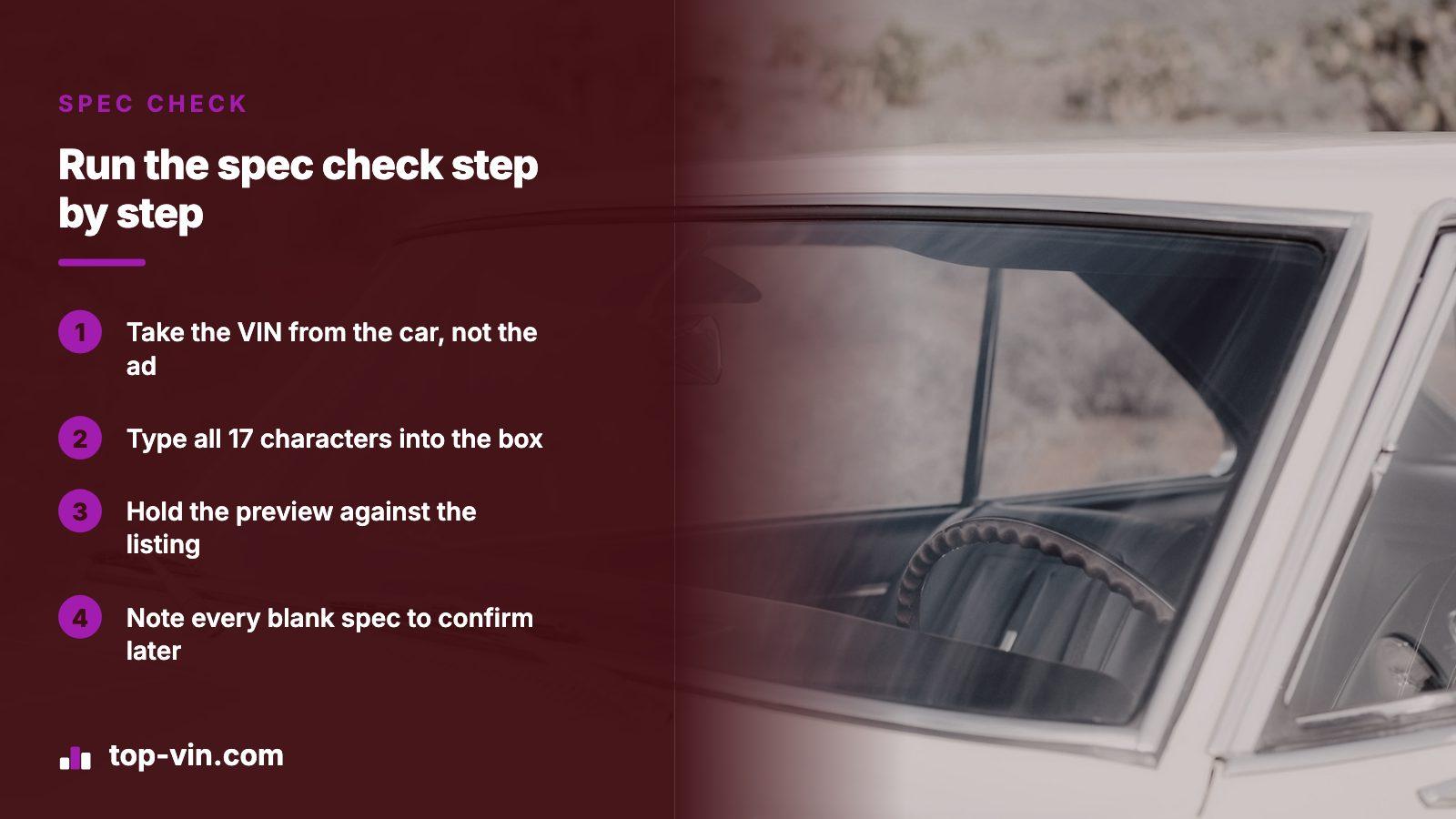
- Take the VIN from the car, not the ad. Read the dashboard plate from outside, through the glass on the driver's side, then the door-jamb sticker, and confirm they agree.
- Count all 17 characters and type them into the box on this page.
- Open the preview and hold it up against the listing: year, make, model and body style should match what the seller advertised.
- Write down every spec the decode left blank, and plan to read those off the door placard.
- If the car still fits, buy a single report. Weighing a shortlist? A pack of 3, 5 or 10 covers it.
Three specs a VIN never held
Of the common specs, three live entirely outside the VIN: towing capacity, axle ratio and paint code. A towing rating turns on how that exact truck or SUV was equipped and on the maker's own tables. Axle ratio has no slot in the federal schema. Paint is logged on its own sticker, under the manufacturer's private color naming.
The reason sits in 49 CFR Part 565, which treats the VIN as an identifier with a check digit, never as an equipment manifest. A site claiming to return these three from the VIN alone is selling a guess, and a TopVIN report does not cover them either. Use the maker's tow guide, the build sheet and the sticker on the car.
Specs describe the build, a report describes the car
A decode speaks for the vehicle as manufactured. It cannot know the engine was swapped, the transmission rebuilt or the wheels replaced, and it says nothing about crashes, title brands or odometer problems. Those come from title systems and insurers, not from the maker. That second layer is what a TopVIN report adds to the specs:
- Title brands and the accident or damage records behind them
- Odometer readings logged over the years
- Salvage and auction history, with photos where they exist
- Liens, impounds and theft records
- Insurance records, plus any open recall
- Who has owned it, how it was used, its market value and the factory specs
Each line shows what a source filed. A quiet report is encouraging but not proof, so pair it with a test drive and a mechanic's inspection.
Spec mismatches that should stop you
| What you see | What it can mean | Your move |
|---|---|---|
| Decode says 4 cylinders and 1.5 L, ad promises a bigger engine | A listing mistake, or an engine that is not the original | Ask the seller to explain and have a mechanic look |
| Body class or door count differs from the car on the lot | A wrong VIN in the ad, or a different vehicle | Pause until the seller shows the title and the VIN plate together |
| Dash VIN and door-jamb VIN disagree | A swapped part, a repair, or a mislabeled car | Walk away unless paperwork explains it |
| Decode is silent where the seller is very specific | The seller is quoting a brochure, or the maker never filed it | Verify on the door placard |
Price and your next move
The federal decoder carries no charge, and neither does the TopVIN preview. After that, the report is one payment with no subscription. The pricing page lists current amounts for a single report and for the 3, 5 and 10 packs. With several cars on your list, a pack lets you check every VIN before you spend a weekend on test drives.
Before you drive out
Decode the VIN, open the preview, photograph the door placard, then buy the report if the car still fits. Use the placard for what the car was fitted with and the report for what has happened to it.
Where this information comes from
- NHTSA: vPIC VIN decoding API — The public federal database behind every decoded field discussed here.
- NHTSA: VIN decoder — The agency's own front end for reading the same records without an account.
- 49 CFR Part 565: Vehicle Identification Number requirements — What a VIN must encode, which explains why it never doubled as an equipment list.
Sources and photos: Facts checked against the sources above in November 2026. Photos by Sander Jeurissen, Wesley Tingey and Scott Graham on Unsplash; diagrams by TopVIN.
Keep reading
- How to read a VIN: a left-to-right walkthrough with a worked decodeWhat each position in the 17 characters encodes, and what none of them do.
- Engine size by VIN: what a lookup returns, how tools compare, and what it missesEngine size and cylinders are among the specs a decode returns reliably.
- Towing capacity by VIN: what a VIN check can and cannot tell youOne of the three specs a VIN never carried, and where to find it.
- Sample reportSee how the factory specs sit beside the history in a finished report.
Frequently asked questions
Can a VIN lookup give me all the specs at no cost?
Partly. The federal decoder returns the factory identity at no charge, including trim, body class, engine, fuel and assembly plant. Whether drive type, transmission, seats and horsepower appear depends on what the maker filed. Where the decode is blank, read the door placard on the car.
Why do some spec fields show N/A after a decode?
Because the maker left that field empty when it filed with the federal database. The field exists, so the tool shows a placeholder. It does not mean the car lacks a transmission. That is also why one brand's decode looks richer than another's: you are comparing two filings, not two tools.
Does a VIN tell you the transmission or drivetrain?
Sometimes. Both are defined fields, yet many makers leave them blank, while others fill some of them, as the X3 decode did for drive type. If yours comes back empty, check the build sheet, the original window sticker or the door placard.
Can a VIN tell me the paint color or axle ratio?
No. Neither is encoded in the VIN, and the federal database has no axle ratio field at all. A tool that seems to supply either is guessing from the model. Look for the paint sticker on the car, and the build sheet for the ratio.
Does a specs check show accidents or title brands?
A decode does not, because it describes the car as built. Accident and damage records, title brands and mileage readings arrive from title systems, insurers and auctions, which is what a history report gathers. Start with the TopVIN preview, then buy one report if the specs match the car in front of you.
Now check the car itself
The guide explains what to look for. The report shows what this VIN has on record.