THE SHORT ANSWER
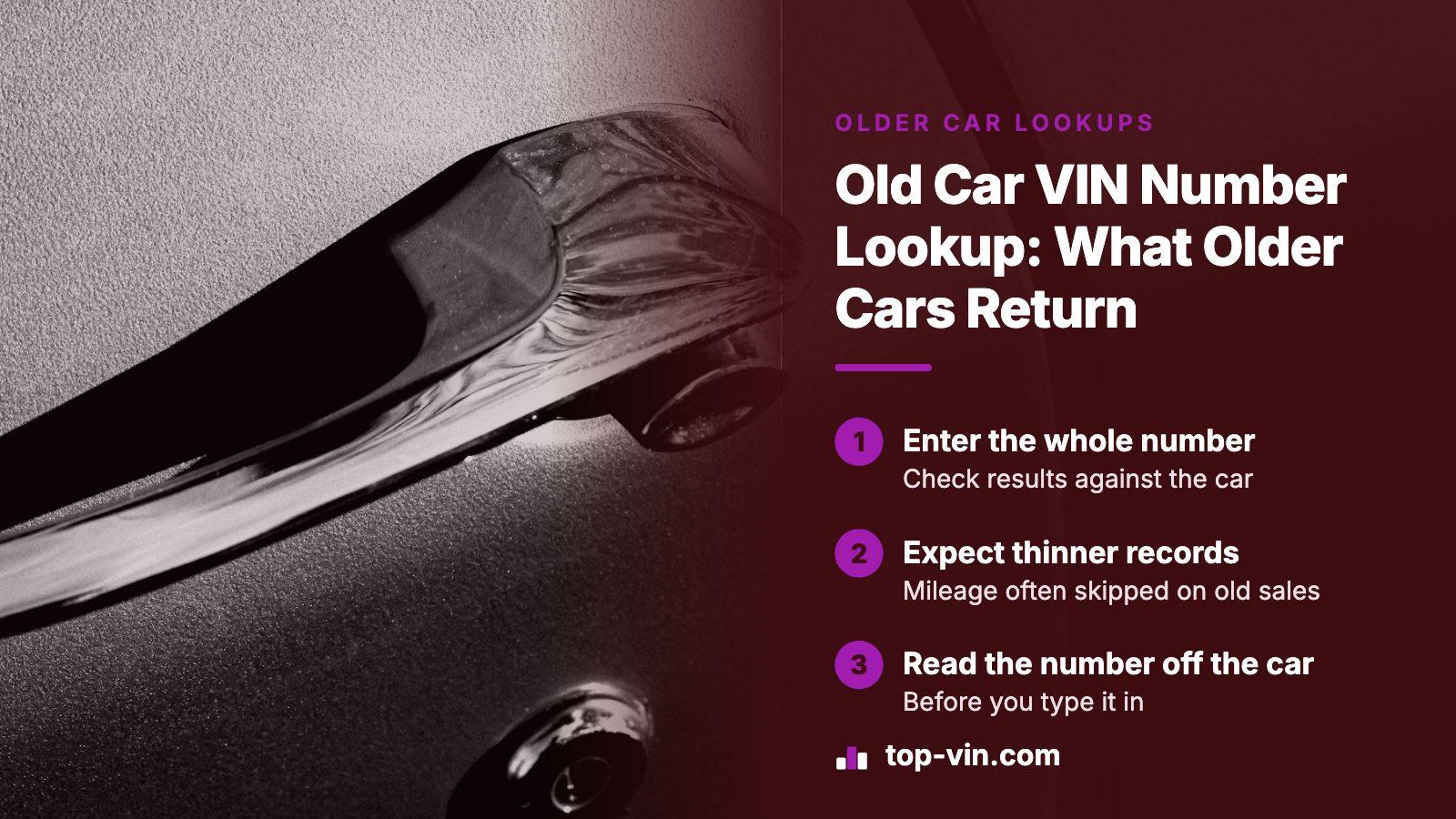
Enter the whole number and check what returns against the car. A 17-character VIN can pull state title brands, odometer entries, insurer total-loss and salvage reports, and open recalls. NHTSA's decoder refuses model years before 1981, and records for very old cars run thin, so a quiet result proves less than on a newer car. Read the free TopVIN preview before deciding on a report.
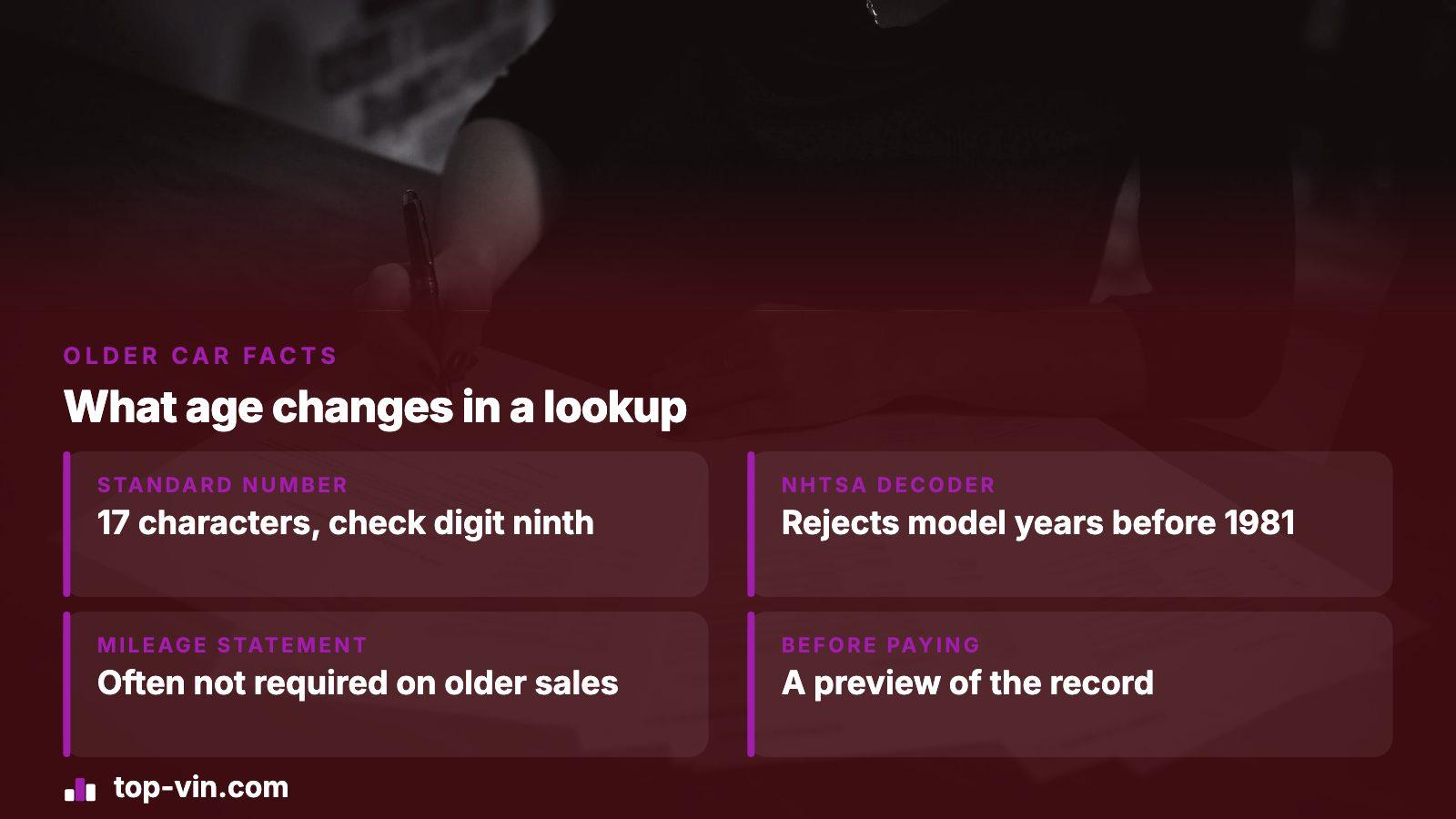
- Standard number
- 17 characters, check digit in ninth place
- NHTSA decoder
- Rejects model years before 1981
- Mileage statement
- Often not required on older sales
- Before paying
- A free preview
How the car's age changes what a lookup can do
A VIN lookup draws on several record systems, and each has its own cut-off. NHTSA's decoder throws an error when asked for a model year before 1981. Records filed under a number are the other half, and on older cars they are thinner, partly because some entries were never required.
| Car's age | The number you will find | What a lookup can do |
|---|---|---|
| Before 1981 | May not be 17 characters, so count what is stamped | The federal decoder rejects the year. Lean on the title, a physical check and any records |
| 1981 to 2009 | 17 characters, with a check digit in ninth place | The decoder reads the build, and records attach to the full number |
| 2010 on | 17 characters, with a letter in seventh place on cars and light trucks | Same lookups, newer year coding |
What comes back on a full 17-character number
A number in the modern pattern can retrieve:
- State title brands like salvage, junk or flood. The federal title database keeps a brand once any state applies it, so crossing a state line does not wipe it.
- Odometer readings logged at title events, to set against the dash.
- Insurer total-loss and salvage determinations, and transfers to recyclers or salvage yards.
- Recall campaigns. NHTSA's files include entries from 1966, though the early ones carry almost no description.
TopVIN's report layers accident and damage entries, auction photos and a market value on top, where they exist.
Where an old car's record runs thin
Reporting is uneven. The federal title system puts its coverage at 87 percent of vehicles, but more than half of the states feed it data, and some do not title vehicles beyond a certain age. The system itself warns of false negatives, such as a search showing no salvage history because nothing was ever reported.
Mileage statements fade out
Under the federal odometer rule, mileage need not be disclosed at sale on a model year 2010 or older vehicle once 10 years or more have passed since January 1 of that model year. For model year 2011 and newer the wait is 20 years. A thin odometer history on an old car can be a paperwork gap rather than tampering. A reading that drops is another matter.
Reading the number off the car before you type it
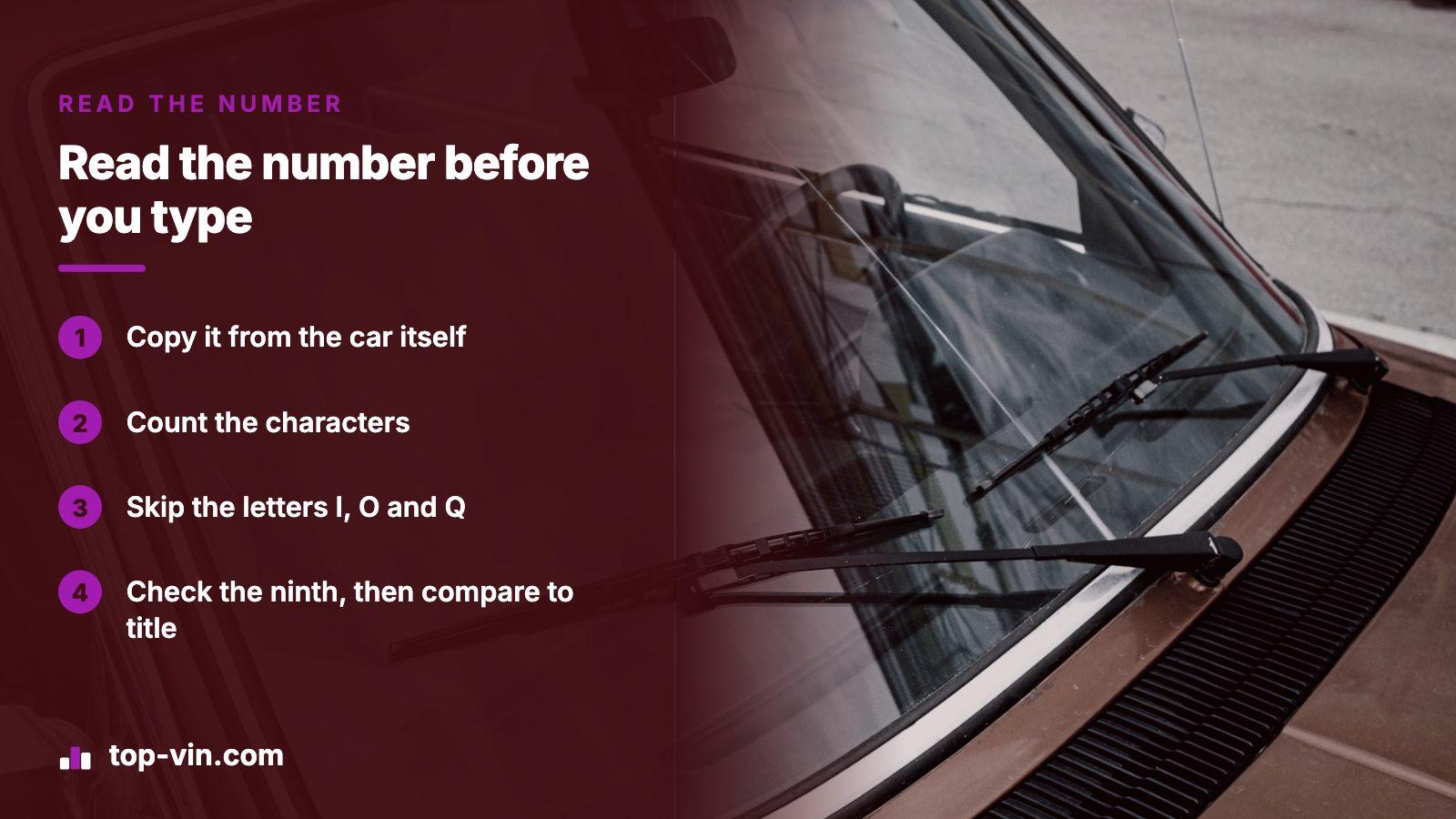
- Copy it from the car. The federal rule has makers place it inside the cabin, legible through the glass from outside at the windshield's left edge, in characters 4 mm or taller.
- Count the characters. Seventeen means the modern pattern; fewer on a pre-1981 car is not a typo.
- Skip the letters I, O and Q. Standard numbers never use them.
- Check the ninth character, a numeral or X meant to expose copying errors. If a 17-character number is rejected, recheck that spot first.
- Hold it up to the title. If they disagree, stop before paying anyone.
On a car or light truck, a numeral in the seventh place means the year code in the tenth place points to 1980 through 2009; a letter points to 2010 or later. For model year 2009 and earlier the federal rule only bars repeats within 30 years, so check that the decoded car matches yours.
Free checks worth running before you pay
- NHTSA's recall lookup, which the FTC calls free, shows any campaign on the car that is still open.
- NICB's VIN check, which the FTC also points to, reports whether the car was flooded, stolen and never found, or declared salvage.
- EPA's fueleconomy.gov covers model years 1984 through 2026, handy for checking a seller's fuel economy claims.
If the stamping is corroded, NHTSA's decoder will take a shortened number with asterisks in the gaps and does not need the ninth character. That shows how the model was built, but it cannot pull records for one specific car.
When a lookup and a dealer disagree on an old car
Recall answers on older vehicles are where owners hear conflicting things, and NHTSA's complaint files show it.
From an NHTSA owner complaint
A 1993 Ford F-150 owner reported in 2024 that NHTSA's VIN tool listed his truck in two recall campaigns, while the local dealer said the VIN was not covered. The maker sided with the dealer and cited the truck's build date. Parts for the repair were not yet available, and at roughly 360,000 miles the truck was shifting fuel between its tanks, nearly overfilling one.
The lesson: a recall answer belongs to an exact number and build date. Note which source said what, and ask the maker to confirm for your VIN.
From an NHTSA owner complaint
A 1985 Mercury Grand Marquis stalled at 40 mph, and a 2018 complaint says a mechanic blamed the fuel pump. A search online turned up a fuel system recall number, but the owner could not tell whether the car's VIN fell under it. The maker and a dealer both confirmed there were no open recalls. NHTSA's record for that campaign covers aftermarket replacement pumps.
A campaign found by searching make and year is a lead, not a verdict. A VIN check confirmed with the maker settles it.
Red flags in an old car's result
| What shows up | What it may mean | What to do |
|---|---|---|
| A salvage, junk or flood brand | A state judged the damage severe or water-related; some states have no flood label at all | Ask for repair paperwork and inspect before talking price |
| Mileage above the dash reading, or readings that fall | A rollback, a swapped cluster or a data-entry slip | Compare dated entries and ask the seller |
| A total-loss entry on a clean-looking car | An insurer wrote it off; a stolen car found undamaged can carry the same label | Ask what the loss was and who fixed the car |
| Nothing at all | Nothing adverse in the sources searched, from a thinner record on an old car | Inspect in person |
Read entries in date order. Mileage should only climb, and a long gap with nothing logged deserves a question.
Running the lookup on TopVIN and what it costs
Type the full number into TopVIN and a free preview appears before you commit to anything. One car's report is a single purchase, and shoppers weighing several cars can pick 3, 5 or 10 reports in one go. There is nothing to cancel later. Amounts are listed on the pricing page.
For a pre-1981 number, let the preview act as the test: if it finds little, you learned that without paying.
After the lookup: what to do with the result
A lookup narrows the odds; it does not examine the car. The FTC says an independent inspection is still needed after any history report. Ask the mechanic to write the make, model and VIN on the findings so the verdict is tied to the number you searched.
If a seller will not let an outside mechanic look at the car, treat that as an answer and walk away. Keep the preview or report, the inspection notes and the title together until the sale is final.
Where this information comes from
- NHTSA: VIN decoder (vPIC) — The pre-1981 year error, that results rest on maker-reported data, and how model year entries are handled.
- eCFR: 49 CFR Part 565, VIN requirements — Length, excluded letters, the check digit, the 30-year rule for 2009 and earlier, and the year-code note on the seventh place.
- eCFR: 49 CFR 580.17, odometer exemptions — The 10-year and 20-year age exemptions from stating mileage at sale.
- NMVTIS: information for consumers — Coverage figures, state differences, age exemptions from titling and the false-negative warning.
- FTC: used cars — NHTSA's recall lookup, NICB's VIN check and why a report does not replace an inspection.
- NHTSA owner complaint 11596212 — owner experience, paraphrased
- NHTSA owner complaint 11071993 — owner experience, paraphrased
Sources and photos: Facts checked against the sources above in November 2026. Photos by Linus Belanger, Max Tokarev and Dimitri Karastelev on Unsplash; diagrams by TopVIN.
Keep reading
- How to read a VIN: a left-to-right walkthrough with a worked decodeWhat each stretch of the number tells you about the car.
- VIN check digit: how the ninth character is worked out and what it provesHow the ninth character exposes a copying slip.
- VIN verification: the four checks people mean and what each provesConfirming that the number on the car is the right one.
- Sample reportSee how a finished report reads before running your own.
Frequently asked questions
Can I look up the VIN of a car built before 1981?
You can try, but expect less. NHTSA's decoder rejects those model years, and the numbers may not follow the 17-character pattern, so a lookup only helps if records were filed under that exact string. The TopVIN preview shows whether anything turns up.
Will an old car lookup show the real mileage?
Only readings someone reported, and there may be few. A seller of a model year 2010 or older vehicle need not state mileage when the sale comes a decade or more after that model year began. Read entries in date order and treat any reading below an earlier one as a flag.
Does a lookup show open recalls on an older car?
NHTSA's recall files go back at least to 1966, so an old car can have campaigns on record. Repair parts can lag behind a campaign, as the F-150 owner above found, and a campaign found by make and year may cover only certain builds. Have the maker confirm your VIN.
What if the VIN is partly worn away?
Use a partial decode to learn how the model was built, then look for a second stamping or read the number from the title. NHTSA's decoder accepts numbers under 17 characters, but records tied to one particular car need the complete number.
If an old car's lookup is clean, is it a good buy?
It means nothing adverse turned up in the sources searched. Reporting is uneven, some states do not title old vehicles, and the federal title record is short by design. Only an inspection examines the car itself; the FTC treats a history report as no replacement.
Now check the car itself
The guide explains what to look for. The report shows what this VIN has on record.