THE SHORT ANSWER
No, the public cannot pull another owner's policy from a VIN. Some states hold coverage on file and let approved users search it by VIN, but access goes to police, courts, insurers and the registrant, and federal privacy law adds a second lock. After a crash, use the police report and your own insurer. Before a purchase, a VIN history check describes the car rather than the seller.
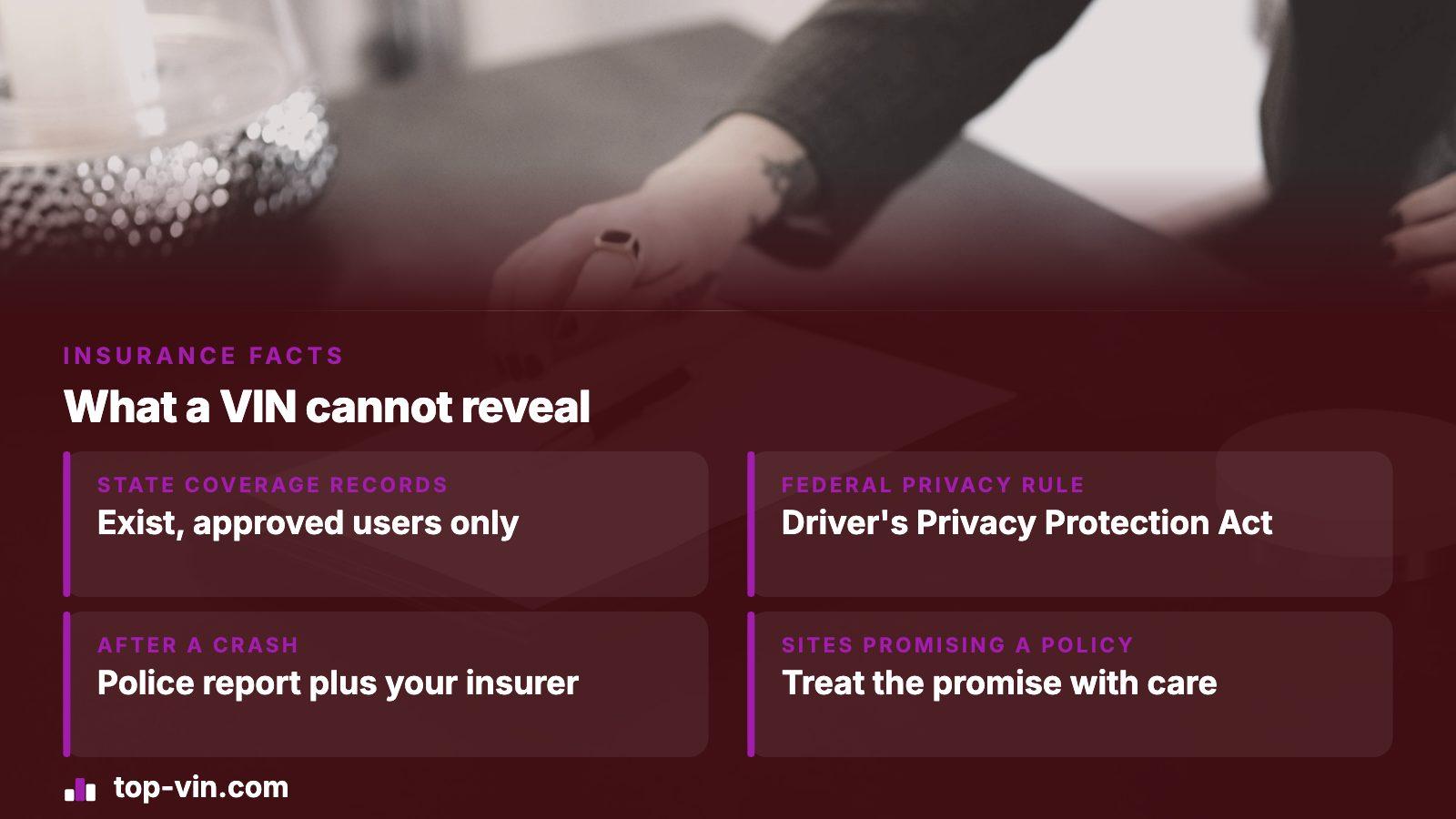
- State coverage records
- Exist, approved users only
- Federal privacy rule
- Driver's Privacy Protection Act
- After a crash
- Police report plus your insurer
- TopVIN check
- Free preview, then one payment
Which VIN-based check answers an insurance question
Search results for this phrase mix up three different things: a policy lookup, a vehicle history check and a recall lookup. Only the first is about insurance, and it is the one you cannot run. This table sorts the routes by what each one actually returns.
| Route | What it returns | Who gets in |
|---|---|---|
| State insurance system | Current insurer and coverage activity on a registered car | Police, courts, insurers and the registrant |
| Police crash report | Insurance details of each party in that crash | The people involved |
| Your own insurer | A way to trace the other driver's carrier after a claim | You, as a customer |
| NHTSA recall lookup | Open safety recalls, no coverage data | Anyone, no charge |
| NICB VINCheck | Theft and salvage entries filed by insurers that take part | Anyone, no charge |
| TopVIN history report | Title, damage, theft and insurance-related history of the car | Anyone: free preview, then one payment |
No row hands a stranger a policy number. The top row does exist, which is why paid lookup sites sound believable.
What a state insurance system holds
Insurers report coverage to the state electronically, the state matches those reports against registered vehicles, and a gap in coverage produces a notice without anyone filing a complaint.
New York's version is the clearest published example. The state's supplement for its Record Search Service describes a separate insurance database, and the sample menu lets a user search with a plate, a registrant's name or a VIN. A record lists the vehicle, the current insurer with an effective date, and a dated trail of activity such as new business and cancellations.
Unknown is not the same as uninsured
The same supplement warns that a record reading current insurer unknown may not mean the car is uninsured. It means no insurer transaction showing coverage has been posted. Even for authorized users, a blank is a prompt to follow up, not a verdict.
A database built this way takes a VIN easily, which is why the search you typed is technically simple and legally off limits to you.
California's reporting rule and who is let in
California's DMV fact sheet on financial responsibility cites Vehicle Code section 16058: insurers must report private-use vehicle coverage to the DMV electronically. That reporting lets the DMV watch for lapses and act through registration suspension. On access, the sheet says police and court staff can view insurance status electronically. It names who is let in rather than listing who is kept out, so the public's exclusion is an inference from that list, and the statute is the place to confirm it.
- Vehicles under commercial or business policies are exempt from the electronic reporting, so they may be missing from the data.
- Drivers must show evidence of coverage when an officer asks, at registration renewal and after a collision.
- A document or card from the insurer is the usual proof.
Where federal privacy law reaches and where it stops
The federal privacy act for drivers, section 2721 of Title 18, says a state motor vehicle office may not release personal details held in its records unless the request fits a listed permitted use. Courts, police and insurers working on claims, fraud checks, rating and underwriting fit. Idle curiosity does not.
The definition is narrower than the shorthand suggests. Under section 2725(3), personal information is data that identifies an individual, such as names, addresses, phone numbers, photographs and ID numbers. The same definition says it does not include information on vehicle accidents, driving violations or driver's status.
The New York sample record shows where the line falls: it carries the registrant's name, birth date and address right beside the insurer. A request that would reveal the person behind the car runs into the Act, and the way each state runs its system closes off the rest.
After a crash: the route that does produce the other driver's insurer
Many people typing this search are standing beside a damaged bumper, and the database is the wrong tool for that moment.
- At the scene, get the other driver's carrier and policy number plus the plate, and photograph the documents instead of copying them by hand.
- Get the police crash report, which records the insurance details of the people involved.
- Tell your own insurer right away. It has permitted access and established channels to find and pursue the other carrier.
- If the other driver has no coverage at all, the claim goes to your own uninsured motorist coverage, so ask your insurer how that applies.
Your insurer holds the lawful access you lack, and asking it is the faster path.

Buying a used car: the question under the question
A buyer who asks whether a car is insured usually wants to know whether the seller is straight or whether the car has a bad past. Coverage answers neither. It describes whoever owns the car today, it shifts as soon as the car is sold, and an insured car may still carry two write-offs.
| What is bothering you | Run this |
|---|---|
| The car may have been written off | A history report: title brands, damage and insurance-related entries |
| It may have been stolen | NICB VINCheck, then the theft entries in a report |
| A safety defect may be unfixed | NHTSA's recall lookup by VIN |
| The seller may not be the owner | Ask to see the seller's photo ID beside the title, in person |
Run the no-charge rows first. If the car still looks right, the TopVIN preview costs nothing and shows whether the VIN's history is worth paying for. The full report is bought once, and the pricing page lists the options.
Sites that promise a policy from a VIN
Some results for this search sell insurance details from a VIN or plate. Nothing they can lawfully sell to the general public covers another person's policy, and paying does not change that. A site willing to advertise what it cannot deliver tells you how far to trust its other claims.
Before you enter a card
Expect one of two results: a generic car description that the federal decoder gives at no charge, or a recurring charge that is harder to cancel than it was to start. Neither is the insurance record.
Running the check on the car in front of you
Read the VIN off the car itself before you read it off the listing, then compare the two character by character. A mismatch goes to the seller first and to a database only afterwards.
- Copy all 17 characters from the car, then again from the paperwork.
- Type them into the VIN form and open the free preview.
- Decide from the preview whether the car matches the listing.
- If it does, buy one report, or a pack when you are comparing several cars.
Insurance entries in a TopVIN report belong to the car's history. They do not name who insures it today or give a policy number, and no lawful VIN check does.
Where this information comes from
- California DMV: Financial responsibility (insurance) requirements — Insurer reporting under section 16058, the commercial exemption and who has electronic access to insurance status.
- New York DMV: Insurance Information and Enforcement System supplement — How a state insurance database can be searched with a plate, a name or a VIN, and what a record contains.
- 18 U.S.C. 2721: Prohibition on release of personal information — The federal limit on releasing motor vehicle record data and the list of permitted uses.
- NHTSA: Recalls — The federal recall lookup by VIN, one of the checks that is open to anyone.
- NICB: VINCheck — Theft and salvage entries filed by participating insurers, looked up by VIN.
Sources and photos: Facts checked against the sources above in November 2026. Photos by Karwin Luo, Alejandro Escamilla and Annika Wischnewsky on Unsplash; diagrams by TopVIN.
Keep reading
- Motor vehicle records: what a car buyer can see, and what stays closedWho may lawfully obtain a state record, and what the privacy act allows.
- DMV VIN check compared: what the state shows and what to run beside itWhat a state file shows about a VIN and what it leaves out.
- Vehicle registration lookup: what it shows and which check to addThe registration side of the same state records.
- Sample reportSee what a TopVIN report looks like before you run one.
Frequently asked questions
Can I look up someone's car insurance by VIN?
No. States do hold coverage records linked to vehicles, and some systems can be searched by VIN, but access goes to authorized users such as police, courts and insurers. Federal privacy law separately restricts release of anything that identifies the person behind the car. A VIN check can describe the vehicle, not the policy.
Who can see a car's insurance status in a state database?
It depends on the state. California's fact sheet says police and court staff can view coverage status electronically. New York's insurance database can be searched with a plate, a name or a VIN through its Record Search Service. Insurers have their own permitted uses under the federal act, such as claims and underwriting.
Will a VIN history report tell me whether a car is insured right now?
No. A history report records what happened to the car, including insurance-related entries, and it carries no live policy status, carrier name or policy number. The history stays with the VIN, while coverage changes when ownership does.
What if the other driver won't share insurance details after a crash?
Get the plate and a description of the car, then file a police report, since reports record the insurance details of the people involved. Tell your own insurer straight away, because it can pursue the other carrier. If that driver proves uninsured, your uninsured motorist coverage is the next step.
Does an empty insurance record mean the car is uninsured?
Not necessarily. New York's own guide says an unknown current insurer may only mean no coverage transaction has been posted. Commercial policies can also sit outside electronic reporting, as California's rules show, so a blank calls for a follow-up.
Now check the car itself
The guide explains what to look for. The report shows what this VIN has on record.