THE SHORT ANSWER
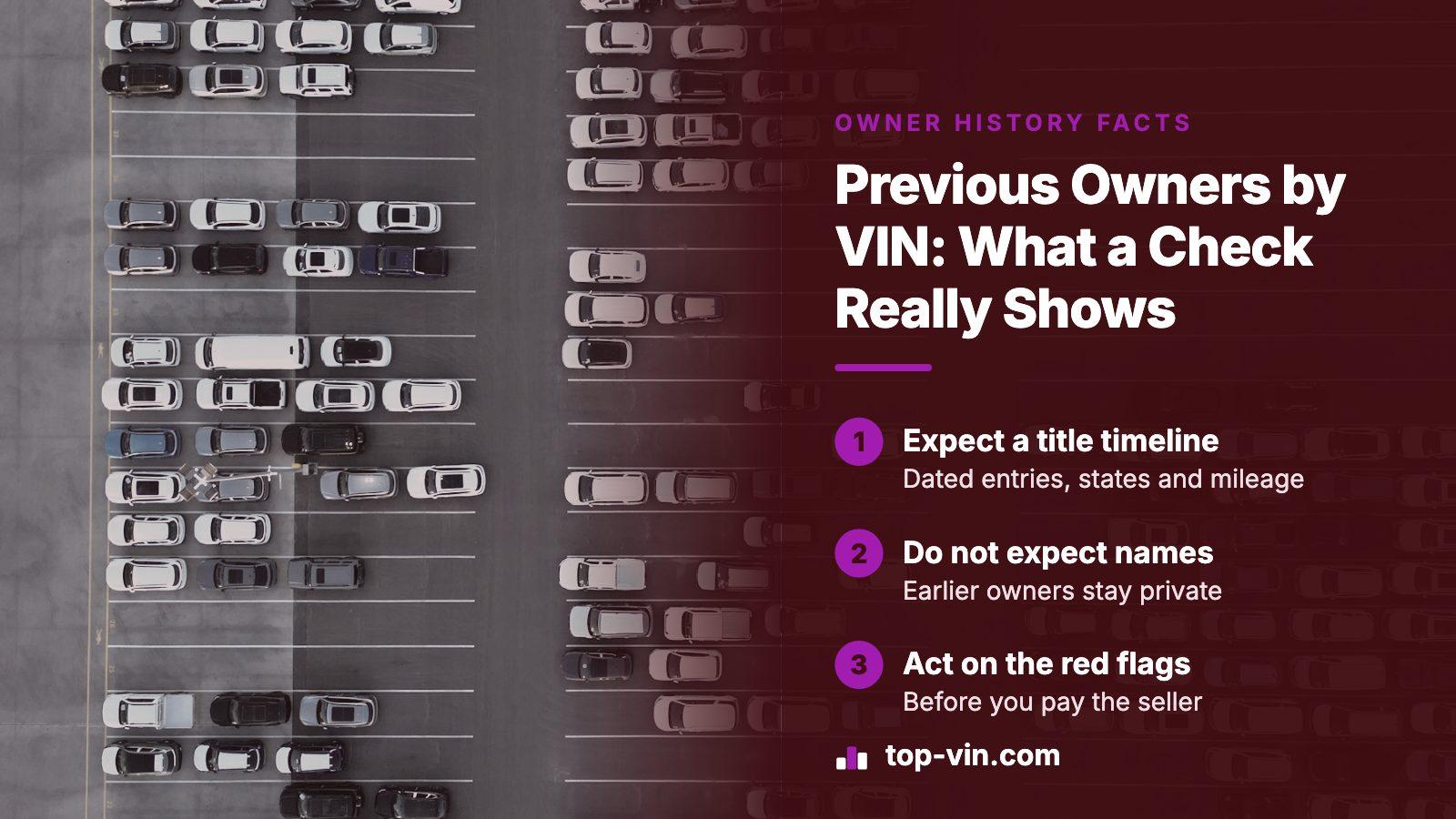
You can check previous owners by VIN, but what comes back is a title timeline, not a list of people. A TopVIN report shows each recorded change with its date and state, the mileage at each step, any brands, and how the car was used. Owner names are withheld from consumers. Judge the car by how long each stretch lasted and whether the mileage kept climbing.
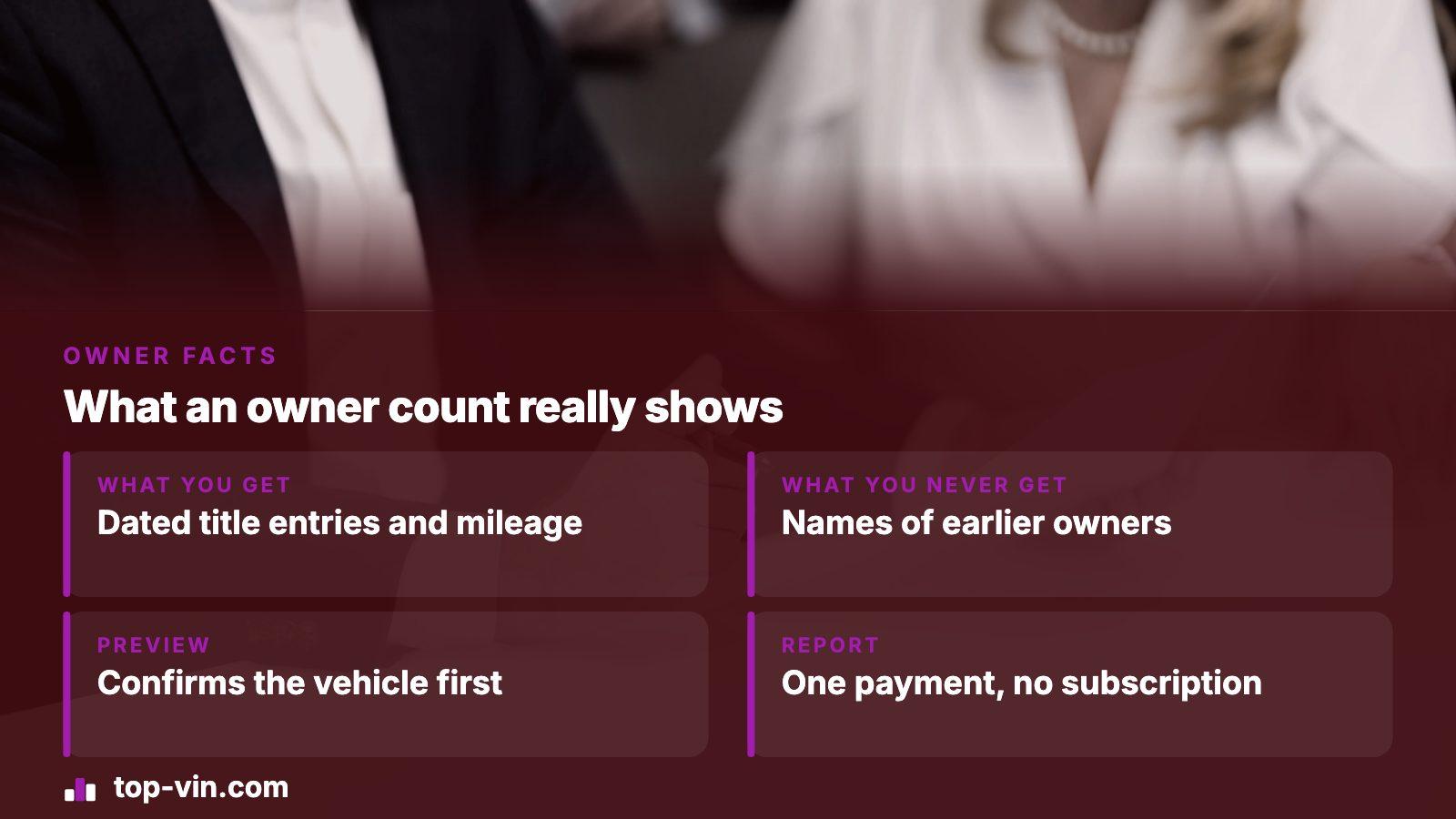
- What you get
- Dated title entries, states, mileage, use type
- What you never get
- Names of earlier owners
- Preview
- No charge, confirms the vehicle first
- Report
- One payment, no subscription
What a previous owners by VIN check shows about a car
The word owner covers more than most listings admit. A buyer, a finance company holding the title during a lease and a dealership that took the car in trade can each leave a separate entry. A VIN check reads those entries for the number you type and sets them out in date order, beside the brands, damage records and odometer readings for the same vehicle, so a change of hands can be read against what else happened around it.
| Part of the check | What you get | What stays out |
|---|---|---|
| Title entries | A date and a state for each recorded change | The name on each one |
| Use type | How the car was held and used, such as personal or commercial, where the record says | Who actually drove it |
| Odometer readings | A mileage figure tied to a dated entry | Mileage between entries |
| Brands and damage | Salvage, flood or similar labels and when they were applied | Work done outside any record |
Treat an owner total as a summary of title events
Where a total appears, in an ad or any report, it is a tally of title events. The federal data holds certificates, not drivers, so two services can read the same entries and reach different totals. A tally usually runs high for these reasons:
- A lease ended in a buyout, so the lender's name and then the lessee's both sat on the title while one person did all the driving.
- The car moved to another state, which issued its own certificate to the same person.
- A dealer put the car in the dealership's name before the next sale.
- A lost-title replacement, a name change or a transfer into an estate produced a new certificate with no buyer involved.
The error also runs low. A van titled to one small business and driven by a whole crew shows a single entry, and so does a family sedan handed down through teenagers. A total describes paperwork, not people.
How to run the check on the car in front of you
- Read the 17-character number off the car, not the ad. The label on the driver's door post and the plate in the dash corner ought to read identically and match the title. If the two disagree, raise that with the seller first.
- Type it into the TopVIN preview. It names the make, model and year behind the number before you pay anything, which catches a mistyped digit or an ad that lists the wrong car.
- Try the free tools from others if you like. NHTSA's recall lookup and the NICB VINCheck cost nothing and cover recalls, theft and total-loss entries.
- Buy the report once the car is a real candidate. You pay once, and a pack exists for comparing several cars.
- Open the ownership and title sections first, and write down every date, state and mileage figure before you speak to the seller.

Reading the timeline: dates, states and mileage
How long each stretch lasted says more than how many there were. Three long stretches look nothing like six short ones, and the dates on each entry make that plain.
| Pattern in the record | What it can mean | What to do |
|---|---|---|
| Long stretches, mileage rising steadily | A car that was kept and probably maintained | Ask for service invoices from those years |
| Several entries in a short span | A quick flip, a dealer in the middle or paperwork churn | Ask the seller why the car moved so often |
| Lower mileage at a later entry | A reading error or a wound-back odometer | Treat it as serious and ask for records |
| One brief stop in another state | Usually an ordinary move | Compare the brands listed before and after it |
| Use type shifts from personal to commercial | Heavier wear than the dash suggests | Ask how it was used and inspect closely |
Mileage is disclosed when a certificate is issued, so every transfer is a checkpoint. Figures that climb at a believable pace between checkpoints are a good sign.
Red flags worth acting on before you pay the seller
- A late-model car with many entries in a few years, unless the seller can name a lease or dealer step that explains them.
- A salvage, flood or similar brand at any point, even when the listing says clean.
- Mileage that falls between two dated entries.
- A rental or commercial use type on a car sold as a one-owner commuter.
- A seller who cannot say who owned the car before, or why they sold.
A quick sanity test
Divide the odometer reading by the car's age in years. If the answer is far from normal driving, or a young car carries a long entry list, ask where it has been.
Unexplained, any of these justifies a lower offer, a request for documents or walking away.
Comparing VIN checks that promise owner details
The promises on previous owner lookups vary widely. Put each service through the same test before paying anyone.
- Does it say what an owner entry is: a person, a lender, a dealer, or any certificate at all? A total without a definition is only a number.
- Does it show a date and a state for each entry, or only the total?
- Does it say where its title data comes from? The Justice Department publishes a list of approved providers of the national record.
- Does it promise names or contact details for earlier owners? Distrust that claim, given what the national system releases to consumers.
- Can you see a preview before paying, and is the purchase one payment or a subscription that renews?
TopVIN answers the last question with a no-charge preview and one purchase for the report, with amounts kept on its pricing page.
Cost, and where to go from here
Nothing is charged for the preview. When you want the full report you pay once, with no renewal attached, and the pricing page lists the amount. Check the car first, then decide whether it earns the spend.
With the report open, line up its title dates against the service records the seller can produce, and compare the mileage at each entry with the dash. Finish with the NHTSA and NICB lookups for recalls and theft, then book an independent inspection. A tidy timeline lowers the odds of a bad purchase, but it never replaces an inspection.
Where this information comes from
- eCFR via GovInfo: 28 CFR 25.54, state responsibilities — Lists the titling data states must send, including the name on each certificate, and the 24-hour schedule.
- NMVTIS: frequently asked questions — Says what a federal title report holds and that personal identifying information is not released to consumers.
- NMVTIS: vehicle history and approved providers — The Justice Department's list of approved providers that sell the federal title record to the public.
- NHTSA: recalls — Federal lookup for open recalls by VIN, useful beside any ownership timeline.
- NICB: VINCheck — A no-charge theft and total-loss screen fed by participating insurers.
Sources and photos: Facts checked against the sources above in November 2026. Photos by Iain, Michal Biernat and Carrie Allen www.carrieallen.com on Unsplash; diagrams by TopVIN.
Keep reading
- Motor vehicle records: what a car buyer can see, and what stays closedWho may obtain owner information from state records, and why the default is no.
- Sample reportSee how the ownership and title sections are laid out before you pay.
- Vehicle registration lookup: what it shows and which check to addWhat a registration lookup returns, and why it is not an ownership history.
- VIN verification: the four checks people mean and what each provesConfirm the number on the car matches the number you checked.
Frequently asked questions
Can I get the names of previous owners from a VIN?
No. States record the name on each title, but the national title system does not release personal identifying information to individual consumers, and a VIN check cannot get around that. You can get dated title changes, states, mileage readings and use type, which show how the car was handled.
How many previous owners did my car have?
A check shows how many title entries exist and how long each lasted, but entries are not always people. A lease buyout, a dealer stop or a move to another state can each add a line. Read the dates and mileage rather than the total, and ask the seller about any entry that looks odd.
Is a one-owner car always the better buy?
Not always. One owner can mean a careful driver who kept service records, or a business vehicle that many employees drove. Long ownership with steady mileage and matching invoices is a good sign. A single entry proves nothing about care by itself, so ask about daily use and storage.
Is there a free way to check previous owners by VIN?
The TopVIN preview is free and confirms the vehicle behind the number. The ownership and title detail sits in the report, a one-time payment. Other free tools exist, such as NHTSA's recall lookup and the NICB VINCheck, but they cover recalls, theft and total loss, not ownership.
Why do two VIN checks show different owner totals?
Each service decides which title events count as a new owner. One may count a lender, a dealer holding the car and a move to another state, while another merges them. Both read the same records, so the gap reflects the counting rule. Compare the dated entries instead.
Now check the car itself
The guide explains what to look for. The report shows what this VIN has on record.