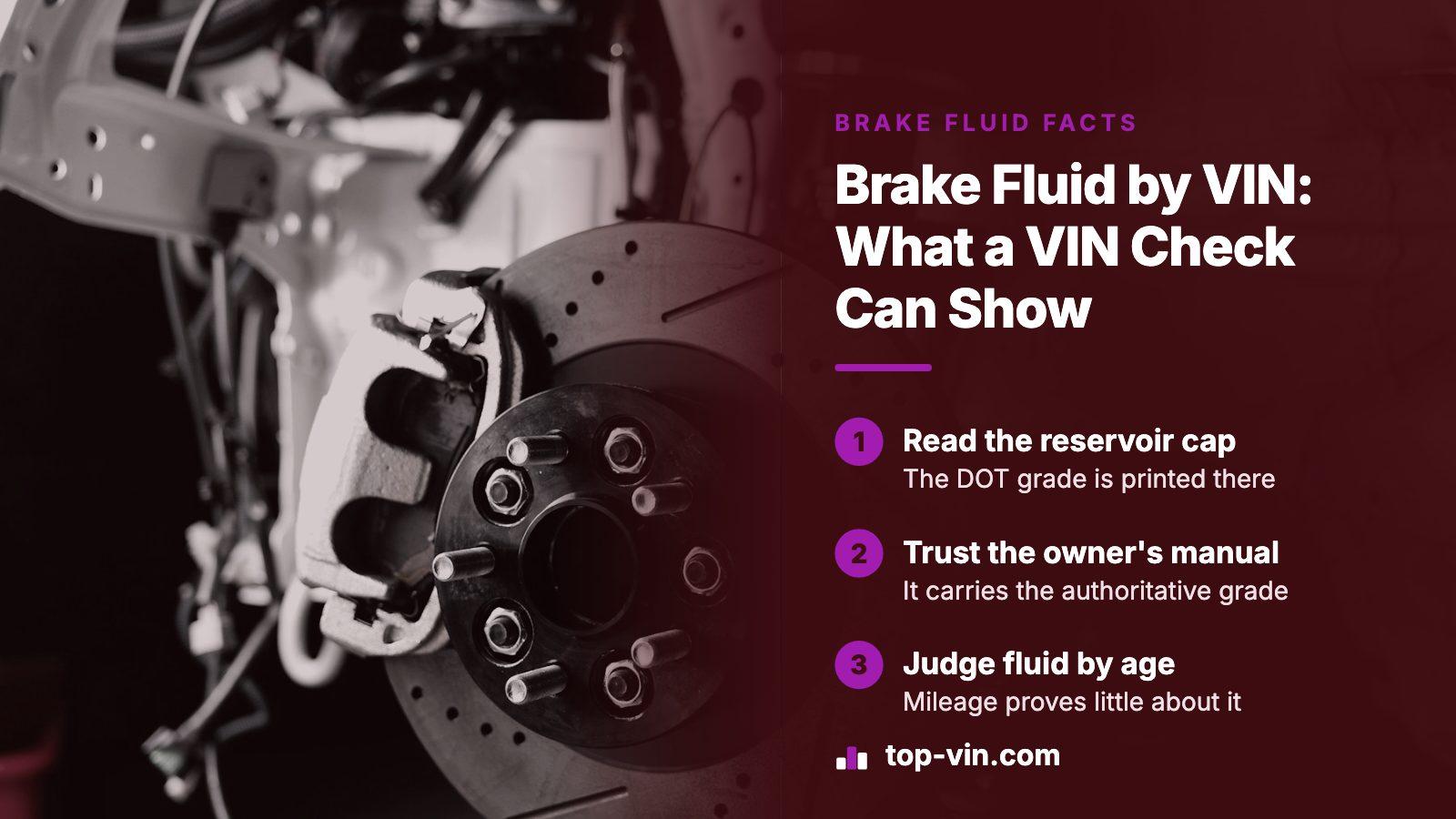
THE SHORT ANSWER
No. A VIN decode holds the factory configuration of the car, such as make, model, year, body and engine, and it has no brake fluid field. The DOT grade sits on the reservoir cap and, with more authority, in the owner's manual. Use the VIN to confirm the exact trim, then check the cap, read the manual and find the date of the last fluid change, because fluid ages with time rather than miles.
- In the VIN
- The car's build, not its fluid
- Where the grade is
- Reservoir cap and owner's manual
- Federal wet minimums
- 140 °C DOT 3, 155 °C DOT 4, 180 °C DOT 5
- TopVIN check
- Free preview, then one payment
Which lookup answers which brake fluid question
A VIN check is the head term, but the sources behind it do different jobs. Here is how each one fares when the question is brake fluid.
| Source | What it settles | What it leaves open |
|---|---|---|
| Federal VIN decoder | The exact make, model, year, body and engine | Fluid grade, fluid age, service interval |
| TopVIN free preview | Whether the VIN matches the year, make and model in the listing | The grade or age of the fluid |
| TopVIN full report | The car's title brands, damage, odometer readings, open recalls and factory specs | When the fluid was last changed |
| Reservoir cap | The DOT grade the system was built for, usually molded or printed on it | How old the fluid inside is |
| Owner's manual | The required grade and the replacement interval | What earlier owners actually did |
| Dealer parts desk | The specification, looked up from the VIN, when manual and cap are missing | The condition of the fluid |
| Test strip or tester | Moisture content or estimated boiling point of the reservoir fluid | The state of fluid at the calipers |
What the federal decoder returns about a brake system
The federal decoder reports how a car was configured at the factory: make, model, year, body style, engine and fuel type. There is no brake fluid entry, and there never was one. Fluid is a requirement the manufacturer publishes for a brake setup, not a fact the VIN encodes, so a site that prints a DOT grade beside your VIN is reading the model name and guessing.
The useful thing a VIN gives you is the right car. Braking hardware varies by trim within one model line, so the question has to be asked about the exact vehicle in front of you. The rest of the answer sits under the hood.
The federal standard names two boiling points
Brake fluid falls under Federal Motor Vehicle Safety Standard 116. For every grade it sets a boiling point minimum twice over: once for new fluid and again, at a lower figure, for fluid that has absorbed water. The figures below are degrees Celsius.
| Grade | Fresh fluid minimum | Wet fluid minimum | Drop |
|---|---|---|---|
| DOT 3 | 205 | 140 | 65 |
| DOT 4 | 230 | 155 | 75 |
| DOT 5 | 260 | 180 | 80 |
A standard writes a wet requirement only for something it expects to happen. Absorbing water is the ordinary life of glycol fluid, and the margin a car has on the day of service is not the margin it has years later.
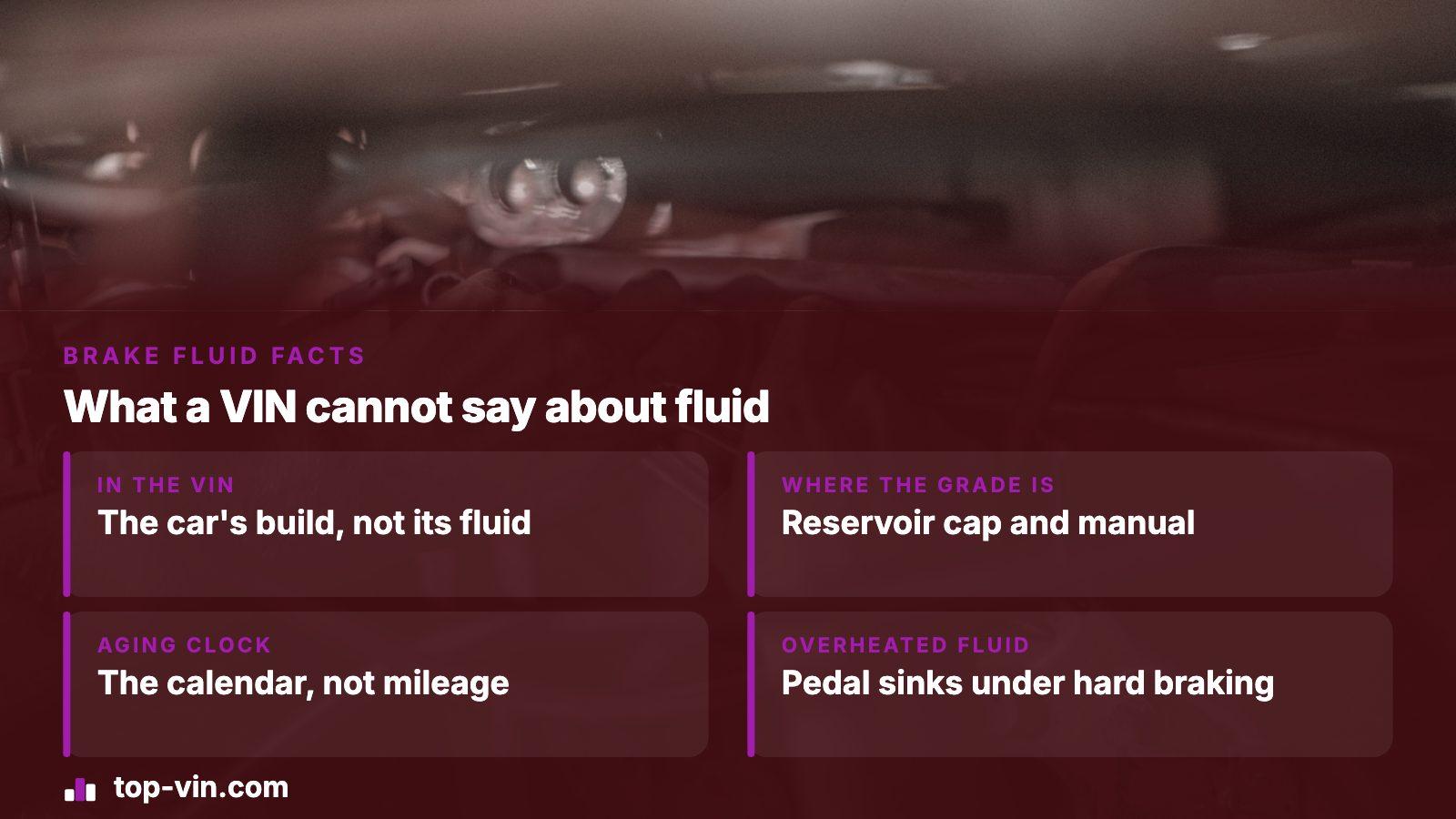
Fluid ages on the calendar, so mileage proves little
Glycol-based fluid is hygroscopic: it draws in moisture and holds it. No leak is needed. Moisture creeps in across the walls of rubber brake hoses and around seals, and the reservoir admits more air whenever it is opened or the level falls as pads wear. This is by design, since water spread through the fluid does less harm than a pool that would corrode a caliper from inside. The price is a slow loss of boiling margin.
Absorption follows exposure, not use. A weekend roadster with few miles can carry older, wetter fluid than a delivery van of the same age, and a car parked in a garage for years has been taking on water the whole time with no service to interrupt it. When a seller answers with low miles, ask for a date instead.
Why overheated brake fluid makes the pedal sink
A hydraulic brake works because liquid will not compress. Pushing the pedal sends pressure through the fluid and into the calipers. If some of that fluid boils, the vapor can be squeezed, so the pedal squashes a gas pocket rather than moving the pistons. The driver feels a pedal that travels long or sinks toward the floor, and braking often returns once things cool.
When it shows up
Heat builds fastest under the hardest braking, such as a long mountain grade, back-to-back stops, a full load or a trailer in tow. The pedal fades when the car needs it most.
DOT 3, DOT 4, DOT 5 and what may go in the reservoir
Both DOT 3 and DOT 4 use a glycol base, and the DOT 4 minimums are higher. DOT 5 is the odd one out. The standard defines a silicone base fluid as one with a diorgano polysiloxane content of at least 70 percent by weight, so the bigger number marks a different chemistry, not an upgrade.
- Follow the grade named on the cap and in the manual. It is a rule for the system, not a suggestion.
- Where the maker allows it, a DOT 3 system can usually take a DOT 4 top-up, since the two share a glycol base.
- Do not stretch that rule to DOT 5. Treat it as a separate fluid.
- DOT 5.1, despite its number, is glycol-based, so go by the cap and not the digit.
- An opened bottle keeps absorbing moisture from the air, so buy a small one and use it up.
Checking the fluid on a used car before you buy
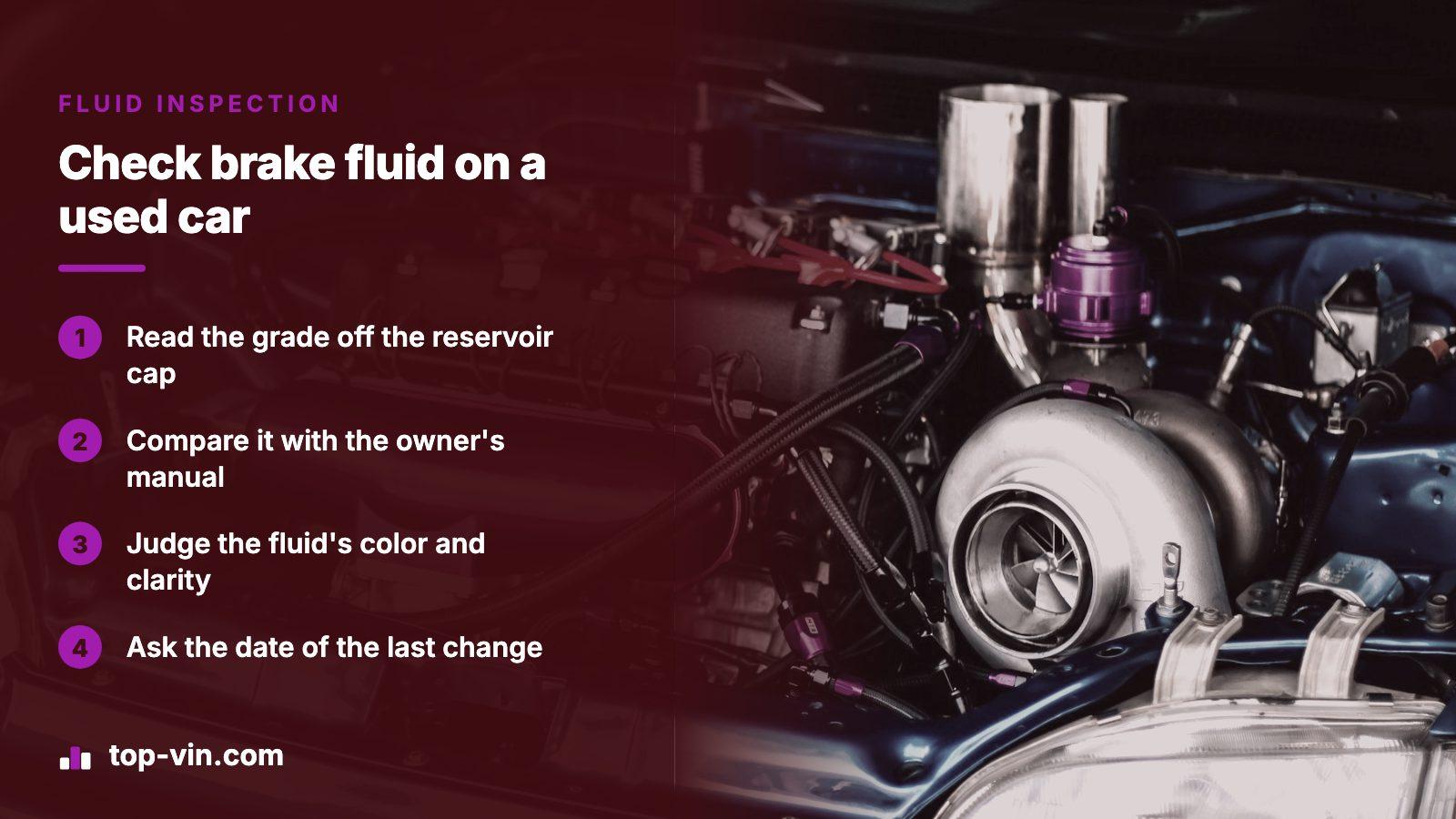
- Open the hood and read the grade off the reservoir cap.
- Compare it with the owner's manual. If the two disagree, follow the manual.
- Look at the fluid itself. Fluid that looks dark or murky, on a car with no paperwork, counts as a finding, and so does residue around the cap.
- Ask for the date of the last change, not the mileage.
- If nobody can say, have a shop test the moisture content or estimated boiling point.
Color alone misleads. Fresh fluid is usually light and clear and darkens with age, but water is colorless, so badly wet fluid can still look fine. Strips and electronic testers sample the reservoir, yet the calipers run hotter and their fluid is often in worse shape. With no records at all, replacing the fluid early in your ownership costs little and removes an unknown you cannot otherwise pin down.
Where a TopVIN check fits before you pay for the car
TopVIN starts from the head term: a VIN check you can run on any 17-character code. The preview is free. It shows whether the VIN decodes to the year, make and model in the listing, so the cap and manual you consult belong to that car. If it still fits, you pay once, with no subscription, for a single report or a bundle of three, five or ten. Amounts sit on the pricing page.
The report adds records a decoder cannot supply. On the title side it covers brands, liens and impounds, theft and insurance entries. On the history side it covers accidents and damage, odometer readings over time, and salvage or auction records with photos. Ownership and use type, open recalls, a market value and the factory specs round it out. It holds no fluid or maintenance data, so the cap and the date still come from the car and the seller. Braking parts turn up in recalls often enough that NHTSA's recall lookup, which is free, is worth running on the same VIN.
Where this information comes from
- eCFR via GovInfo: 49 CFR 571.116, motor vehicle brake fluids — The fresh and wet boiling point minimums for each grade and the definition of a silicone base brake fluid.
- NHTSA: Federal Motor Vehicle Safety Standards — Shows where the brake fluid rule sits within the federal standards series.
- NHTSA: Recalls — Open safety recalls can be looked up by VIN at no cost, and braking parts are a common subject.
Sources and photos: Facts checked against the sources above in November 2026. Photos by Erik Mclean, Willian Cittadin and Nina Mercado on Unsplash; diagrams by TopVIN.
Keep reading
- Specs by VIN compared: what each lookup returns and what it leaves blankWhich factory specs a decode returns and which come back blank.
- Timing belt or chain by VIN: which VIN check can answer itAnother question the VIN cannot answer, where the maker's schedule has to.
- Tire size by VIN: which lookups can answer it and which cannotA second spec you read off the car itself instead of from a lookup.
- Sample reportSee how a finished report lays out records beside the factory specs.
Frequently asked questions
Does a VIN lookup show my brake fluid type?
No. Decoders return the build of the car and none carries a fluid field. The VIN's job is to settle which model and trim you have, since the specification belongs to that. The grade itself is on the reservoir cap, and the owner's manual outranks the cap if they conflict.
Does low mileage mean the brake fluid is still good?
No. Water gets into the fluid with age, not with driving, so a car that sat can have worse fluid than a busier one of the same age. Treat low mileage as a non-answer and ask when the fluid was last changed. A shop test settles it if nobody knows.
Is it safe to add DOT 4 to a DOT 3 system?
Generally yes where the manufacturer permits it, since both are glycol-based and DOT 4 has the higher boiling point minimums. DOT 5 is the exception, being silicone. When in doubt, buy the grade your manual names.
Is DOT 5 a better version of DOT 4?
No. DOT 5 is silicone-based, a separate fluid family and not a higher rung of the same ladder. Its required boiling points are higher on paper, but fitting it where a glycol fluid is specified changes what is in the system instead of adding headroom.
Will a TopVIN report show when the brake fluid was changed?
No. The report draws on records such as title brands, damage, odometer readings, liens and recalls. A fluid change is a private job that leaves no record there. Run the free preview to confirm the car, then ask the seller for the service date.
Now check the car itself
The guide explains what to look for. The report shows what this VIN has on record.