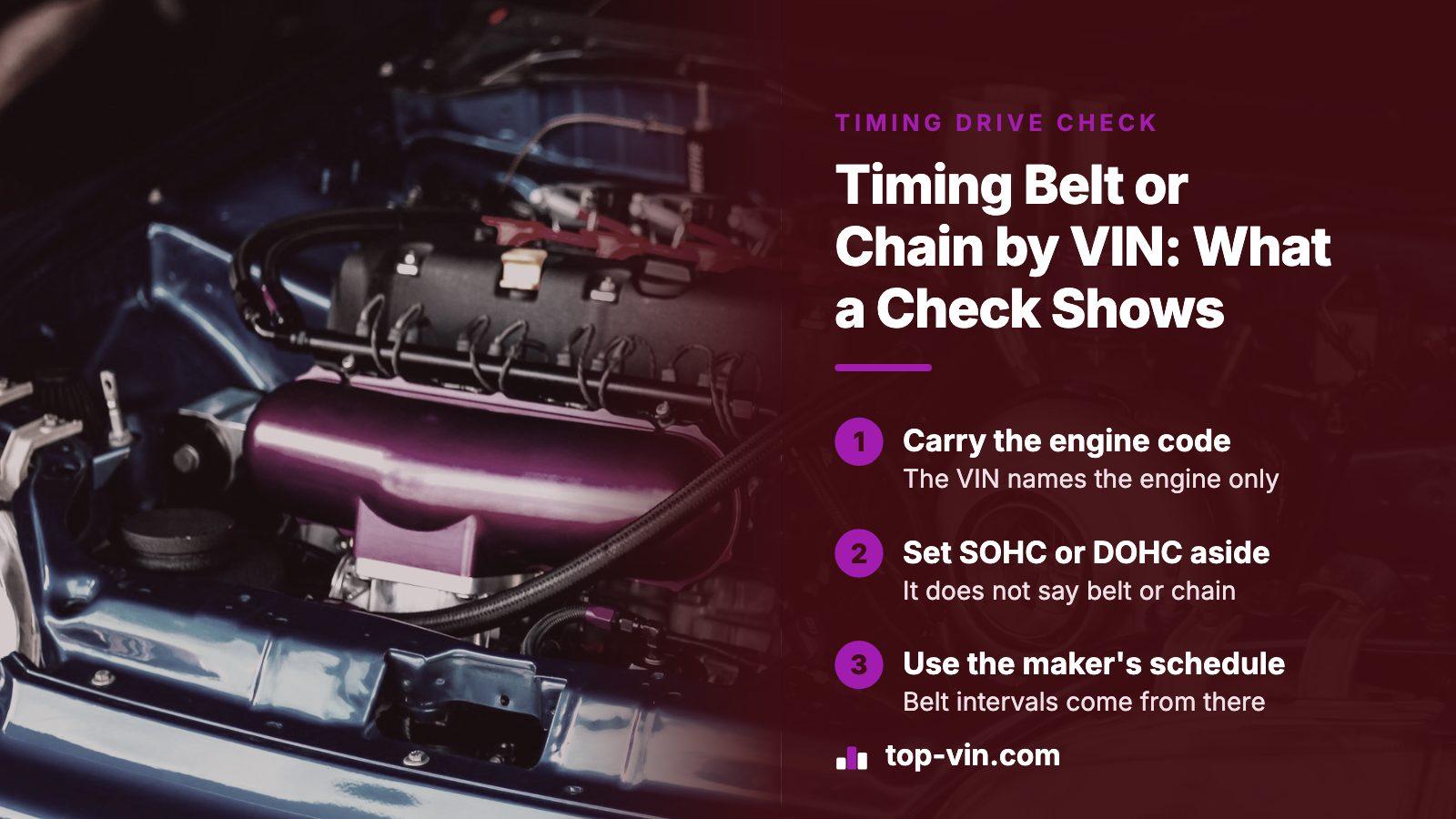
THE SHORT ANSWER
No VIN check lists the timing drive. The federal decoder defines 140 variables and none covers belt or chain, and the SOHC or DOHC entry only describes the camshafts. Use the VIN to get the engine code, then find that engine in the manufacturer's maintenance schedule: a published belt interval means a belt, and no interval usually means a chain. Whether a failure wrecks the engine is a separate question.
- In the VIN
- The engine, not the timing drive
- Federal decoder
- 140 variables, none for belt or chain
- Where the answer lives
- The maker's schedule for that engine code
- TopVIN check
- Free preview, then one payment
What a decode returns about the engine
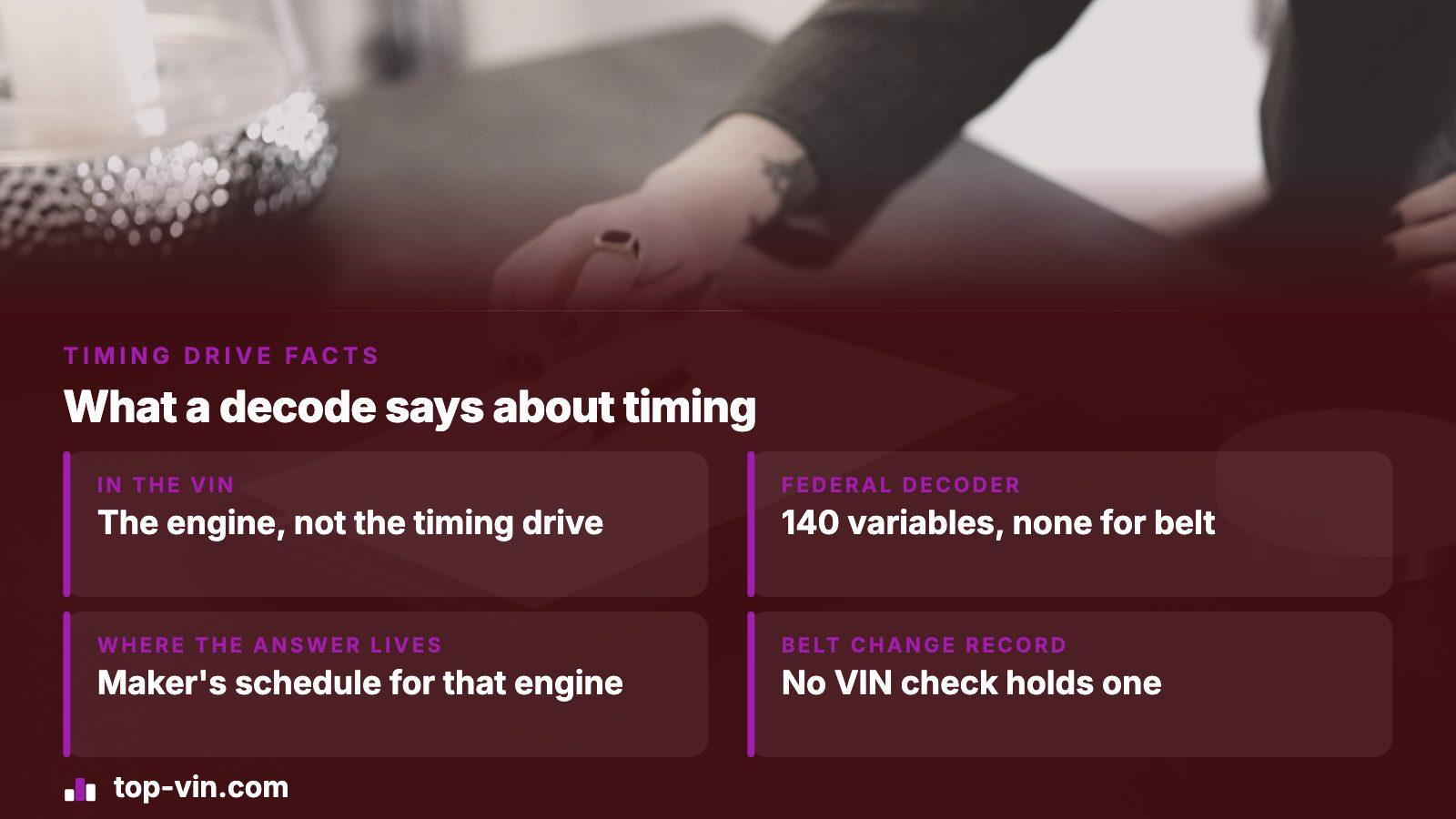
Feed a VIN to the federal decoder and it hands back fields describing how the car was configured at the factory: make, model, year, body, engine, assembly plant and more. The decoder defines 140 variables. None is named for the timing drive. A lookup that prints belt or chain from the VIN alone is guessing from the model name, and one nameplate often ships with several different engines.
This is no flaw in the decoder. On how a vehicle was built it is the authority. Belt or chain is a design choice made engine by engine, and the decode simply does not carry it. What it does carry, the engine identification, is the part worth keeping, and the next sections show how to put it to work.
Which source answers which timing question
People type VIN check, VIN lookup and VIN decode as if they were one tool. For this question they split into sources with very different reach.
| Source | What it settles | What it leaves open |
|---|---|---|
| Federal VIN decoder | The engine identification and the factory build | Belt or chain, interference, service interval |
| TopVIN free preview | Whether the VIN matches the year, make, model and engine in the listing | The timing drive, which no preview field covers |
| TopVIN full report | Dated odometer readings, ownership and use type, title and damage records beside the factory specs | Whether a belt was ever replaced |
| Manufacturer maintenance schedule | Whether that engine has a published belt interval | What a past owner actually did |
| Belt maker's application guide | Whether a given engine is an interference design | Anything about this particular car |
| Shop invoice | The work done, on which car, with which parts | Nothing more, and it exists only if the seller kept it |
Carry the engine code and set SOHC or DOHC aside
Among the decoded fields, write down the engine model entry. It is a short alphanumeric code, the maker's own label for one engine family and variant, and it looks meaningless. It is the key anyway, because maintenance schedules attach to that code and not to the name on the tailgate. A model name spans every engine sold under it during a production run, while an engine code points to exactly one.
The field that misleads
Valve train design usually reads single or double overhead cam. That entry gives the camshaft count and layout, not the part that turns them. Overhead-cam engines come with belts and they come with chains, so the entry cannot settle the question in either direction.
Belt or chain is only half the question
Belt against chain tells you whether a replacement sits on the maintenance schedule, and so whether a past owner could have skipped it. It says nothing about the cost of a failure. That depends on whether valve travel and piston travel overlap. In an interference engine the drive keeps open valves out of the piston's path, and when it fails the crankshaft keeps turning while the camshaft stops, so valves meet pistons.
- Belt, no overlap: a scheduled job, and a failure that stops the engine without wrecking it.
- Belt, overlap: a scheduled job that is costly to miss.
- Chain, no overlap: nothing to skip and a mild failure, the easiest pairing to own.
- Chain, overlap: no appointment on the schedule, yet a worn tensioner can still end in bent valves.
Both drive types exist in both layouts. Overlap is settled one engine at a time, from the maker or a belt maker's guide, never from displacement or reputation. This page names no engines because a list that cannot be sourced row by row goes stale.
A chain still has parts that wear out
A chain is built without a replacement date, and plenty outlast their owners. It does not run alone, though. It rides against plastic guides and is held taut by a tensioner, and both sit in hot oil for as long as the engine runs. On many designs the tensioner relies on oil pressure, which links timing health to how well the oil was kept up. Slack lets the chain skip teeth, and a chain that has jumped puts cams and crank out of step.
- Owners most often notice a cold-start rattle, and most often ignore it.
- A chain job usually means opening more of the engine than a belt job does, so it can cost more when it comes due.
Where a belt interval comes from
The interval that counts is the one in the manufacturer's schedule for that engine. Makers pair a mileage figure with an age limit and the earlier one applies, because rubber ages parked as well as driven. A low-mileage car that sat for years can be overdue on the calendar alone. No single figure is printed here, since one number broad enough for every car would be wrong for most.
Many belt-driven designs have the belt turning the water pump too, tucked behind the same covers. The labor to reach one reaches the other, so pump and tensioner are often replaced in the same visit. When you collect quotes, ask whether the price covers the belt alone or the full set, since those are different jobs.
No VIN check records a belt change
Title brands get reported, odometer readings get recorded at transfer and open recalls are published by the maker for lookup by VIN. Routine maintenance appears in none of them. A belt change is a private job between an owner and a shop, and nothing requires anyone to create a record, keep it or disclose it at sale. That holds for every history report, TopVIN's included. The evidence is paper: the shop invoice naming the car and the parts. Price an undocumented belt as still owed.
A history report can still test the seller's account. Dated odometer readings show how the miles piled up against a distance-and-time interval, ownership and use type show how hard the car worked, and accident and damage records flag repairs worth asking about. Start with the free preview to confirm the engine. The full report is one payment with no subscription, and the pricing page lists current amounts.
What the Buyers Guide and an inspection can settle
A dealer must post the Buyers Guide that 16 CFR Part 455 requires, known as the Used Car Rule. It states whether the car carries a warranty or none and names covered systems, and shorthand such as drive train is not allowed. Section 455.3 makes the form part of the contract and lets it override contrary terms, and 455.4 bars statements that contradict it. Nothing on it concerns maintenance, so a car with an overdue belt can pass the Rule with no warning.
Where state law limits as-is sales, the as-is heading gives way to an Implied Warranties Only notice. Coverage stops at heavier vehicles: the Rule applies below 8,500 pounds gross rating and 6,000 pounds curb weight, so big pickups may carry no form. A pre-purchase inspection can confirm which engine is fitted and whether a chain sounds worn on a cold start. It cannot read a belt's remaining life, because the belt sits behind covers and its age matters more than its look.
Where this information comes from
- eCFR: 16 CFR Part 455, Used Motor Vehicle Trade Regulation Rule — Backs the Buyers Guide points: warranty disclosure, no shorthand for covered systems, the contract override and the as-is rules.
- NHTSA: vPIC VIN decoder — The public decoder whose variable list contains an engine entry and a valve train entry but no timing drive field.
- NHTSA: Recalls — Open safety recalls are searchable by VIN, unlike routine maintenance, which has no public record.
Sources and photos: Facts checked against the sources above in November 2026. Photos by Willian Cittadin, Nina Mercado and Annika Wischnewsky on Unsplash; diagrams by TopVIN.
Keep reading
- Engine size by VIN: what a lookup returns, how tools compare, and what it missesThe engine is what this question attaches to, and size is one of its decoded fields.
- Specs by VIN compared: what each lookup returns and what it leaves blankWhich factory specs a decode returns and which come back blank.
- How to read a VIN: a left-to-right walkthrough with a worked decodeWhich of the seventeen positions point toward the engine.
- Sample reportSee how odometer readings and ownership sit beside the factory specs in a finished report.
Frequently asked questions
Can a VIN lookup say whether my car runs on a timing belt or a chain?
Not directly. The decode returns the engine, and belt or chain is a property of that engine, so it is not a field you can read off. Take the engine code to the manufacturer's maintenance schedule: a published belt interval means a belt, and no belt interval strongly suggests a chain.
Does a VIN check show whether the timing belt was replaced?
No. A belt change is a private repair and no rule requires a record of it, so no history report lists one. Dated odometer readings and ownership history help you judge whether the seller's claim is plausible, but only the shop invoice proves the work.
Is a timing chain better than a timing belt?
A chain removes the scheduled replacement, which is a real advantage. It does not remove the exposure. Guides and the tensioner wear, and a jumped chain can damage an interference engine just as a snapped belt does. A chain is easier on the schedule, not safer on consequence.
How can I tell if an engine is an interference design?
Ask the manufacturer or check a belt maker's application guide for that exact engine, using the code from the VIN decode. Displacement and model name do not settle it, and two engines of the same size from one maker can differ.
Does SOHC or DOHC mean belt or chain?
No. It only gives the camshaft count and layout. Both layouts are built with belts and with chains, which is why the valve train entry in a decode cannot answer the question.
Now check the car itself
The guide explains what to look for. The report shows what this VIN has on record.