THE SHORT ANSWER
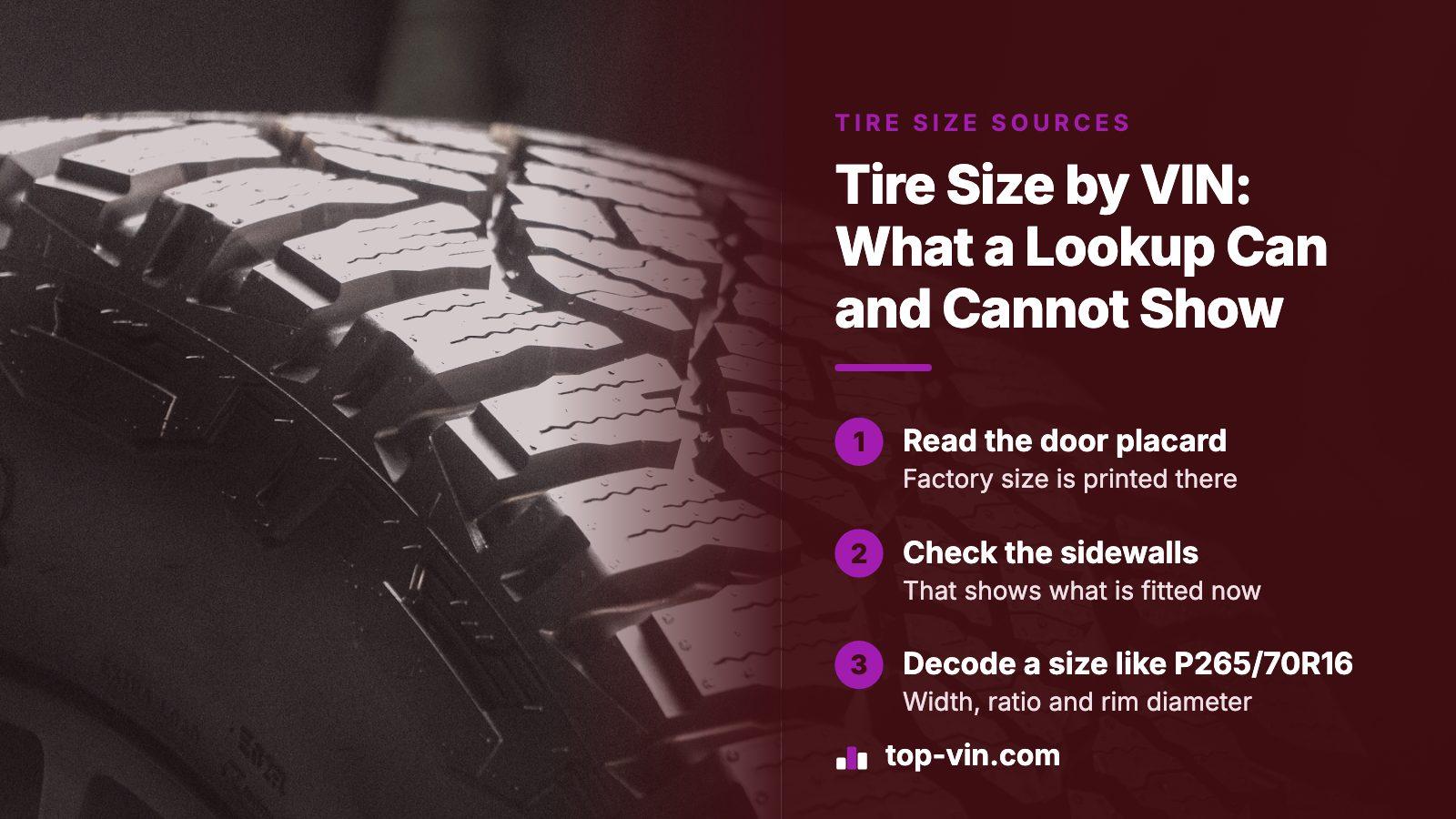
No. Nothing in a VIN spells out a tire size. NHTSA's decoder can return wheel diameter, the pressure monitor type and a weight class, and on four popular models checked for this page it left wheel diameter blank. The factory size is printed on the door placard, and the tires on the car today may differ from it. A VIN check confirms the car and its history, while the label and sidewalls give the size.
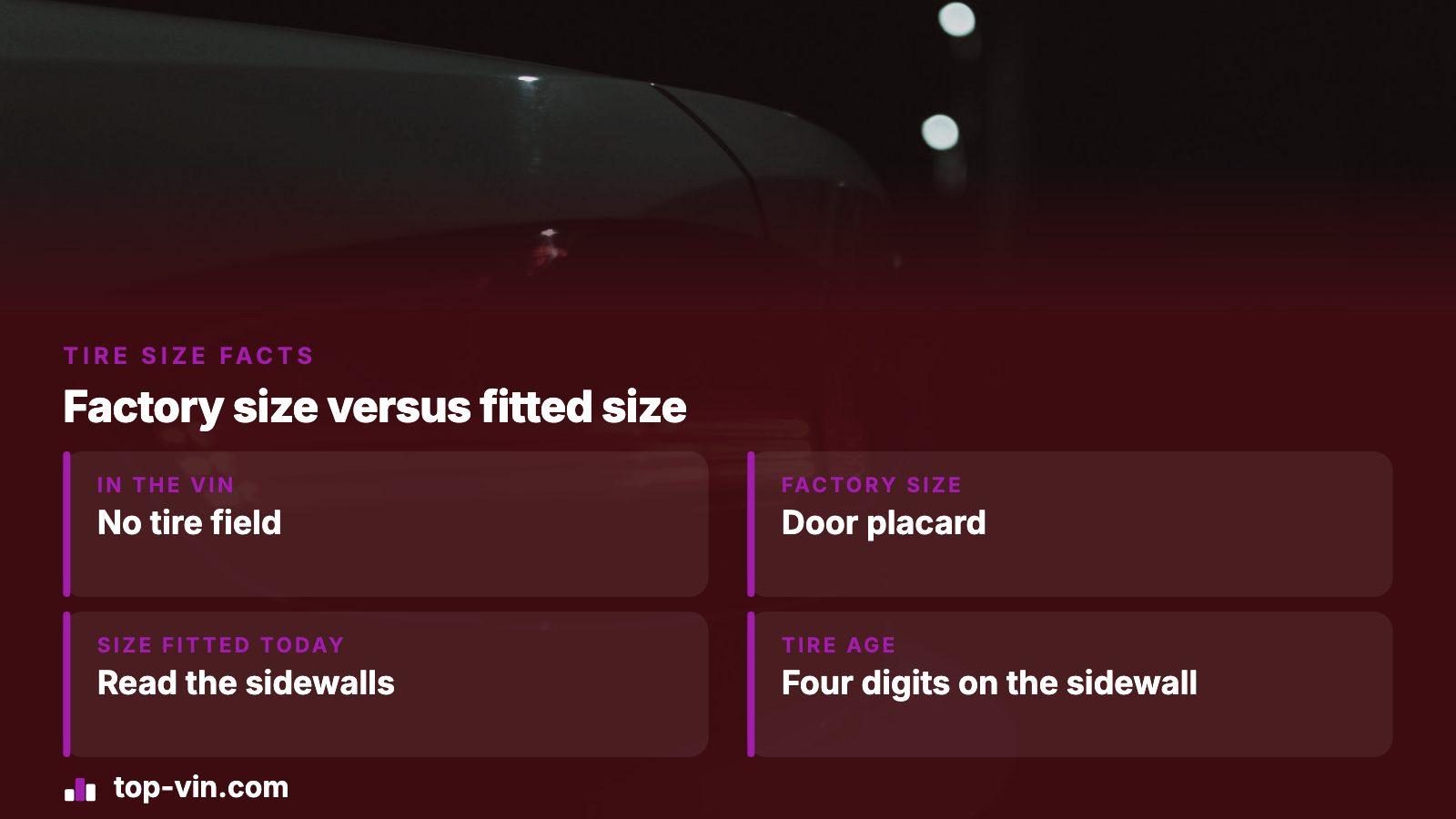
- In the VIN
- No tire field
- Factory size
- Door placard
- Size fitted today
- Read the sidewalls
- TopVIN check
- Free preview, then one payment
What a tire size by VIN search can really return
The federal rule on VIN construction lists, for each vehicle type, what the characters must let a reader work out. A passenger car's list covers the make, line, series, body, engine and restraints. A truck adds its chassis, cab, brakes and weight rating. Tires are on no list.
A tire shop's VIN box therefore cannot be reading rubber from the number. It generally identifies the vehicle first, then asks its own fitment catalog which sizes belong on it. NHTSA's public decoder lists 145 variables. The wheel-related ones are the number of wheels, front and rear wheel diameter, the pressure monitor type and the wheelbase. None is a tire size.
Four ways to get the size, compared
Searches such as tire size by VIN, VIN search tire size and VIN lookup tire size share one goal. Sorted by what each source can honestly return, they separate fast.
| Source | What comes back | What it cannot tell you |
|---|---|---|
| NHTSA's public decoder | Year, make, model, body, weight class, usually the engine | Any tire size, width or aspect ratio |
| A tire shop's VIN box | Candidate sizes from its own catalog | Which size is on the car now |
| The door placard | Size fitted at first sale, spare, cold pressures | Changes made by later owners |
| The sidewalls | Size on the ground today, build week and year | What the factory fitted |
| TopVIN preview and report | The car the VIN belongs to, then its history | The tires now on the wheels |
What four popular models returned from the decoder
To see the gap first-hand, NHTSA's decoder was run on partial VINs for four models built in 2018 and 2019. Front and rear wheel diameter came back blank every time.
| Model | Wheel size, front and rear | Pressure monitor | Weight class |
|---|---|---|---|
| 2018 Ford F-150 | Blank | Direct | 6,001 to 7,000 lb |
| 2018 Toyota Camry | Blank | Blank | 4,001 to 5,000 lb |
| 2019 Tesla Model 3 | Blank | Direct | 4,001 to 5,000 lb |
| 2019 Jeep Wrangler Unlimited | Blank | Direct | 5,001 to 6,000 lb |
A blank marks a gap in what the maker filed, not a car with no pressure monitor, and a full 17-character VIN may fill more fields. The list of fields stays the same, with no size among them. All four weight classes sit well below 10,000 pounds, the line for the federal placard rule.
Where the factory size is printed on the car
The tire-selection standard requires a placard headed Tire and Loading Information on cars, trucks and SUVs whose weight rating is 10,000 pounds or under. Four places are allowed, in a set order, so a bare pillar means try the next spot.
- The driver's side B-pillar, the post behind the front door.
- Where a car has two doors on the driver's side that swing open in opposite directions and no B-pillar between them, the front edge of the rear door.
- The rear edge of the driver's door, when the earlier spots could not hold a label that is easy to see and read.
- A surface facing inward beside the driver's seat.
A maker may put the size and pressures on a separate Tire Information label next to the placard instead. The entry is headed size, original size or original tire size, and the spare gets its own line.
Reading a size such as P265/70R16
That size is the example the federal rule itself prints for a truck's axle-rating label. The P marks a passenger tire, 265 is the width in millimeters, 70 is the sidewall height as a share of the width, R means radial and 16 is the wheel diameter in inches.
- LT in place of P means a light truck tire, which is rated and loaded differently.
- Diameter alone does not settle fitment, because two trims on 16-inch wheels can take different widths.
When the tires on the car do not match the sticker
On a used car a mismatch is common, because the label lists the tires installed at first sale and a later swap does not rewrite it. Two owners told NHTSA how it happens.
From an NHTSA owner complaint
An owner of a 2013 Ford Explorer wrote that the SUV came on 20-inch tires and that studded winter tires needed the 18-inch size Ford had suggested at purchase. Ford would not adjust the speedometer for the smaller tires, and the dealer was “locked out of this option.”
From an NHTSA owner complaint
An owner of a 2021 Ford Explorer reported that body cladding came off a rear door at highway speed and cut a tire. Far from home, the owner had a nearby shop fit a different wheel size with a tire chosen to roughly match the original circumference.
Neither change shows on the door label. Check the sidewalls against it and ask the seller why:
- Compare all four sidewalls first; two sizes on one axle is grounds to walk.
- A larger diameter than stock changes the speedometer reading and the miles the odometer records.
- The spare is often the original and long past its best, so inspect it on its own.
Tire age: four digits on the sidewall
Age is in neither the VIN nor the placard. Federal rules have each new tire carry a 13-symbol identification number molded into one sidewall. Its final group is a four-digit date: two digits for the week, two for the year. In the rule's worked example, 0109 marks a tire built in the opening full calendar week of 2009, and weeks run Sunday through Saturday.
Only one sidewall has to show the full code, so a tire that looks blank outside may carry it on the inner face. Retreads use a shorter code of seven symbols. The rule requires the date to be printed and sets no retirement age, so follow the tire maker's own replacement guidance.
Where a TopVIN check fits into a tire purchase
Run the VIN through the TopVIN preview before ordering anything. It is free, and it shows whether the number decodes to the year, make, model and body style in the ad, which is where any fitment catalog begins. If the preview describes a different car from the one in front of you, stop there.
Tires also hint at a car's past. Wear along one edge points to alignment trouble or a tired suspension part, and that deserves a look beside the accident and damage records and odometer readings in the full report. There is no subscription: one purchase covers a report, and the pricing page lists current amounts for a single report or a multi-vehicle pack.
A short routine before you buy tires or the car
- Copy the VIN off the car rather than the listing, double-check all 17 characters, and run the free preview.
- Confirm the preview matches the year, make, model and body style you were told.
- Photograph the door placard, or the separate tire label beside it, trying the other spots in order if the pillar is bare.
- Photograph each sidewall with its date code, and note any size that differs from the label.
- If the car still fits, buy the report, read its damage and odometer entries against the tire wear, and give the tire shop both sizes.

Where this information comes from
- 49 CFR 571.110: tire selection and rims — Where the placard goes, what it must list and when a vehicle needs a new one.
- 49 CFR 574.5: tire identification requirements — The 13-symbol code and how its four-digit date reads.
- 49 CFR Part 565: VIN requirements — The traits a VIN must let a reader decipher, none of them a tire.
- NHTSA: vPIC decoder API — The public decoder behind the four test results and its list of fields.
- NHTSA owner complaint 10550424 — owner experience, paraphrased
- NHTSA owner complaint 11443304 — owner experience, paraphrased
Sources and photos: Facts checked against the sources above in November 2026. Photos by Rob Wingate, Owen Michael Grech and Johnathan Kaufman on Unsplash; diagrams by TopVIN.
Keep reading
- Trim level by VIN: what each lookup tells you and where it falls shortTrim often decides the wheel and tire package a car left the factory with.
- Towing capacity by VIN: what a VIN check can and cannot tell youThe weight ratings that share a door label with tire entries.
- Specs by VIN compared: what each lookup returns and what it leaves blankWhich factory specs a decode returns and which come back blank.
- Sample reportSee how factory specs sit beside the history in a finished report.
Frequently asked questions
Can I find my tire size from a VIN?
No position in the code is set aside for tires. A tire shop's VIN box can suggest sizes from a catalog, but the door label is the factory record, so check any suggestion against it.
Why does a decoder show wheel size but never tire size?
When it fills a wheel field it gives one number, the diameter in inches. Width and sidewall height vary by trim, so diameter cannot name a tire. Many makers leave even that empty, as all four models checked here did.
Is the size on the door label always the size on my car?
No. The label records the tires fitted at first sale and is not rewritten when an owner changes them. Read the sidewalls for what is on the wheels today.
What does the TopVIN preview show before I spend money?
The preview is free and confirms the car your VIN describes: year, make, model and body style. That is enough to check a fitment catalog has the right vehicle. A paid report then adds title brands, accident and damage records and odometer readings.
How do I tell how old a tire is?
Read the last four digits of the code on the sidewall: two for the week, two for the year. If the outer face has no code, look at the inner face, since the full number is required on just one side of the tire.
Now check the car itself
The guide explains what to look for. The report shows what this VIN has on record.