THE SHORT ANSWER
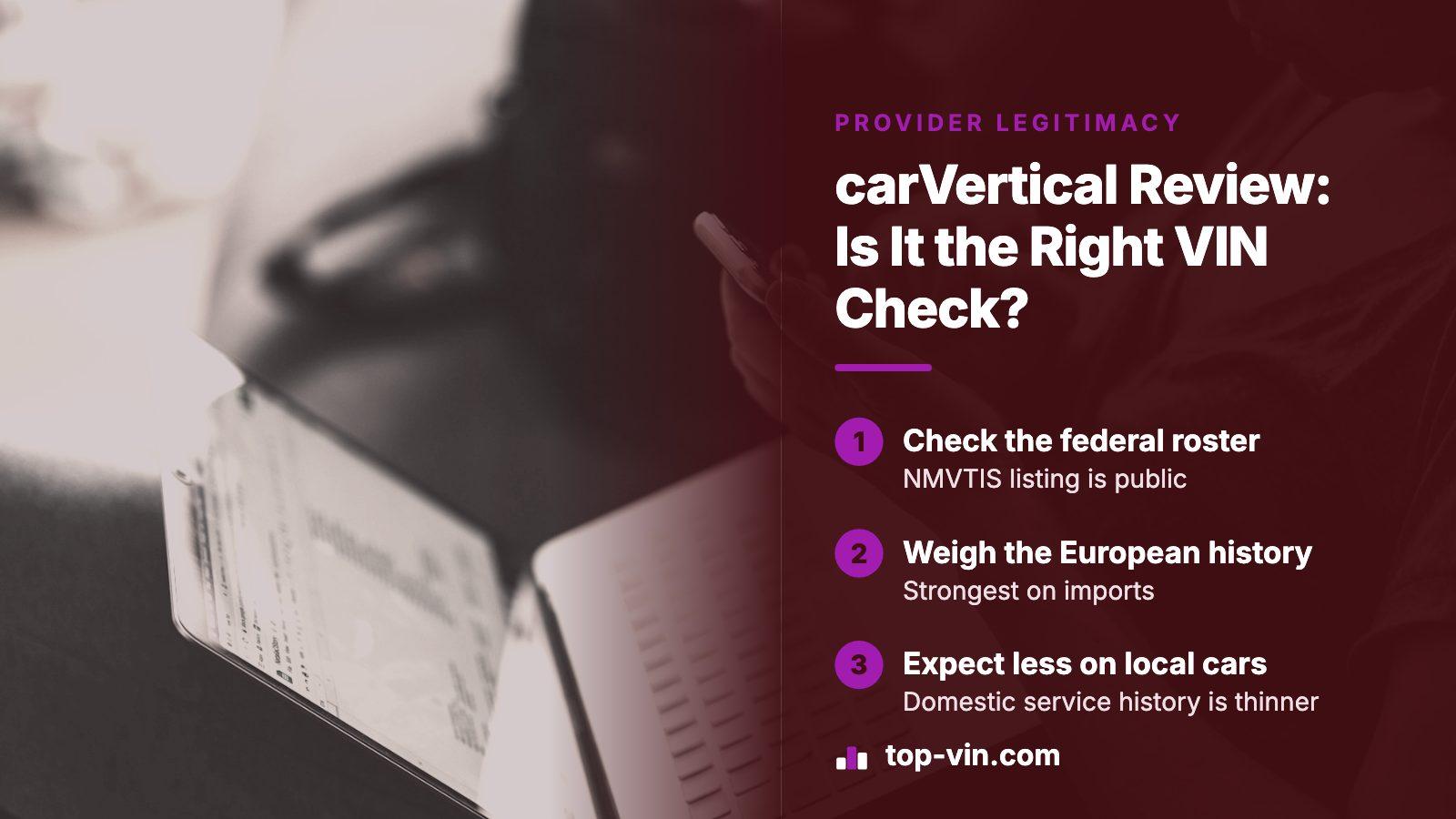
Yes, carVertical is legitimate: it appears on the federal NMVTIS roster of data providers cleared to sell reports to consumers. Its edge is history from European registries, which matters for imports and cars that lived abroad. On a domestic car with years of US service, the American incumbents hold deeper local records. Run the no-charge tools first, then pay for the report that matches where the car has been.
- Federal listing
- Approved NMVTIS provider, public sales
- Best fit
- Imports and cars with a European past
- Weaker fit
- US-built cars with long local service
- TopVIN preview
- Free, then one payment
Where carVertical lands on a best VIN check list
Searches for the best VIN check usually end in a ranking by brand and price. That framing hides the fact that one service can be the right pick for one car and a poor pick for the next. With carVertical the deciding variable is the car's background, not the company's overall grade.
| The car's background | Lean toward | Why |
|---|---|---|
| Built and sold in the US, a couple of owners | A US-record report plus the no-charge federal tools | Local reporting networks hold most of what exists |
| Imported under the 25-year rule | carVertical, or any provider with foreign registry access | Years of history sit in databases abroad |
| Brought home by a returning owner | carVertical, then check mileage against paperwork | A registration abroad may be the only trace |
| A European make built for the US market | Treat it as a domestic car | It was never registered in Europe, so nothing is there to find |
Sort your car into one of those rows before comparing prices. The right row often settles the choice.
What the Justice Department listing proves, and what it does not
The Justice Department's NMVTIS page names carvertical.com among providers approved to serve both commercial and public customers. The same page separates those from providers that sell only to dealerships, and it notes that some providers run affiliated sites that sell reports. That is a checkable credential, and plenty of look-alike sites cannot show it.
Approval tells you the source of the title-brand entries: the national database that state agencies, insurers and salvage operators file into. Every approved provider reads from that same record. It does not tell you how much extra data a company holds, how current it is, or whether a particular report will be complete.
Two questions that predict value
Is the company on the federal list, and which sources beyond that list does it hold? Both have answers you can look up. Marketing language does not.
Why a European chapter changes the answer
American databases begin when a car is first titled here. An imported vehicle therefore shows up with a blank first page: the odometer figure is whatever the importer wrote on the disclosure, and the years of ownership, repairs and registrations before that are invisible to any US-first provider.
carVertical built its data relationships in European markets first. Entries from countries such as Germany, Lithuania and the Netherlands can include registration events, mileage readings and damage records, and on cars from those markets the damage entries sometimes come with photographs. Mileage tampering is a documented problem across the continent, so a reading taken before export can be the one honest benchmark for the dash figure.
The 25-year import threshold keeps adding enthusiast cars to this pool every year, and those are the cars whose most meaningful decades happened abroad. Coverage is uneven, since some national registries are far richer than others, so a thin result for one country is not proof of a clean car.
Against Carfax and AutoCheck on a domestic car
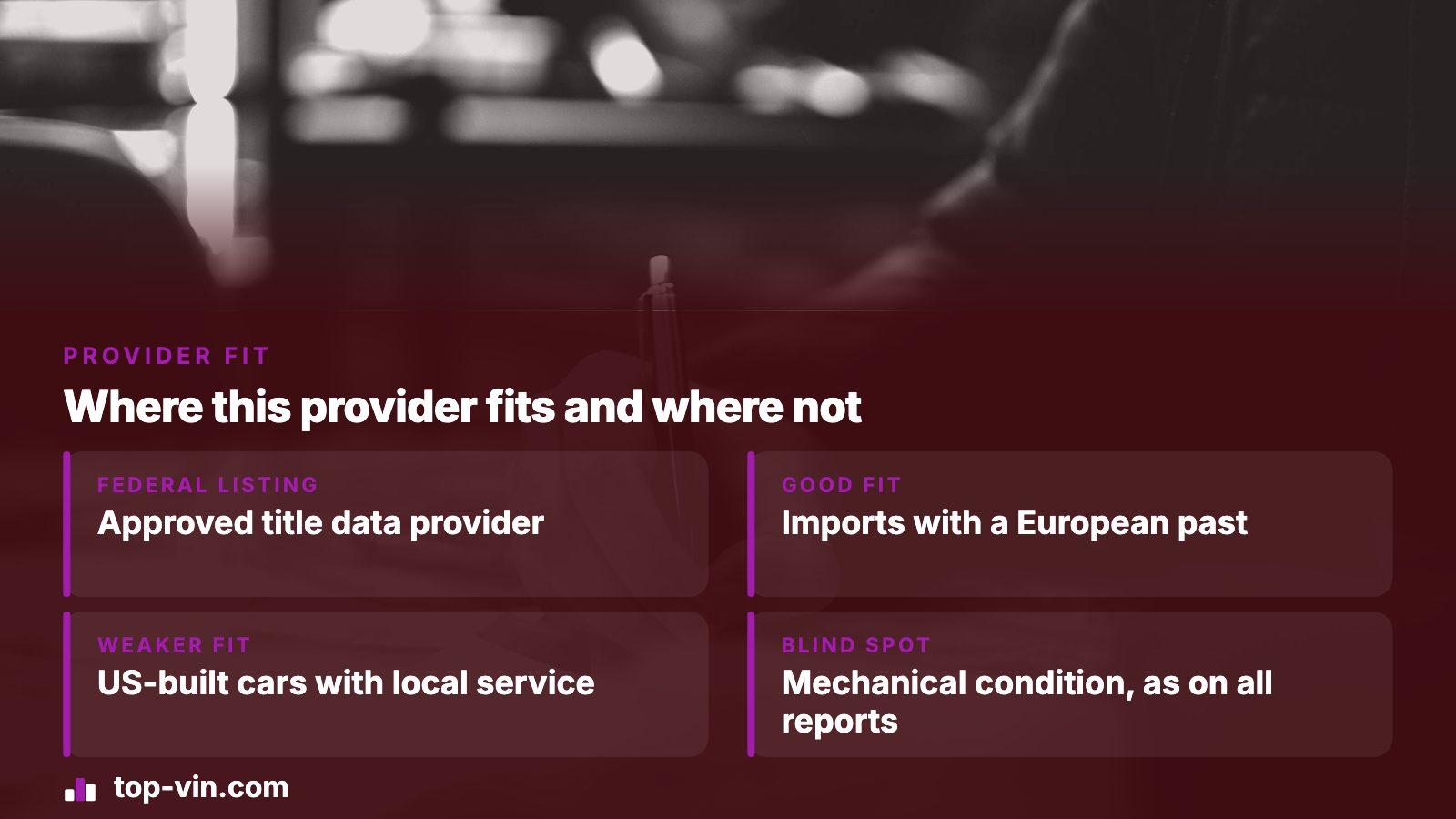
The older American names spent decades connecting with dealer groups, repair chains, insurers and auctions in this country. On a vehicle that has lived its whole life here, that network depth is the asset, and carVertical has no matching advantage. Its reports handle federal title brands competently but run thinner on local service and accident reporting.
- US maintenance and service entries are sparser than at the established incumbents
- Domestic accident reporting lacks their long local relationships
- Foreign coverage varies country by country
- No report names the owner, because federal privacy law binds every provider
- Mechanical condition stays invisible, as it does on every history report ever sold
Cheaper routes cover a domestic car well. A single federal-title report plus the no-charge lookups will answer most of what a buyer needs.
The blockchain pitch, set aside
The company launched on the idea of storing vehicle data on a ledger that nobody can alter, and that story still shapes its marketing. As a buyer you can ignore the storage question. What makes a report worth buying is the registries behind it, and a clever filing system cannot rescue thin inputs.
Judge the inputs
Ask which registries contribute records for the car you are inspecting. If the answer is a European registry and your car lived in Europe, the report has something to say. If your car never left Ohio, the technology story adds nothing.
Reading a report on an imported car
Once you have a report on an import, read it as a timeline across borders instead of a list of separate lines. These are the entries that deserve a pause.
| Entry | What it may mean | Your move |
|---|---|---|
| Mileage lower at the US title than at export | A rollback or a unit mix-up between kilometers and miles | Ask for the export paperwork before discussing price |
| A long silence between export and first US title | Storage, repair or a stretch the records simply miss | Ask the seller who owned it in between |
| A damage entry abroad with no repair story | An accident handled outside any US record | Have a body shop check panel gaps and welds |
| Several countries in a short span | A car moved around, perhaps to shed a problem | Read every registration date in order |
| A VIN on the car that differs from the paperwork | A clerical slip or something worse | Stop and resolve it before any money moves |
Free checks to run before paying any provider
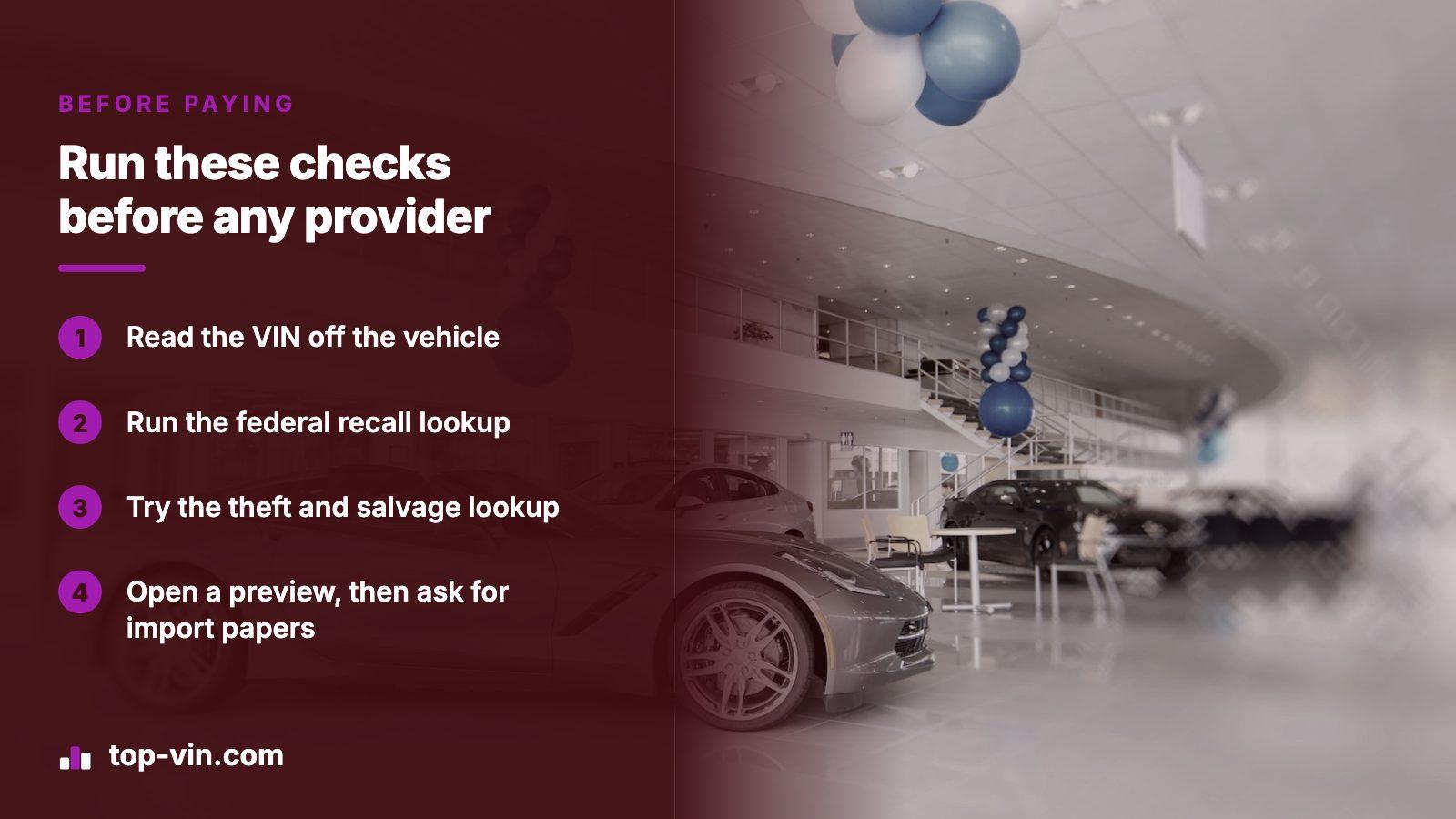
Whatever report you end up buying, a handful of lookups are free and can end a search before you pay. Start with them.
- Read the 17 characters off the vehicle, then match them against the title and the listing.
- Run the VIN through the federal recall lookup to see any open safety campaign.
- Try NICB's VINCheck, which flags reported theft and salvage.
- Open the TopVIN preview to see whether the record matches the car described.
- For an import, ask the seller for foreign registration papers and the export documents.
If any of the first four turns up a theft or salvage entry, you may not need to pay for anything else.
Where a TopVIN report fits beside it
TopVIN reports are built on US records. Expect branded titles, crash and damage entries, odometer readings, salvage and auction listings with photos, lien and impound notices and theft flags. For a domestic used car those are the questions that decide a purchase, and the preview costs nothing, which lets you confirm the VIN matches before paying.
Paying once covers the report, and there is no recurring plan. Current amounts for a single report or a multi-report pack (3, 5 or 10) are on the pricing page. A pack suits a shortlist, since checking every VIN is cheaper than driving to each car.
An import is different. A US-record report covers the American half of the story, and the years abroad need an origin-country record from a provider that holds one. For those cars, run both and compare the mileage.
Where this information comes from
- NMVTIS: approved data providers — The Justice Department list that names carvertical.com among providers selling to the public.
- NHTSA: importing a vehicle — Federal rules that create the import market, including the 25-year threshold.
- NICB: VINCheck — A no-charge theft and salvage screen to run alongside any report.
- NHTSA: recalls — The federal lookup for open recalls by VIN.
Sources and photos: Facts checked against the sources above in November 2026. Photos by Michal Biernat, Richard R and Owen Michael Grech on Unsplash; diagrams by TopVIN.
Keep reading
- VinCheckUp review: where it sits on a best VIN check listAnother provider put through the same buyer's test.
- Visor VIN review: a car search tool, not a VIN checkA third service weighed on what it adds for a US car.
- VIN check with photos: what a report shows and what it can'tHow auction and damage photos change what a report tells you.
- Sample reportSee what a full report looks like before you pay.
Frequently asked questions
Is carVertical legitimate?
Yes. The Justice Department's NMVTIS page lists carvertical.com among approved providers that serve the public, which is the credential worth checking in this market. It started in Europe and expanded to the US, and that history explains both its main strength and its main limit.
Is carVertical any good for a US-built car?
It is adequate. As an approved provider it supplies the same federal title-brand entries as any other approved provider, but for local service and accident history the long-established American names have deeper networks. A cheaper US-record report usually does the job on a car that never left the country.
Is carVertical better than Carfax?
Only on one kind of car. If the vehicle was registered abroad, carVertical may hold records Carfax never saw. If it lived entirely in the US, Carfax and AutoCheck have more local history, so neither service wins across the board. Match the report to where the car has been.
Does a carVertical report show who owned the car?
No. Federal privacy law keeps owner identity out of public vehicle reports, and that applies to every provider alike. A report can show how many times a car changed hands or where it was registered, but a name only appears on the title the seller shows you.
Should I buy more than one report on the same car?
For a domestic car, one is plenty. For an import, a second report can make sense: one covering US title and damage records, one from a provider with origin-country data. Compare the mileage readings between them, because a gap or a drop is what you are looking for.
Now check the car itself
The guide explains what to look for. The report shows what this VIN has on record.