THE SHORT ANSWER
Visor is a car search and market tool, not a VIN check. The pages we read on November 5, 2026 describe listings, price tracking and market research, and none sells a history report. The Justice Department's roster of approved title-record sellers has no Visor entry. Use Visor to judge an asking price, then run a VIN check on the specific car for title brands, damage and odometer readings.
- What Visor is
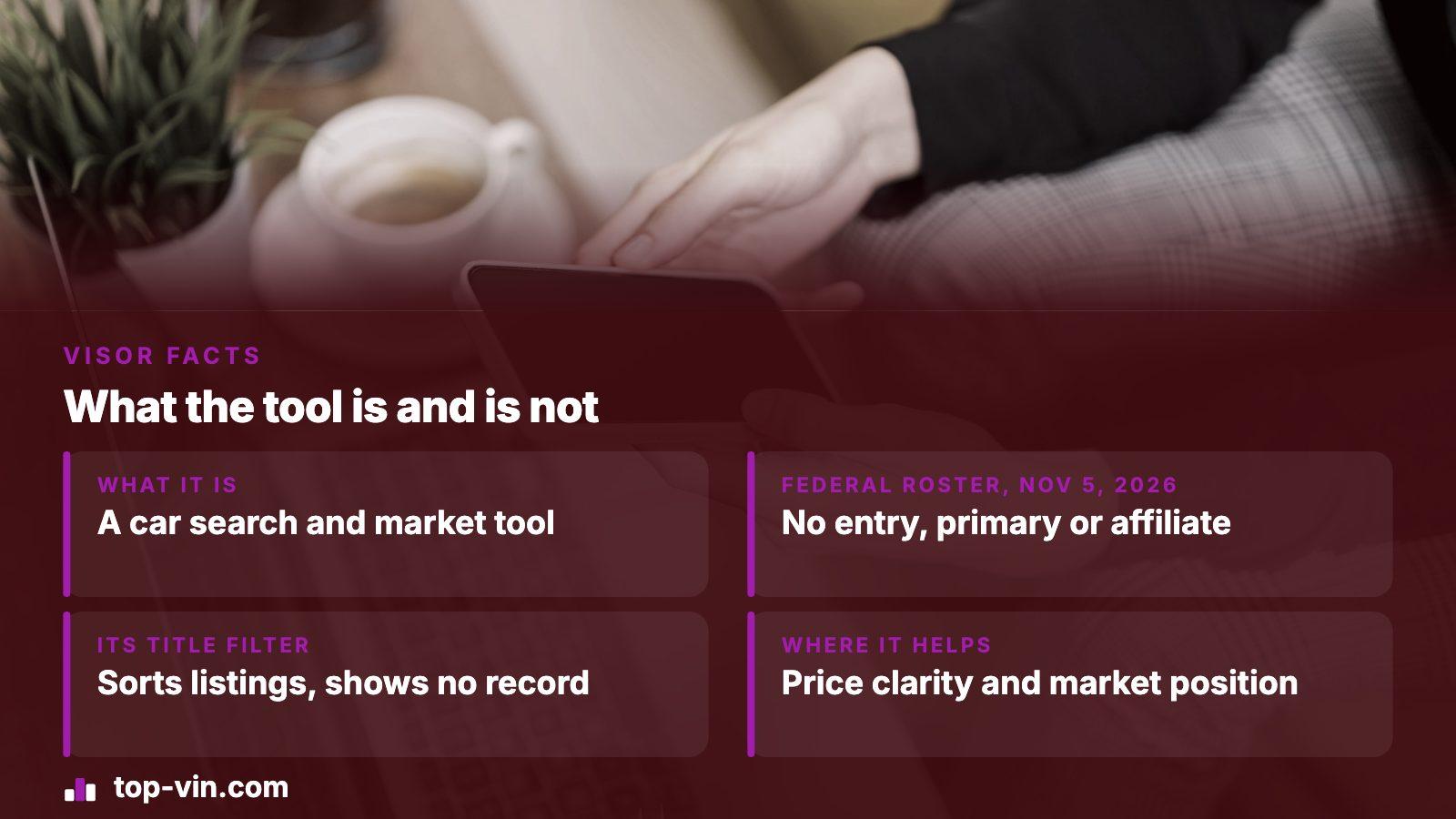
- A car search and market tool
- Federal roster, Nov 5, 2026
- No Visor entry, primary or affiliate
- Its title filter
- Sorts listings, shows no title record
- TopVIN preview
- Free, then one payment
Does Visor belong on a best VIN check list?
A best VIN check list ranks services that answer one question: what has been recorded about this car. Visor answers a neighboring one, what the car is listed for and how the market has treated it. Sorting by job shows the split quickly.
| Your question | Visor | A report on the VIN |
|---|---|---|
| Is the asking price in line? | Yes, its core job | Partly, through a market value line |
| Has the title been branded? | A search filter, no record shown | Yes, from title records |
| Was it damaged or sold at salvage auction? | Not stated on any page we read | Yes, with photos where held |
| Is the mileage believable? | Mileage as advertised | Readings recorded over the years |
| Does the VIN match the factory build? | Yes, through its spec catalog | Yes, factory specs |
Visor leads on price questions, and a report on the VIN leads on questions about the car's past. Neither replaces the other.
What Visor says about itself
Its home page promises a view of the whole market. It is a search site with iPhone and Android apps that gathers dealer listings, adds price-history tracking, and publishes research on asking prices, days to sell and new arrivals.
- Buyer-funded: the site says a paid tier lets buyers, not dealers, pay for it.
- No lead selling: it names personal details sold as leads, deal-rating badges and ad-first listings as practices it rejects.
- Small team: two brothers started it, with offices in California and Ohio.
- Hedged data: the footer calls listing data as is, and asks buyers to verify details with the seller before any transaction.
Across the home page, changelog, roadmap and research pages, nothing offers a vehicle history report. That is not a flaw. It is a different product and deserves to be judged as one.
What a VIN does on Visor
A VIN is how Visor finds a car, not how it opens a file on the car. Listing pages sit at addresses ending in the 17-character VIN, and the second version of its mobile app added VIN search by typing, pasting or scanning, along with a listing price breakdown and market velocity figures.
The roadmap also marks search by VIN pattern as delivered. Either way the output is listings. A hit means some dealer advertised a matching car, and finding no listing says nothing about whether a car has problems.
The title and previous-use filters, read carefully
On October 28, 2026 the changelog announced used-car filters for certification program, title status and previous use. The title filter sorts by brand, with salvage and rebuilt as the examples given. The previous-use filter sorts by histories such as rental or fleet, and the entry says it draws on dealer statements and VIN records.
A filter is not a record
A filter sorts listings by a tag. It does not hand you the title record behind the tag, the dates, the state that issued it or the damage that led to it. Those details come from a report built on state title data, and on the day we looked, Visor had no entry on the Justice Department's list of approved sellers of that data.
As a shortlist tool the filters are handy: hide rebuilt cars before wasting a drive. As proof a car is clean they mislead, because a missing tag in someone's listing data is not a clean title record.
Where Visor earns its place
- Price clarity: listings lead with a price that includes mandatory dealer fees, and a breakdown separates discounts, incentives, fees and add-ons.
- Market position: a chart plots a listing's price and mileage against comparable cars, and its research pages report how long models sit.
- Deal Check: the roadmap lists a tool that splits a deal into price, trade-in, fees and add-ons. We did not test it.
- Spec matching: listings are matched to factory build documents, and Visor keeps its own open catalog of specifications.
Every one of those strengths sits on the advertisement side of the transaction. They help you negotiate. They do not help you decide whether the car deserves a negotiation.
What Visor costs next to a TopVIN report
Visor has a no-charge tier. Its paid tier, Visor Plus, adds option-level filters, installed options on listings, documents found across the web and previous sellers on used listings. The subscribe page showed these plans on November 5, 2026, each marked cancel anytime.
| Visor Plus plan | Price shown | Billing |
|---|---|---|
| Weekly | $5 | Every week |
| Monthly | $15 | Every month |
| Annual | $60 | Once a year |
| One-time | $250 | Single purchase |
Buying a plan needs a sign-in and prices can change, so read the page before paying. TopVIN's preview shows what exists for a VIN before any money moves. Buying a report comes later and happens once: no renewal, no monthly charge. Packs for 3, 5 or 10 VINs exist for shortlists, and the pricing page lists every amount.
A buying order that uses both
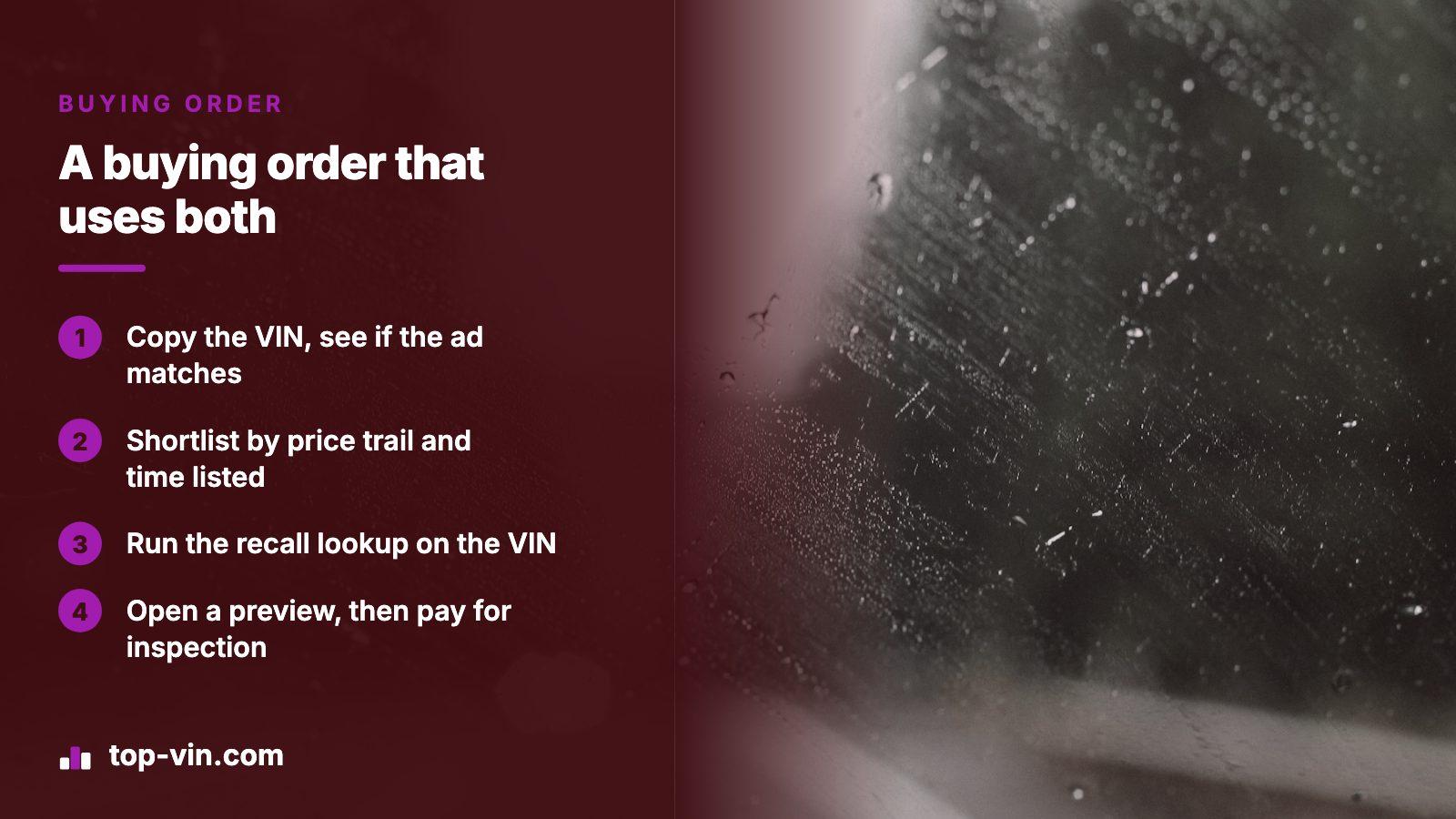
- Copy the VIN from the vehicle itself, and see whether the ad and the title papers carry the same characters.
- Shortlist on Visor: price trail, time on the market, price including fees.
- Run NHTSA's recall lookup on the VIN, at no charge.
- Search NICB's VIN database, which the Justice Department's buying tips page points to.
- Open a TopVIN preview for the car you are serious about, and buy the report once the VIN checks out.
- Pay a mechanic for an independent inspection, which the Justice Department strongly encourages.
Most of these steps cost nothing, and any of them can end the search early. The inspection comes last because it looks at the car itself, where every other step reads a record.
Where a TopVIN report fits
Once a car clears the price check on Visor, the record questions begin, and a TopVIN report answers them from US records. Two entries matter most beside a Visor shortlist: the odometer readings, which you can set against the mileage in the ad, and any title brand or damage entry with auction photos.
Start with the preview. No charge applies, and it confirms the VIN matches the car in the listing. Visor's listing data comes with no warranty, so let a report on the VIN settle the car's past.
Next step: pick your best candidate on Visor, then put its VIN into the preview before the test drive is booked.
Where this information comes from
- Visor: home page — What the site says it is, how it is funded, and the footer disclaimers.
- Visor: what's new — The October 28 entry on title status and previous-use filters, and the mobile app update.
- Visor: roadmap — Delivered features such as Deal Check, fee-inclusive prices and VIN pattern search.
- Visor: Plus plans — The four Visor Plus plans and prices as shown on November 5, 2026.
- Justice Department: approved NMVTIS providers — The public roster checked for a Visor entry, affiliates included.
- Justice Department: used car buying tips — Advice to pair a history database with a mechanic's inspection.
- NHTSA: recalls — The federal open-recall lookup by VIN.
Sources and photos: Facts checked against the sources above in November 2026. Photos by Iain, Cole Keister and Jakub Żerdzicki on Unsplash; diagrams by TopVIN.
Keep reading
- carVertical review: where it fits on a best VIN check shortlistA provider that does sit on the federal roster, weighed the same way.
- VinCheckUp review: where it sits on a best VIN check listA name the roster does not show, and how to treat its preview.
- Previous owners by VIN: what a check shows and what it can'tListing sellers are not owners; see what ownership records add.
- Sample reportA finished report laid out before you decide to buy one.
Frequently asked questions
Does Visor give vehicle history reports?
No. It works as a search and pricing tool, built around dealer listings, price tracking and market research, and the pages we read on November 5, 2026 never mention a history report. Its data describes the advertisement, so turn to a VIN-based report for the car's accident, title and odometer records.
Does Visor appear on the Justice Department's NMVTIS roster?
On November 5, 2026 the public roster held no entry for Visor, as a provider or as an affiliate. That fits a product that does not claim to sell title-record reports. It is no mark against Visor, only a reason to buy title records from a seller the roster names.
Can Visor show whether a car has a salvage title?
Its title status filter sorts listings by brand, so you can hide or find salvage and rebuilt cars. That is a filter on listing data, not the title record itself. Confirm any brand, and the cars without one, with a report built on state title records.
Is Visor free to use?
A free level exists, alongside Visor Plus, a paid level offered by the week, month or year or bought once. Each plan type is marked cancel anytime. Plus adds option-level filters and previous sellers on used listings. Prices sit on its subscribe page and can change, so read it before paying.
Should I use Visor or a VIN check?
Use both, since they do different jobs. Visor helps you judge whether an asking price is realistic and how long a car has been listed. A VIN check reports what was recorded about the vehicle. Add NHTSA's recall lookup and a mechanic's inspection before handing over money.
Now check the car itself
The guide explains what to look for. The report shows what this VIN has on record.