THE SHORT ANSWER
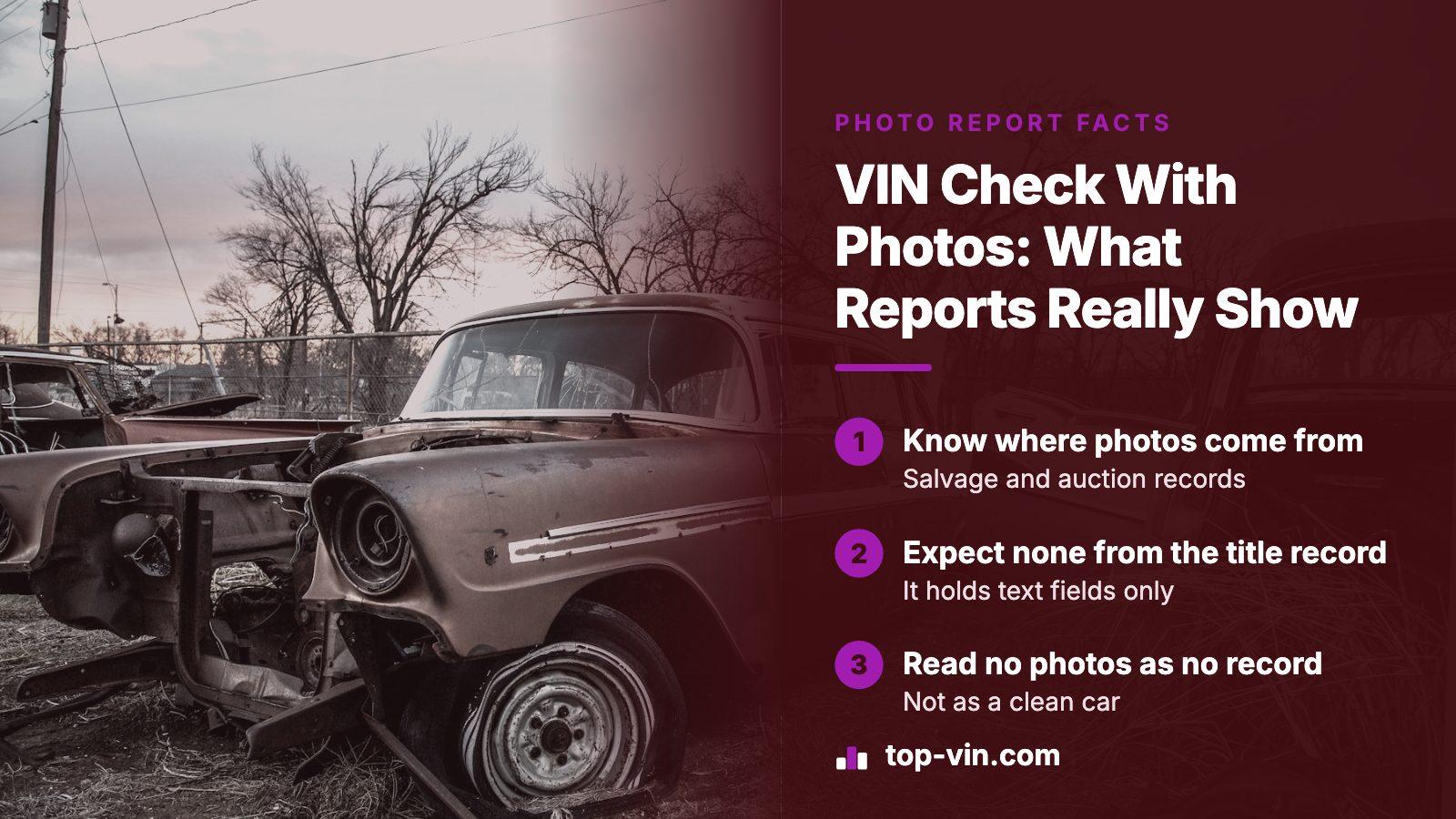
Yes, with one condition: the pictures have to exist. Photos in a VIN check come from salvage and auction records, so they appear when a car was written off or sold through an auction that photographed it, and not otherwise. A TopVIN report shows those photos beside the title brands and odometer readings. They show the car as it looked then, the before-repair view, not its condition today.
- Where photos come from
- Salvage and auction records
- Federal title record
- Text fields only, no images
- Nothing found
- Means none on file, not a clean car
- TopVIN preview
- Free, then one payment for the report
What a VIN check with photos can show about a car
The pictures belong to events, not to the VIN itself. When a car is declared a total loss or goes through a salvage or insurance auction, its sale listing is typically shot from several angles, because bidders need to see the damage. A VIN check that carries photos is reaching back to those records. TopVIN places them next to the title brands, damage records and odometer readings for the same VIN, so a picture can be tested against the paper trail.
| Where a car picture comes from | In a VIN report? | What it can tell you |
|---|---|---|
| Salvage or insurance auction lot | Yes, when the record carries photos | The damage as it stood before any repair |
| Dealer page or classified ad | Not what the report is built on | How a seller chose to present the car that day |
| Federal title record | No, it holds text only | Brands, the titled owner and mileage at titling |
Why the national title record carries no pictures
Buyers often assume an official photo file sits behind every VIN. It does not. Title data is governed by a federal regulation, 28 CFR Part 25, that is built around legal status, and a search of its current text for photograph, image and picture comes back empty. What it asks for is data: who held the title, which brands the title carries, what the mileage disclosure said, and what insurers and salvage yards reported when a car came into their hands.
Insurers must report that a car was designated junk or salvage, but the rule only encourages them to add the reason they took it. A total-loss entry can therefore leave open whether the cause was flood, fire or a collision. That gap is exactly where an auction photo set earns its place, because it shows what the entry never says.
Five questions for comparing VIN checks that advertise photos
Any service can put the word photos in a headline. A buyer weighing the best VIN check options should ask what sits behind it.
- Which record is the picture attached to: an auction lot, a dealer listing or a stock image? Only the first is evidence about damage.
- Is a sale date shown with the picture? An undated photo cannot be placed on the car's timeline.
- Does the report say plainly when no photos exist, or does it leave a blank that reads like good news?
- Are title brands, odometer readings and damage records in the same report, so the photos can be checked against something?
- Can you see a preview before paying, and is the purchase a single payment or a subscription that renews?
TopVIN answers the last one directly: a preview with no charge first, then a single purchase.
Running it on the car in front of you
- Find the 17-character number on the vehicle itself. One copy sits on a plate you can read from outside the windshield, another on a label where the driver's door closes. Compare both with the title paperwork and the listing.
- Enter it in the TopVIN preview. The preview confirms which vehicle the number belongs to before you spend anything.
- Pay for the report once the car is a real candidate, and open the salvage and auction section first.
- Ask the seller for a new, dated photo that shows both copies of the number. A quick yes confirms the car is the one you checked. Hesitation is information.
The last step matters because photographs follow a number, not a car. If the number in the ad belongs to a different vehicle than the one on the lot, the pictures in the report belong to that other vehicle too.
Reading auction photos against the car itself
Treat the set as a map of where to look. Find the panels that were hurt, then go and see how they look now.
| What the photos show | What to check in person |
|---|---|
| Front-end or corner damage | Gaps along the hood and fenders, paint texture, and whether a bumper reflection runs straight across the joint |
| Water lines, mud or a soaked interior | Carpet and seat rails, a musty smell, rust on bolts that normally stay dry |
| Airbags out or the cabin torn open | How the dash and wheel fit, any warning lights, and the repair shop's invoice |
| A paint color that differs from today's | Door jambs and under-hood edges for overspray, and the story behind the respray |
A set of photos is a lead, not a verdict
Auction pictures show the car on one day. They cannot show what the repair shop did afterward. Visible damage in the set and a spotless body now is a reason to ask for invoices, not to walk away on the spot.
When the report shows no photos
Plenty of used cars have none, and the reason is usually dull. The car may never have been sold at auction, or it may have been repaired privately after a crash that no insurer wrote off. A car that lived with one careful owner leaves no photographic trail at all.
Read an empty result as no information. It does not clear the car and it does not condemn it. Lean on the other sections instead: the title brands, the odometer readings, and the damage and insurance records. Then add a mechanic's inspection, which finds what no archive can.
Red flags worth acting on
- Photos of visible collision damage on a car the seller calls accident-free.
- A brand on the title record that the seller never brought up, even if the pictures look mild.
- Mileage in an older record that is higher than the dash shows now.
- The seller's own ad photos turning up under other names or in other cities. A reverse image search takes seconds and catches reused pictures.
- A seller who cannot or will not send current photos that show the VIN plate.
One flag is a question for the seller. Two or three together are a reason to leave the deal, however good the car looks in daylight.
Cost, and the next move
TopVIN lets you look before you pay. You can start with the preview at no charge. The report is a single purchase for one car, and a bundle exists for anyone comparing several cars. There is no renewal, and current amounts sit on the pricing page.
Run the tools from others beside it. NHTSA's recall lookup shows open recalls for the number, and the NICB VINCheck looks up theft and salvage records that member insurers contribute. Both cost nothing, and neither replaces a history report.
Buying: pull the report, read the salvage and auction section, and book an inspection with the findings in hand. Selling: run your own VIN so you know what the next buyer will see, and mention anything the photos show before they do.
Where this information comes from
- eCFR: 28 CFR Part 25, national title information system — The federal rule for title data; its text asks for records about status and never mentions photographs.
- NHTSA: recalls — Federal lookup for open recalls by VIN, a useful check beside any history report.
- NICB: VINCheck — A no-charge theft and salvage screen fed by participating insurers.
Sources and photos: Facts checked against the sources above in November 2026. Photos by Leo_Visions, Justin Cron and Alejandro Escamilla on Unsplash; diagrams by TopVIN.
Keep reading
- Sample reportSee how the salvage and auction section is laid out before you pay.
- Totaled but still drivable: what the title and a VIN check will showWhat a write-off does to a title and how it shows up in a check.
- VIN verification: the four checks people mean and what each provesConfirm the number on the car matches the number you checked.
- carVertical review: where it fits on a best VIN check shortlistAnother option on a best VIN check shortlist, and where its photos come from.
Frequently asked questions
Is there a free VIN check with photos?
The TopVIN preview is free, but photos come with the paid report. Free tools from others, such as NHTSA's recall lookup and the NICB VINCheck, cover recalls, theft and salvage entries without pictures. Photos exist only where a salvage or auction record produced them, so no service can promise a set for every car.
Will a VIN check show photos of accident damage?
If the car went through a salvage or insurance auction and that record carries pictures, the report shows them with the sale record. If the crash was repaired privately or never reported, there is nothing to show. The damage and title records can still flag the event even without a photo.
Does a car with no photos in its history have a clean past?
No. Missing photos mean the car never produced any, or none are on file. Private repairs and unreported damage leave no pictures behind. Use the title brands, odometer readings and an in-person inspection to fill the gap.
Can a VIN check show what the car looks like today?
No. Every picture in a report is from the past, taken when the car was listed for sale at auction. For its present condition, ask the seller for fresh dated photos that show the VIN plate, then see the car in person with a mechanic.
Do the photos prove the car I am looking at is the same one?
Not by themselves. Photos follow a VIN, so first make sure both copies of the number on the car match the report. Then compare distinctive details such as color, wheels and trim between the photos and the car. A mismatch deserves a firm question.
Now check the car itself
The guide explains what to look for. The report shows what this VIN has on record.