THE SHORT ANSWER
On November 5, 2026, the Justice Department's roster of approved NMVTIS sellers showed nothing for VinCheckUp, either as a primary provider or as an affiliate. The nearest name, VinCheck.Info, is filed beneath a different provider and is a separate name. Use VinCheckUp, if at all, as a quick screen. For the federal title and brand record, buy from a business the roster names, and reopen the roster before paying, since entries change.
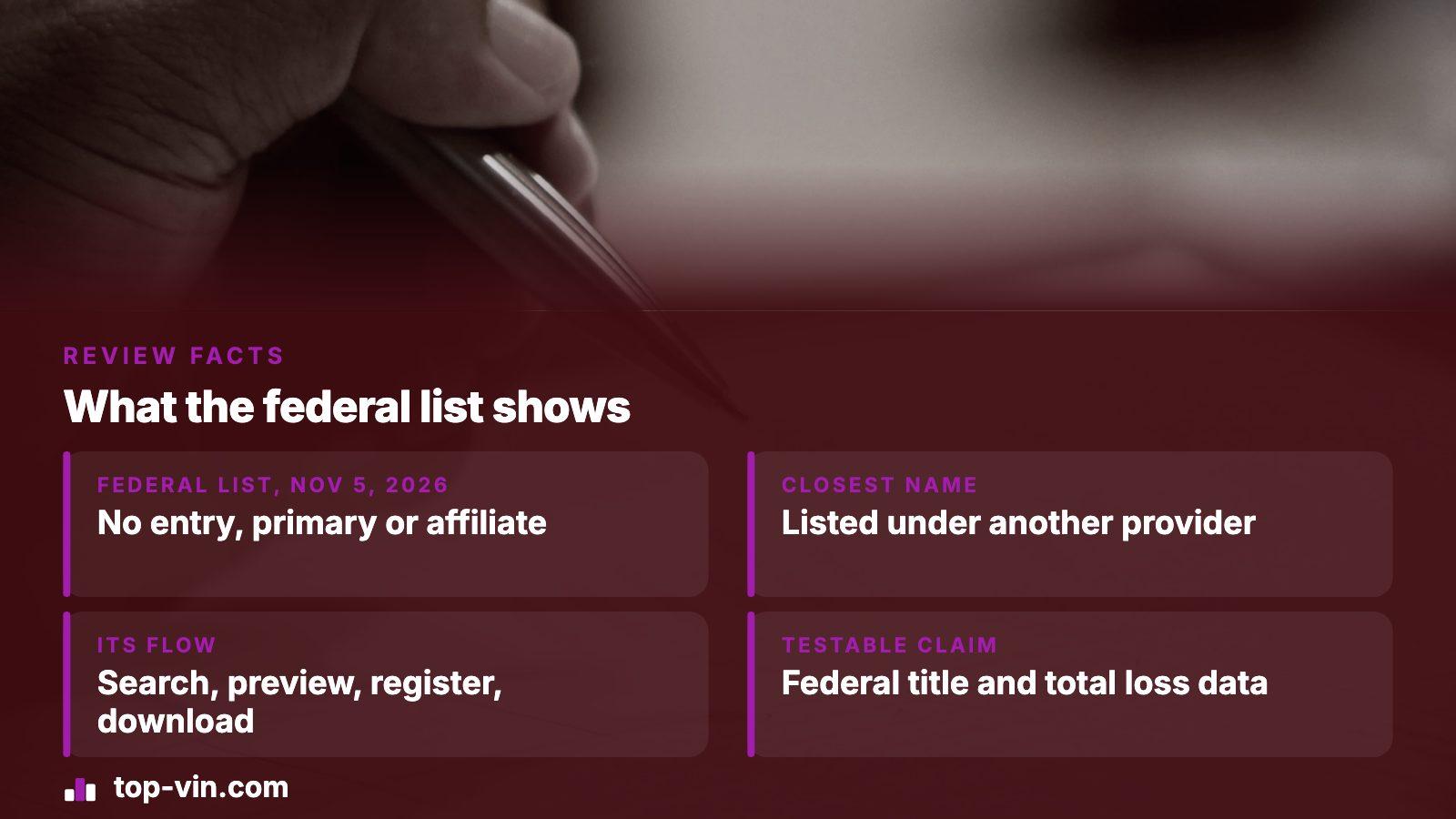
- Federal list, Nov 5, 2026
- No VinCheckUp entry, primary or affiliate
- Closest name
- VinCheck.Info, listed under another provider
- Its flow
- Search, preview, register, download
- TopVIN preview
- Free, then one payment
Where VinCheckUp lands on a best VIN check shortlist
Rankings of the best VIN check services usually sort by price and brand recognition. A more useful sort is by job. Some jobs need the federal title record, and for those the only question is who is allowed to sell it. Other jobs just need a quick look at whether a VIN has records at all, and almost any preview can do that.
| The job | Does the federal list settle it? | Where to look |
|---|---|---|
| Title brand history: salvage, rebuilt, flood | Yes, the list names who may sell it | A business the Justice Department page names |
| Seeing whether a VIN has any records | No | Any preview, VinCheckUp's or ours |
| Open safety recalls | No | NHTSA's recall lookup, at no charge |
| Theft or insurer salvage flag | No | NICB's VINCheck, at no charge |
| Photos, listing history, market value | No | Whatever the seller gathered or licensed itself |
Sorted this way, VinCheckUp's position follows from one fact, covered next.
Running the list check yourself
DOJ publishes a roster of businesses approved to supply NMVTIS reports to the public, with a second group serving commercial customers only. Entries run alphabetically, and the page says the order signals no preference. Read the public group top to bottom, then open every plus sign.
Those plus signs matter. An approved provider can own affiliate sites authorized to sell its reports, and the page files them under the parent. A seller with an unfamiliar name may sit beneath a parent that is listed, so a fast scan of the headline rows proves nothing in either direction.
When we read the page on November 5, 2026, it held no entry for VinCheckUp or vincheckup.com, in the main rows or behind the plus signs. One name sits close, VinCheck.Info, but the page lists it as an affiliate of another provider. Do not read it as the same business.
Recheck on the day you buy
The page is a live record, and a business can be added to it. Run the comparison again at checkout, and match the company name and web address on the payment screen, not just the logo.
What the site says it sells
The summary below reflects VinCheckUp's own marketing copy as we last recorded it, so open its current pages and compare before relying on any line. The site advertises reports touching accidents, titles, odometer readings, liens, ownership, junk and total loss records, flood damage, theft checks and vehicle images. It also talks up federal title data and total loss records, and it names the national title system outright.
- Federal title and total loss data: the one claim you can test, against the roster above.
- More than 60 title brands: plausible as a nationwide count, since states disagree on both the names and the damage thresholds.
- Cars, trucks, vans, RVs and motorcycles: broad coverage on paper, so run a sample VIN of your vehicle type and see what the preview names.
Marketing that names a government system is making a statement about access to it. When that statement and the Justice Department roster disagree, the roster is the record on who may sell the report.
The preview, register, download sequence
The site describes three steps: search a VIN, look at a preliminary result, then register to download the full report. Nothing is wrong with that pattern. What deserves attention is timing, because the email request arrives after a preview has hinted that records exist, which is when people weigh the trade least.
- Does the preview name specific records, or only suggest some exist?
- Is the price of the full report visible before an account is created?
- Does the payment screen show the same business name as the site?
- Is there a stated route for help if the report comes back thin?
For comparison, a TopVIN preview carries no charge, and the report is bought once with no subscription. Amounts for a lone report, or for bundles of 3, 5 or 10, are listed on the pricing page.
The five items a federal title record covers, and the gaps
The 1992 Anti Car Theft Act set NMVTIS up, and since 1996 the Justice Department has run it. Its stated purpose is to let agencies check and trade title, brand, theft and related information electronically. A report built on it is meant to cover five items.
- Where the title stands now, and when it was last issued
- Brands on the title: junk, salvage, flood and similar
- The mileage figure on file
- Total loss events
- Salvage events
Inputs come from state title offices, scrapyards and salvage lots, auto recyclers and insurers, and federal law obliges each of them to file. DOJ adds that private sellers bring material from outside this record, like repair histories, recall notices and upkeep records, and that a clean report guarantees nothing.
Checks to run beside any preview
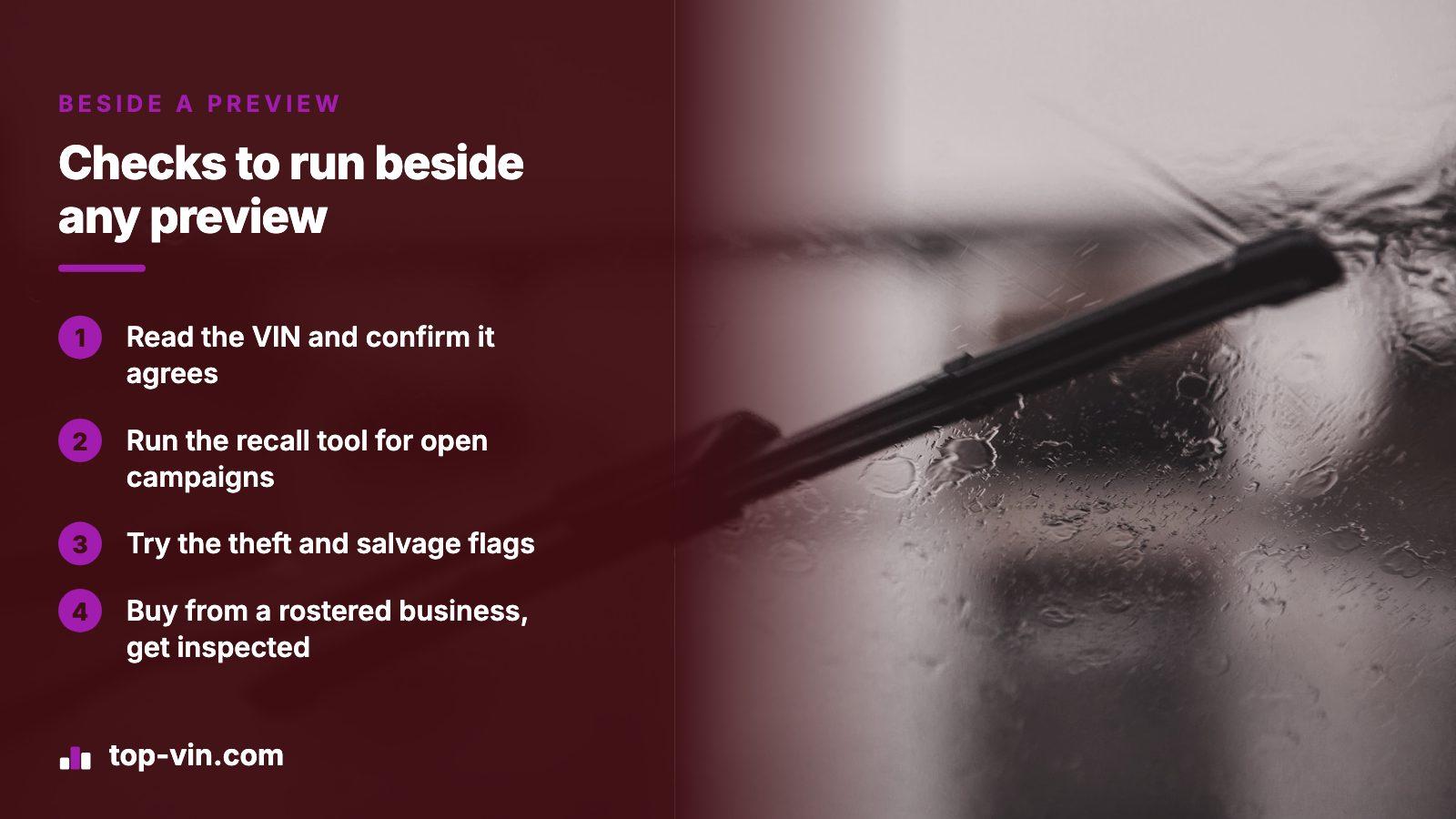
Whichever seller you pick, this order costs little and catches the common problems.
- Read the VIN straight from the vehicle and confirm it agrees with the title paperwork and the ad.
- Put the VIN into NHTSA's recall tool to see unrepaired safety campaigns.
- Try NICB's VINCheck for theft and insurer salvage flags.
- Buy a report from a business the roster names before you commit to the car.
- Pay a mechanic for an independent inspection, which DOJ urges before any used-car purchase.
If step two or three turns up a problem, you may never need step four. A report says nothing about worn brakes or a weeping gasket. A mechanic will.
Where a TopVIN report fits
A TopVIN report is built on US records. The entries that usually decide a purchase are title brands, accident and damage notes, odometer readings, and salvage or auction history with photos.
Begin with the preview. Running one is cheap in effort and carries no charge, and it shows whether the VIN fits the car in front of you before a payment is requested. When you are weighing several sellers, put the same VIN through each preview and compare which specific records each one names. Bundles suit a shortlist of cars.
Next step: if the car clears the recall and theft screens, run its VIN through the preview.
Where this information comes from
- Justice Department: approved NMVTIS data providers — The public list read for this page, including the affiliate entries behind each provider.
- Justice Department: understanding an NMVTIS report — The five items an NMVTIS report covers and where its data comes from.
- Justice Department: used car buying tips — Advice to pair a history report with a mechanic's inspection.
- Bureau of Justice Assistance: NMVTIS overview — Background on the system's 1992 origin and its purpose.
- NICB: VINCheck — A no-charge theft and salvage lookup to run before paying anyone.
- NHTSA: recalls — The federal open-recall lookup by VIN.
Sources and photos: Facts checked against the sources above in November 2026. Photos by Michal Biernat, Thibault Valjevac and Masjid MABA on Unsplash; diagrams by TopVIN.
Keep reading
- carVertical review: where it fits on a best VIN check shortlistA provider that does appear on the federal list, weighed the same way.
- Visor VIN review: a car search tool, not a VIN checkA third service tested on what it adds for a US car.
- VIN check with photos: what a report shows and what it can'tHow salvage and auction pictures change what a report tells you.
- Sample reportSee a full report laid out before you pay for one.
Frequently asked questions
Is VinCheckUp legit?
That depends on the claim. On November 5, 2026, the federal roster of approved sellers had no entry for it, so a claim of federal title data could not be confirmed there. A business can still sell a decode, a preview or listing data without being on that roster. Judge it by what it names for your VIN, and buy the title record from a listed seller.
Is VinCheckUp free?
The site describes a free first search, followed by registration to download the full report, so finishing the process involves opening an account. Look up what the complete report costs on its own pages before typing an email address, and set that against a preview that shows records without any signup.
Does VinCheck.Info mean VinCheckUp is approved?
No. The two names differ, and the Justice Department page shows VinCheck.Info as an affiliate under another provider. A look-alike name proves nothing, so compare the exact company name and web address on the payment screen with the entry on the page.
Should I trust VinCheckUp reviews on other sites?
Treat them as opinion. No review changes what the Justice Department page shows on the day you buy. Read any write-up for the date it checked the list and whether it opened the affiliate entries, then run the comparison yourself, which takes a couple of minutes.
What can I run if I do not want to register anywhere?
Start with NHTSA's recall tool and NICB's VINCheck, which carry no charge, then open a TopVIN preview to see whether records exist for the VIN. None of those commits you to a purchase. Save the paid report for a car that has survived the screens and an inspection.
Now check the car itself
The guide explains what to look for. The report shows what this VIN has on record.