THE SHORT ANSWER
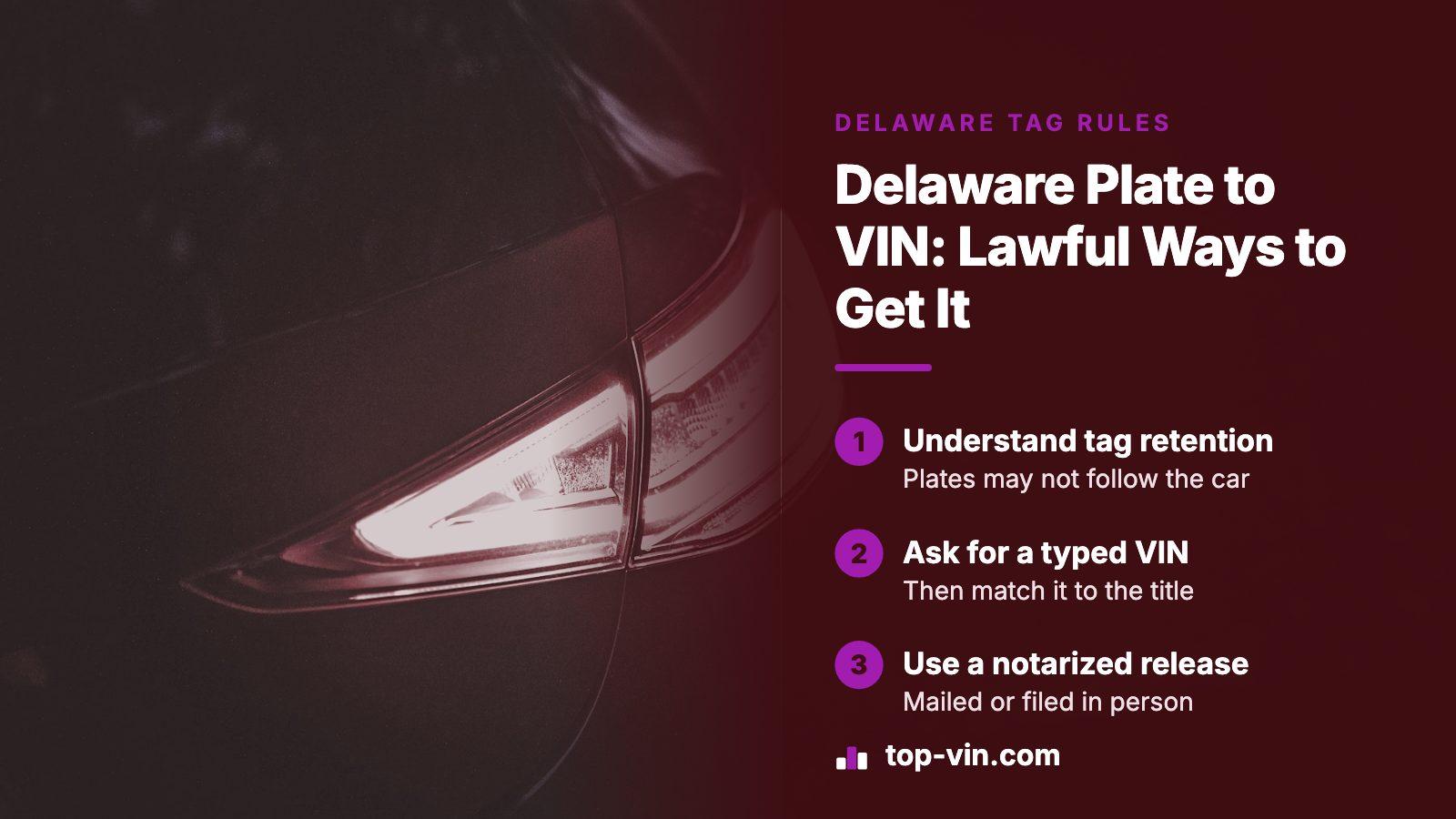
A Delaware plate cannot be exchanged for a VIN through any lawful public lookup. The DMV treats the registration record as protected personal information and releases it only with the person's consent or under a legal exception. Get the VIN from the seller as a typed message, check it against the title, then try TopVIN's preview, which costs nothing.
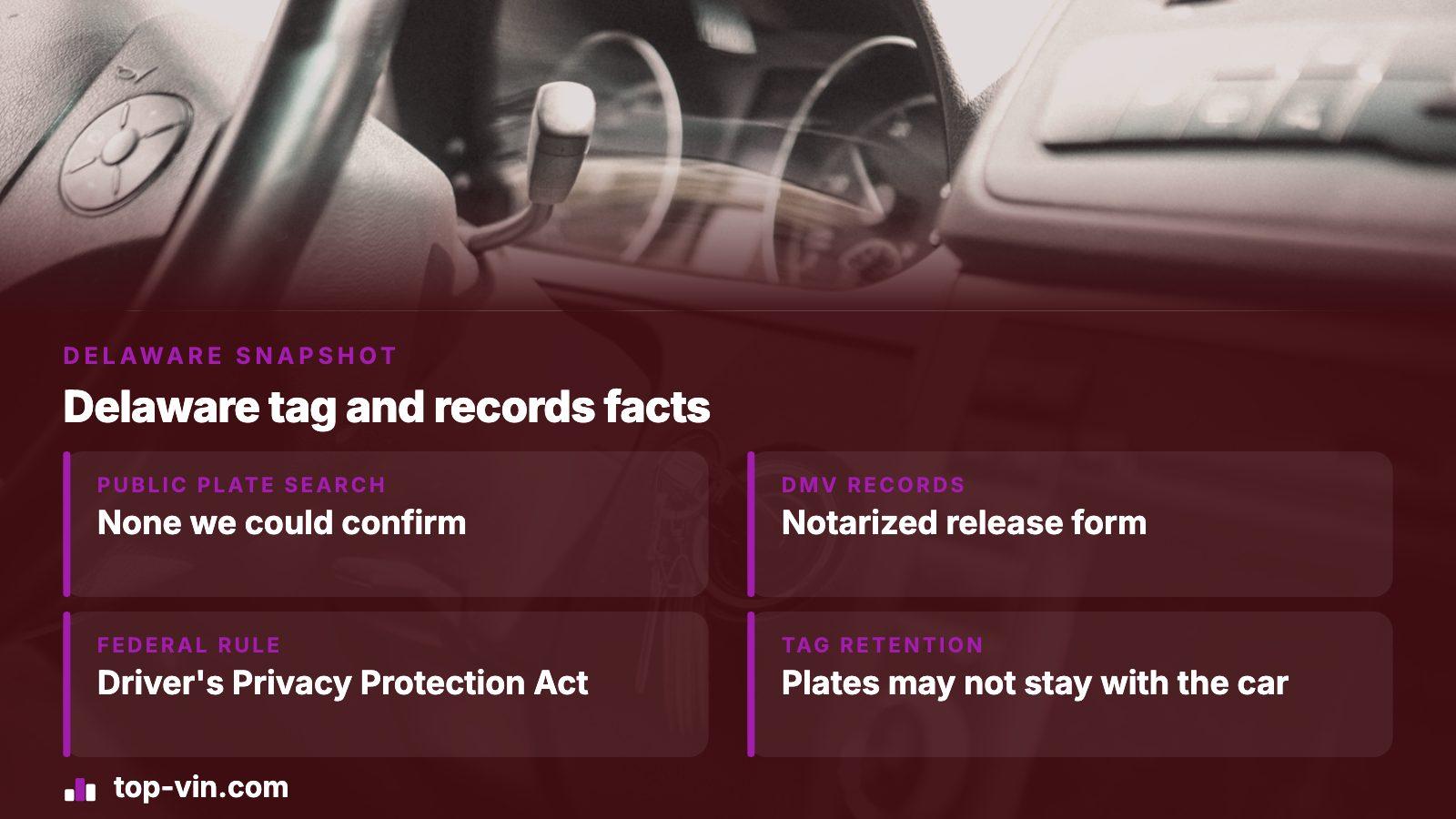
- Public plate-to-VIN search
- None we could confirm
- DMV vehicle records
- Notarized release form, mailed or filed in person
- Federal rule
- Driver's Privacy Protection Act
- TopVIN
- Free preview, then one payment
Why a Delaware tag is the wrong thing to search
A plate is a label stuck to a bumper. It tells you nothing about airbags, brands or mileage. Those details hang on the VIN, and the VIN sits in a separate file from the one that ties a tag to a person.
In Delaware the tag is even less dependable than elsewhere. The state lets an owner keep a plate after selling, trading or gifting a vehicle, so the number you photographed on a listing may be gone before the car changes hands. TopVIN takes a VIN and describes the vehicle. It does not search by plate and never gives out an owner's name or address.
What the tag-retention rule means for a shopper
Delaware's DMV explains that a plate left on a sold vehicle is lost unless the seller placed it into retention first. A retained tag can go onto another car in that person's name, wait for a future purchase, or be handed to someone else.
- A seller who removes the plate is following a normal state process, and it says nothing about the car.
- A plate number in an old ad may not match the car on the day you see it.
- Never use a tag number as proof that two cars are the same vehicle. Use the VIN.
That is one more reason to anchor everything on the 17 characters and ignore the plate.
The privacy rules that block a plate search
Section 2721 of the federal code (title 18) forbids a state licensing agency from knowingly releasing personal details held in its files, unless the statute names the purpose. Named purposes include safety and theft matters, recalls, government work, court cases, insurers, licensed investigators and requests backed by the person's express consent.
Delaware's own pages say the same thing in plain terms. The state counts names, street addresses, telephone and license numbers, photographs and medical details as protected, and the Division warns that large fines can follow an improper release. Delaware also points to section 305 of title 21 of its code for the exceptions. Judging a stranger's used car before you buy is not on the federal list.
Getting the VIN the ordinary way
A serious seller can hand over the number in a minute. Work through these in order.
- Before you drive out, text the seller and request the VIN as a typed message.
- Ask for a photo of the front of the title. Delaware's DMV tells buyers to insist on a properly signed title, not a bill of sale or registration card in its place.
- Read the number on the car itself. Delaware's DMV points buyers to the dashboard corner nearest the driver, seen through the glass.
- Read the car's number and the title's number aloud together, slowly.
When the numbers disagree
A single typo happens. A real mismatch between the car and its title can mean a swapped part, an altered document or a different vehicle entirely. Settle it before any money moves.

If you truly need the DMV to look it up
Someone with a recognized reason, such as an insurer handling a claim, can ask the state. For vehicle records by mail, Delaware wants the Personal Information Release Form (MV703) completed, then either stamped by a notary or handed in at a DMV counter, along with payment for a 3 year record. The envelope is addressed to the Correspondence desk at P.O. Box 698 in Dover. The DMV's number for vehicle-record questions is 302.744.2538.
The exceptions are listed on the back of that form. A private buyer who only wants to size up a car is unlikely to fit one, and we did not confirm what a records response contains for a tag number. Check the DMV's current instructions before mailing anything.
Running the check once you hold the VIN
Paste the VIN into TopVIN and a short preview appears before anything is charged. Confirm that the model year, brand and model fit both the car and the listing. If they do, you can open the whole report with a single payment; the amount is on the pricing page and nothing renews.
On a Delaware car, start with brands on the title, then crash or damage entries, the order of odometer readings, auction photos and liens. The state is small and wedged against three neighbors, so a brand earned across a nearby border travels with the car.
Turning findings into a decision
| Finding | Your move |
|---|---|
| Salvage, flood or rebuilt brand | Delaware's DMV advises a thorough shop inspection before purchase. Negotiate as a branded car or leave. |
| Mileage below an earlier reading | Suspect a rollback and request dated service invoices. |
| Open lien | Hold your money until you have the lender's release in hand. The DMV expects the seller to produce a notarized receipt from the lienholder. |
| Theft record | Pause the deal and ask police or the insurer. |
| Open recall | Book the free manufacturer repair after purchase, or ask the seller to do it. |
The DMV adds a warning about titles that are already signed by someone who is not the person selling. That is a middleman, and the practice is illegal in Delaware.
Official checks that start from the VIN
Delaware runs a VIN-based inspection lookup on a DMV portal. Type the VIN and it returns the latest inspection date, make, model, year, odometer reading, location and result. Mileage from an inspection is a handy second data point to set against the title and the report.
The federal NMVTIS, run by the Department of Justice, collects title, brand, odometer and some theft data from state agencies, insurers and salvage yards. TopVIN's report draws on records of that kind, together with other sources, and adds photos and a damage map where they exist.
Paying, and the steps after purchase
Looking at the preview costs nothing. Opening the full report takes one payment, for a lone report or a bundle, with prices listed on the pricing page. Nothing renews.
Once the car is yours, Delaware gives you 30 days from the purchase date to apply for a title in person, or a penalty charge applies. Do not accept a promise to sort out paperwork later.
Where this information comes from
- Delaware DMV: how to obtain driving and vehicle records — The release form, the notary step and where mailed vehicle-record requests go.
- Delaware DMV: tips on purchasing a used vehicle — Title, lien and VIN checks the state tells buyers to do.
- Delaware DMV: tag retention — Why a plate may leave with the seller.
- Delaware DMV: vehicle inspection check by VIN — What the VIN-based inspection lookup returns.
- Federal statute on motor vehicle record privacy — The prohibition on release and the permitted uses.
- NMVTIS consumer information — What the national title system covers.
Sources and photos: Facts checked against the sources above in November 2026. Photos by Maurice Sahl, Thibault Valjevac and tim on Unsplash; diagrams by TopVIN.
Keep reading
- Vehicle registration lookup: what it shows and which check to addWhat registration records hold and who may see them.
- Motor vehicle records: what a car buyer can see, and what stays closedHow a state record differs from a vehicle history report.
- VIN check digit: how the ninth character is worked out and what it provesTest whether the number you were given is even valid.
- VIN verification: the four checks people mean and what each provesConfirm the number on the car matches its paperwork.
Frequently asked questions
Can I look up a VIN by license plate in Delaware?
Not through any public tool we could confirm. Delaware treats registration data as protected personal information, and federal law limits release to listed purposes. The practical route is asking the seller for the VIN, reading it off the car and title, and checking that number.
Who owns a Delaware license plate, and can I find out?
No lawful public service returns an owner's name from a plate. Delaware's DMV releases personal information with the person's approval or under a specific legal exception. Curiosity about a stranger or a car you might buy is not one of those exceptions.
Will the plate on a used car stay with it?
Often not. A Delaware owner can retain the tag from a vehicle sold, traded or gifted, and a plate left on a sold vehicle is lost if it was not retained. Expect the seller to remove the tag, and rely on the VIN instead.
What is form MV703?
It is the Delaware DMV's Personal Information Release Form. For records by mail, the DMV asks you to complete it, have it notarized or submit it in person, and pay the record fee. The back lists the exceptions that allow release.
Next step once I hold the VIN?
Compare it with the title and the vehicle, then load a TopVIN preview and check that the year, make and model fit. If those agree, decide on the full report and read it for brands, damage, mileage and liens before you haggle.
Now check the car itself
The guide explains what to look for. The report shows what this VIN has on record.