THE SHORT ANSWER
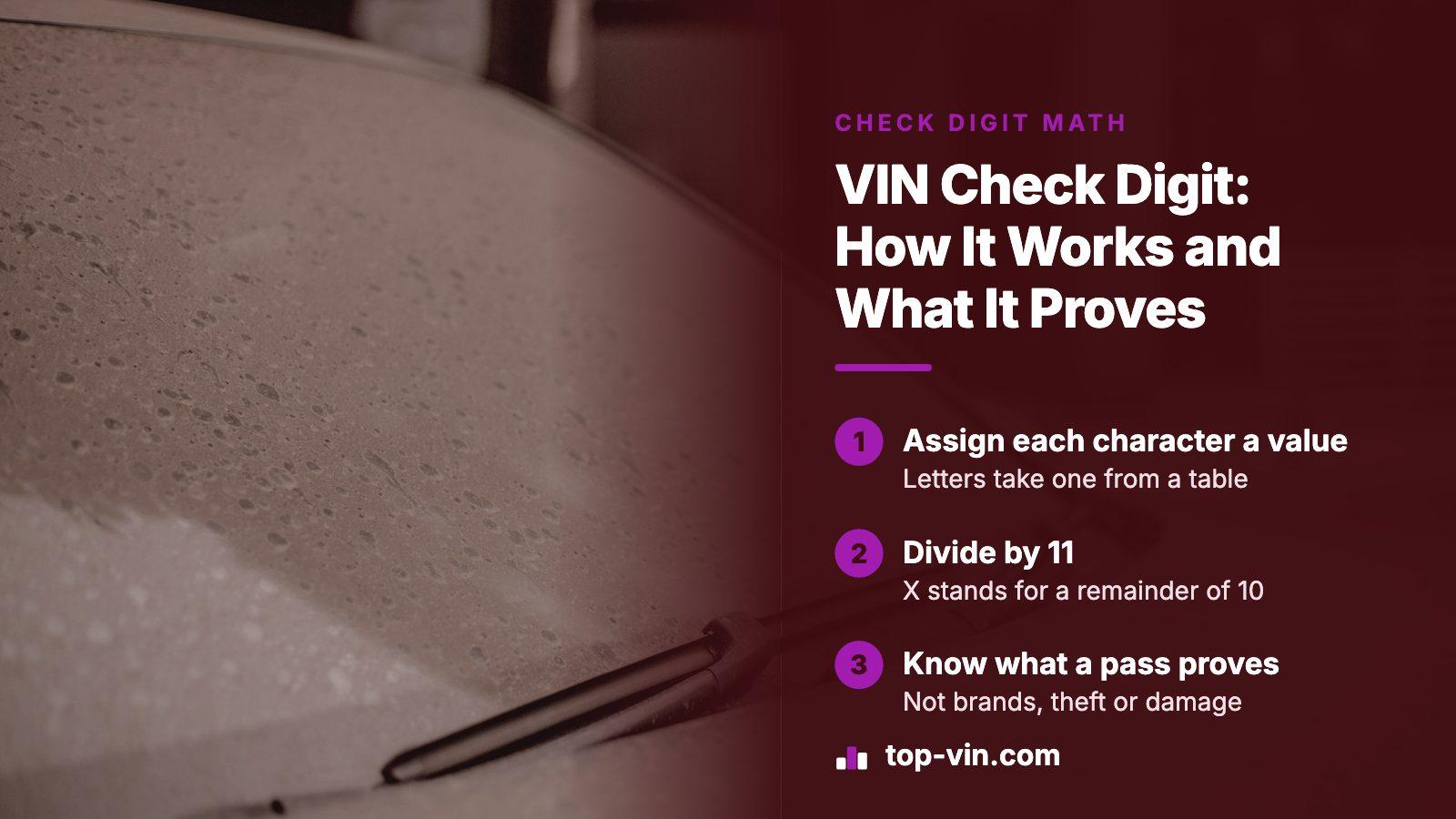
Position nine of a 17-character VIN holds a check digit. Give every other character a value (digits keep theirs, letters take one from a federal table), multiply each by the weight of its position, add the products and divide by 11. The remainder is the digit, with X standing in for a remainder of 10. A wrong ninth character means a typo or an import the rule excludes. A right one shows the string is internally consistent and nothing more.
- Position
- Ninth of 17 characters
- Divisor
- 11, with X written for a remainder of 10
- Catches
- A misread or mistyped character, nearly always
- Cannot show
- Title brands, theft, damage or odometer history
What position nine does, and who has to supply it
Federal rules give every covered vehicle's VIN a check digit in the ninth place. The maker works it out last, once the other sixteen characters are fixed, and has to print it both on the vehicle and on the transfer paperwork prepared for the first owner. That gives a buyer at least two places to compare.
The digit has one stated purpose: confirming the number was copied down correctly. It sits between the five characters describing the build and the model-year character in position ten, and it tells you nothing about the engine, the trim or the plant. The rule has an older subpart for cars the maker designates as model year 2009 or earlier and a current one for the rest; both share the same values, weights and divisor.
The arithmetic in five steps
- Write the 17 characters in a row and leave position nine empty.
- Swap each character for a value. Digits keep their own. Letters take a value from 1 to 9 out of a federal table, and I, O and Q have none because they are banned from every position.
- Multiply each value by the weight for its place. The weights run 8, 7, 6, 5, 4, 3, 2, 10 across positions one to eight, then 9, 8, 7, 6, 5, 4, 3, 2 across ten to seventeen.
- Add the sixteen products and divide the total by 11.
- Look at what is left over. A remainder from 0 to 9 is the check digit as it stands. A remainder of 10 will not fit in one place, so the letter X is written.
The stored digit is right when it matches that result. A pencil is enough, though a calculator saves slips.

A worked example from the federal rule itself
The rule prints its own practice string, 1G4AH59H_5G118341, with position nine left blank. It is a demonstration number, not a vehicle to look up. Each row below gives a character's value times its weight.
| Place | Character | Value×weight | Product |
|---|---|---|---|
| 1st | 1 | 1×8 | 8 |
| 2nd | G | 7×7 | 49 |
| 3rd | 4 | 4×6 | 24 |
| 4th | A | 1×5 | 5 |
| 5th | H | 8×4 | 32 |
| 6th | 5 | 5×3 | 15 |
| 7th | 9 | 9×2 | 18 |
| 8th | H | 8×10 | 80 |
| 10th | 5 | 5×9 | 45 |
| 11th | G | 7×8 | 56 |
| 12th | 1 | 1×7 | 7 |
| 13th | 1 | 1×6 | 6 |
| 14th | 8 | 8×5 | 40 |
| 15th | 3 | 3×4 | 12 |
| 16th | 4 | 4×3 | 12 |
| 17th | 1 | 1×2 | 2 |
Dividing the total, 411, by 11 gives a quotient of 37 and a remainder of 4. The ninth character is therefore 4, and the finished string reads 1G4AH59H45G118341. NHTSA's decoder agrees: with the 4 in place it raises no check digit message, and with a 5, a 2 or an X there instead it flags the digit.
Which slips the digit catches and which it lets through
Eleven is prime and every weight is smaller than eleven, so changing one character to another with a different value always shifts the remainder. A single misread is caught every time unless the two characters share a value. Two neighbors swapped places are caught as well, provided their values differ.
| Value | Characters that carry it |
|---|---|
| 0 | 0 |
| 1 | 1, A, J |
| 2 | 2, B, K, S |
| 3 | 3, C, L, T |
| 4 | 4, D, M, U |
| 5 | 5, E, N, V |
| 6 | 6, F, W |
| 7 | 7, G, P, X |
| 8 | 8, H, Y |
| 9 | 9, R, Z |
Trade one character for another in the same row and the total does not move, so the digit still passes. The lookalikes that trip people up on stamped metal, such as 5 and S, 8 and B, 2 and Z or 0 and D, sit in different rows and get caught. 8 and H share a row, and that swap would slip by. Two separate errors can also cancel out. A pass lowers the odds of a typo without ruling one out.
When the ninth character fails to calculate
Start with the dullest explanation: a typo in the ad, a misread on the dash, a character dropped in copying. NHTSA's decoder reports a bad ninth character as error code 1, adds code 400 for a banned letter and code 6 for fewer than 17 characters entered.
| Where it fails | Likely meaning | Next step |
|---|---|---|
| Only in the listing | Seller or ad site mistyped it | Use the number read off the car |
| Your reading of the car, but not the title | You misread a character, or the title was keyed wrong | Look again in daylight and compare each character with the title |
| Same failure on car and title | An excluded import, or a number nobody validated | Ask for import papers, then run a record search |
| Car or title fails, not both | The documents describe different vehicles | Hold the money until the seller explains |
The exclusion in row three is real. The rule leaves out cars imported through the registered-importer route, used for vehicles not built to US safety standards, unless the importer is the assembler or its subsidiary. Such a car's original number can fail the sum with nothing wrong, which is a reason to ask how it arrived, not to shrug.
What a passing digit cannot tell you
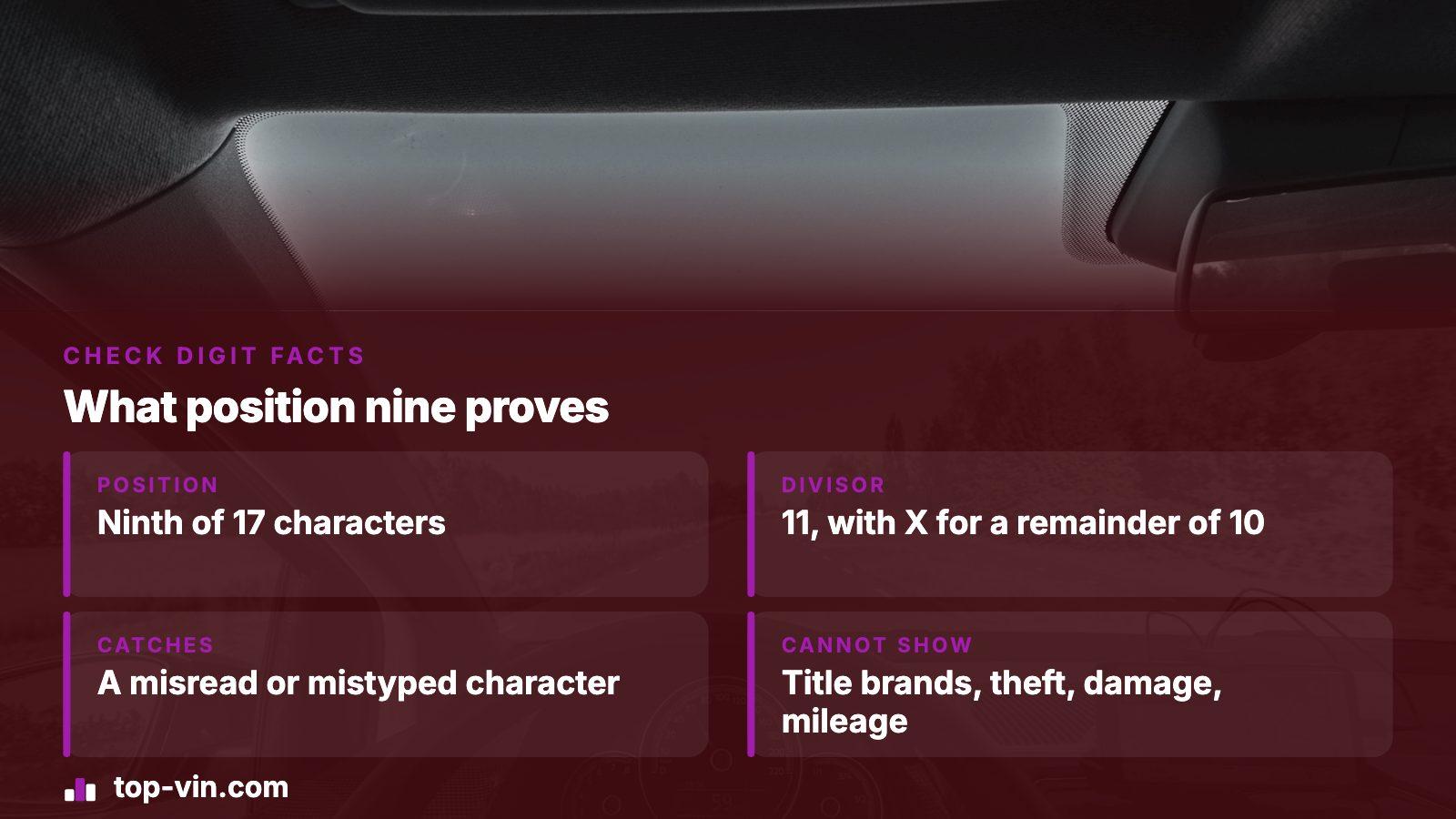
The arithmetic checks the string against itself and nothing else. It cannot see a car's brands, claims, theft entries or mileage, because none of that is stored in the number.
A copied number passes too
In a case described on the Justice Department's NMVTIS site, thieves swapped the VINs on stolen cars for numbers removed from other cars of the same make, model and year. Buyers, title offices and police could not tell. About 250 such vehicles were recovered. A number copied from a genuine car already satisfies the sum, since its maker did the sum.
What separates a clone from the original is the record history filed under the number. A TopVIN preview is free and shows what turned up before you decide anything. The report behind it is a single payment for that one VIN, with prices on the pricing page. Keep in mind that NMVTIS itself warns of false negatives while reporting is incomplete.
Where the arithmetic fits in a purchase
- Copy the VIN from the metal, not the ad, and hold it against the title. A dealer's Buyers Guide shows it on its front, which gives you a third copy.
- Run the sum, or feed the number to NHTSA's decoder, and note any check digit message.
- Look up open recalls by VIN and the insurers' theft and salvage database.
- Open the TopVIN preview. When the car survives it, buy the report for that VIN.
- Have a mechanic go over the car, with make, model and VIN written on the findings.
A failure at the first or second step ends the search for that car until someone explains it. A paid record search on a number that does not describe the vehicle in front of you answers a question nobody asked.
Where this information comes from
- eCFR: 49 CFR Part 565, VIN requirements — Where the check digit sits, the values, weights and divisor, the printed sample sum and the import exclusion.
- eCFR: 49 CFR 591.5, declarations for importation — What the registered-importer route named in the exclusion covers.
- NHTSA: VIN decoder (vPIC) — Maker-reported data and partial VINs. The check digit messages came from runs against its API.
- NHTSA: vPIC API — Decoding with unknown characters left as asterisks, and the ninth digit not being required for it.
- NMVTIS: consumer information — The VIN cloning case with stolen vehicles, and the warning about false negatives.
- FTC: used cars — The VIN on the Buyers Guide, plus the recall and theft and salvage lookups.
- FTC: buying a used car from a dealer — Putting make, model and VIN on a mechanic's written report.
Sources and photos: Facts checked against the sources above in November 2026. Photos by JavyGo, Carrie Allen www.carrieallen.com and Sander Jeurissen on Unsplash; diagrams by TopVIN.
Keep reading
- How to read a VIN: a left-to-right walkthrough with a worked decodeWhat the other sixteen characters say about the car.
- VIN cloning: why a VIN check can pass a stolen car and what catches itHow a copied number gets past checks like this one.
- VIN verification: the four checks people mean and what each provesHow an inspector matches the stamped number to the title.
- VIN search engine: what one searches and what comes backWhat a lookup searches once the number is typed correctly.
Frequently asked questions
Which character is the check digit in a VIN?
Position nine, counting from the left across 17 characters. It is the character just ahead of the model-year code in position ten, and it is a single numeral or the letter X.
Why do some VINs have an X in position nine?
X is how a remainder of 10 is written. Dividing by 11 can leave anything from 0 to 10, and 10 will not fit in one place. Elsewhere in the number an X carries a value of 7 in the sum, so the letter means something different in this slot.
Does every VIN have a valid check digit?
Not quite. Cars imported through the registered-importer route are excluded from the requirement unless the importer assembled them. A typo or an altered number fails as well. A failure calls for a question about the number's origin, not an accusation.
Can a VIN pass the check digit test and still be fake?
Yes. The test shows the characters are consistent with one another, nothing more. A number lifted from a real car passes, which is how cloned vehicles slipped through, and a forger who does the sum passes too. Title, theft, salvage and odometer records filed under the number show whether the car's story fits.
Do I need the check digit to decode a VIN?
No. NHTSA's decoder accepts partial VINs, with an asterisk for each unknown character, and its documentation says that digit can be left out of such lookups. The check digit matters when you want to validate a full number someone typed, not when you only want to read the build.
Now check the car itself
The guide explains what to look for. The report shows what this VIN has on record.