THE SHORT ANSWER
A VIN lookup returns the engine the manufacturer built into that car: liters, cylinder count, layout, engine model and whether it is turbocharged, wherever the maker filed those details. No single character is the engine, because each maker picks its own spot within positions 4 to 8. Trailers carry none. A swapped engine will not appear, so pair the lookup with the history records and a look at the block.
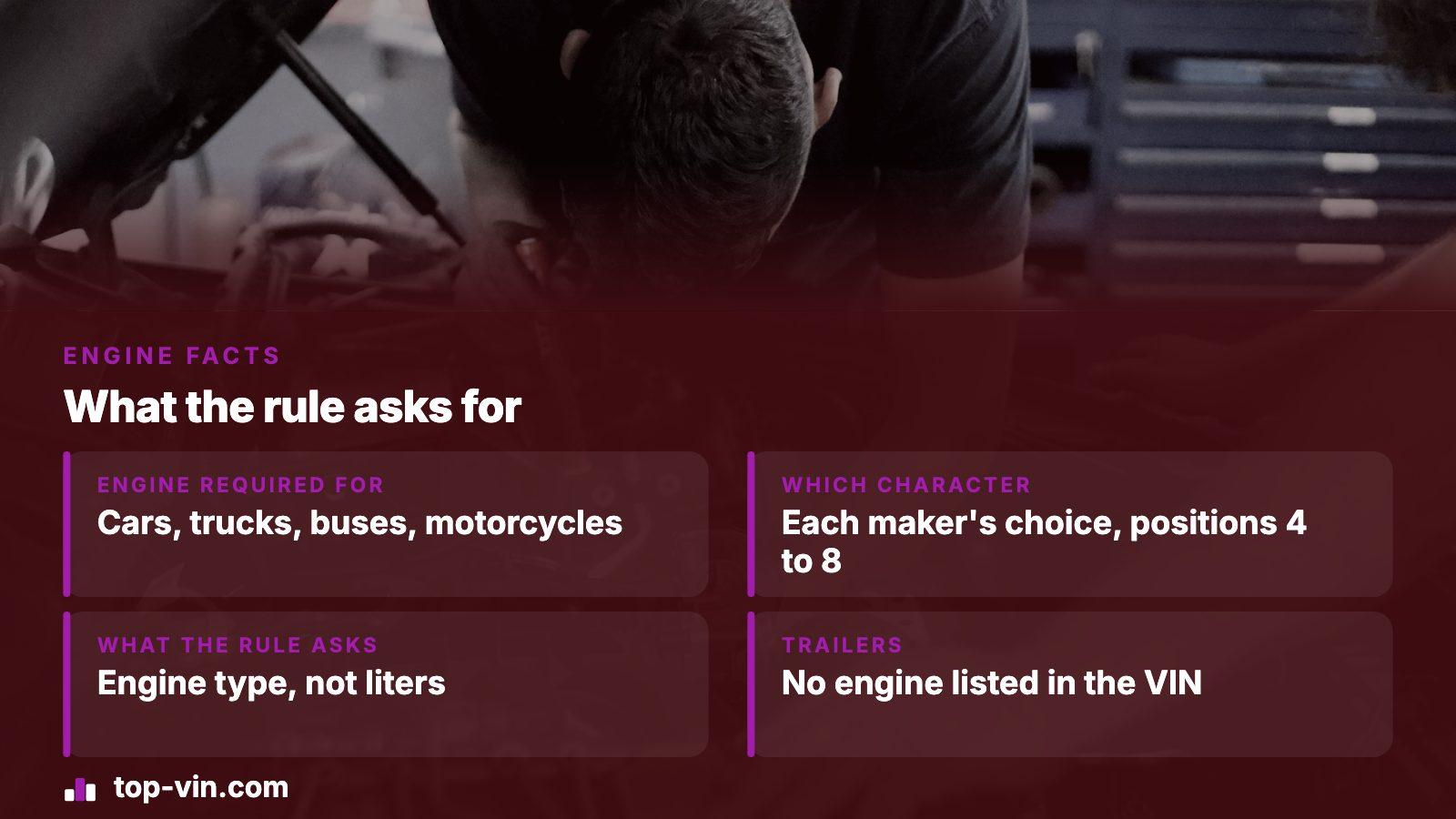
- Engine is required for
- Cars, trucks, buses, motorcycles
- Which character
- Each maker's choice, positions 4 to 8
- What the rule asks for
- Engine type, not liters
- TopVIN check
- Free preview, then one payment
What an engine lookup returns for your car
Enter a VIN in a decoder and the engine comes back as a bundle of fields, not one number: displacement in liters, cylinder count, layout (in-line or V), the maker's engine model code, a turbo flag and the fuel type. Some makers add a free-text line with extras such as direct injection, and some leave pieces blank.
That bundle lets a shopper test a listing. A seller who promises the big engine can be held to a model code. A TopVIN report prints the same factory specs beside the title, damage and odometer records, so one entry shows what the car was built with and what has happened since.
Decoder, preview or paid report: which one fits
Searches such as VIN check, VIN lookup and engine size by VIN all land on tools that answer different questions. Match the tool to your decision.
| Your question | Best tool | What to know |
|---|---|---|
| Which engine did this model leave the factory with? | The federal vPIC decoder | Costs nothing, reads the maker's filed key |
| Does this VIN belong to the car in the ad? | The TopVIN preview | Free; shows year, make and model before you pay |
| Was the engine replaced, or the car damaged? | A TopVIN report plus an inspection | Odometer, title, salvage and auction records give clues |
| Which exact part fits this motor? | The parts counter | Hand over the full VIN and the engine model code |
| Does the stamp on the block match the decode? | A flashlight and your own eyes | No database can read it for you |
Once money is on the line, the records around the engine count as much as the liter figure.
Why no chart can say which character is the engine
Positions 4 through 8 form a five-character block that must identify the attributes listed for that vehicle class. Federal rules leave the manufacturer free to pick the characters and their order within that block. So the engine character floats, and a chart pinning it to one position describes a single maker's habit.
A filing closes the loop. Each maker must give NHTSA the key to its VINs at least 60 days ahead of the first sale of any car with that coding, and amend it when the coding changes. Decoders read that key, which is why answers stay consistent while the characters differ.
Engine type comes first, liters follow
The regulation asks for engine type, not a displacement figure. A maker usually defines a type as one engine family, and every family has a displacement, so the liters come along in the decode, usually listed beside the model code. If a result ever seems to contradict itself, trust the engine model designation. Where an engine is required:
- Passenger cars, multipurpose passenger vehicles and trucks
- Buses, motorcycles and low speed vehicles
- Incomplete vehicles other than trailers
- Not trailers, whose VIN lists no engine
Run the lookup in four steps
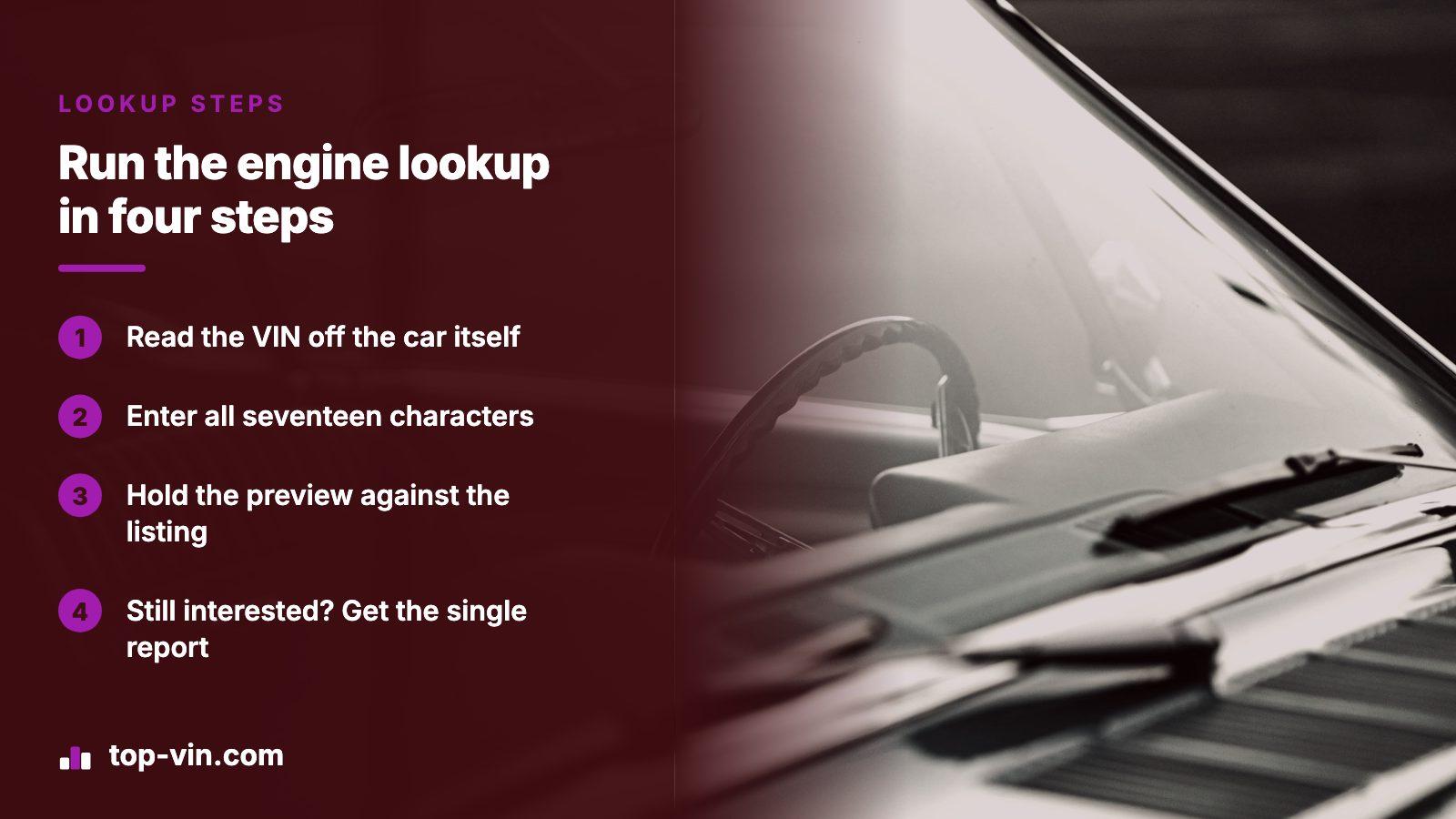
- Read the VIN off the car itself, never the ad: the metal tag at the foot of the windshield on the driver's side, then the label on the door frame. If they disagree, stop.
- Enter all seventeen characters in the TopVIN box. One wrong character changes the decode or breaks the check digit.
- Hold the free preview against the listing: year, make, model and body style first, engine fields next.
- Still interested? Get the single report. Comparing more than one car makes a three-, five- or ten-report purchase the cheaper route per VIN.
Engine mismatches worth a pause
| What you see | Likely explanation | What to do |
|---|---|---|
| Decode shows a smaller engine than the ad claims | A loose listing, or a non-original motor | Ask for proof, then book an inspection |
| The block stamp contradicts the engine family | A replacement, or a mislabeled car | Ask for the replacement invoice before any offer |
| Liters and cylinders appear but horsepower is blank | The maker left that field out of its filing | Read it as unfiled, not as missing power |
| A salvage or odometer entry sits near a repair story | Damage, or a rebuilt car | Read the report records and price in the risk |
Treat each row as a reason to ask, not to walk away.
The decode cannot see an engine swap
A VIN is stamped at the factory and never rewritten, so it describes the motor the car was built with. Fit a different one later and the decode reads the same. That is a limit of factory codes, not a fault in decoders.
From an NHTSA owner complaint
A 2012 Chevrolet Malibu owner told NHTSA the car stalled at highway speed with an engine-hot warning and refused to restart. A mechanic who inspected it concluded the motor was a replacement, not the factory unit. Mileage was near 100,000, with no repair made yet.
Here the engine's history surfaced only after the breakdown. Ask about replacements before you pay, and compare the block stamp with the decode. A report cannot look inside the engine bay, but a salvage sale, damage record or odd odometer entry may show where a swap came from.
Ordering parts: the engine decides, not the model name
Parts catalogs ask for the full VIN because one model year can ship with several engines, and many components differ between them.
From an NHTSA owner complaint
A 2014 Chevrolet Silverado 1500 owner followed a no-crank problem past a battery and cable swap to a failed starter. The removed starter's part number was listed for the 4.3L V6, yet the truck has the 5.3L V8. The owner could not tell if the factory fitted the wrong part or GM retired it, and said GM announced nothing.
Whatever the cause, check a part number against the engine, not the badge on the tailgate. Give the counter the VIN and the engine model code from the decode.
A matching engine does not mean matching coverage
A decode names the engine family. Whether that engine falls under a recall or service notice is decided VIN by VIN, from the ranges the maker lists, so two cars with the same engine can fall either side of the line.
From an NHTSA owner complaint
A 2013 Chevrolet Equinox owner with the 2.4L engine said the dealer blamed a clogged PCV valve, a fault covered by a GM notice for that engine. The dealer and Chevrolet customer care both said this VIN fell outside the range, so the owner paid about $900.
A decode proves nothing about coverage either way. Enter the VIN in NHTSA's free recall lookup, and note that a TopVIN report also lists open recalls.
Cost, and what to do with the result
The federal decoder costs nothing, and so does the TopVIN preview. Past the preview, a report is one payment and there is no subscription. The pricing page shows what a single report and each pack cost, and a pack lets you screen a whole shortlist before the first test drive.
Before you pay for the car
Decode the VIN, open the preview, match the engine fields to the listing, then read the history records. Finish with a look at the engine stamp and a mechanic's inspection.
Where this information comes from
- 49 CFR 565.15: VIN content requirements — Table I lists engine type among the attributes a VIN must make decipherable, and lets makers place the characters.
- 49 CFR 565.16: VIN reporting requirements — Makers must file the key for reading their VINs ahead of sale and amend it when the coding changes.
- NHTSA: vPIC VIN decoder — The public decoder that returns the engine fields discussed here, built on those filings.
- NHTSA: recalls lookup by VIN — Where to check whether a specific VIN has an open recall, whatever engine it carries.
- NHTSA owner complaint 11140664 — owner experience, paraphrased
- NHTSA owner complaint 11161959 — owner experience, paraphrased
- NHTSA owner complaint 11181789 — owner experience, paraphrased
Sources and photos: Facts checked against the sources above in November 2026. Photos by Victor Hughes, Dylan Michaud and Mustafa Sheikhmouss on Unsplash; diagrams by TopVIN.
Keep reading
- How to read a VIN: a left-to-right walkthrough with a worked decodeWhat each stretch of the seventeen characters stands for, including the block that holds the engine.
- Specs by VIN compared: what each lookup returns and what it leaves blankThe other factory specs a decode returns, and the fields that come back blank.
- Timing belt or chain by VIN: which VIN check can answer itThe next question once you know the engine: what drives its timing, and who can answer.
- Sample reportA finished report, so you can see where the factory specs sit beside the history.
Frequently asked questions
Does the VIN tell you the engine size?
Through a decoder, yes. Under federal rules the engine type has to be decodable, and the maker's filing ties that type to a displacement and cylinder count. A trailer carries no engine data, and a replacement motor will not show.
Which digit of the VIN is the engine?
No digit works for every car. The engine code sits inside the five-character block at positions 4 to 8, and each manufacturer decides the character and the spot. A chart built for one brand can mislead on another, so use a decoder that reads the filing.
Is a free decoder accurate enough for ordering parts?
It is a sound starting point because it reads the maker's own filing. On an older vehicle, confirm it against the engine in the car, since a replacement changes the hardware and not the VIN. Bring the VIN and the engine model code to the counter.
Why does my decode show liters but no horsepower?
Makers fill in some fields when they file and skip others. A blank horsepower entry means the figure was never supplied, not that the engine lacks power. For the rating, look at the engine's own markings or the maker's documentation for that model.
Can a vehicle history report show an engine was replaced?
Not directly. A report draws on title, odometer, salvage, auction, insurance and damage records, and none of those is a parts log. It can surface events that sometimes sit behind a motor swap, such as a salvage sale. Treat the block stamp and the seller's paperwork as the proof.
Now check the car itself
The guide explains what to look for. The report shows what this VIN has on record.