
THE SHORT ANSWER
Go left to right: maker and vehicle type in positions 1 to 3, the maker's own description of the build in 4 to 8, a self-check in 9, the model year in 10, the plant in 11 and the production serial in 12 to 17. I, O and Q are banned, which settles any doubt between the letter O and zero. Decoding gives the factory spec only. Title brands, damage and mileage live in other records.
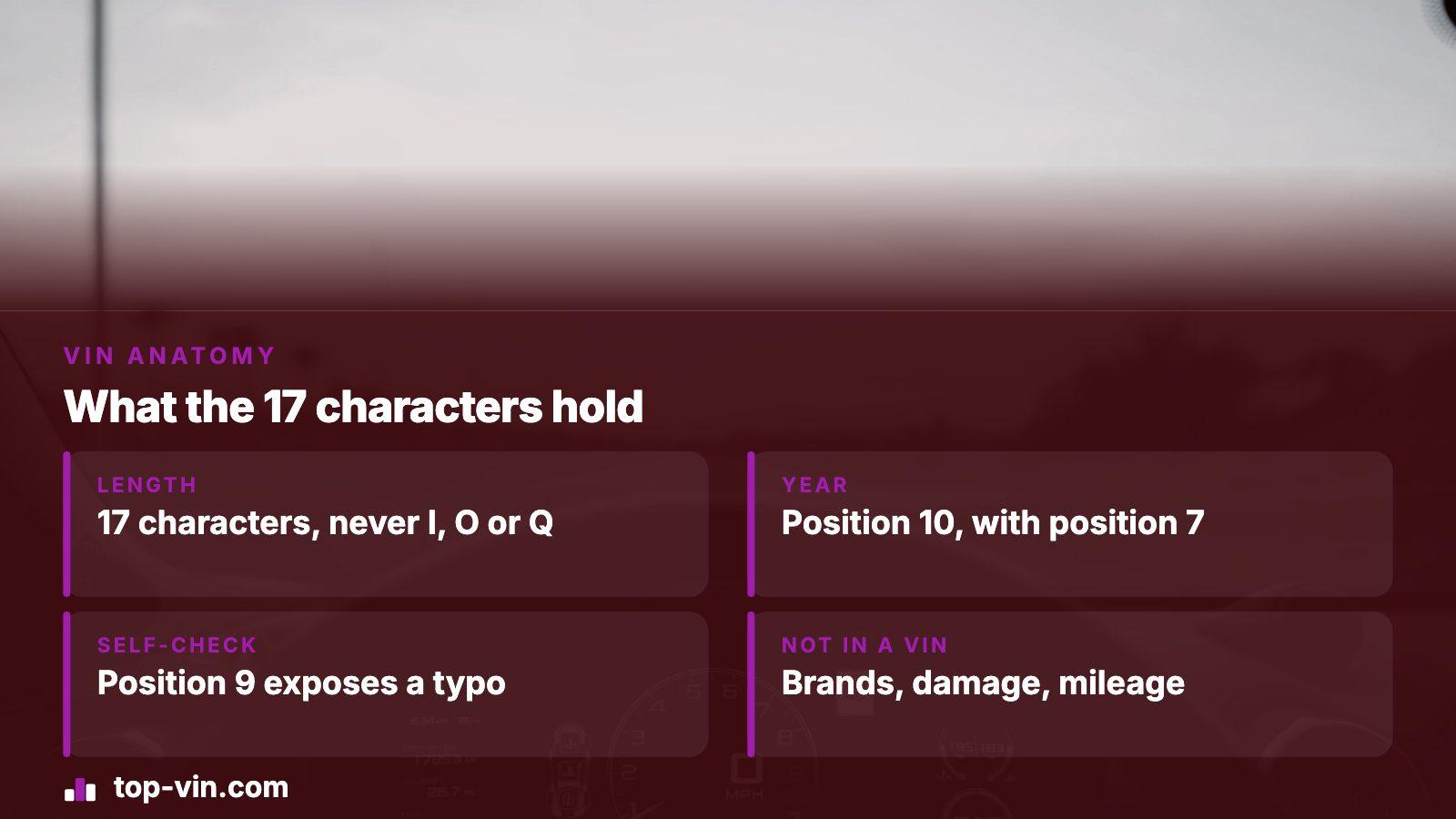
- Length
- 17 characters, never I, O or Q
- Year
- Position 10, read together with position 7
- Self-check
- Position 9 exposes a mistyped number
- Not in it
- Title brands, damage, mileage
Read it off the car first, then the paperwork
Federal rules have the maker mark each vehicle on a body part that stays put unless repaired, or on a plate permanently fixed to one. On cars, SUVs and light trucks it sits inside the cabin, where someone standing outside at the driver's windshield pillar can see it through the glass in daylight. Characters are capitals and numerals in a plain typeface, 4 mm tall at minimum, and no space is left blank.
- Photograph the metal rather than copying the ad.
- Compare it with the title and registration. The maker's first-owner transfer papers carry it as well, check digit included.
Four sections, and what a buyer takes from each
Many guides teach three blocks. The rule counts four, since the check digit stands by itself. That moves the dividing lines without changing what any character means.
| Positions | Federal section | What it settles for a buyer |
|---|---|---|
| 1 to 3 | First | Maker and vehicle type |
| 4 to 8 | Second | The build in the maker's own code: line, body, engine, and on a car the restraints |
| 9 | Third | Whether the other 16 characters were copied correctly |
| 10 to 17 | Fourth | Model year, plant and serial number |
Only the second section is the maker's private code. Makers must give NHTSA the key, and the agency's public decoder is built from those filings, which is why it beats a chart copied from the web. One letter in position 8 can mean different engines on different makes.
A worked decode of the federal sample number
The rule prints a practice string for its check digit arithmetic, 1G4AH59H_5G118341, with the ninth place blank. The sum yields a 4, giving 1G4AH59H45G118341. It is a demonstration number, not a car you could buy. NHTSA's public decoder returned this for it.
| Characters | Positions | What the decoder returned |
|---|---|---|
| 1G4 | 1 to 3 | Buick, built by General Motors, a passenger car |
| AH59H | 4 to 8 | A four-door sedan with a 2.2 L four-cylinder engine |
| 4 | 9 | Accepted, no check digit error |
| 5 | 10 | Model year 2005, since position 7 is a digit |
| G | 11 | Plant fields left empty |
| 118341 | 12 to 17 | Serial number, not decoded |
The model field also came back empty, with error codes 5 and 14. NHTSA words them as errors in a few positions and information it cannot provide from the maker's submission. Change the ninth character to a 5 and code 1 joins them, saying the check digit does not calculate. A decode reports what the maker filed, and a blank field means the filing stopped short.
Position 10 gives the year only when position 7 agrees
The year code is one character on a 30-year cycle. A meant 1980, then meant 2010, and the digits 1 to 9 do double duty for 2001 to 2009 and 2031 to 2039. For a car or light truck rated at 10,000 lb or less, position 7 settles which cycle applies. A digit there means 1980 to 2009. With a letter, the year falls from 2010 to 2039.
| Code in position 10 | Position 7 is a letter | Position 7 is a digit |
|---|---|---|
| A | 2010 | 1980 |
| J | 2018 | 1988 |
| P | 2023 | 1993 |
| T | 2026 | 1996 |
| 5 | 2035 | 2005 |
Year codes leave out I, O, Q, U and Z. A decoder applies position 7 for you, but doing it by hand shows quickly whether the ad's year is even possible.
Positions 11 to 17: plant, serial and the small-maker twist
Position 11 names the plant, which the rule defines as wherever the manufacturer affixes the VIN. Positions 12 to 17 carry the production sequence, and on cars and light trucks the last five must be numerals. The rule forbids repeats among vehicles built across 60 years from the 1980 model year, so one number on two cars needs explaining.
A maker building fewer than 1,000 vehicles of a type yearly changes the layout. Positions 12 to 14 join positions 1 to 3 to name it, leaving 15 to 17 as the serial, and a 9 in position 3 flags that six-character identifier.
Model year and build date differ
The rule treats a model year as a label that holds whatever the calendar year of production, across a run of 24 months at most. Neither position 10 nor 11 shows the month a car was built. The label by the driver's door does.
When one character will not read
- Rule out I, O and Q first. They appear nowhere in a VIN, so a doubtful O is a zero and a doubtful I is a one.
- Photograph the plate in daylight and zoom in.
- Run the ninth-character arithmetic, or let NHTSA's decoder do it. It raises error code 1 when position 9 fails.
- Compare the car's string with the title's. A single differing character is reason to hold the deal until the seller explains.
The decoder will also work from a partial string in which each unreadable character is replaced by an asterisk, and its documentation says the ninth is not needed. Use that to narrow things down, not to buy on.

Imports and older cars bend the pattern
A car imported by the registered-importer route, because it was not built to US safety standards, is excluded from the length, check digit and character rules unless the importer is the assembler or its subsidiary. If its number does not comply, it carries a plate headed SUBSTITUTE FOR U.S. VIN, with the number the original maker assigned filled in beside it.
Cars from before the 1981 model year pre-date the 17-character format. Each maker numbered them its own way, so there is no check digit to test and no reliable position for the year. Decoders such as NHTSA's rest on filings for 17-character numbers, which leaves factory tags and marque registries to do the identifying.
After the read: what a decode cannot show
Reading a VIN tells you what the factory built, and a history check tells you what came after. The federal title database behind consumer history reports covers five indicators: the current title and its brand history (junk, salvage, flood), the latest odometer reading, an insurer's salvage or total-loss call, transfers to recyclers or salvage yards, and sometimes theft data. States brand titles by their own rules, so one car can be branded in one state and clean in another.
A copied number reads perfectly
That database's consumer site describes thieves who put numbers taken from other cars of the same make, model and year onto stolen vehicles. About 250 cloned cars were recovered. Every character of such a number decodes cleanly, since it belongs to a real car. Only records filed under it can show the mismatch.
NHTSA's recall search and the insurers' NICB database are no-cost places to start, one for recalls and one for theft and salvage entries, and the FTC points buyers to both. When comparing VIN checks, give each the same number and see whether its decode matches the plate. TopVIN opens a free preview from the 17 characters, so you see what turned up before paying. The report itself is bought once, nothing renews, and prices sit on the pricing page. A clean result can still hide a problem while reporting has gaps, so put the VIN on the mechanic's written report too.
Where this information comes from
- eCFR: 49 CFR Part 565, VIN requirements — The four sections, the character set, plate placement, year codes, position 7 rule, importer plate and the definitions of model year and plant.
- eCFR: 49 CFR 591.5, declarations for importation — The registered-importer route that the VIN rule's exclusion points to.
- NHTSA: vPIC API documentation — Partial numbers with an asterisk, the ninth digit being optional there, and the decoder's reliance on manufacturer submissions. The worked decode came from runs against this API.
- NMVTIS: consumer information — What a federal title database report holds, state branding differences, false negatives and the cloned-number case.
- FTC: used cars — Where the VIN appears on a Buyers Guide, and the recall and theft and salvage lookups a buyer can run.
- FTC: buying a used car from a dealer — Putting make, model and VIN on a mechanic's written report.
Sources and photos: Facts checked against the sources above in November 2026. Photos by Cole Keister, Scott Graham and Dennis Eusebio on Unsplash; diagrams by TopVIN.
Keep reading
- VIN check digit: how the ninth character is worked out and what it provesThe ninth character worked out by hand, step by step.
- VIN check year: read a car's model year, make and model from its VINPositions 7 and 10 in more detail, with year codes for recent cycles.
- Old car VIN number lookup: what comes back for an older carWhat changes when the number comes from a car older than the 17-character format.
- VIN search engine: what one searches and what comes backWhat a lookup does with the number once you have read it correctly.
Frequently asked questions
Can I read a VIN if I only have part of the number?
Partly. NHTSA's decoder accepts a short string with an asterisk for each unknown character. Expect less detail than from the full number, and fill the gaps from the car before you pay for anything.
Is the serial number the same as the VIN?
No, the serial is only the tail. For a high-volume maker it is positions 12 to 17. A small maker uses positions 12 to 14 as part of its identifier, which leaves three characters for the serial.
Why does a decoder show errors or a blank model?
The answer is built from what the maker filed. Error 14 means the submission did not cover some characters, error 5 flags mistakes in a few positions and error 6 means the number is incomplete. Recheck the characters against the plate first.
Can two cars have the same VIN?
Not legitimately. When two cars carry one number, one is a clone, a transcription slip or an altered number, and a record search under it helps show which story fits the car in front of you.
Does a VIN show accidents, mileage or the owner?
No. It identifies the vehicle as built. Title brands, odometer readings and salvage determinations come from separate title and insurer records, and who owned the car is not part of the number.
Now check the car itself
The guide explains what to look for. The report shows what this VIN has on record.