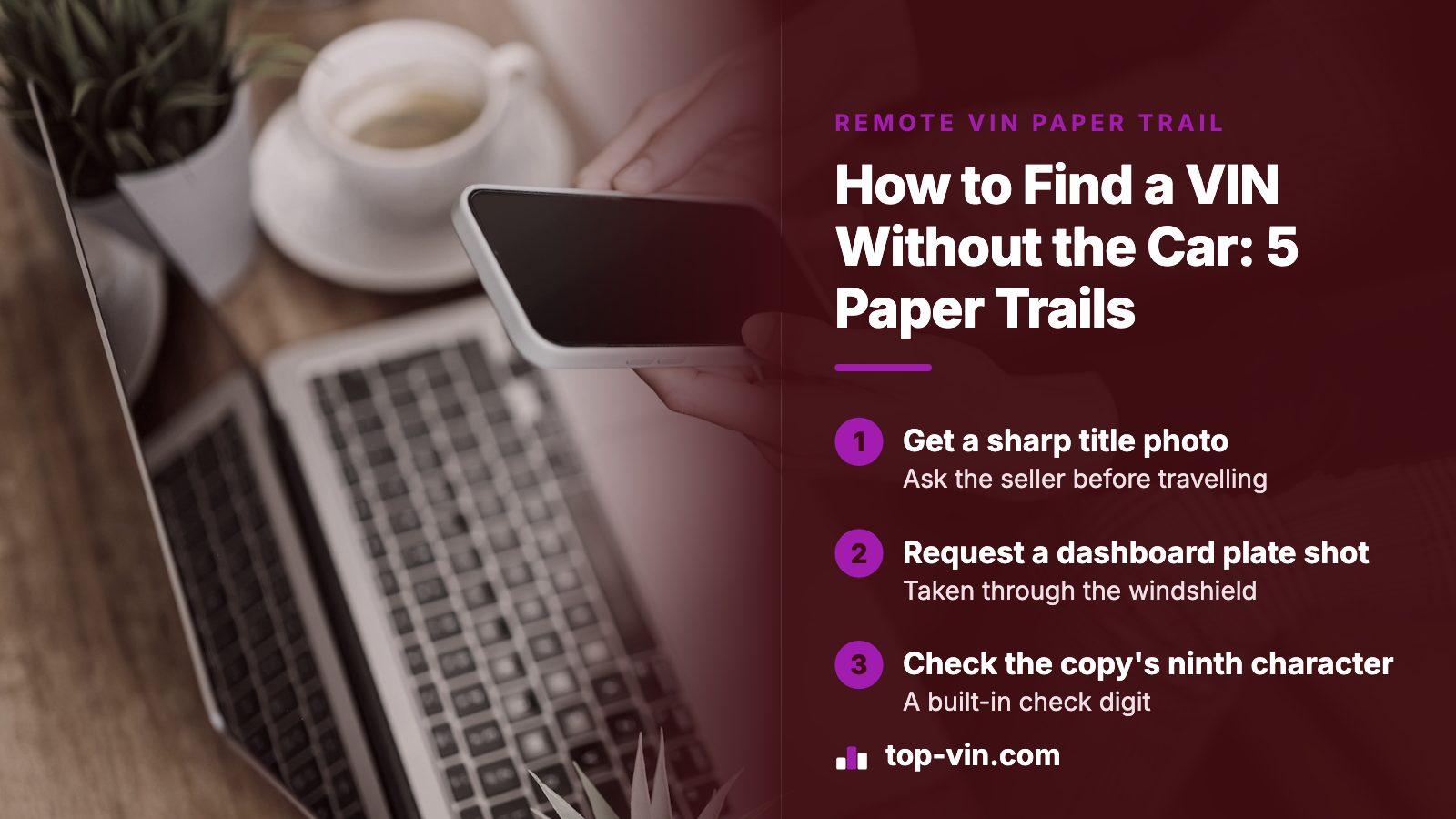
THE SHORT ANSWER
Get a sharp photo of the title from the seller, plus one of the dashboard plate shot through the windshield. The owner's registration card and insurance card also carry the 17 characters. Do not rely on anyone promising to turn a plate into a VIN for you, because state records of that kind are restricted by federal law. Once you hold the number, decode it, then run a history check.
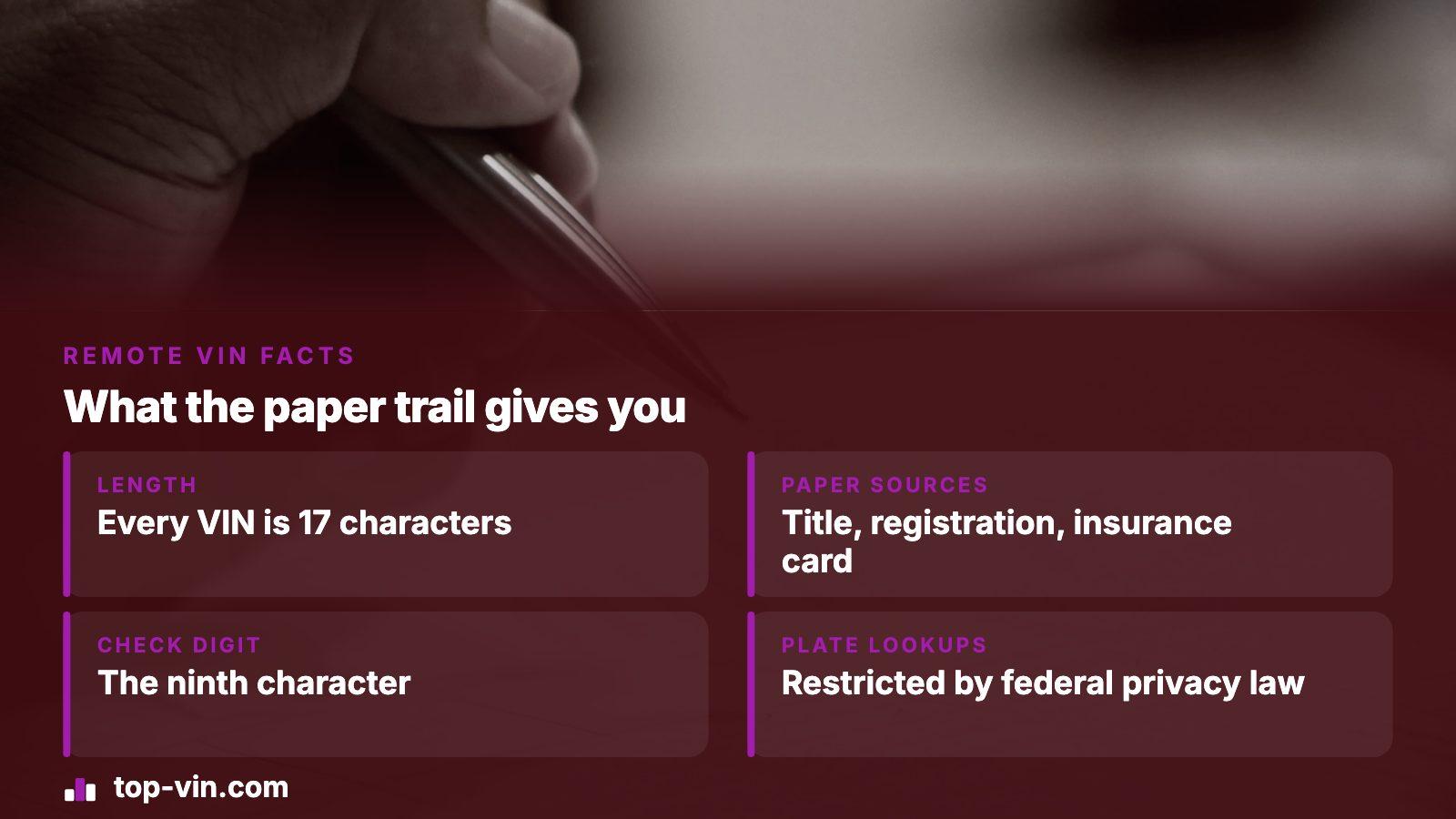
- Length
- Every VIN is 17 characters
- Paper sources
- Title, registration, insurance card, sale paperwork
- Checking the copy
- The ninth character is a built-in check digit
- Plate lookups
- State records are restricted by a federal privacy law
Why get the number before you travel
A listing three states away puts you in an awkward spot. Driving there costs a day, and the history of the car is the one thing the seller cannot show you on a test drive. Getting the VIN first flips the order: records first, road trip second.
A buyer who has the number can run a title and damage search from a phone, and a bad result saves the whole trip. A clean result means the visit is spent on the things only a visit can show, like rust, tire wear and how the engine starts cold.
This page covers ways to obtain the number lawfully and accurately. It does not cover finding a stranger's car or looking someone up, and TopVIN does not offer plate searches.
Five places the number already sits on paper
The identification number is a required item on documents that travel with a vehicle. Whoever owns the car, or is selling it, should be able to produce at least one of these within minutes.
| Document | Who has it | What to ask for |
|---|---|---|
| Certificate of title | The owner, or the lender when there is a loan | A photo of the front showing owner name, number and any brand wording |
| Registration card | The owner, usually kept in the car | A photo of the card with the plate number covered if they prefer |
| Insurance card or policy page | The owner and the insurer | A photo of the vehicle line on the card |
| Bill of sale or prior purchase paperwork | A seller who bought it recently | A copy of the page listing the vehicle details |
| Dealer or auction listing | A dealer selling the car | The stock sheet or the listing screen that shows the number |
Ask for photos rather than typed text. A person copying seventeen characters by hand will slip once in a while, and a slipped letter returns the wrong vehicle or no vehicle at all.
A photo of the dashboard plate works too
Federal rules for ordinary cars and light trucks put the number inside the passenger compartment, where it can be read through the glass from outside, standing near the left windshield pillar. The characters have a minimum height of 4 mm, so a decent phone photo in daylight is enough.
That gives you a second source to match against the title. A seller who sends only the paperwork and refuses a photo of the car's own number has told you something worth weighing.
- Ask for the photo in daylight, not under a garage light.
- Request a second angle if there is glare on the glass.
- Compare every character with the title photo, letter by letter.
- A mismatch means pause the deal; do not shrug it off as a typo.
What not to expect from a plate number
Searches for a VIN usually start from a plate because the plate is the one thing visible in a photo. Be careful here. Under the Driver's Privacy Protection Act, a state DMV holds back owner details unless the request fits a permitted use. Those uses include government business, safety and recalls, theft, insurer claims and fraud work, litigation, and a signed release from the person concerned.
Personal information under that law covers a name, an address beyond the five-digit zip code, a phone number and similar identifiers. So an owner's record is not something to expect from a website for a few minutes of typing, and a DMV records request needs a stated reason that fits the law. The simple route is still the owner or seller handing the number over.
A claim to be wary of
A service that promises the owner's name and address from any plate number should make you ask which permitted use it is relying on. When the answer is vague, go back to the paperwork route above.
Check the number before you trust it
A real VIN runs to 17 characters and leaves out the letters I, O and Q altogether, so seeing one of those means somebody misread a digit. Position nine holds a check digit, produced by weighting the other sixteen positions and dividing the sum by 11. When one character is wrong, the digit usually stops matching.
NHTSA's free decoder does this for you. Type the number into the vPIC tool and it reports make, model, model year, body style and engine, and its message says whether the check digit came out correct. If the decoder says an old sedan and the listing says a recent SUV, you have found the problem before spending anything.
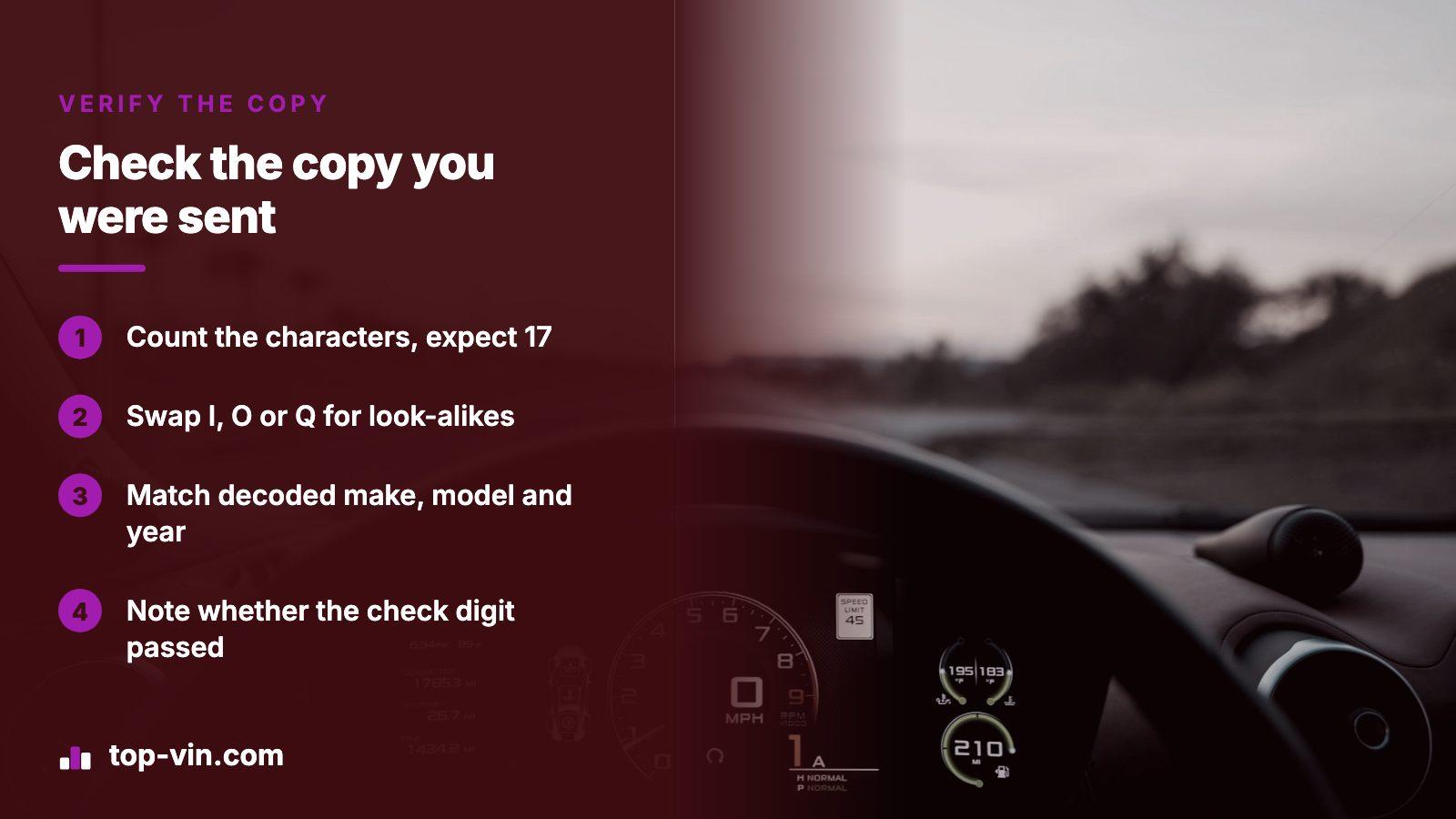
- Count the characters: anything other than 17 is wrong on a modern vehicle.
- Look for I, O or Q and swap them for 1 or 0 if they came from handwriting.
- Match the decoded make, model and year with the listing.
- Note whether the check digit passed.
Run the history on the number you now have
With a decoded, matching number, the next job is the history. The government's title database, NMVTIS, aims to protect consumers from title fraud and unsafe vehicles and to stop thieves reselling stolen cars. A report built on that data, alongside insurance and salvage records, is the quickest way to see if the car carries a title brand, a damage entry or an odometer story that does not add up.
On TopVIN you enter the number and see a free preview first, and one payment if you decide to buy the full report. There is no subscription. Pricing is on the pricing page.
Read the result against the seller's story. A car described as one owner and no accidents should not come back with a salvage record or three title transfers in a year.
Match the number to the title before money moves
Before any payment, the number on the title, the number in the dashboard photo and the number you checked should be the same string. Texas gives buyers 30 days to put a purchase in their own name, and its DMV warns that a seller whose transfer never happens can get stuck with tolls and tickets. Other states set their own timelines, so ask your own DMV.
If the title is held by a lender, ask when and how it will be released. A payoff has to happen before the title can move to your name.
Where this information comes from
- eCFR 49 CFR 565.13: VIN requirements — Source for the 17-character length, the windshield-visible location and the character set.
- eCFR 49 CFR 565.15: VIN content — Explains the check digit and the weighted calculation.
- NHTSA vPIC VIN decoder — The free decoder that returns make, model year and check-digit result.
- 18 U.S.C. 2721: Driver's Privacy Protection Act — Lists the permitted uses for motor vehicle record data.
- VehicleHistory.gov: NMVTIS — Describes the federal title information system and its consumer purpose.
- Texas DMV: Buying or selling a vehicle — Backs the 30-day transfer window and the seller warning.
Sources and photos: Facts checked against the sources above in November 2026. Photos by Jakub Żerdzicki, Dennis Eusebio and Masjid MABA on Unsplash; diagrams by TopVIN.
Keep reading
- How to read a VIN: a left-to-right walkthrough with a worked decodeLearn what each of the 17 positions tells you once you hold the number.
- VIN check digit: how the ninth character is worked out and what it provesSee how the ninth character catches a mistyped number.
- Insurance lookup by VIN: which checks answer it and which do notWhat an insurance record can and cannot tell you about a car.
- Vehicle registration lookup: what it shows and which check to addHow registration records fit into a pre-purchase check.
Frequently asked questions
Is there a way to get a VIN from just a plate?
Not through any simple public tool. Owner records at the DMV fall under the Driver's Privacy Protection Act and go out only for permitted purposes. The workable route is the owner or seller sharing a document that prints the number.
Is a VIN photo from the seller enough?
A clear photo of the dashboard plate plus a photo of the title is a good start. Compare them character by character. If the two disagree, or the seller only sends one of them, pause the deal until the difference is explained in writing.
How do I know I copied the VIN correctly?
Count the characters, look out for stray I, O or Q letters, and run it through NHTSA's free vPIC decoder. The decoder reports whether the check digit is correct and what vehicle the number describes, which you can compare with the listing.
Is it safe to share my own VIN with a buyer?
Yes, buyers expect it, and it is visible through the windshield of a parked car anyway. Keep your name, address and the title's other details covered if you send photos. The number alone does not give anyone access to your records.
What if the title shows a different number than the car?
Stop and ask why before paying. The cause may be a misprint or a replacement part, but a mismatch can also signal a stolen or altered vehicle. Check with your state DMV and run a history check on both numbers.
Now check the car itself
The guide explains what to look for. The report shows what this VIN has on record.