THE SHORT ANSWER
A Florida plate does not give an ordinary shopper a VIN. Florida law keeps personal information in its vehicle records confidential and releases it only as the federal Driver's Privacy Protection Act permits. Get the VIN from the seller, title, registration, insurance card or the vehicle, then enter it at TopVIN to see a free preview of the history.
- Public plate-to-VIN tool
- None we could confirm
- Florida rule
- Personal data in vehicle records is confidential
- Where buyers get the VIN
- Seller, title, registration, insurance card, the car
- TopVIN
- Free preview, then one payment
Why a Florida plate will not return a VIN
Shoppers search by plate because it is the only identifier you can read from the curb. The records that matter to a buyer, though, hang on the VIN: title brands, damage entries, odometer readings and theft flags. The plate merely points into the registration system, and the state, not the searcher, decides who gets to follow it.
Websites that advertise an instant Florida owner or VIN from a plate number are promising something the law fences off. TopVIN does not offer a plate search and never returns an owner's name or address. It starts where the useful data starts, with the 17-character number that describes the car.
What Florida's own statute says
Florida Statutes section 119.0712 has a subsection for the state's highway safety and motor vehicle agency. Its definition of a vehicle record is broad: anything about a driver permit, a title, a tag registration or a state ID. Personal details in those files are declared confidential, and they leave the agency only on the terms of the federal privacy act of 1994.
The statute also attaches a penalty. Pulling or passing along data from the agency's driver and vehicle database for a reason the law does not expressly allow is a noncriminal infraction, with a fine that can reach $2,000. Florida also bars using records obtained under the federal act to mass-solicit clients for lawsuits against vehicle dealers.
Who the federal act lets in
Congress wrote the rule into 18 U.S.C. 2721. A state licensing agency may not knowingly release personal details from its files unless one of the listed purposes fits. Photos, Social Security numbers and medical data sit behind a tighter gate and mostly need the person's own written consent. These are the permitted purposes closest to this topic.
- Public agencies, courts and police carrying out official duties.
- Safety, theft, emissions, recall and advisory matters.
- Insurance companies working claims, fraud cases, pricing or underwriting.
- Lawsuits and administrative or arbitration cases, including delivering legal papers.
- Telling a registered owner where a towed or impounded car ended up.
- Licensed investigators working toward one of the other permitted aims.
- Anyone holding written consent from the individual named in the record.
Wanting to look over a used car before buying is not on that list. The act also lets a state add its own authorized uses when they relate to operating a vehicle or public safety, and lets it charge an administrative fee for a record.
Asking Florida's DMV when you do qualify
A claims adjuster, a party in a court case or a tow operator with a real purpose goes through the department's formal records channel and states which permitted use applies. That is a legal process with certifications attached, not a shortcut for shoppers.
What we could not confirm
The Florida Highway Safety and Motor Vehicles website refused our automated reading on every page we tried. We therefore cannot quote the form name, the fee or the turnaround for a records request. Read the current instructions on the department's own site before you file, and think hard before you certify a purpose on any form.
Five ordinary ways to get the number
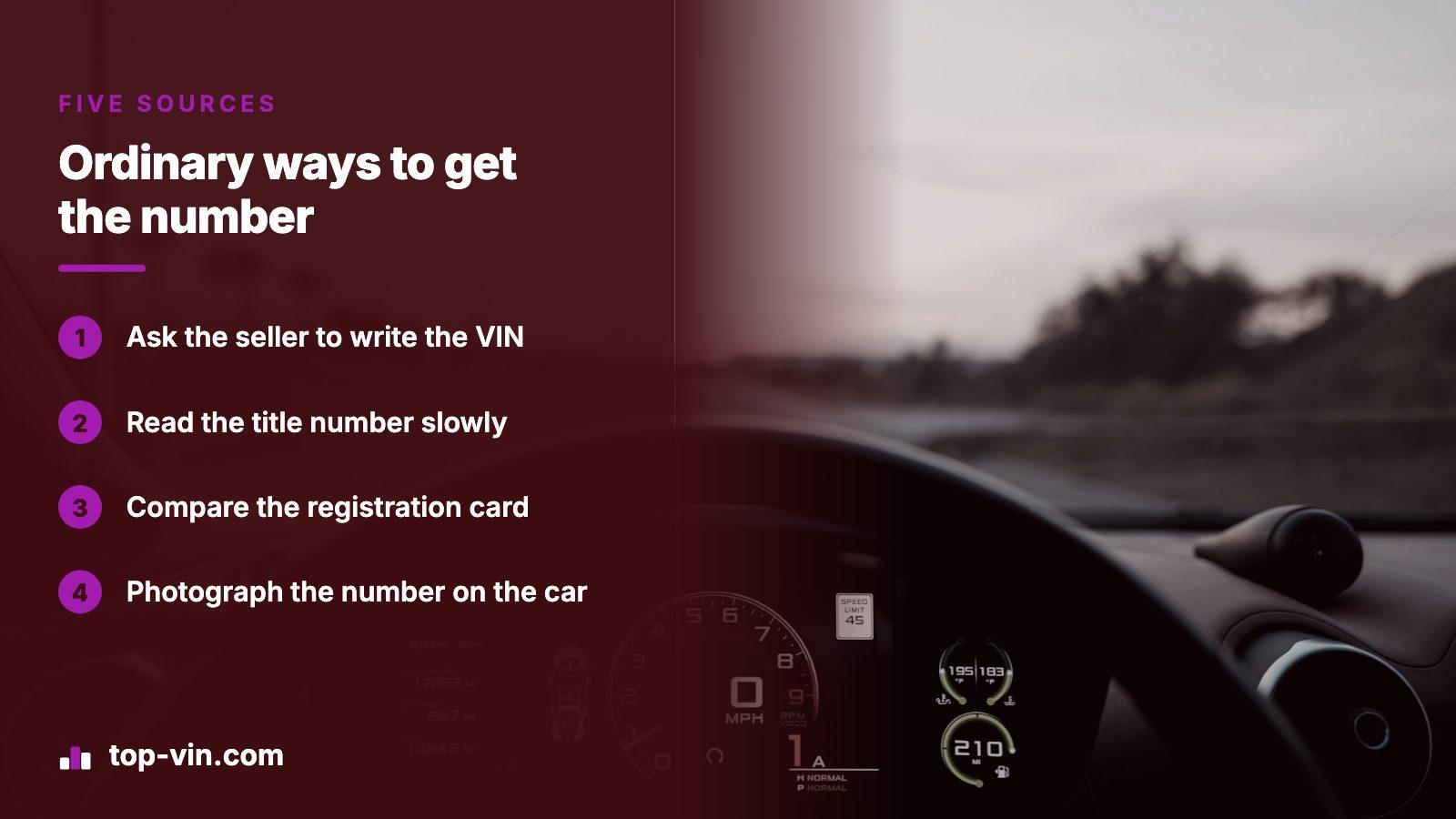
A buyer almost never needs a records request. The VIN is printed on documents and stamped on the vehicle, and a seller with nothing to hide can send it in one text. Work down this list.
- Ask the seller to send the VIN in writing before you travel to see the car.
- Look at the title and read the number slowly, character by character.
- Ask for the registration, which should repeat the same number.
- Request the insurance card or a screenshot of the policy page naming the insured vehicle.
- Standing at the car, photograph the stamped number and hold it against the documents.
If two sources disagree, stop. A typo is possible, but so is a swapped part or an altered document, and that question should be answered before any money moves.
Running the VIN through TopVIN
Type the VIN into TopVIN and a preview opens before you pay anything. Compare the decoded model year, make and model against the listing and the vehicle itself. A match means the whole report is yours for one payment, never a monthly fee. The pricing page has the amounts.
For a Florida car, read the title section first. Title brands, damage and crash entries, odometer history, salvage auction records, liens and open recalls each answer a different worry. After hurricanes, the federal title system's operators publish notices about flood-damaged vehicles, which is a reminder to look for water-related brands before you fall for a low price.
How to act on what the report shows
| Finding | Sensible response |
|---|---|
| Salvage, flood or other brand | Ask about the incident and the repair shop, then value it as a branded car or pass. |
| Odometer entry higher than a later one | Treat it as possible rollback and ask for service receipts. |
| Lien still open | Do not pay until the lender's release is in your hands. |
| Theft entry | Stop and verify with the police or the insurer. |
| Open recall | Book the repair with a franchised dealer after purchase. |
The federal title database underneath these records exists so buyers are shielded from fraud and dangerous cars, and so thieves cannot easily resell what they took. A clean report cuts risk but never replaces a test drive and an independent inspection.
Why the plate is the weaker clue
Plates can be moved from one vehicle to another, so a plate that matches a listing proves very little. The number stamped on the vehicle is the anchor. If the stamped VIN and the titled VIN differ, the plate stops mattering.
That is also why a plate-only search can mislead you even when it returns something: the answer might describe a different car that once wore the same metal.
A short checklist before you pay
- Collect the VIN from two independent sources and confirm they agree.
- Run the free preview and compare it with the advertisement.
- Open the full report if the preview fits; the pricing page shows current choices.
- Look at the title in person and demand any lien release in writing.
- Book an independent inspection, especially if the report shows damage or a brand.
Where this information comes from
- Florida Statutes 119.0712, motor vehicle records — Florida's confidentiality rule, the fine for misuse and the definition of a motor vehicle record.
- Driver's Privacy Protection Act, 18 U.S.C. 2721 — The list of permitted uses and the consent rule for sensitive data.
- DPPA definitions, 18 U.S.C. 2725 — What counts as personal information and as express consent.
- NMVTIS consumer information, vehiclehistory.gov — The federal title system's purpose and its flood-damage notices.
Sources and photos: Facts checked against the sources above in November 2026. Photos by Iain, Dennis Eusebio and Carrie Allen www.carrieallen.com on Unsplash; diagrams by TopVIN.
Keep reading
- Vehicle registration lookup: what it shows and which check to addWhat registration records hold and who may see them.
- Motor vehicle records: what a car buyer can see, and what stays closedHow state vehicle records differ from a history report.
- How to read a VIN: a left-to-right walkthrough with a worked decodeMake sense of each position in the number you collected.
- DMV VIN check compared: what the state shows and what to run beside itWhat a state check covers compared with a full report.
Frequently asked questions
Can I find a VIN from a Florida license plate number?
Not through a public search we could confirm. Florida treats personal information in its vehicle records as confidential and follows the federal act on releases. Buyers get the number from the seller, the title, the registration, an insurance card or the car, then run it through a history check.
Does TopVIN search Florida plates?
No. TopVIN works from the VIN and never returns an owner's name or address. Enter all 17 characters, read the free preview, and choose afterward whether the full report is worth buying.
Who can ask Florida for vehicle records tied to a plate?
The federal act names agencies, courts, insurers, parties in legal cases, towing notices, licensed investigators and people holding the record subject's written consent. Florida's department sets the actual request steps and any fee, and we could not read them, so check its site.
A seller keeps dodging my request for the VIN. What now?
Read it as a warning sign. The number sits on the title and on the vehicle itself, so stalling rarely has an innocent explanation. Offer to photograph it at the car yourself, and leave if it disagrees with the paperwork.
Is the TopVIN report free?
No. Only the preview carries no charge. Past that point the report is bought once and never billed monthly; the pricing page has the choices. Begin with the preview to be sure the VIN belongs to the car you mean.
Now check the car itself
The guide explains what to look for. The report shows what this VIN has on record.