THE SHORT ANSWER
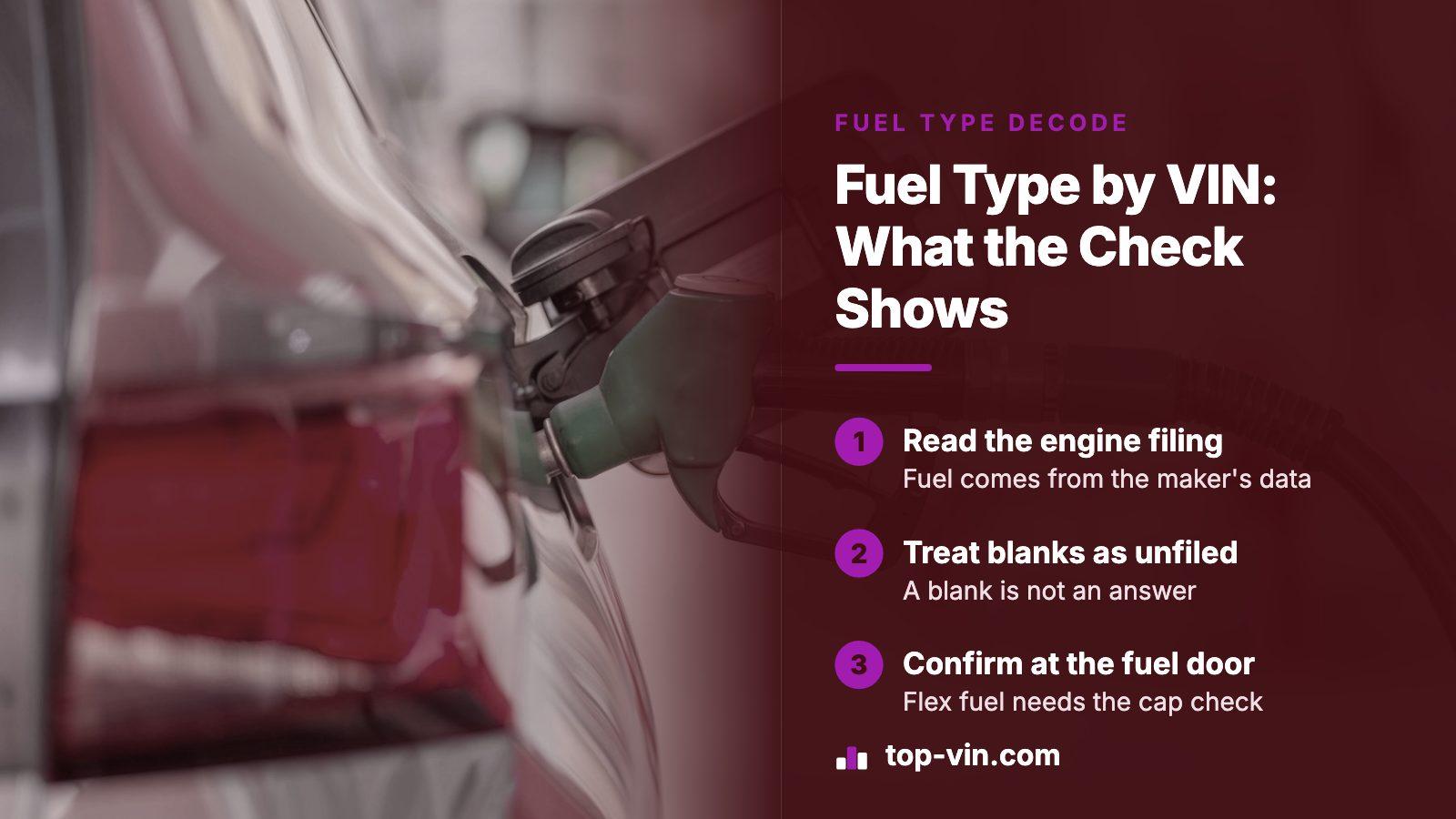
A fuel type by VIN check returns the fuel the manufacturer declared for that engine: gasoline, diesel, electric, flex fuel or another type. It describes the car as built, so a later conversion will not appear. Fuel is not an attribute the VIN must encode, which means a blank field usually reflects an unfiled entry. The TopVIN preview confirms the VIN fits the car, and one paid report adds the history.
- Where the answer comes from
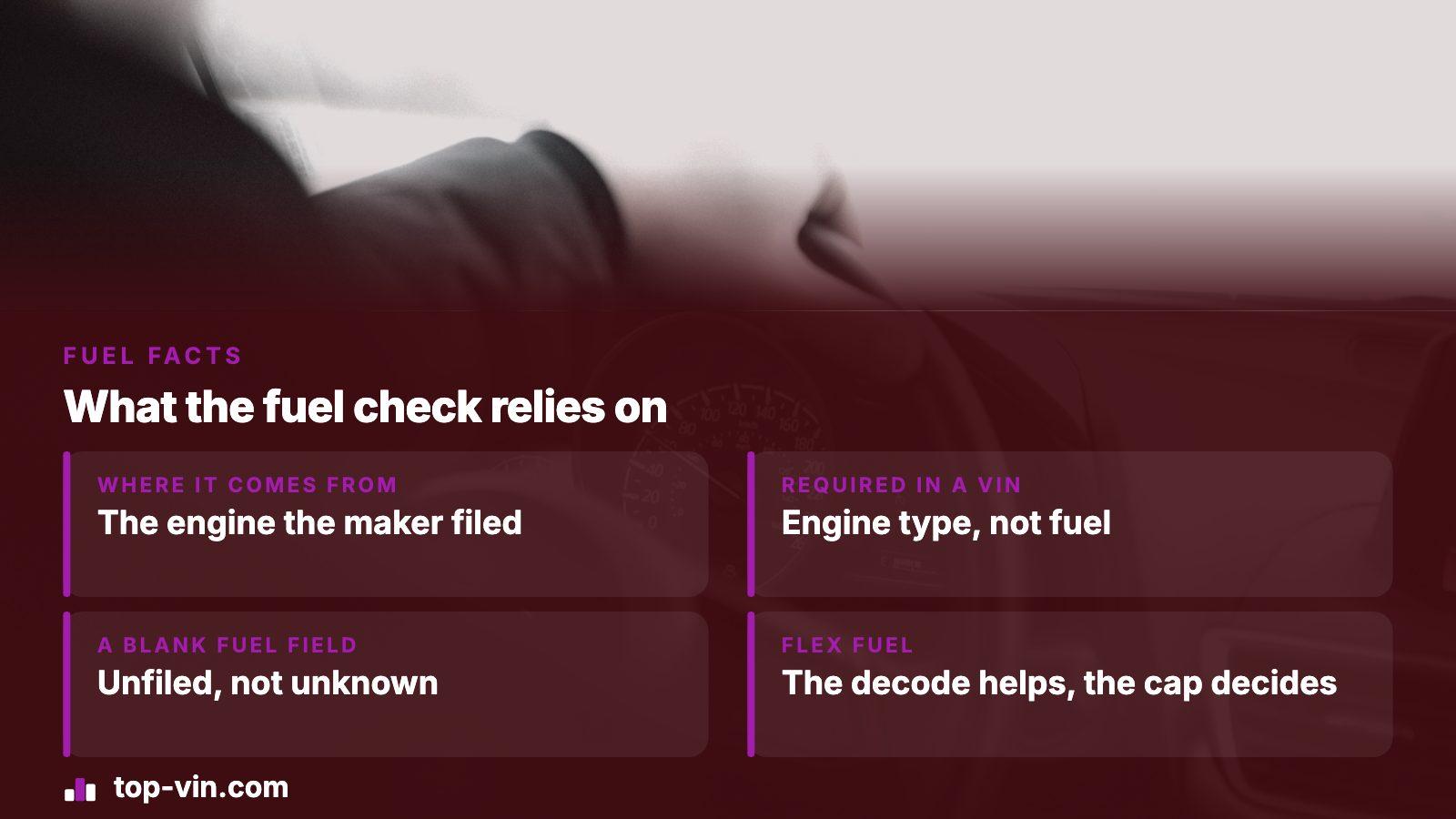
- The engine the maker filed
- Required in a VIN
- Engine type, not fuel
- A blank fuel field
- Unfiled, not unknown
- TopVIN check
- Free preview, then one payment
What the fuel type check returns
The federal decoder keeps a fuel field with a fixed vocabulary: gasoline, diesel, electric, flexible fuel, compressed natural gas, propane, hydrogen and fuel cell, among others. A VIN lookup returns whichever value the maker filed for that engine, beside the model year, make and engine size. Plug-in hybrids can carry a second fuel, and a separate field records how far a vehicle is electrified, from mild hybrid up to battery electric.
TopVIN builds on that lookup. The free preview confirms year, make, model and trim, so you learn at once whether the code matches the vehicle you are inspecting. The paid report adds factory specs and the history: title brands, odometer readings, damage records and open recalls.
Why no character in the VIN spells out the fuel
Federal rule 49 CFR 565.15 reserves positions 4 through 8 to describe the vehicle. Its table of what must be decipherable names engine type for cars, trucks, buses and motorcycles alike, and fuel is missing from every row. Those attributes need only be decipherable with information the manufacturer supplies, and 49 CFR 565.16 governs that filing.
So the fuel in a decode is derived. An engine family has a known fuel, and a decoder holding the maker's filing can state it. If the maker left that entry out for the model, the result is empty. A gap like that says the filing was thin; it does not hint at an unusual fuel.
Which source settles which fuel question
Fuel type by VIN, VIN lookup and VIN check overlap in search results, so sort the sources by the question each can settle.
| Your question | Best source | Keep in mind |
|---|---|---|
| What fuel was this engine built for? | Federal decoder, or factory specs in a TopVIN report | Reads the maker's filing; blank means unfiled |
| Does the VIN match the car in the ad? | The TopVIN preview | Year, make, model and trim, before you pay |
| What does it take at the pump today? | Fuel door label and cap | Describes the car as it sits now |
| Can it run E85? | Yellow cap or ring, fuel door, manual, badges | Check the car; a decode alone is not enough |
| Any open fuel system recalls? | NHTSA recall lookup, or a TopVIN report | Search by VIN before you sign |
| Was anything converted later? | Seller's paperwork, mechanic's inspection | No VIN record shows aftermarket changes |
Flex fuel: the decode helps, the cap decides
Flex-fuel capability is the fuel question that costs people money, because these vehicles look like their gasoline-only twins. The decoder's vocabulary has a flexible fuel value, but it shows only when the maker filed it. The Department of Energy and EPA fuel economy site points to evidence on the car: a yellow cap or filler ring, a fuel door label, E85 or FFV badges, and the owner's manual.
From an NHTSA owner complaint
One 2014 Chrysler 300 owner reported a fuel pump failure at 17,000 miles and tied it to ethanol in ordinary pump gasoline. The car had been advertised as flex fuel, yet the owner decided it was not truly built for ethanol blends and said nothing on the car warned against them. This is a single owner's reading, filed with NHTSA, and not a finding about the model.
Take from it: a flex-fuel claim in a listing stays a claim until the cap, the fuel door and the manual agree.
Diesel, hybrid and electric listings
Diesel is the firmest case. The diesel version of a model carries its own engine type, the very attribute the rule requires, so the decode stands on solid ground. Still, run it on a truck or van before the test drive, since two versions of one nameplate differ in price, running cost and the service history worth asking about.
On a hybrid, expect the engine fields to describe the gasoline or diesel engine, with the electrification field covering the rest. A battery electric listing may show electric as its only fuel. No field describes battery condition; a technician reads that from the car, and the used electric car guide covers the order of checks.
From VIN to fuel door: the walk-around check
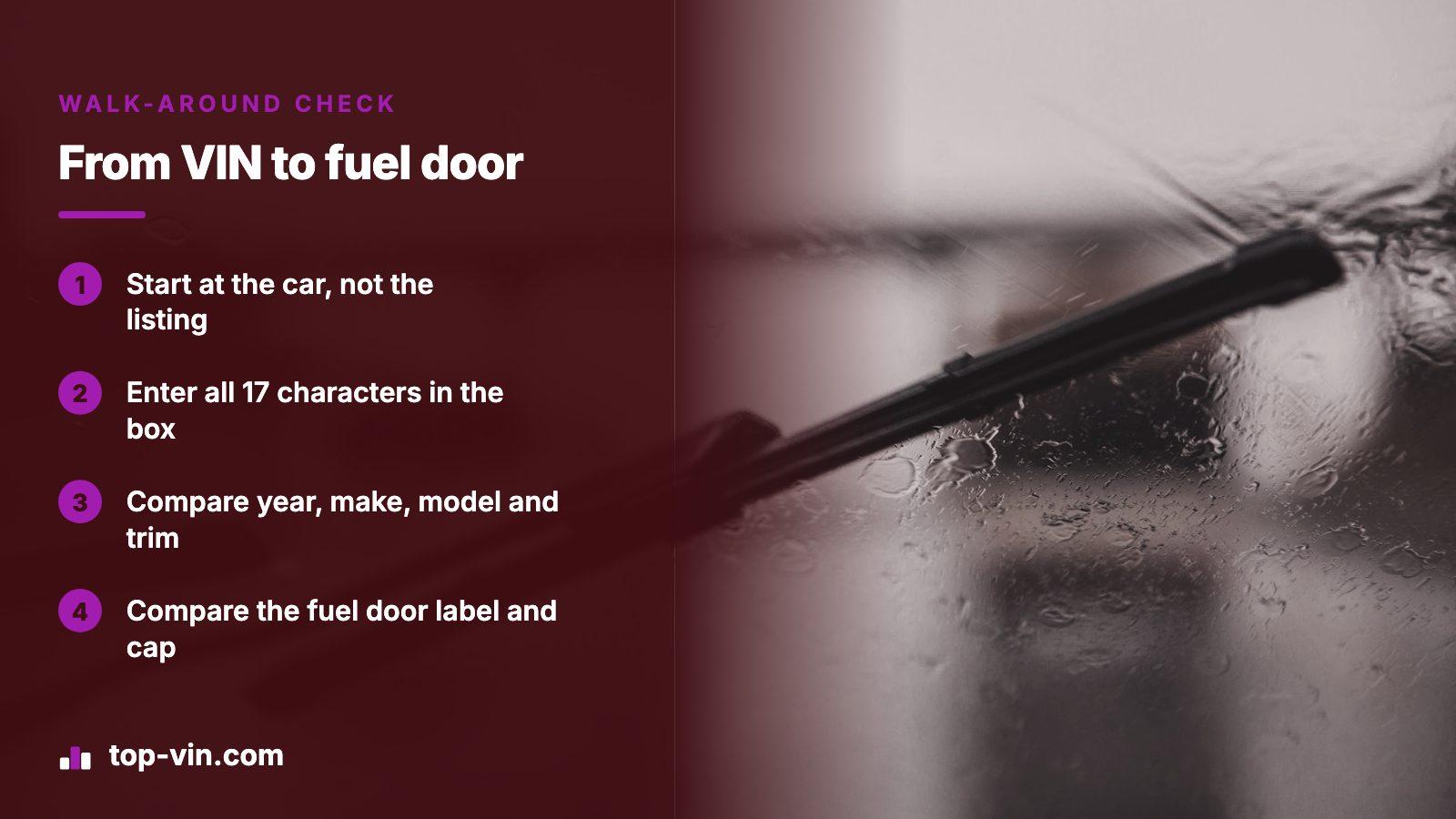
- Start at the car, not the listing. The VIN sits on a plate behind the windshield on the dash and again on a sticker in the driver's door frame. Check both against the ad.
- Enter all 17 characters in the TopVIN box and open the free preview.
- Compare year, make, model and trim with the car. If they differ, stop; the VIN or the car is not what the seller says.
- Walk to the fuel door and compare its label and the cap with the fuel the report lists. Then pick a single report, or a bundle if several cars are on your shortlist.
When the decoded fuel and the car disagree
A mismatch is information, and the explanations are few.
- The decode names one fuel and the fuel door names another. Suspect a mistyped VIN, a different car behind the paperwork or an engine swap, and ask for proof.
- The fuel field is blank. The maker filed nothing there, so lean on the engine line, the cap and the manual.
- The seller mentions a conversion. A VIN records the car as built, so ask for the installer's paperwork and have a mechanic inspect the fuel system.
- The decode says flex fuel but nothing on the car does. Trust the car, and ask for the manual.
Fuel system history before you buy
A fuel type tells you what goes in the tank; whether the pump and lines are sound is a history question. NHTSA's recall lookup costs nothing and lists open campaigns by VIN, fuel system ones included, and a TopVIN report shows open recalls beside odometer readings and damage records.
From an NHTSA owner complaint
One 2015 Chevrolet Impala owner described dash warnings, then being told the high-pressure fuel pump and feed pipe needed replacing. The service adviser asked about E85 and said it causes that kind of damage in these cars. The owner pointed to the manual's encouragement of E85, and said GM would not pay.
Before relying on cheap E85 in a used flex-fuel car, ask what it has been running on and what the pump's service record says.
Cost, and what to do after the preview
Starting with the preview costs nothing; it shows whether this VIN fits the vehicle. A report is one payment with no subscription, and nothing renews. Reports are sold singly or bundled for shoppers with a shortlist, and the pricing page lists the current amounts. If the decode, the fuel door and the listing agree, one report covers the history. A bundle only earns its keep when several cars are in play. Keep the VIN and a photo of the fuel door label together in your notes, so any later disagreement is easy to spot.
Where this information comes from
- 49 CFR 565.15: VIN content requirements — The table of vehicle attributes a VIN must make decipherable, where engine type appears and fuel does not.
- 49 CFR 565.16: VIN reporting requirements — The decoding information manufacturers file, which is what a decoder reads.
- NHTSA: vPIC VIN decoder — The public federal decoder, with its fuel type and electrification fields.
- NHTSA: recalls lookup by VIN — Open recalls for a specific VIN, fuel system campaigns included.
- FuelEconomy.gov: flex-fuel vehicles — How to tell whether a car can take E85: cap color, fuel door, badges and manual.
- NHTSA owner complaint 10862265 — owner experience, paraphrased
- NHTSA owner complaint 11172049 — owner experience, paraphrased
Sources and photos: Facts checked against the sources above in November 2026. Photos by engin akyurt, Thibault Valjevac and Miles Loewen on Unsplash; diagrams by TopVIN.
Keep reading
- Engine size by VIN: what a lookup returns, how tools compare, and what it missesEngine type is the required attribute the fuel answer rides on.
- Specs by VIN compared: what each lookup returns and what it leaves blankWhich other factory specs a decode returns and which it leaves blank.
- How to read a VIN: a left-to-right walkthrough with a worked decodeWhat each of the 17 positions encodes, including the five that describe the vehicle.
- Used electric car check: what a VIN report shows, and what it cannotBattery condition is the one fuel question no VIN field answers.
Frequently asked questions
Can you find fuel type by VIN?
In most cases. A decoder reads the engine the maker filed with federal regulators and reports the fuel that engine uses. The fuel is inferred rather than stored in a character of its own, so treat it as a description of the vehicle on the day it was built and confirm at the fuel door.
Why does my VIN decode show no fuel type?
The maker left that field empty in its filing, and the rule never demanded a fuel entry. The car still has a fuel. Check the engine line, the fuel door and the owner's manual, or try a second decoder built on the same federal filings and see whether it agrees.
Does a fuel type check show a propane or natural gas conversion?
No. The VIN describes the vehicle as built, so a later conversion leaves no mark in the code. Ask the seller for the installer's paperwork, look for added tanks or fittings, and have a mechanic inspect the fuel system before you pay.
Is a decoded fuel type reliable?
For the car as built, usually, because it rides on engine type, which the VIN rule requires. The weak spots are a field the maker never filled, a flex-fuel claim and anything changed after the factory. A disagreement with the fuel door should send you back to the seller with questions.
Does TopVIN charge to check fuel type?
The preview is free and confirms year, make, model and trim for the VIN. A full report, with factory specs and the history, is one payment and no subscription. Reports are sold singly or in bundles for shoppers with a shortlist; the pricing page lists current amounts.
Now check the car itself
The guide explains what to look for. The report shows what this VIN has on record.