THE SHORT ANSWER
Georgia offers no open search that converts a plate into a VIN. Collect the VIN from the seller, or read it off the dashboard, the title, the registration or an insurance card. A person with a permitted purpose under federal privacy law can ask the state for records. With the 17 characters in hand, enter them on TopVIN, where the preview is free and the full report is a separate purchase.
- Public plate-to-VIN tool
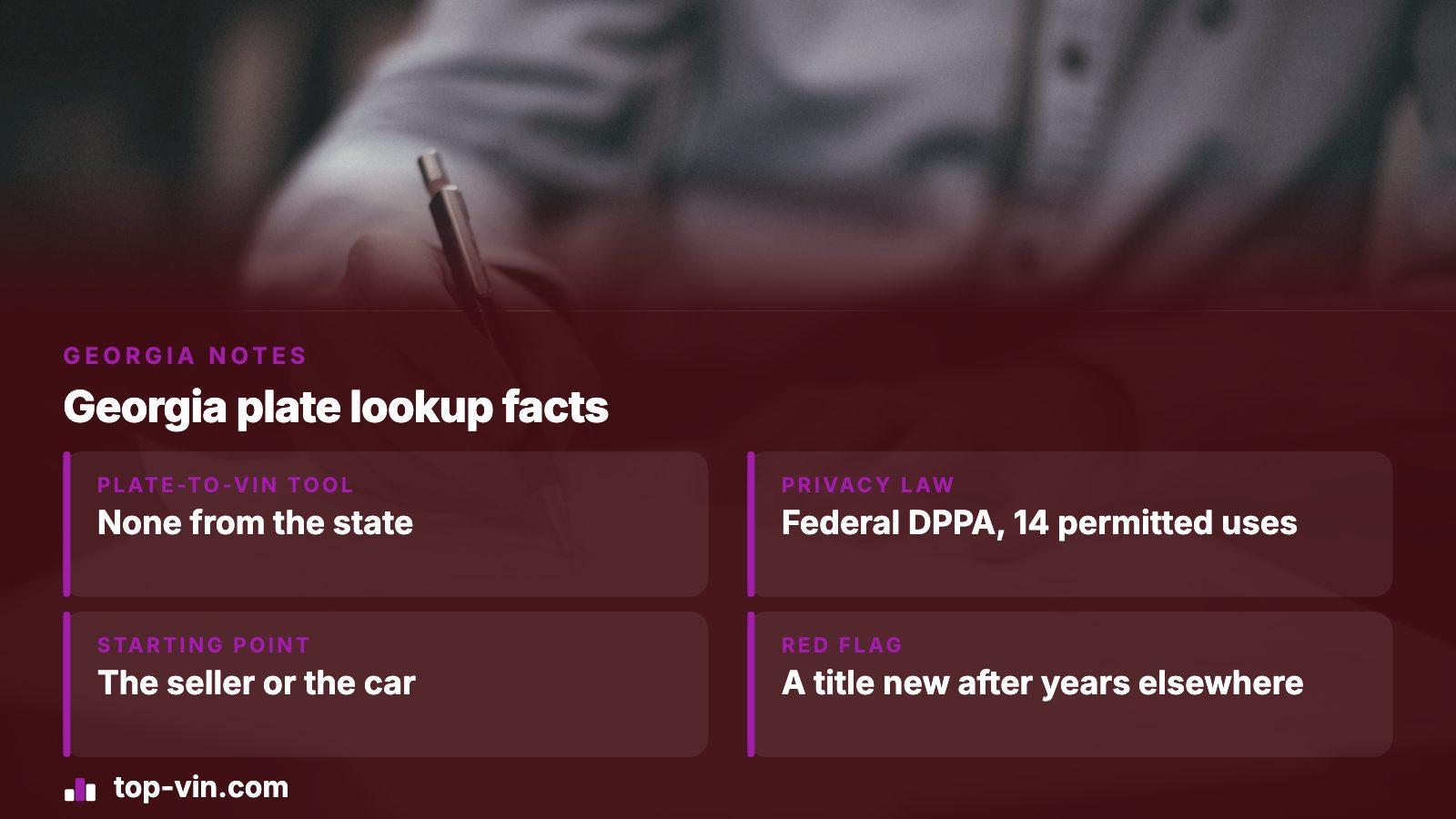
- None from the state
- Privacy law
- Federal DPPA, 14 permitted uses
- Best starting point
- The seller or the car itself
- TopVIN check
- Free preview, then one payment
Why a Georgia plate search comes up empty
Typing a tag into a box and getting a VIN back sounds simple, and sites that advertise it are common. The catch sits in the data. A plate record points to a registered owner, and the Driver's Privacy Protection Act bars a state vehicle office from knowingly handing out that person's details unless the request matches a listed use.
That is why a page promising any Georgia owner, address or history from a tag should make you cautious. At TopVIN we start from the other end. The VIN is the number every history file is keyed to, and the plate is just a tag that can move between cars. So the sensible job is to collect the VIN by honest means, then check the vehicle it identifies.
Six honest ways to get the number
Work down this list from cheapest to slowest. Nearly every buyer is done by the second line.
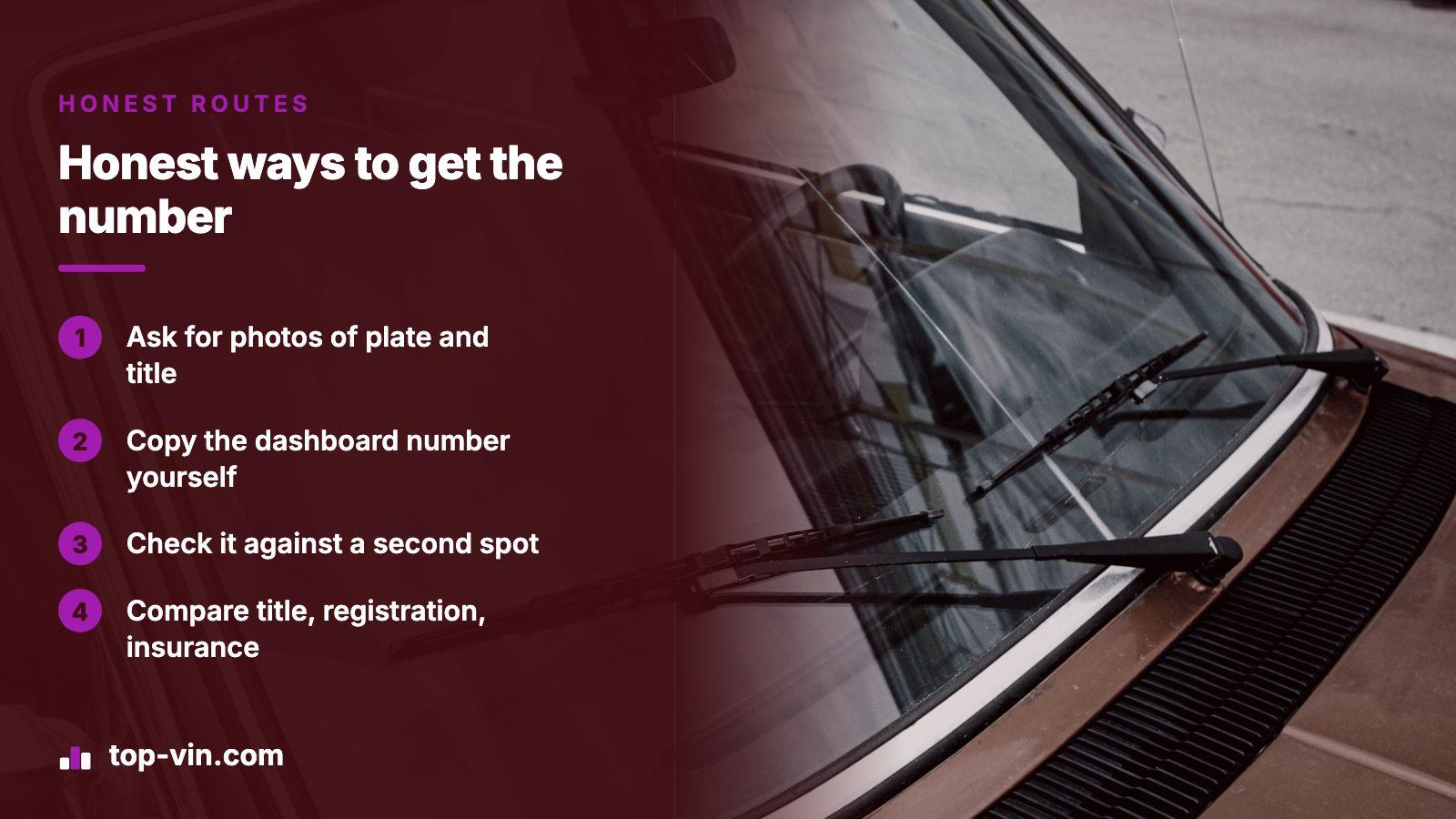
- Ask the seller to send a clear photo of the VIN plate on the dashboard and of the title page.
- Go see the car and copy the number from the dashboard yourself, then compare it with a second spot on the vehicle.
- Look over the title, where the VIN sits beside the year and make.
- Check the current registration card for the same string.
- Open the insurance card or policy summary, which normally lists the VIN of each insured car.
- If you have a recognized legal purpose, ask the state's motor vehicle agency for a records release and expect it to check your reason.
Hesitation from a seller over the number before a visit tells you something. A number that changes between dashboard and documents is worse, and a reason to leave.
What the privacy law lets a requester do
Section 2721 of the federal code lists 14 permitted uses. Several are ordinary: public agencies, court work, insurers handling claims or fraud, impound notices to owners, and licensed investigators acting within a permitted purpose. Others cover safety and theft work, recalls, and legitimate businesses verifying information a person already gave them.
| Permitted use | Who typically uses it |
|---|---|
| Government and court functions | Agencies, law enforcement, courts |
| Claims, antifraud, underwriting | Insurers |
| Towed or impounded vehicle notices | Tow operators and lots |
| Legal proceedings and service of process | Attorneys and process servers |
| Written consent from the person | Any requester holding it |
Wanting to find out whether a stranger's used car is a good buy is not on that list. A buyer does not need the owner's identity anyway. The vehicle's history is what matters, and it hangs on the VIN.
Filing a records request with the state
If you do have a permitted purpose, for instance a claim with your insurer or a lawsuit, the route is a written request to Georgia's motor vehicle agency. Expect to state who you are, what you need and which permitted use applies. The agency decides whether to release it.
Form names, fees and turnaround change, so take them from the state's own site on the day you apply rather than from a third party. Do not pay a plate-search website to file this on your behalf unless it clearly shows it is acting under a permitted use. For a plain purchase, skip this step entirely and use the seller's VIN.
Why a plate is a weak anchor in a sale
A plate describes a registration, not a car. It can be removed, swapped or carried over to another vehicle, and a tag photographed in an ad may belong to a previous vehicle. Treat any plate shown in a listing as a hint about where the car was registered and nothing more.
Match three numbers before you pay
Dashboard, title and the entry you typed into the check must read exactly alike. A single differing character justifies halting the sale to ask why.
Put the number into a VIN check
Type the 17 characters into TopVIN and a preview comes back at no charge. Should the car still look interesting, you buy the full report in one transaction, and nothing renews. Current rates live on the pricing page.
On a Georgia car, begin with these parts: title brands, entries for crashes and damage, the mileage history, auction or salvage sales, liens and theft flags. Those cover the problems that make a car expensive after you own it. Open recalls matter too, and they are tied to the VIN as well.
Reading the results and spotting red flags
The federal title system behind many reports pools records submitted by state title offices, auto recyclers, scrapyards and insurers. What comes out is title data, the newest mileage figure, brand history and, now and then, theft. Brands are condition labels that states stamp on a car, among them salvage, junk and flood.
- Any salvage, junk or flood label: value it as a lesser car or leave it.
- A mileage figure that falls from one record to the next.
- A title issued very recently in Georgia after years in another state, which can point to a brand that was cleared somewhere else.
- An open lien the seller has not mentioned.
- Theft entries, or a number that does not fit the car you are standing next to.
The government site on this system describes flooded cars leaving a hurricane zone to be cleaned up and sold in other states. Georgia sits close to hurricane country, so water history deserves a direct question.
When the VIN itself is the problem
Occasionally the number is real and the car is not. The Justice Department's title-system page describes a case where criminals copied VINs from genuine cars that matched a stolen one in make, model and year onto the stolen ones, and about 250 cloned cars were recovered. Paperwork for such a car can look clean.
Defend against it by looking, not only by searching. Compare the dashboard number with the one on the title, check that the decoded make, model and year match the vehicle, and drive it with the registration in hand. If the decode says one engine and the hood shows another, ask why before paying.
Free checks to run alongside
The safety agency NHTSA publishes a decoder that turns a 17 character number into factory details, and it cautions that an empty field is not proof a feature is missing. Its recalls data can also be searched by make, model and year. Both cost nothing and are worth a minute before you spend on a report.
They answer different questions from a history report. A decoder says what the car was built as. A history report says what has happened to it since.
Where this information comes from
- Cornell Law: 18 U.S.C. 2721 — The federal rule on motor vehicle records and the list of permitted uses.
- NMVTIS: information for consumers — What the national title system reports, where its data comes from, and the flood and cloning examples.
- NHTSA vPIC VIN decoder API — The public decoder that returns factory details for a VIN.
- NHTSA recalls API — Recall data searchable by make, model and model year.
Sources and photos: Facts checked against the sources above in November 2026. Photos by Matthias Speicher, Max Tokarev and Scott Graham on Unsplash; diagrams by TopVIN.
Keep reading
- Vehicle registration lookup: what it shows and which check to addWhat a registration record shows and who can see it.
- Motor vehicle records: what a car buyer can see, and what stays closedHow state motor vehicle records are released.
- VIN search engine: what one searches and what comes backSearching by VIN once you have the number.
- VIN verification: the four checks people mean and what each provesMaking sure the number on the car agrees with the documents.
Frequently asked questions
Can I find a VIN from a Georgia license plate?
Not through a public state tool. The workable routes are asking the seller, reading the dashboard, or using the title, registration or insurance card. Someone with a permitted purpose under federal privacy law may request records from the state, which decides whether to release them.
Is it legal to look up a Georgia plate to see the owner?
Only for a purpose the federal law lists, such as court work, insurance claims or a licensed investigation. Curiosity about a seller does not qualify. If you are buying a car, you can skip the owner and check the vehicle's history through its VIN.
The seller keeps dodging my VIN request. Now what?
Treat that as a warning. A genuine seller can photograph the dashboard number in a minute. If they refuse, or the number in the photo differs from the title, stop before you travel or send money.
Does TopVIN search by license plate?
No. TopVIN starts from the VIN. After you enter the 17 characters, a preview appears at no charge, and the full report is an optional one-time purchase, not a recurring plan.
Which free checks can I run on a Georgia car?
NHTSA offers a VIN decoder and recall data at no charge. Those confirm what the car was built as and whether recalls exist. They do not replace title, damage and odometer records, which come from a history report.
Now check the car itself
The guide explains what to look for. The report shows what this VIN has on record.