
THE SHORT ANSWER
A VIN search engine is a lookup, not a crawler. You type the 17-character number and it returns what several record systems hold under it: factory build details filed by the manufacturer, title brands and odometer entries from state and insurer reports, and open recalls. Each source covers a different slice, so a good search shows which source said what. Check the number against the car first, because one wrong character returns another vehicle or nothing.
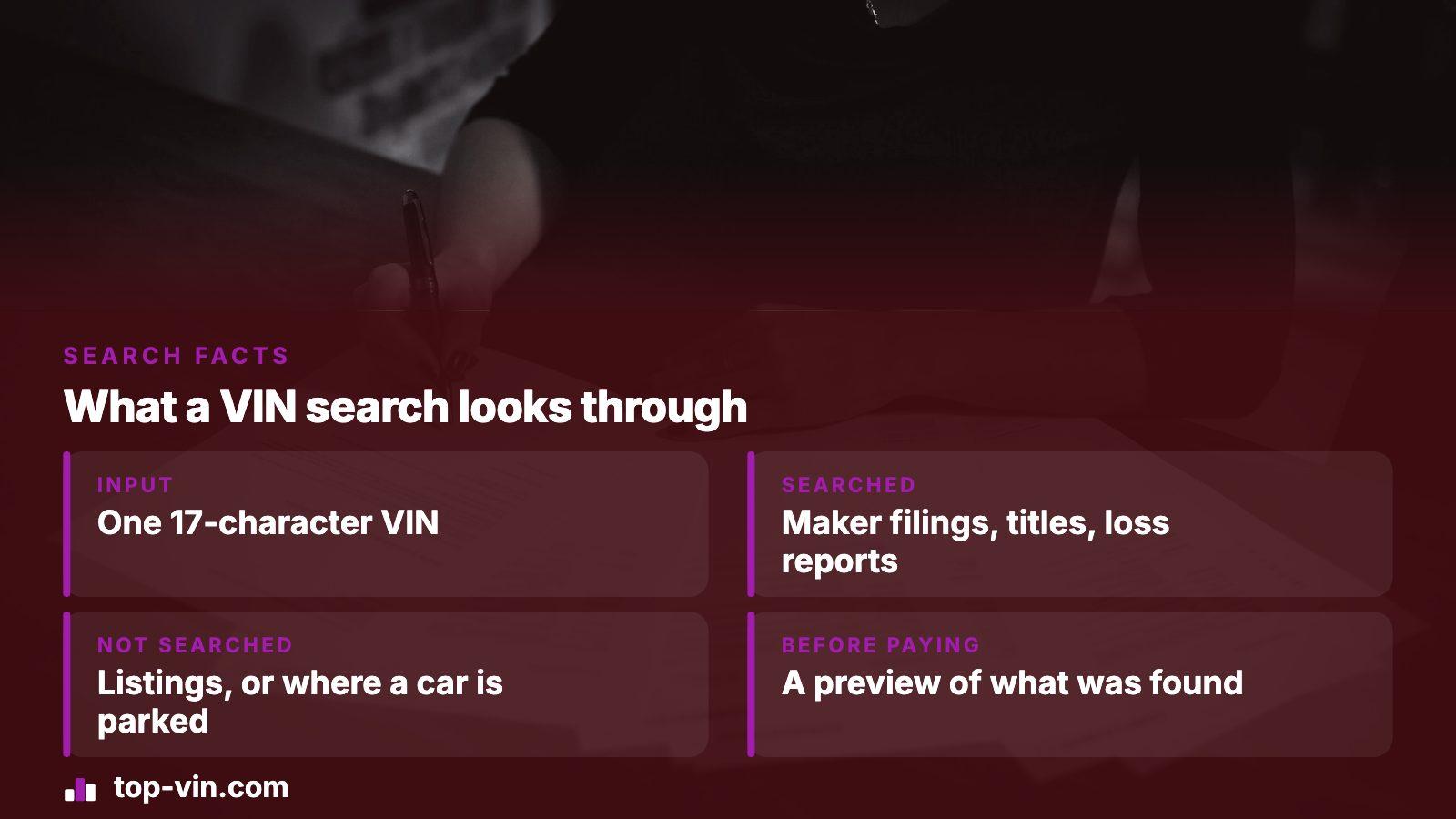
- Input
- One 17-character VIN
- Searched
- Maker filings, title records, loss reports, recalls
- Not searched
- Listings, or where a car is parked now
- Before paying
- A preview of what was found
What a VIN search engine actually looks through
The federal VIN standard forbids reusing a number on any two covered vehicles within a sixty-year span that opens with model year 1980. That is what lets a VIN act as a key to exactly one vehicle. A search engine built on it hands the key to separate record systems and collects whatever each one holds.
| Record system | Held under the number | Where it stops |
|---|---|---|
| NHTSA decoder (vPIC) | Build details the maker reported: make, model, engine, plant | Silent on title, damage and use |
| NMVTIS title records | Title state and date, brands, odometer entries, total loss and salvage history | Called intentionally concise in the program's own words |
| NICB lookup | Flood damage, theft not recovered, salvage declarations | Only cars carrying insurance at the time of the loss |
| NHTSA recall lookup | Safety recalls whose repair is still open | Recalls and nothing else |
A paid report pulls records of this kind into one document and can add accident and damage entries, auction photos and a market value. The FTC notes that some providers add accident and repair detail that title-based reports lack, so contents vary by provider.
Copying the number off the car without a slip
Most searches that fail were typed wrong. For passenger vehicles, the standard wants the number inside the cabin, placed so a person standing at the left windshield pillar outside can read it by day through the windshield. Each character has to stand at least 4 mm tall.
- Read the number from the car, not from the ad. Ads get retyped.
- Enter it with no spaces and count 17 characters.
- Scan for the letters I, O and Q, which the standard rules out. A lookalike on the plate is more likely a digit you misread.
- Hold the number up against the title paperwork. The FTC counts a VIN that disagrees with the car as a red flag on its own.
- If the search rejects the number, recheck position nine. That character is a check digit designed to catch transcription errors.
What a TopVIN search returns
You enter the number and a preview appears before any payment. Paying is a one-off: a report for the car you searched, nothing recurring.
- Title brands: salvage, junk, flood and similar labels a state has applied.
- Accident and damage entries, with salvage and auction history and photos where they exist.
- Odometer readings logged over time, to hold against the dash.
- Open recalls, plus theft, insurance, lien and impound records where something was reported.
- Market value and factory specs, so you can check the car against the seller's description.
A search shows only what was reported. A blank line means nothing was filed, which is different from nothing having happened.
Reading the result line by line
| What shows up | What it suggests | Your move |
|---|---|---|
| A salvage, junk or flood brand | A state called the car badly damaged, and it may have been repaired out of sight | Ask for repair records and have a mechanic inspect it before discussing price |
| An odometer entry above the dash reading | A rollback, a replaced instrument cluster or a data-entry mistake | Compare the other dated entries and ask the seller to explain |
| A total loss entry with no brand | An insurer wrote it off, and severe damage generally sits behind that | Find out who repaired it, then get it inspected |
| Specs that do not fit the car | A misread number, or a number belonging to another vehicle | Reread the VIN at the windshield and again on the title |
| Nothing under any heading | No adverse entry in the sources searched | Still inspect it in person |
Read entries in date order. Mileage should only climb, and a gap of several years with no entry is a fair reason to ask where the car spent that time.
Where a single search runs out
Every system sees only what its reporters send in. The insurer database knows about a car only when an insurer was on the hook, so a cash repair or an uninsured loss never reaches it. The federal title record leaves repair history to private providers.
A clean result is not an inspection
According to the FTC, a report can show accidents and flooding yet usually leaves mechanical faults out, and it cannot stand in for a mechanic's inspection.
Ask the mechanic to put the make, model and VIN on the written findings, which ties the verdict to the number you searched. A dealer who refuses to let an outside mechanic look at the car hands you the FTC's advice ready-made: shop elsewhere.
Telling a real VIN search from a fee trap
The FTC described a scheme aimed at people selling a car online. Someone playing the buyer demands that the seller first purchase a history report from a website of their choosing. The seller pays a fee by card, forwards the document, and the buyer disappears. The sites involved ended in .vin, a domain any group may register, so an ending proves nothing either way. Judge the business instead.
- Does it say, in plain terms, which sources stand behind the report?
- Can you see a preview of what was found before paying?
- Is the charge a one-time amount stated before the card form, not a recurring plan?
- Does it name a company, and do searches on that name plus words like complaint or scam come up quiet?
If a buyer you have never met asks you to run a report on one particular website, ask why before you enter any card details.
What it costs, and what is free elsewhere
Some steps are worth doing first and cost nothing: NHTSA's recall lookup by VIN and the insurers' theft and salvage database are both no-charge public tools, and the federal decoder is a public NHTSA service. A TopVIN search begins with a free preview. The report behind it is a single purchase for the vehicle you searched, and shoppers lining up many candidates can choose a pack instead. Running them first shows whether the car deserves a paid report. Prices are listed on the pricing page.
A sensible order for the searches
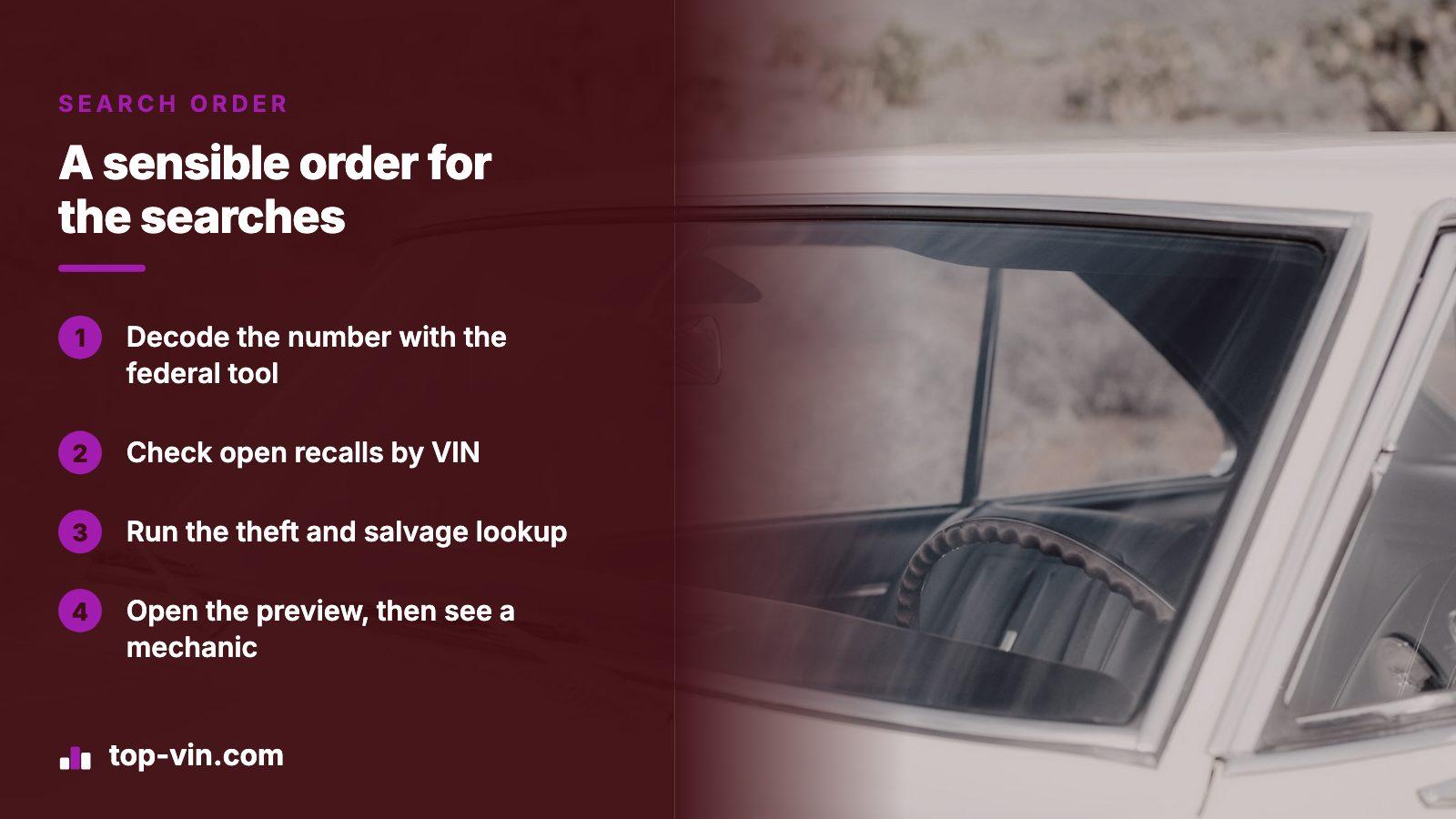
Work from the cheapest answer to the most expensive one, and stop the moment a car fails.
- Decode the number with the federal tool and confirm the result describes the car in front of you.
- Check open recalls by VIN.
- Run the insurer theft and salvage lookup.
- Open the TopVIN preview, read what it found and, if the car has survived so far, buy the report.
- Take the findings, with the VIN written on them, to a mechanic.
Dropping out early is a win. A car that fails the second step never needs a paid report.
Where this information comes from
- NHTSA: VIN decoder (vPIC) — What the federal decoder returns, that its data comes from the maker, and its handling of partial VINs and pre-1981 years.
- eCFR: 49 CFR Part 565, VIN requirements — Length, permitted characters, check digit, uniqueness window and where the number must be readable.
- NMVTIS: understanding a vehicle history report — The title indicators a federal record covers and its own description of its limits.
- FTC: used cars — Where open recalls and insurer theft and salvage lookups sit, and why a report is not an inspection.
- FTC: buying a used car from a dealer — What history reports typically leave out and what the mechanic's written findings should carry.
- FTC: avoid a flood-damaged used car — The insured-cars-only limit of the NICB database.
- FTC: steering clear of vehicle history report scams — How the fake report-site scheme works and how to vet an unfamiliar site.
Sources and photos: Facts checked against the sources above in November 2026. Photos by Anastasiia Nelen, Wesley Tingey and Dimitri Karastelev on Unsplash; diagrams by TopVIN.
Keep reading
- How to read a VIN: a left-to-right walkthrough with a worked decodeWhat each group of characters in the number encodes.
- VIN check digit: how the ninth character is worked out and what it provesHow position nine catches a mistyped search.
- Sample reportSee how the sections look before you run your own search.
- VIN check with photos: what a report shows and what it can'tHow salvage and auction photos appear when a search finds them.
Frequently asked questions
Can a VIN search engine show where a car is or who owns it?
No. The records behind a VIN search are filed by number: factory build data, title and brand entries, insurer loss reports and recalls. They describe a vehicle's paperwork, not its current position. A site promising a live location from the number alone is promising something these systems do not hold.
Can I search a VIN when some characters are missing?
The federal decoder accepts a partial VIN and decodes what it can, which tells you about the build. Records tied to one specific car need all 17 characters, so read the rest from the car or the title instead of guessing at the gaps.
What is the difference between a VIN decoder and a VIN search?
A decoder reads what the characters themselves encode, such as make, body type and engine, using the maker's own filings. A search goes further and retrieves records filed under the number afterward: brands, odometer entries, loss reports and recalls. One covers how the car left the factory, the other what has happened to it since.
Why does my search say the VIN is invalid?
Most often a slipped keystroke or a misread character. Position nine holds a check digit built to expose transcription errors, and the standard excludes I, O and Q altogether, so one of them in your entry is a typo. Cars built before 1981 sit outside the federal decoder, which rejects those years.
Is the car safe to buy if a VIN search comes back clean?
It tells you only that nothing adverse was filed under that number in the sources searched. Reports usually leave mechanical faults out, insurer data covers just insured cars and the federal title record is deliberately short. A clean result lowers the odds of a hidden brand, but only an inspection checks the car itself.
Now check the car itself
The guide explains what to look for. The report shows what this VIN has on record.