THE SHORT ANSWER
A government VIN check is really four separate lookups. NHTSA shows open safety recalls and the factory build at no charge. The federal title system holds brands, the latest odometer reading, total-loss decisions and theft data, but approved providers sell it. A state will release its own title file for a fee. None of them combines everything, which is the job of a TopVIN report after the free preview.
- One-stop government VIN check
- None exists
- NHTSA recall search and decoder
- No charge
- Federal title record
- Sold by approved providers
- TopVIN check
- Free preview, then one payment
The official lookups side by side
Anyone who types a government VIN check into a search box is hoping for one page that returns everything. That page does not exist. What exists is four official tools and one nonprofit lookup that often gets grouped with them, each built for its own job.
| Lookup | Run by | What it answers | Cost |
|---|---|---|---|
| Recall search | NHTSA | Open recall status for this VIN | No charge |
| VIN decoder | NHTSA, through vPIC | The build details the maker filed for this VIN | No charge |
| Title record report | Justice Department system, sold by approved providers | Brands, latest odometer, total-loss and theft entries | Set by each provider |
| State title file | The state that titled the car | That state's own record of the vehicle | Set by the state |
| VINCheck | NICB, a nonprofit and not an agency | Theft and salvage reports from member insurers | No charge, capped per address |
What the federal title record holds and how you buy it
The federal title database, NMVTIS (National Motor Vehicle Title Information System), is overseen by the Justice Department and has been run by an association of state motor vehicle administrators since 1992. The government site sends consumers to a list of approved sellers instead, and the seller you pick sets the fee, because the law behind the system wants it paid by user fees rather than federal money.
- Current-state title data, with each brand and the date the state applied it
- The most recent odometer reading in the title record
- An insurer's salvage or total-loss decision
- Theft history where any exists, and reports of a move to a salvage yard or recycler
DOJ calls the report intentionally short and says a clean one is good news. Its states page, which cites 2026 data, counts 51 jurisdictions that both report data and check before issuing new titles, with one still in development.
Where the official record runs thin
Brands are state decisions. DOJ's own example: one state brands a damaged car salvage, another does not because the repair estimate sits under its threshold, and in others no flood label exists. NMVTIS retains each brand any state has reported, so crossing a state line should not erase one, but it cannot invent a brand nobody applied.
Damage that never became a brand or an insurer's total-loss decision may appear nowhere in the federal file. States send updates at different speeds: some in real time, others daily or after several days. Repair history is not in the system at all.
Read the fine print
Federal guidance warns that no report replaces an independent inspection. Treat a quiet record as a reason to keep looking, not as a clearance.
Running the checks in order
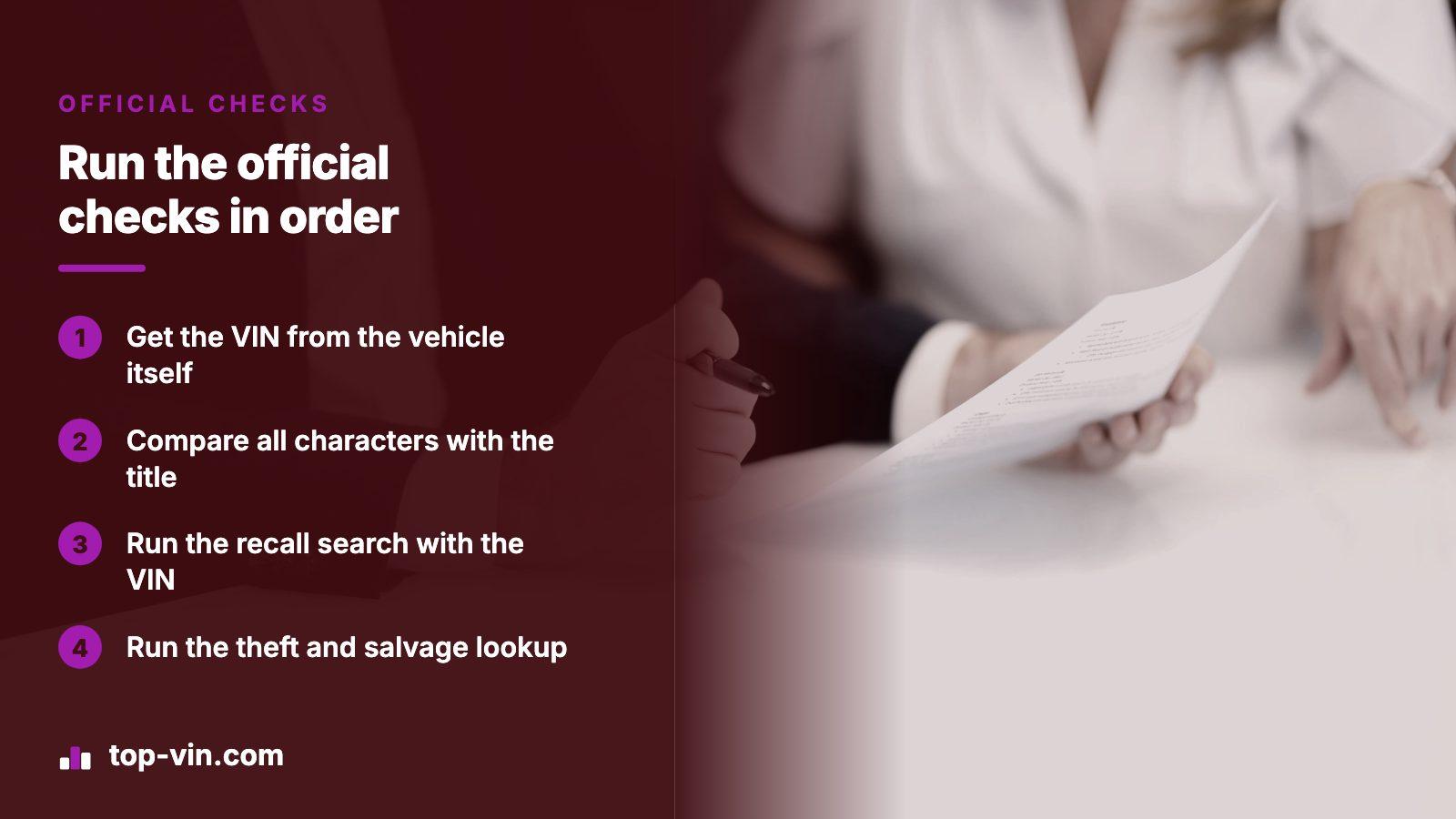
- Get the VIN from the vehicle itself, never from the advertisement. The lower-left corner of the windshield carries it, per NHTSA, and the registration card repeats it.
- Compare each of the 17 characters with the title and the listing. If a single character disagrees, hold off until the seller explains.
- Run NHTSA's recall search with the VIN. It also takes a plate and a state, but an outdated state record can return a former owner's car, so the VIN is the safer input.
- Run VINCheck for insurer theft and salvage reports. A correct VIN is required to match anything, and searches are capped at five within 24 hours for each IP address.
- Open the TopVIN preview and confirm it matches the car in front of you. Then decide on the report.
Price a title record from an approved provider, or a state file, only after these steps leave the car on your shortlist.
Reading what comes back
Some lines look reassuring and are not. These are the ones buyers misread most.
| Result | What it can mean | Your move |
|---|---|---|
| 0 unrepaired recalls | Nothing open on file today. Repaired recalls, some brand-new ones and those over 15 years old do not appear | Search again just before you pay, since VINs are added continuously |
| No brand, odometer or title data | No participating state has reported any for that VIN, which DOJ says happens now and then | Record it as unknown rather than clean |
| Total loss | An insurer judged the repair too costly. The label can stay on a stolen car that came back in good shape | Ask for repair paperwork and a structural inspection |
| Salvage at NICB | A member insurer declared a total loss, though a salvage car can still be repaired and titled again | Compare it with the brand on the title in your hand |
Asking the state for its own file
When one document or one lien decides the deal, go to the titling state. DOJ publishes an October 2024 sheet on how each state handles vehicle record requests, and it shows how little the processes have in common.
| State | Route on the sheet | Fee shown |
|---|---|---|
| Virginia | Prospective Purchaser Inquiry on the DMV site, made for a buyer | Not shown on the sheet |
| South Carolina | Request for Vehicle Information, form 5027-A, open to a prospective buyer | Not shown on the sheet |
| Texas | Form VTR-275, mailed with an ID copy or taken to a regional office | $5.75 title history, $6.75 certified |
| Kansas | Online purchase | $15 registration record, $30 title history, $40 certified |
| Arizona | The owner of record orders it, so a buyer asks the seller | Not shown on the sheet |
Arizona adds a catch: a car with no Arizona title or registration in the past 5 years may not be eligible. Hawaii is missing from the sheet because it had no data in the federal system when the sheet was written.
Where a TopVIN report fits after the official checks
The official tools answer narrow questions for the agencies that run them. A TopVIN report gathers the items buyers actually argue over: title brands and the damage records behind them, odometer readings over the years, salvage and auction entries with photos, liens and impounds, and how many owners the car had and what it was used for.
A sensible order
The recall search and VINCheck cost nothing, so run them first. Then open the TopVIN preview, and pay for a report only if the car still fits. A report repeats what sources filed, so keep the inspection on your list, and save a state request for the day one particular document matters.
What each step costs and what to do next
NHTSA's recall search and decoder carry no charge, and neither does VINCheck inside its cap. A title record report costs whatever the approved provider charges. A state file carries that state's fee, and the DOJ sheet shows $2.20 for a Colorado record search and $40 for a certified Kansas title history.
The TopVIN preview is free. For the report there is a single payment and no subscription, and for several cars at once the packs hold 3, 5 or 10 reports. Current amounts sit on the pricing page.
Next step: copy the VIN from the vehicle, check recalls with it, then put the same VIN in the box on this page.
Where this information comes from
- DOJ: NMVTIS for consumers — What the federal title system covers, how brands differ by state, and why a clean report is not a full history.
- DOJ: NMVTIS frequently asked questions — Who runs the system, why fees vary by provider, what records it holds and what it leaves out.
- DOJ: Approved NMVTIS data providers — The list where a consumer finds an approved seller of title records.
- DOJ: State vehicle record request information — How each titling state handles requests for its own vehicle record, with forms and fees as of October 2024.
- DOJ: NMVTIS state participation — How many jurisdictions report to the system and what states must verify before issuing a title.
- NHTSA: Check for Recalls — The federal recall search by VIN, and the list of recalls it does not show.
- NICB: VINCheck — A nonprofit's lookup of insurer theft and salvage reports, with its search limit and its own caveats.
Sources and photos: Facts checked against the sources above in November 2026. Photos by Alejandro Escamilla, Carrie Allen www.carrieallen.com and Justin Cron on Unsplash; diagrams by TopVIN.
Keep reading
- DMV VIN check compared: what the state shows and what to run beside itWhat a state file holds, and why most states offer no public search.
- Motor vehicle records: what a car buyer can see, and what stays closedWho may lawfully get a state record, and how to request one.
- Insurance lookup by VIN: which checks answer it and which do notWhich checks surface insurer salvage and theft entries, and which do not.
- Sample reportSee what a full report looks like before you run one.
Frequently asked questions
Is there a government website that runs a VIN check?
Not one that returns a full history. NHTSA runs a recall search and a decoder, the Justice Department's site lists approved sellers of title records, and each state handles requests for its own file. Every one answers a narrow question, which is why buyers usually add a report that gathers the pieces.
Is a government VIN check free?
The NHTSA recall search and decoder carry no charge. Federal title records come from approved providers at prices they set, since the law behind them calls for user fees, and states charge per record. A free TopVIN preview comes first, and the report after it is a single payment.
Can a government VIN check show who owns the car?
No. Consumers receive no personal details from the federal title system, and states release personal information only to people with a permitted reason. A VIN check describes the vehicle. To vet a seller, compare the name on the title with their photo ID.
Does a clean title-system report rule out an accident?
No. A crash usually reaches the federal file through a state brand on the title or an insurer's total-loss ruling, and repairs are not recorded at all. DOJ's own disclaimer says to get an independent inspection as well, so book one before you pay.
Which government check should I run first?
Start with the NHTSA recall search, since it takes seconds and needs only the VIN. Add VINCheck for insurer theft and salvage reports, though that tool belongs to a nonprofit, not an agency. Move to a title record or a state file when you need brand history or one specific document.
Now check the car itself
The guide explains what to look for. The report shows what this VIN has on record.