THE SHORT ANSWER
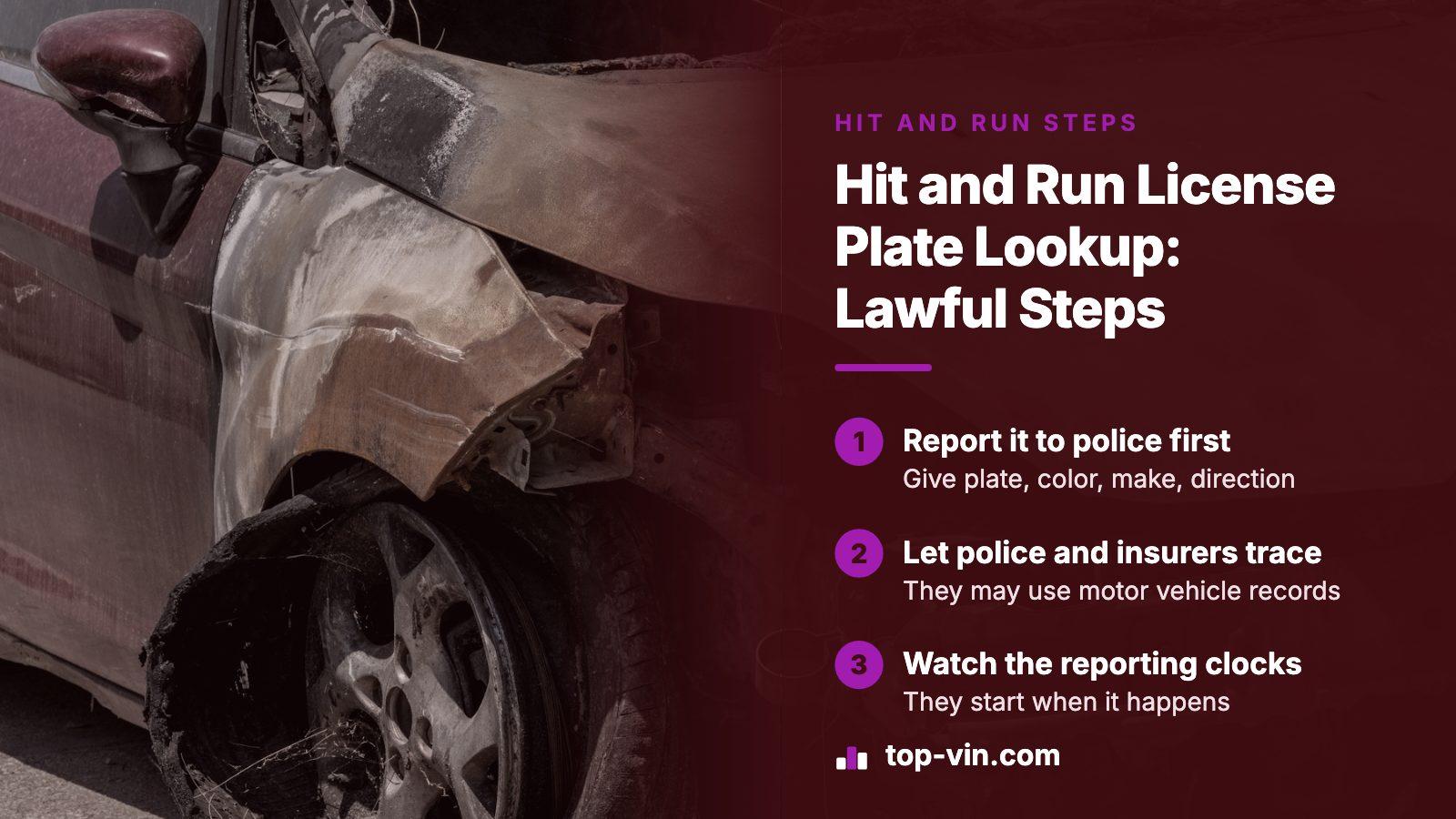
Report the crash and give police the plate, the car's color, make and direction of travel. Law enforcement may use state motor vehicle records for its work, and an insurer may use them for claims, so they do the trace. You can ask your insurer to pursue it. A VIN-based report only helps when you are buying a car with unexplained damage.
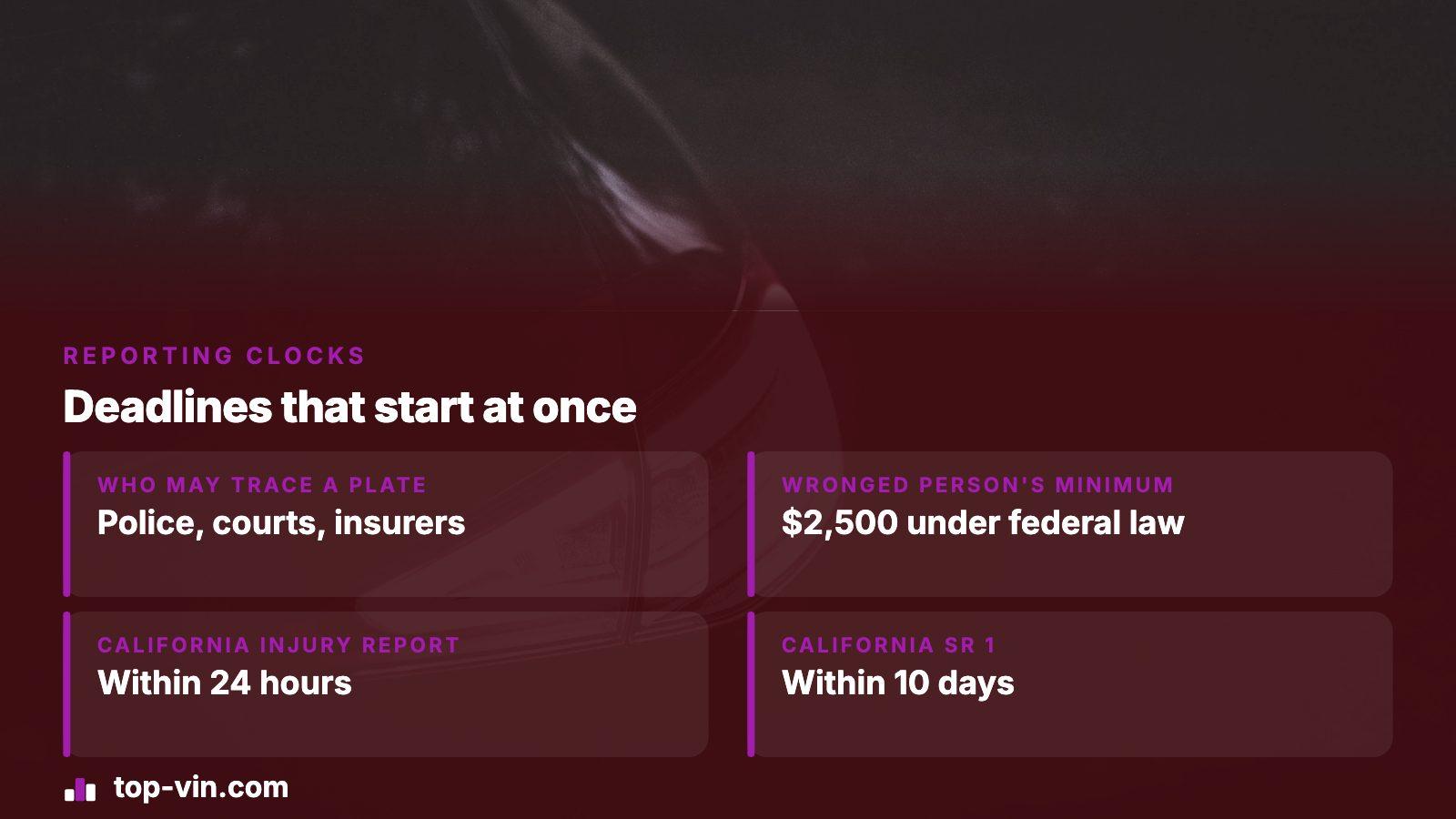
- Who may trace a plate
- Police, courts, insurers
- Federal minimum for a wronged record subject
- $2,500
- California injury report to police
- Within 24 hours
- California SR 1 filing
- Within 10 days
Why a plate does not open an owner file
Behind every plate sits a registration file at the state, and that file carries the owner's home address. Congress restricted what states may release from those files. A site that promises the driver's name after a collision is either selling something other than what it implies or skirting the statute, and the person who gets hurt by that is you if you confront the wrong household.
The rule is not designed to shield hit-and-run drivers. It sends the sensitive step to parties with a job and a duty to document it. You supply the observation; they run the record.
What to do in the first hours
Evidence fades quickly, so write things down before you drive away from the spot where it happened. Memory of a plate drops a character or swaps two within an afternoon.
- Call 911 if anyone is hurt. If nobody is, get out of traffic first, then call.
- Write the plate exactly as seen, with any characters you are unsure of marked as unsure.
- Note color, make, body shape, damage you caused, direction of travel, and the time and place.
- Photograph your own damage, any paint transfer, debris, and nearby cameras on shops or doors.
- Ask witnesses for contact details before they leave.

Who legally runs the plate
The federal driver privacy statute lists permitted uses of motor vehicle records. Two matter here. Agencies of government, the courts and police departments may draw on records while doing their jobs. Insurers may use them for claims investigation and antifraud work. A court case can also qualify, including the investigation done before filing one.
| Party | Why it may see the record | What you do |
|---|---|---|
| Police | Agency use of records for its own work | File the report, hand over the plate and details |
| Your insurer | Claims investigation | Open a claim, share the report number and photos |
| A court or attorney | Legal proceedings, including pre-suit investigation | Ask a lawyer whether a suit makes sense |
| You, alone | No qualifying use on its own | Do not chase the owner yourself |
Reporting clocks that start the moment it happens
Deadlines vary by state, so treat this as an example and check your own DMV. In California's driver handbook, a crash that hurts or kills someone must reach the police inside 24 hours, though the driver's insurance agent, broker or legal representative may submit it. It also requires the SR 1 form to reach DMV within 10 days when damage tops $1,000 or anyone was hurt.
Each driver files, at fault or not, and failing to file can suspend driving privileges. California also notes that police will not file the form for you. If your state differs, the DMV's crash page names its own limits.
Can you request the owner's record from the DMV
Sometimes, for a permitted purpose, though not the way people hope. California's DMV accepts form INF 70 for public vehicle registration records, charges a fee printed on the form, and must notify the person whose record was pulled. Home addresses, phone numbers and Social Security numbers are confidential and go out only when authorized by law.
Insurance details are gated too
California releases insurance information only to specified parties, among them courts, law enforcement, an insurer checking its own record, and a person involved in a reported accident. The report number is therefore your key.
What misuse costs
Obtaining a record for a use the statute does not allow is unlawful, and lying to get one is too. Knowing violations carry criminal fines. The person whose record was taken can bring a federal lawsuit, where the court may award real losses with a $2,500 minimum, with punitive damages possible for willful or reckless conduct and attorney fees on top.
- Do not pay a site that claims to name the owner.
- Do not post a plate and guess publicly; mistakes land on innocent people.
- Do not approach the car's registered address yourself.
Where a VIN check does fit
A vehicle history report describes a car, not a person, and that is the legitimate overlap. Say you are shopping for a used car and the seller waves off a crumpled fender as a parking lot scrape. A VIN report from TopVIN can show accident and damage records, title brands, salvage or auction history and odometer readings tied to that exact car.
Start with the preview, which costs nothing. After that the full report is a single payment, detailed on the pricing page, and no subscription follows. It cannot tell you who struck your parked car last week, and nothing lawful can from a plate alone.
What federal title data does and does not cover
The federal title database open to consumers lists brands like junk, salvage or flood, plus the most recent mileage reading, an insurer's total-loss ruling and any move to a salvage yard. Its own page calls the report intentionally concise, built on five indicators, and says about 87 percent of the vehicle population is covered.
Brand rules differ by state, and a car tagged as a total loss may not have been scrapped at all. Use it as one layer next to a fuller report and a mechanic's inspection, especially on a car with fresh body work.
Where this information comes from
- California DMV: driver handbook, collisions — Supports the example reporting clocks and what hit-and-run means.
- California DMV: records requests — Supports form INF 70, confidentiality and insurance-record limits.
- 18 U.S. Code chapter 123 (GovInfo) — Supports permitted uses, penalties and damages.
- NMVTIS for consumers — Supports what the federal title database shows and its limits.
Sources and photos: Facts checked against the sources above in November 2026. Photos by engin akyurt, Jakub Żerdzicki and Maurice Sahl on Unsplash; diagrams by TopVIN.
Keep reading
- License plate lookup privacy laws: what you can and cannot get from a plateThe full list of who may request plate records.
- License plate to VIN: the lawful ways to find a car's VIN from its plateThe lawful ways to get a VIN from a plate.
- Is the VIN on the insurance card? What to check before you trust itFinding a VIN on your own policy paperwork.
- Vehicle registration lookup: what it shows and which check to addWhat a registration record shows and who can see it.
Frequently asked questions
Can I look up a hit and run driver by plate online?
Not for a name or address. State agencies release owner details only to parties with a permitted use, such as police and insurers. Give your plate notes to the police and your insurer, and let them run it. Sites claiming otherwise are not working from a lawful shortcut.
What if I only caught part of the plate?
Write down the characters you are sure of, the state if you saw it, and the car's color, make, damage and direction. Police can combine partial plates with camera footage and witness accounts. Never fill in a guess; a wrong character can point at the wrong car.
Will my insurance cover a hit and run?
That depends on the coverages on your policy and your state, so ask your insurer directly. File the police report first, because insurers usually want its number. A shortage of coverage can be costly, and California notes that driving without proper insurance can lead to suspension.
Can a VIN report show who hit my car?
No. A report describes a vehicle's records, like title brands, damage, odometer readings and recalls. It does not name drivers involved in a crash. It helps when you buy a car and want to know whether it had damage the seller skipped over.
Is it illegal to track down the owner myself?
Pulling a protected record for a use the federal statute does not allow is unlawful, and lying to obtain one is too. The person whose record is taken may sue, with a $2,500 floor on damages. Going to the address also risks a confrontation with the wrong person.
Now check the car itself
The guide explains what to look for. The report shows what this VIN has on record.