THE SHORT ANSWER
State agencies keep the file behind every plate, and a federal statute lets them release owner details only under 14 enumerated exceptions: insurance work, court cases, safety matters, a signed release from the person, and similar jobs. Browsing and bargain hunting are absent. A shopper does better asking for the VIN and running a vehicle report.
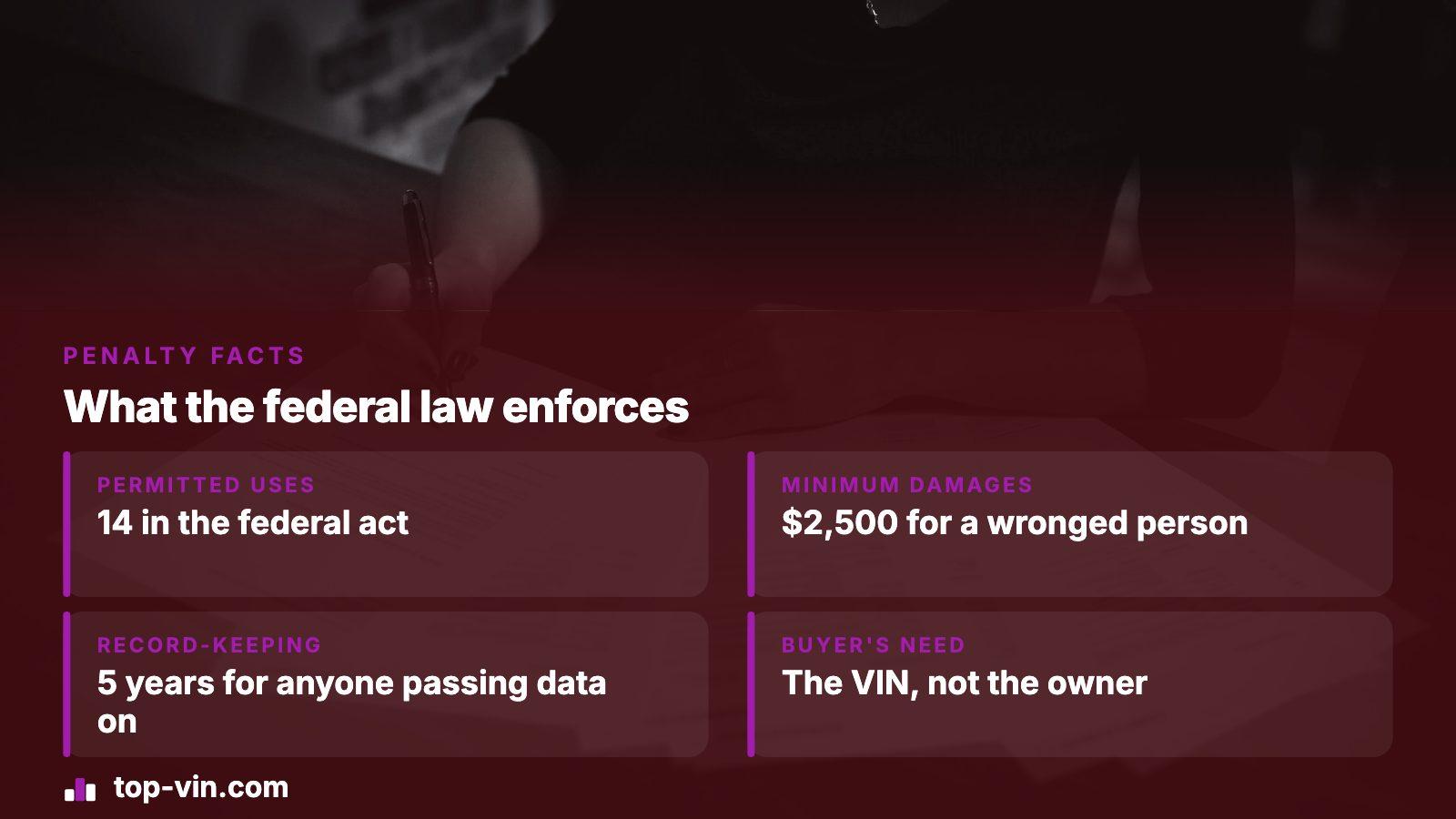
- Permitted uses in the federal act
- 14
- Minimum damages a wronged person can seek
- $2,500
- Record-keeping for anyone who passes data on
- 5 years
- What a buyer actually needs
- The VIN, not the owner
What the law actually protects
Registration, title and license files kept by a state are all treated as motor vehicle records under the statute. Inside them, the protected material is whatever identifies a person: name, street address, phone number, driver ID number, photo, Social Security number and medical details. A bare 5-digit ZIP code is excluded, as are crash reports, tickets and a driver's standing.
Responsibility sits with whoever holds the data. A state agency, plus the people who work for it or under contract to it, has to refuse a request for the protected fields unless one of the section's exceptions fits. Your plate number only points to the file; the file is the thing under lock.
Who can get plate records, and for what
The exceptions are narrow. Nearly all describe work someone is doing, not a wish to know who owns a car. The rows below are the ones that tend to raise questions for buyers.
| Permitted use | Who it serves |
|---|---|
| Government functions | Agencies, courts and law enforcement |
| Safety, theft, recalls, emissions | Work on vehicle and driver safety matters |
| Fraud and debt | A legitimate business checking data a customer gave it |
| Legal proceedings | Serving papers and investigating before a lawsuit |
| Insurance | Claims, antifraud, rating and underwriting |
| Towing and impound | Notifying the owner of a towed vehicle |
| Licensed investigators | Only for a purpose the section already allows |
| Written consent | A requester who holds the person's signed permission |
A final exception lets a state approve other uses connected to driving or public safety. Shopping, hunches and nosiness are nowhere in the list.
What a state records request looks like
Each state runs its own process, so the paperwork differs. California's DMV is one example. Its records page says addresses and Social Security numbers are not public and will not be shared, and it points owners to one form for their own vehicle and to INF 70 for anyone asking about somebody else's record.
Check your own state
Form names, fees and the permitted uses a state accepts vary. Read the records-request page on your state DMV's own site before you file anything, and expect to state your permitted use.
Under the federal statute, a state may also mail the person concerned a copy of the request and hold the data until that person waives the protection. Charging an administrative fee for a record is allowed.
Penalties for getting it wrong
Two acts are unlawful for the requester: knowingly obtaining protected data for a use outside the exceptions, and making a false statement to obtain it. Knowing violations draw a fine under federal criminal law.
- The person described in the record may bring suit in a federal district court.
- Damages can never fall below $2,500, and a judge may add punitive damages when the breach was willful or reckless.
- Lawyer fees and the cost of the case can be awarded too.
- A state agency that routinely ignores the rules risks a federal civil penalty of up to $5,000 each day.
Anyone who lawfully receives the data and forwards it may do so only for an allowed use, and must log each recipient and purpose for 5 years.
Why online plate search pages disappoint
A page promising an owner's name for any plate is selling what the law restricts. An honest operator either asks you to certify a permitted use or returns vehicle facts and nothing personal. We cannot vouch for any specific site, so judge each by what it makes you certify and what it actually returns.
A request to confirm a permitted use is a sign the operator understands the act. A promise of anyone's address, with no questions asked, is a sign it does not, and you would be the one taking the legal risk by using a result you were never entitled to.
The lawful way to reach a VIN
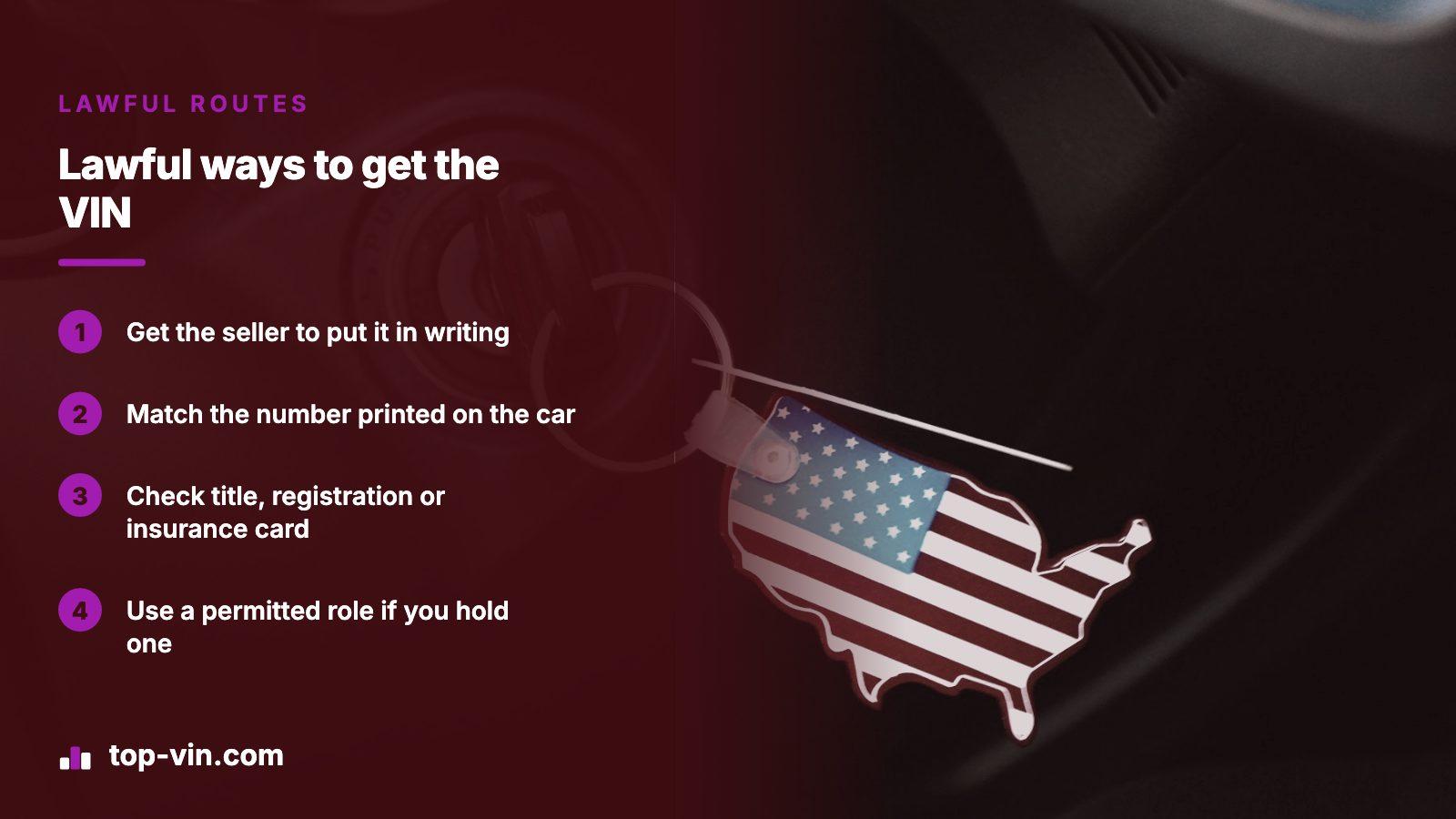
Buyers rarely need the person at all. What they need is the 17-character VIN, and that number is not personal information. Four routes reach it without touching a protected record.
- Get the seller to put the VIN in writing before you travel to see the car.
- Walk around to the car and match what is printed on it against the seller's documents.
- Look at the title, registration or insurance card, all of which print it.
- If you hold a permitted role, such as a lender or insurer, file the state's formal records request.
A seller who refuses to share the VIN has told you something useful about the sale.
Next step: a VIN check
Once you hold the VIN, TopVIN opens with a free preview. Going further means one purchase, with nothing recurring, and the pricing page shows the options. The report looks at the vehicle: title brands, collision and damage entries, mileage readings, auction and salvage records with photos, liens, theft entries and open recalls. It carries no owner names and has no plate search.
That is the point of working from the VIN. The questions that decide whether to buy are about the vehicle's past, and the answers sit in vehicle records.
What the federal title database adds
NMVTIS, the federal title database, is searched by vehicle rather than owner. A search can show the current title, labels like junk, salvage or flood, the newest mileage on file, insurer total-loss rulings and sales to scrap or wrecking yards. Contributors include state titling offices, recyclers, wrecking yards and insurers.
Know the gaps
The system calls its own report deliberately short, built around five indicators. Reporting is incomplete in some states, so a clean result can still miss a record, and every state applies its own brand rules. Treat it as one input, then add a full VIN check and an inspection.
Where this information comes from
- 18 U.S. Code chapter 123 (GovInfo) — Source for the permitted uses, penalties and resale record-keeping.
- California DMV: records requests — One state's approach to confidential data and its two request forms.
- NMVTIS for consumers — Describes what the federal title system shows and where its gaps are.
Sources and photos: Facts checked against the sources above in November 2026. Photos by Nikolai Kolosov, Jake Kling and Dimitri Karastelev on Unsplash; diagrams by TopVIN.
Keep reading
- License plate to VIN: the lawful ways to find a car's VIN from its plateThe practical steps from a plate to a VIN.
- Vehicle registration lookup: what it shows and which check to addWhat a registration record holds and who may see it.
- Is the VIN on the insurance card? What to check before you trust itWhere the VIN sits on a proof-of-insurance card.
- VIN lookup by owner name: what the law lets a buyer seeWhy searching by a person's name runs into the same limits.
Frequently asked questions
Is looking up someone's license plate against the law?
Looking at a plate is not the problem. The statute restricts what a state agency may release from the record behind it, and makes it unlawful to obtain protected details for a disallowed use or by lying. Vehicle facts tied to a VIN are a separate matter.
Will a plate tell me the name of the car's owner?
Generally not for a private buyer. Release of owner details is limited to allowed uses such as an insurance claim, a court matter or the person's signed consent. Shopping for a car is better served by the seller's VIN and the title.
What are the penalties for misusing plate records?
A knowing violation brings a federal criminal fine, and lying to obtain a record is unlawful. The person concerned can sue in federal court, and damages cannot fall below $2,500, with punitive damages and legal costs possible.
Does the law apply to every state?
It is a federal statute, so it sets a floor everywhere, and states layer their own procedures on top. Forms, fees and accepted uses differ, so read your state DMV's records page before requesting anything.
Can a VIN check reveal the owner's name?
No. A VIN check describes the vehicle: title brands, damage, odometer readings, salvage history, liens and recalls. It neither identifies nor locates an owner, and the free preview offers only a first look at that vehicle data.
Now check the car itself
The guide explains what to look for. The report shows what this VIN has on record.