THE SHORT ANSWER
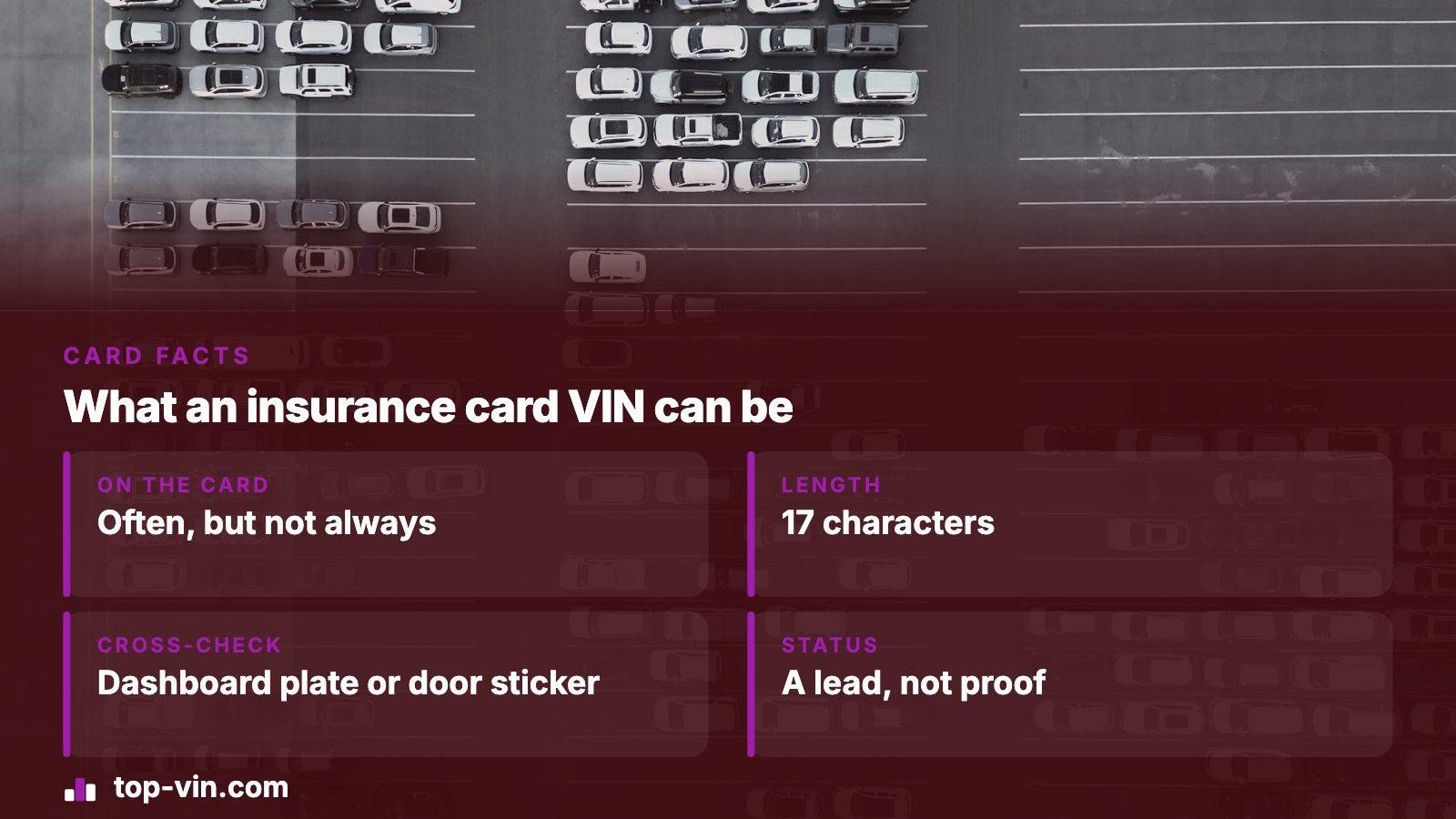
Often, but not always. NHTSA says a vehicle's VIN may be shown on its insurance card, and Texas DMV names the card or policy as a place to find it. Treat the printed number as a lead, not proof. Compare it character by character with the plate on the dashboard or the door jamb, then run a VIN check with a free preview.
- On the card?
- Often, per NHTSA: it may be shown
- VIN length
- 17 characters
- Best cross-check
- Dashboard plate or door sticker
- Preview
- Free before any purchase
What the insurance card tells you about the car
An auto insurance card is a small proof-of-coverage document. It names the insurer, the policy holder and the policy period, and for most policies it also identifies the insured vehicle. The identifier of choice is the VIN, because year, make and model alone cannot separate two similar cars.
Federal guidance is careful on this point. On its recall lookup page, NHTSA lists the registration card as a VIN location and adds a hedge for insurance cards: the number could be printed there. That hedge is the honest summary. Insurers format their cards differently, and some print only the year and make, or truncate the number. If your card shows no VIN, that alone is not a warning sign.
Texas DMV takes a firmer line and lists the insurance card or policy, alongside the title, as a place where the number appears. Both agencies agree on the practical point: the card is a secondary source, useful when you cannot get to the car.
How to read the number off the card
Look for a field labeled VIN, vehicle identification number or simply vehicle. The entry should be one unbroken run of 17 letters and digits. Copy it slowly, because a single swapped character points to a different vehicle or to nothing at all.
- Printed cards often blur zero and the letter O together; zoom in before deciding which you see.
- If the card runs past 17 characters, the extra digits are probably a policy or vehicle number rather than part of the VIN.
- A card with fewer than 17 characters is truncated or mistyped; do not search with it.
Once you have the string, paste it rather than retyping it. If you are working from a photo of the card, zoom in; compression blurs 8 and B, and 5 and S.
Why the card is not proof of anything
An insurance card documents a policy, not the vehicle. The insurer typed the VIN into its system when the policy began, and typing errors survive for years. A seller can also hand over a card for a different vehicle, an old policy or a car that was replaced and never updated.
There is a bigger limit. A card says a policy existed. It does not say the car is clean, that its title is unbranded or that the mileage is honest. California DMV, for instance, treats the insurer's document or ID card as acceptable evidence of coverage, which is a statement about insurance and nothing else.
Mismatch rule
When the card and the dashboard disagree, pause the deal and get an explanation. A typo is the likeliest cause, but paperwork from a different vehicle is possible.
Match the card against the car in five steps
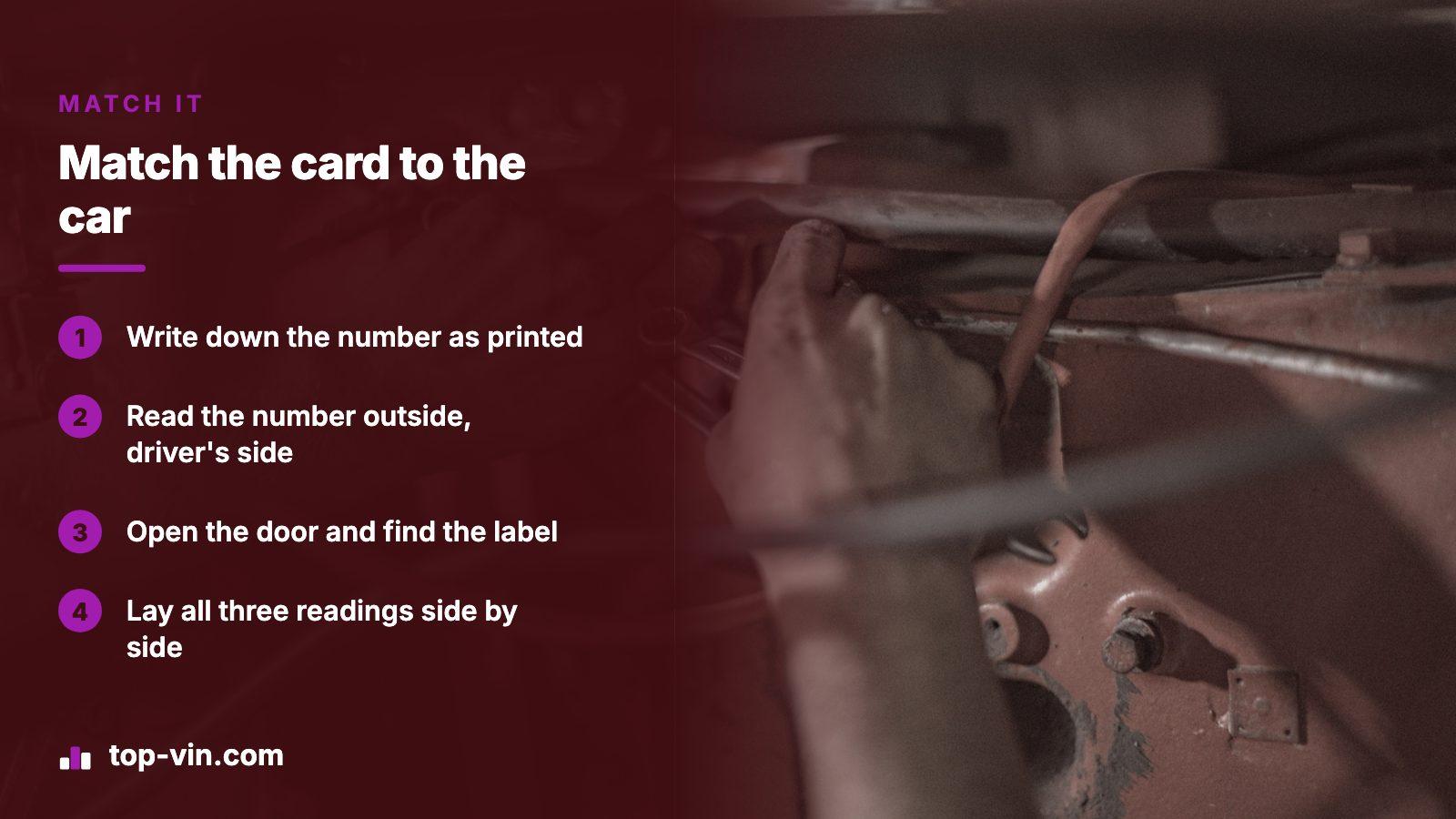
- Write down the number on the card, exactly as printed.
- Stand on the driver's side outside and read the metal plate in the dashboard corner.
- Then open that door and find the label on the frame.
- Lay the three readings side by side and flag any character that differs.
- Look at the registration and title too; they should all agree.
Texas DMV points to the dashboard corner by the windshield and the door or jamb sticker as the places inside the vehicle. If the dashboard plate looks scratched, re-riveted or mismatched with the sticker, treat the car as unverified, whatever the card says.
What to do once the VIN checks out
Once the numbers agree, two public federal tools are worth a few minutes. Enter the VIN in NHTSA's recall lookup and it reports any open, unrepaired recall; a clear vehicle gets a zero-count message. A campaign the owner already had fixed will not appear, and very new campaigns may lag.
The VIN decoder from NHTSA returns the maker's own data for that number. Set it beside the ad: model, body, engine, build plant. A decode that disagrees with the ad deserves an email to the seller.
Those two lookups stop short of title brands, crash damage and mileage trails. TopVIN's preview shows what is on file for the number before you pay anything; paying for the whole report is a single transaction, and rates sit on the pricing page.
What a history report adds that the card cannot
| Question | Insurance card | Recall search | History report |
|---|---|---|---|
| Is the vehicle insured? | Yes, for the policy period | No | Insurance records, where reported |
| Open recall? | No | Yes | Yes |
| Salvage or total-loss brand? | No | No | Yes, from title data |
| Odometer readings over time? | No | No | Yes |
| Theft record? | No | No | Yes |
NMVTIS, the federal title database, has a stated job: shielding consumers from fraud and dangerous vehicles, and keeping stolen ones off the resale market. Title brand data in a history report traces back to that system, which is why a branded car can usually be caught even when the seller hands over spotless insurance paperwork.
When the card has no VIN or you cannot see one
Plenty of buyers meet a car before they meet its paperwork. If the seller has no card, or the card leaves the VIN off, the number is still on the vehicle. Ask for a photo of the dashboard plate and the door sticker, or look in person. The title and registration are the stronger documents anyway, because they come from the state rather than from an insurer's template.
Be cautious when a seller offers a card yet balks at a photo of the car's own number. Honest sellers rarely mind, and the preview runs fine from a phone in the driveway.
Do not share the card
The card also carries the policy holder's name and policy details. Ask the seller for the VIN only, and never post a photo of a card online.
Where this information comes from
- NHTSA: Check for recalls — Says the VIN may be shown on the insurance card, and what a VIN recall search does and does not return.
- NHTSA: VIN decoder — Describes the 17-character VIN and the public decoder, whose data comes from the maker.
- Texas DMV: How to find the VIN — Lists the dashboard, door jamb, insurance card and title as VIN locations.
- California DMV: Insurance requirements — Shows when evidence of insurance must be produced and that an insurer's card qualifies.
- NMVTIS: Vehicle History — Explains the federal title system's purpose.
Sources and photos: Facts checked against the sources above in November 2026. Photos by Cole Keister, Nina Mercado and Iain on Unsplash; diagrams by TopVIN.
Keep reading
- Where the VIN sits on a title, and what to do nextThe stronger document to compare against the card.
- How to find a VIN without the car in front of youOther routes to the number when you cannot get to the vehicle.
- How to read a VIN: a left-to-right walkthrough with a worked decodeWhat the 17 characters mean once you have them.
- VIN verification: the four checks people mean and what each provesHow to confirm a VIN really belongs to the car in front of you.
Frequently asked questions
Is the VIN always printed on the insurance card?
No. NHTSA says the VIN may appear on it, which is not a promise. Insurers lay their cards out differently, and some show only the year and make. If yours lacks it, read the number from the dashboard plate, the door sticker, the registration or the title instead.
Can I run a VIN check using the number on a seller's insurance card?
Yes, as a first pass, once you have compared it with the car. A mistyped or stale card produces a report on the wrong vehicle, or an error. Match it to the dashboard plate, then enter it for the free preview.
Is a digital insurance card good enough to copy the VIN from?
Generally yes, since it carries the same policy data as paper. Zoom in and copy the text if you can instead of retyping it. A screenshot with blurred characters is a poor source, so ask for a clearer image or read the number off the vehicle.
What if the VIN on the card does not match the car?
Hold off buying until the gap is explained. The insurer may have typed it wrong, and the owner can get that fixed. The paperwork might instead belong to another car. Check the title and registration as well, and leave if the seller has no answer.
Does the insurance card show accidents or title problems?
No. It proves a policy existed for a period and nothing about the car's history. Salvage brands, odometer readings, theft records and past damage come from title and other databases, which is what a VIN-based history report is for.
Now check the car itself
The guide explains what to look for. The report shows what this VIN has on record.