THE SHORT ANSWER
A plate points to a state registration record, and federal privacy law keeps the personal details in that file from most requesters. The VIN itself is printed on the car and its paperwork, so the lawful routes are asking the seller, reading it off the vehicle, using the title or insurance card, or filing a DMV records request with a permitted use. Once you have it, enter it for a free preview of the history.
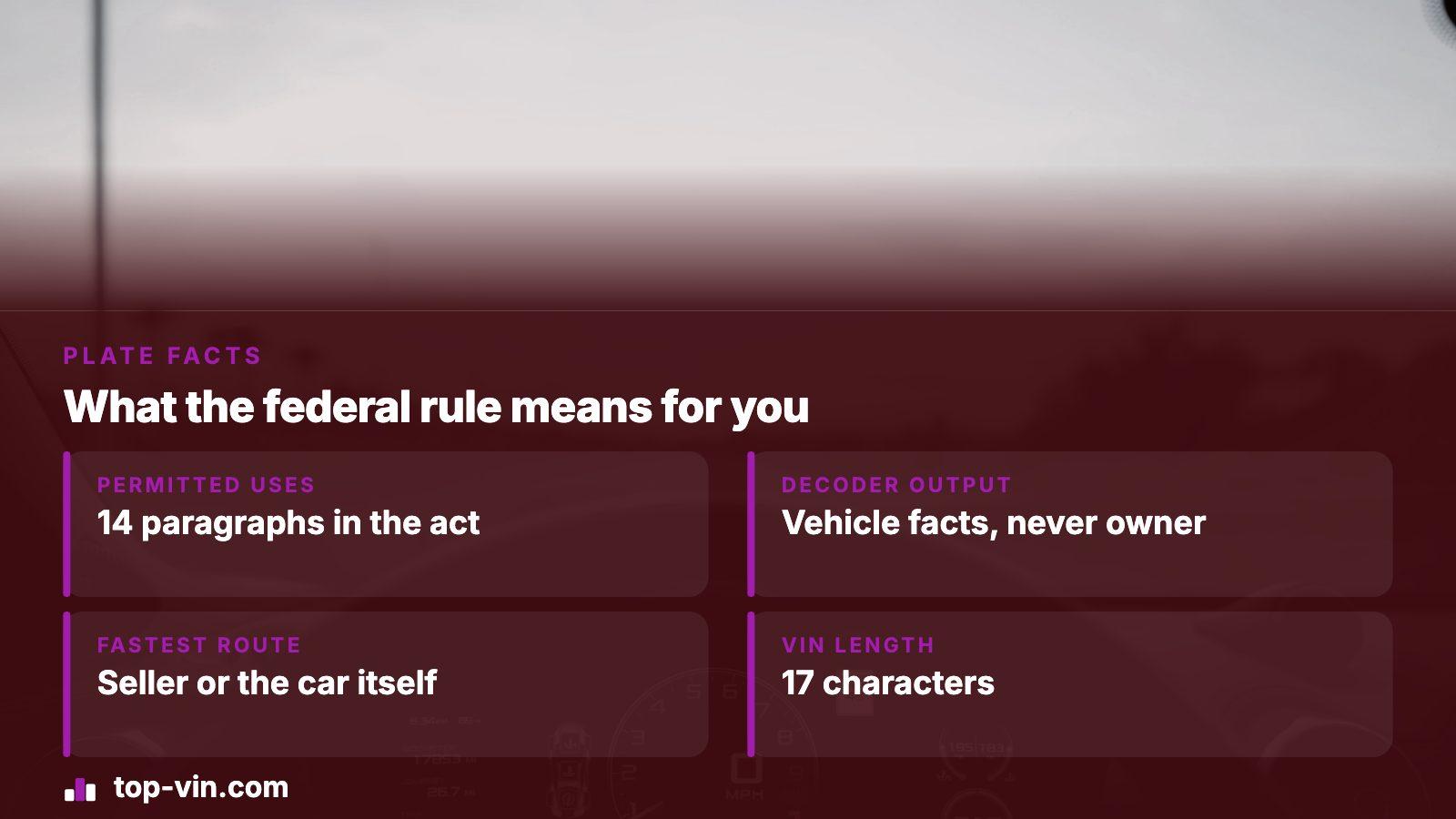
- Permitted-use paragraphs in the federal act
- 14
- Federal decoder output
- Vehicle facts, never owner facts
- Fastest lawful route
- The seller or the car itself
- VIN length
- 17 characters
What a plate gets you, and what it does not
A plate number is a registration marker. It leads to a file kept by whichever state issued it, and that file is where the owner's name and address live. Those details are the protected part. The car is a different matter: its 17-character VIN is on the car, on its paperwork and on the insurance card, and nothing about it is private.
So the practical route from plate to VIN does not involve a search box that hands over the answer. It runs through paperwork you can lawfully hold or ask for. Once you have the VIN, every vehicle check from NHTSA, from the federal title database and from a history report can run, and those are the checks that tell a buyer whether the car is worth the money.
Be wary of the promise
A page that claims to turn any plate into a VIN and an owner name for a small fee is promising something a state is barred from handing to the general public. Read what the sale actually includes before paying.
The federal rule behind the wall
Driver's Privacy Protection Act rules bind a state licensing agency and its employees may not knowingly release identifying data from a title, registration or license file unless the request fits one of the listed uses. That covers any record tied to a title, a registration, a driver permit or an ID card.
The statute counts as personal anything that points to an individual: name, address beyond the zip code, phone number, photograph, Social Security number, driver ID number and medical details. Accident data, violations and driver status are carved out of that definition. The point for a car shopper is simple: the vehicle's description is not protected, the person attached to it is.
Uses the law allows
The statute spells out 14 permitted-use paragraphs. A handful matter to people who land on this page:
- Government agencies, courts and police doing their work.
- Safety, theft, recall and emissions matters, plus market research.
- A business checking details a customer gave it, only to stop fraud or collect a debt or security interest.
- Court and administrative proceedings, including serving papers.
- Insurers working on claims, fraud or underwriting, and notices to owners of towed vehicles.
- Anyone who can show signed approval from the individual named in the file.
- Anything else the record-holding state authorizes if it relates to driving or public safety.
Curiosity about a stranger's car does not appear on that list. Neither does sizing up a seller before a test drive.
Four lawful ways to get the VIN
Whichever route you take, you are collecting a 17-character number you are entitled to see. Work down the list from fastest to slowest.
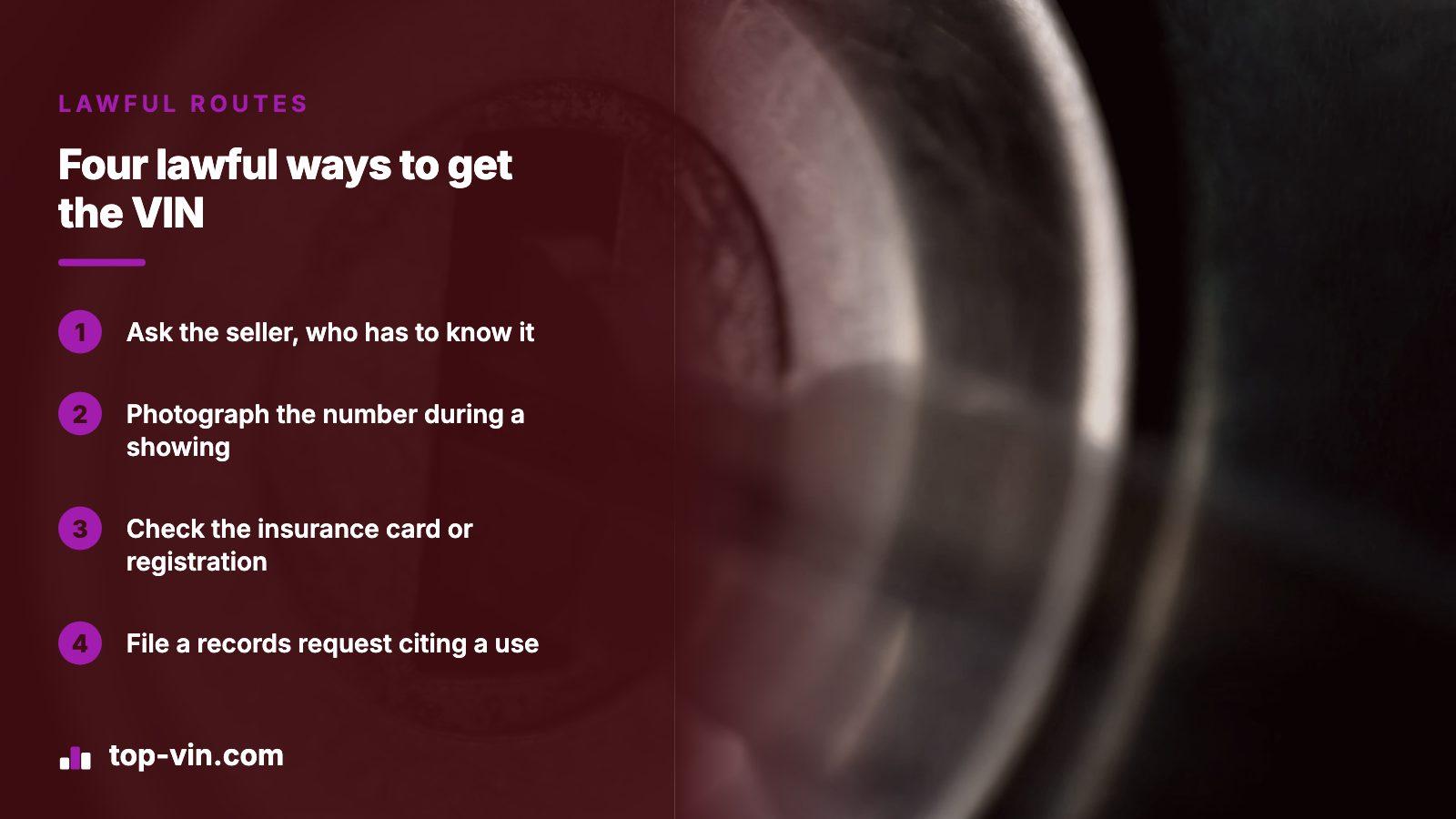
- Ask the seller, who has to know it. A private owner can read it off the windshield-base plate, the label inside the driver's door, the title or the registration card.
- During a showing, photograph the number on the vehicle and hold it against the title. If they differ, stop there.
- Check the insurance card or the registration slip, both of which carry it, if the car is yours or you are authorized to hold the paperwork.
- File a state records request that cites a permitted use, and accept that you may get an owner record with personal details withheld or reviewed.
For a car you are thinking about buying, the first two take minutes and are usually enough.
What a DMV records request looks like
California shows how formal the process can get, and other states vary, so confirm anything specific on your own state's DMV page. California's DMV asks anyone who wants someone else's vehicle record to complete form INF 70 and mail it with a check. Requesters give their real name, address and phone number, and state a permitted use under the federal act.
The vehicle section takes either a California plate or a VIN, one vehicle per form. A current record lists the registered owner, the legal owner, the vehicle description and the registration status, and an ownership history goes back to roughly three prior owners. The agency's own instructions warn that a false statement, or using the record for a purpose other than the one stated, is a misdemeanor, and that the record's subject receives a copy of the request. A shopper kicking tires rarely has a use that fits, which is why most buyers skip this route.
Run the VIN check once you have it
With the number in hand, the work gets useful. NHTSA's decoder reads the factory details baked into the VIN: make, model, model year, where it was built, body class and engine layout. Its recall lookup then lists campaigns for that exact model and year. Neither shows an owner, which is the point: the decoder describes the car.
Next comes title history. The federal NMVTIS database collects from state title offices, insurers, recyclers and scrapyards, and shows title records, brands, the latest reported odometer reading and sometimes theft history. TopVIN's preview works from the same VIN, and the full report adds damage, auction, lien and market-value sections on top, so you see what the car has been through before you hand over cash.
Enter the VIN on the TopVIN home page to open the preview, then decide whether one report is worth it. Looking at the preview costs nothing. The full report is one purchase rather than a plan, and /pricing shows what is offered.
Red flags when the plate and the VIN disagree
People searching by plate usually have a specific car in front of them, so use that. A seller who will not show the VIN, or who offers a number that differs from the dash plate, is telling you something. So is a VIN that decodes to a different year or body style than the car in the driveway.
| Observation | Possible meaning | Move |
|---|---|---|
| Seller will not share the VIN | Paperwork problem or a car they cannot title | Walk away or ask for the title first |
| Dash VIN differs from the title | Altered or mismatched documents | Stop and report the mismatch |
| Decoder year or body class is off | Wrong VIN, or a rebuilt car | Compare the car with the decode |
| Plate from another state | Title and registration may sit elsewhere | Run the full history, not a local check |
None of these proves fraud alone. Each one is a reason to slow down and read the history.
What to do next
When the car is still a candidate, collect the VIN, decode it, run the recall lookup and open the TopVIN preview. If you are the owner and cannot find the number, your insurance card, registration slip or title has it. Where the plate matters because of a collision, a driver who fled or a legal dispute, send the request through the police, your insurer or an attorney, who can use the permitted channels. Anything you buy or request should be tied to the VIN itself, because that is the number every record is built on.
Where this information comes from
- 18 U.S. Code 2721: Driver's Privacy Protection Act — Source for what a DMV may release and the list of permitted uses.
- 18 U.S. Code 2725: definitions — Defines personal information and motor vehicle record, and what is carved out.
- California DMV: form INF 70 — Shows one state's records request, its penalties and what an ownership record holds.
- NMVTIS for consumers — Federal title, brand and odometer database searched by VIN.
- NHTSA: vPIC decoder API — Federal tool that decodes a VIN into factory facts.
Sources and photos: Facts checked against the sources above in November 2026. Photos by John Kakuk, Derek Nelson and Dennis Eusebio on Unsplash; diagrams by TopVIN.
Keep reading
- Vehicle registration lookup: what it shows and which check to addWhat a registration record holds and who may request it.
- License plate lookup privacy laws: what you can and cannot get from a plateMore on why plate searches are limited by privacy law.
- DMV VIN check compared: what the state shows and what to run beside itHow state agencies handle VIN requests.
- How to read a VIN: a left-to-right walkthrough with a worked decodeFind the number on the car and read what each part means.
Frequently asked questions
Can I find a VIN from a license plate for free?
Not through a public lookup. Federal privacy rules limit what a state hands out from a plate record. The free routes are practical ones: ask the seller, read the dash and door-jamb labels, or check the title and insurance card. The VIN preview on TopVIN is free once you have the number.
Is it legal to look up a plate to find the owner?
Only for a purpose the Driver's Privacy Protection Act permits, such as a court proceeding, an insurance claim or a safety matter, and the request goes through the state, not a consumer website. Curiosity or sizing up a seller does not qualify.
What if I need the plate checked after a hit-and-run?
Hand the plate number to officers and to your insurance company. Both can ask the registration record through permitted channels, where a private citizen cannot. File a report quickly and keep your own notes on the time and place.
Does a DMV records request return the VIN?
It can include the vehicle description, and some states show the VIN on the record. The form usually needs your identity, a stated permitted use and a fee, and the owner may be notified. For a purchase, getting the VIN from the seller is simpler.
Is the TopVIN report free?
Only the preview. A VIN entered on the site brings up a preview at no cost. Past the preview, you pay once for a report or a pack and nothing recurs. Current options sit on the pricing page.
Now check the car itself
The guide explains what to look for. The report shows what this VIN has on record.