THE SHORT ANSWER
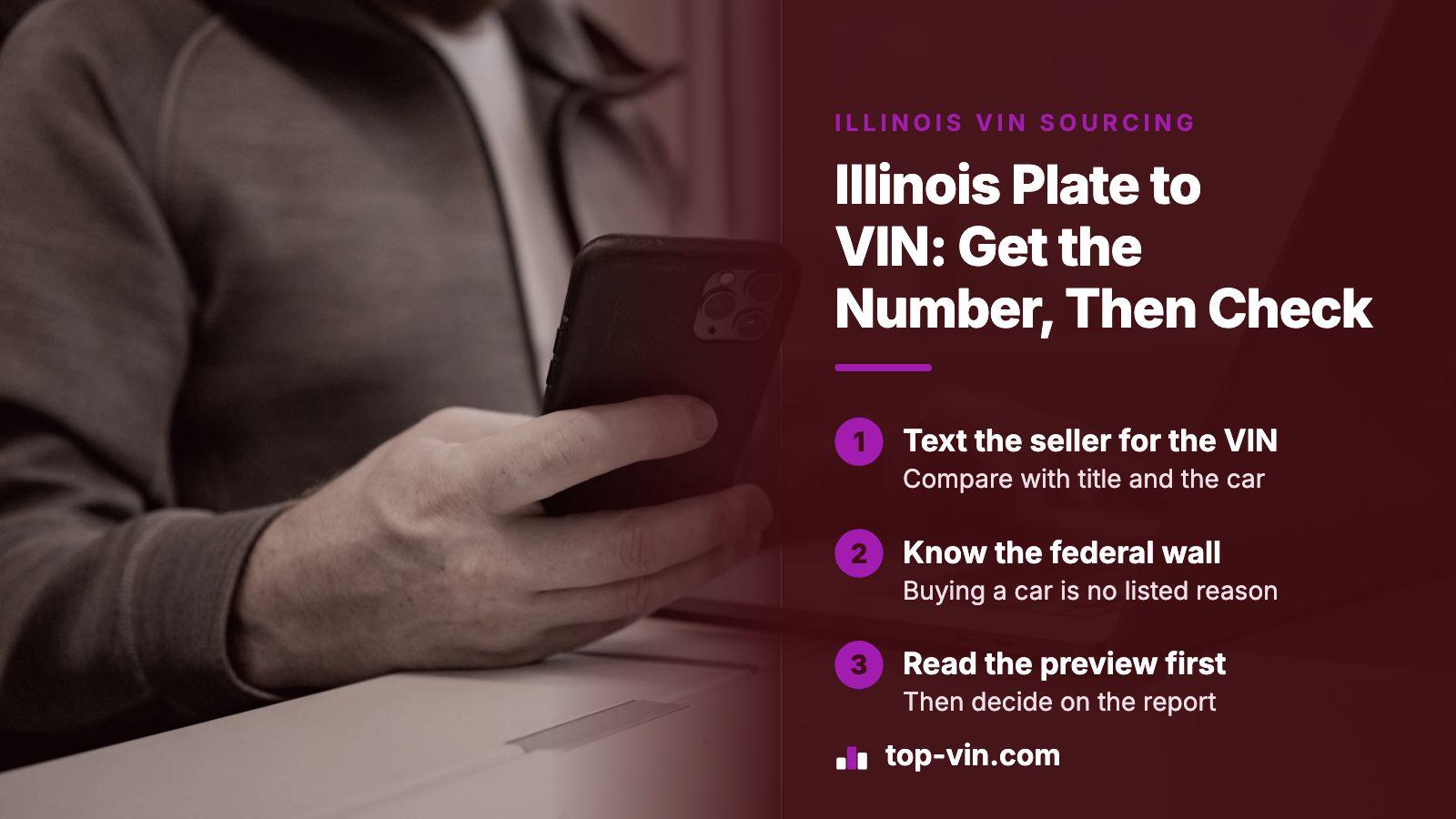
An Illinois plate does not hand a buyer the VIN. Federal law limits what a state can hand out from its vehicle files, and wanting to size up a used car is not one of the reasons it accepts. Have the seller send the VIN in a text or email, check it against the title and the number on the car, then type it into TopVIN and look at the free preview first.
- Plate search at TopVIN
- None, by design
- Governing rule
- Federal Driver's Privacy Protection Act
- Better starting point
- The 17-character VIN
- TopVIN
- Free preview, then one payment
What an Illinois plate can and cannot tell you
A plate is the one identifier you can read from the curb, which is why so many people type it into a search box. But everything a careful buyer cares about is attached to the VIN: brands on the title, damage entries, odometer readings, theft flags, open recalls. The plate only points into a registration file, and plates can be moved to other vehicles.
TopVIN is built around the VIN for that reason. It has no plate search, and it never shows an owner's name, address or phone number. If a site promises an instant Illinois owner or VIN from nothing but plate characters, treat the promise as a reason to leave.
The federal law behind the wall
Section 2721 of the federal code (18 U.S.C.) forbids a state vehicle agency from knowingly disclosing personal details held in its files, unless the disclosure fits a purpose the statute lists. Personal information covers a name, address (the five-digit ZIP excepted), telephone number, driver ID number, photo, Social Security number and medical details. Photos, Social Security numbers and medical data face a stricter gate and generally need the person's written consent.
The law is a federal floor, so Illinois can add its own limits on top. We could not read Illinois's own pages to see how, which is covered further down. What the federal text alone shows is that a shopper vetting a car before purchase is missing from the permitted uses.
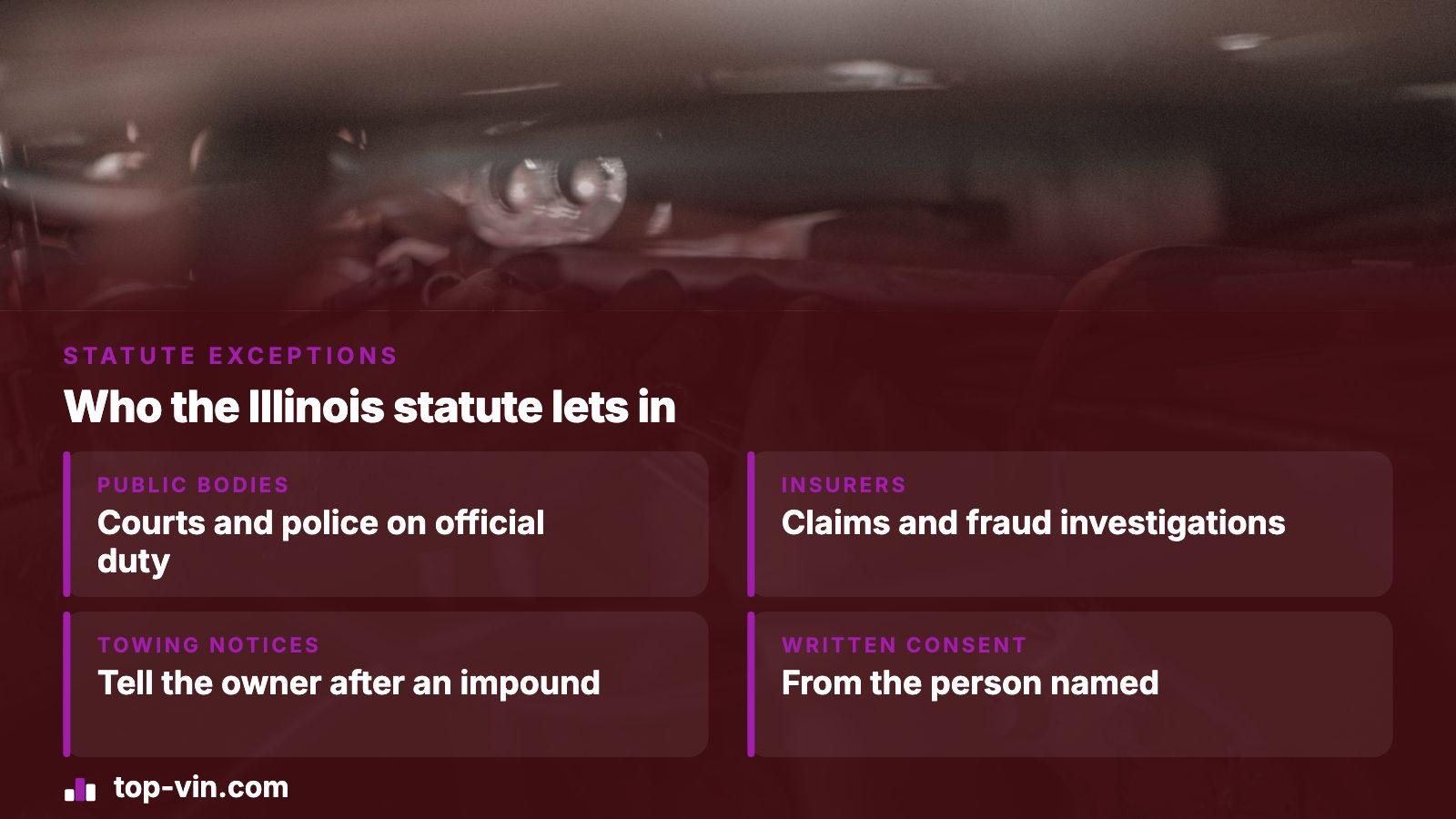
Who the statute does let in
These are the permitted purposes closest to a plate question. Each one is tied to an official or legal function, not to a purchase decision.
- Public bodies, including courts and police, carrying out official work.
- Insurance companies investigating claims or fraud, or setting rates.
- People involved in lawsuits or agency hearings, such as those delivering legal papers.
- Tell-the-owner notices after a car is towed or impounded.
- Licensed private investigators pursuing one of the other allowed purposes.
- Safety, theft, recall and emissions matters.
- Anyone who can show the written consent of the person named in the record.
Anyone who obtains data this way and passes it along is limited to the same list of purposes, and has to keep a log of each recipient and reason for 5 years. That obligation is one more reason legitimate channels ask for a stated purpose and are not casual lookups.
Asking the state directly
If you really do fall under a permitted use, for instance a claim file or a lawsuit, the request goes to the state agency that issues Illinois titles and registrations, and you certify the use you are claiming. The federal act lets a state charge an administrative fee for a record, and says a state cannot make you obtain someone's consent as a condition of issuing that person's own record.
What we could not confirm
Illinois's state vehicle pages refused our automated reading every time we tried, and the legislature's site would not connect. We therefore cannot quote an Illinois form name, a fee, a turnaround time or any state statute. Read the agency's current instructions yourself before filing, and certify a purpose only if it is true.
Getting the VIN without a records request
A buyer rarely needs the state at all. A seller with nothing to hide can text the number in a minute. Work through these in order and stop when you have two sources that agree.
- Have the seller send the VIN as a message before you make the trip to see the car.
- Read it off the Illinois title, one character at a time.
- Compare it with the registration card, which should show the same string.
- Ask for the insurance card or a screenshot of the policy page listing the insured vehicle.
- At the car, photograph the stamped number and hold the picture against the paperwork.
If two sources disagree, pause. A typo is possible, but so is a swapped part or an altered document, and that is worth settling before any cash or deposit changes hands.

Running the Illinois car's VIN through TopVIN
Enter all 17 characters at TopVIN and a free preview opens first. Compare the decoded year, make and model with the listing and with the vehicle in front of you. NHTSA's public decoder works the same way: given a VIN, it returns the make, model, model year and plant, so a mismatch at this stage is a loud signal.
When the preview matches, that vehicle's full report can be bought a single time, with no renewal. Amounts are on the pricing page. Read the title and brand section before anything else, then damage and salvage entries, odometer readings, liens and open recalls. Each answers a different fear, and a car that has lived near the Great Lakes deserves a close look for flood or salvage history.
How to act on what you find
| Finding | Sensible response |
|---|---|
| Salvage, junk or flood brand | Ask what happened and who repaired it, then value it as a branded car or leave. |
| Odometer reading higher than a later one | Suspect rollback and ask for service receipts. |
| Open lien | Hold your money until the lender's release is in your hands. |
| Theft entry | Stop and confirm with the police or the insurer. |
| Open recall | Book the repair with a franchised dealer after purchase. |
Federal law created the title system with the aim of protecting buyers from fraud and unsafe cars. Its guidance calls a clean result a good outcome. Five things are tracked: title status, brands, odometer, total loss and salvage; repair and maintenance records are left to private providers. Even a clean report does not replace a test drive and an independent inspection.
A short list before money moves
- Collect the VIN from two sources and confirm they match the car.
- Run the free preview and compare it with the advertisement.
- Open the full report if the preview fits, and read the title section first.
- Look at the paper title in person and insist on a written lien release if one shows.
- Pay a mechanic to inspect the car, and take it out on both city streets and a highway.
The federal buying tips page recommends exactly that mix of inspection, test drive and history report, and it suggests asking for maintenance records and talking with the previous owner when you can.
Where this information comes from
- Driver's Privacy Protection Act, 18 U.S.C. 2721 — The release ban, the permitted purposes, the record-keeping duty and the fee rule.
- DPPA definitions, 18 U.S.C. 2725 — What counts as personal information and as written consent.
- NMVTIS consumer information, vehiclehistory.gov — The purpose of the federal title system.
- Understanding an NMVTIS vehicle history report — The five indicators the federal report covers and what a clean result means.
- Used car buying tips, vehiclehistory.gov — Inspection, test drive and history-report advice for buyers.
- NHTSA vPIC VIN decoder — Shows that a VIN decodes to make, model, year and plant.
Sources and photos: Facts checked against the sources above in November 2026. Photos by Anastasiia Nelen, Cole Keister and Nina Mercado on Unsplash; diagrams by TopVIN.
Keep reading
- License plate to VIN: the lawful ways to find a car's VIN from its plateThe nationwide view of why plates and VINs differ.
- Where the VIN sits on a title, and what to do nextWhere to read the number on the paper title.
- Is the VIN on the insurance card? What to check before you trust itUsing the insurance card as a second source.
- Vehicle registration lookup: what it shows and which check to addWhat registration records hold and who may see them.
Frequently asked questions
Can I find a VIN from an Illinois license plate number?
Not through any public search we could confirm. Federal law restricts what states release from vehicle records, and sizing up a car for purchase is not a listed purpose. Ask the seller, read the title, registration or insurance card, or write the number down from the vehicle itself, then run a history check.
Does TopVIN search Illinois plates?
No. TopVIN works from the VIN and never returns an owner's name, address or phone number. Enter all 17 characters, look over the free preview, and decide afterward on the full report.
Who can legally request Illinois records tied to a plate?
The federal act names agencies, courts, police, insurers, parties in legal cases, towing notices, licensed investigators and anyone holding the record subject's written consent. Illinois sets the actual steps and any fee, and we could not read them, so check the state's own site.
The seller will not give me the VIN. What should I do?
Take it as a warning. The number sits on the title and on the vehicle, so stalling rarely has an innocent explanation. Offer to photograph it yourself at the car, and leave if it disagrees with the paperwork.
Is the TopVIN report free?
No. Only the preview carries no charge. Past it, the report is one purchase, never a monthly bill, and the pricing page shows the options. Begin with the preview so you know the VIN matches the car you intend to buy.
Now check the car itself
The guide explains what to look for. The report shows what this VIN has on record.