
THE SHORT ANSWER
A private buyer cannot get a VIN from an Iowa plate by asking the state. When a request is made with a plate number, Iowa Code 321.11 allows personal information to go only to law enforcement, government employees on official duty, certain investigators and licensed security services. Ask the seller for the title, read the number off the car, then run it through a TopVIN preview.
- Plate request rule
- Iowa Code 321.11(3) limits who may ask by plate
- Federal limit
- Driver's Privacy Protection Act, 18 U.S.C. 2721
- Buyer's title deadline
- 30 calendar days at a county treasurer
- TopVIN step
- Free preview, then one payment
What Iowa will release when someone shows up with a plate number
People search for an Iowa plate lookup when a listing photo shows a plate and the ad leaves out the VIN. The state's own statute shuts that route for a shopper. Section 321.11 of the Iowa Code sets out who can receive personal details if the request starts from a plate: police, government employees working in an official capacity, one category of contract investigator at the inspections and licensing department, and licensed private investigators or security services.
Buying a used car is not on that roster. The section also lets an officer share a registrant's name, address and phone with a person who holds a plate, but only when the officer decides it is necessary for the officer's work. That is the officer's call. It is not a service anyone can order.
The federal law sitting on top of it
Iowa's rule sits under a federal one, the Driver's Privacy Protection Act (federal code section 2721 of title 18). Under it, state motor vehicle offices and their staff and contractors may not knowingly hand out personal details held in a vehicle record unless a listed use applies. Most listed uses have nothing to do with a shopper: courts and agencies, insurers working claims, notices to owners of towed cars, licensed investigators, and anyone carrying the record subject's written consent.
One entry looks tempting and does not fit. Ordinary business use is allowed, yet only to confirm what a customer told it and, where that was wrong, to correct it while guarding against fraud or chasing a debt. Sizing up a car before paying for it is a different purpose. A website offering an Iowa owner's name from a plate for a small fee is selling something the state could not lawfully supply to you.
Five places a VIN is already waiting for you
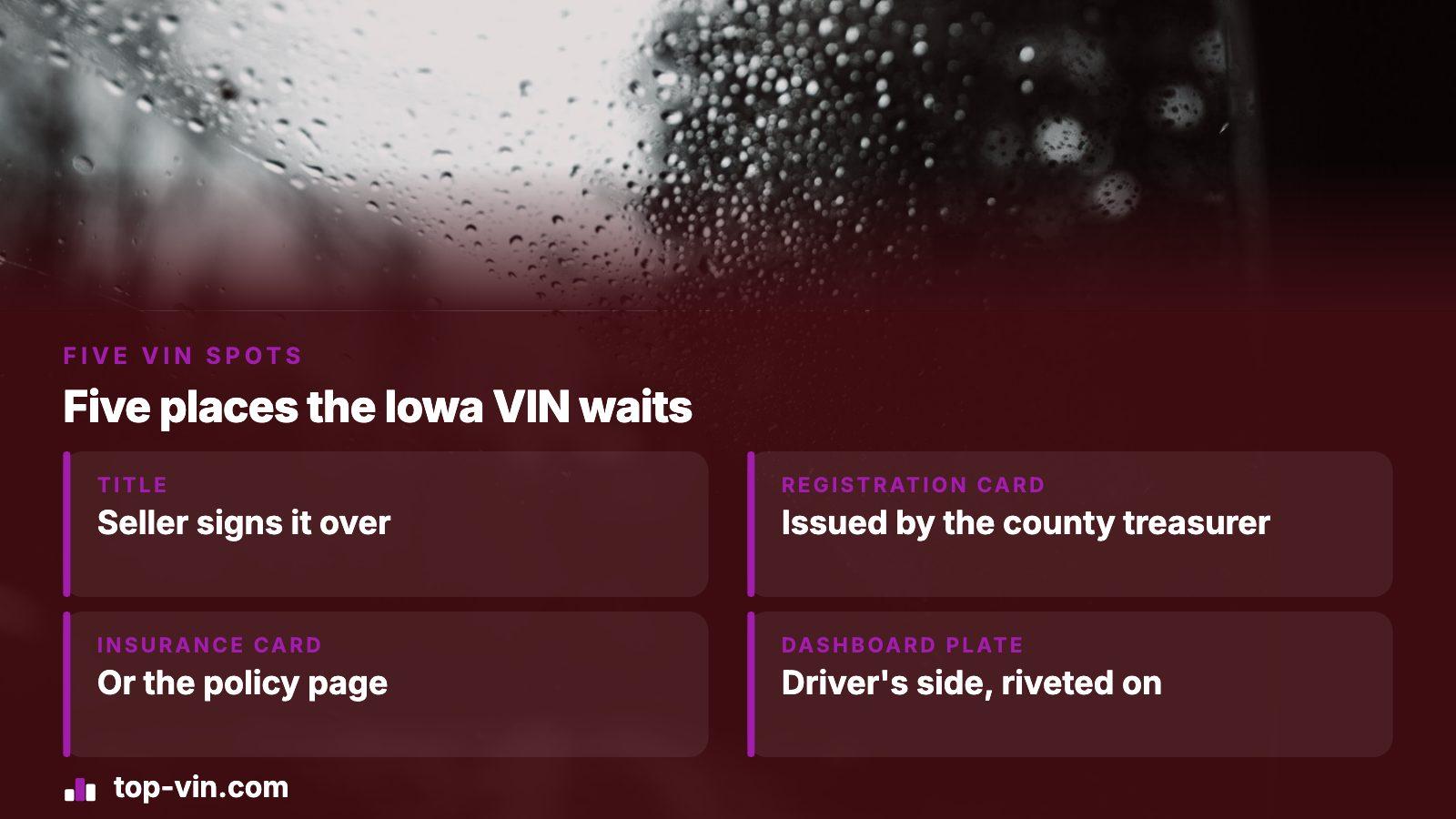
The plate was never the best handle on a car. The vehicle number sits in several spots a buyer can reach without any request to the state.
- The certificate of title. Iowa requires the seller to sign it over to you, so ask for a photo of the front and back before you travel.
- The current registration card, which the county treasurer issues and which belongs in the glove box.
- The insurance card or policy page the seller carries, which usually lists the vehicle number next to the policy details.
- The plate riveted to the top of the dashboard on the driver's side, readable from outside through the glass.
- A listing from a dealer, who keeps the number on the paperwork for every unit on the lot.
Two matches are not enough
Compare the number on the dash with the label on the door frame, then with the title. If the three do not agree character for character, end the visit. A mismatch can mean a swapped part, a typo on the paperwork or something worse, and none of those is yours to solve.
What a TopVIN check shows once you have the number
Type the VIN into TopVIN and you get a preview at no charge. The preview confirms that the make and year match the ad and lists the record groups the lookup found. Moving on to the full report costs one payment with no renewal, and the pricing page lays out the packs.
For an Iowa buyer, read the title brands, damage entries, odometer history and lien record first. Those four answer what a plate never could: has the car been written off, has the mileage gone backward, and does a lender still hold a claim. Salvage and auction entries can include pictures of the car as it looked after the loss.
Why a clean Iowa title is not the end of the story
In the federal NMVTIS, a brand is a descriptor such as junk, salvage or flood that a titling agency pins on a car. Rules differ by state. Identical damage might earn a salvage brand in one place and none in another, since every state draws its own line, and flood wording that exists in one state may be absent next door.
Many used cars reach Iowa from elsewhere. One retitled here after a brand was applied in another state, or never applied at all, can look clean on paper. A check built on titling agencies, recyclers, salvage yards and insurers has a better chance of surfacing that history than the paper in your hand.
| What you see | What it may mean | Next step |
|---|---|---|
| Brand in another state's record | Title history the seller never mentioned | Ask for the earlier title and an explanation |
| Total loss entry, car advertised clean | Insurer wrote it off before resale | Walk away or price the repair risk in |
| Odometer reading lower than an earlier one | Rollback or a reporting slip | Request maintenance receipts that show mileage |
| Open lien | A lender may still hold the title | Get a written release before paying |
Iowa's title and registration steps for the buyer
Under Iowa Code 321.46 the buyer has 30 calendar days to visit a county treasurer's counter, any county, and get the registration and title reissued. Take the title the prior owner signed over, and be ready to name the county of last registration and its expiry date. The statute names a title fee of 30 dollars and a prorated annual registration fee, so ask the treasurer for today's amounts before you go.
The seller has a paper step of their own. A seller may file an affidavit at a county treasurer certifying the sale and the delivery of the title, and the treasurer notes it in the system. Ask whether it has been filed. It protects them, and it also tells you the car is no longer in the seller's name on the state's books.
If you truly cannot reach the seller
Sometimes a plate is all you have: a car left on your street, a hit-and-run, a repossession. Those belong to the people on Iowa's list. Police can pursue a plate through the department, an insurer working a claim has its own federal permitted use, and a court can order records inside a proceeding.
We could not open the Iowa Department of Transportation's own records pages, which blocked automated readers, so we cannot tell you which form or fee applies to a records request. Check with the department directly, and be ready to state a use that matches the statute. Shopping for a purchase will not qualify, and a request that misstates the reason is a bigger problem than a missing VIN.
What to do with the result
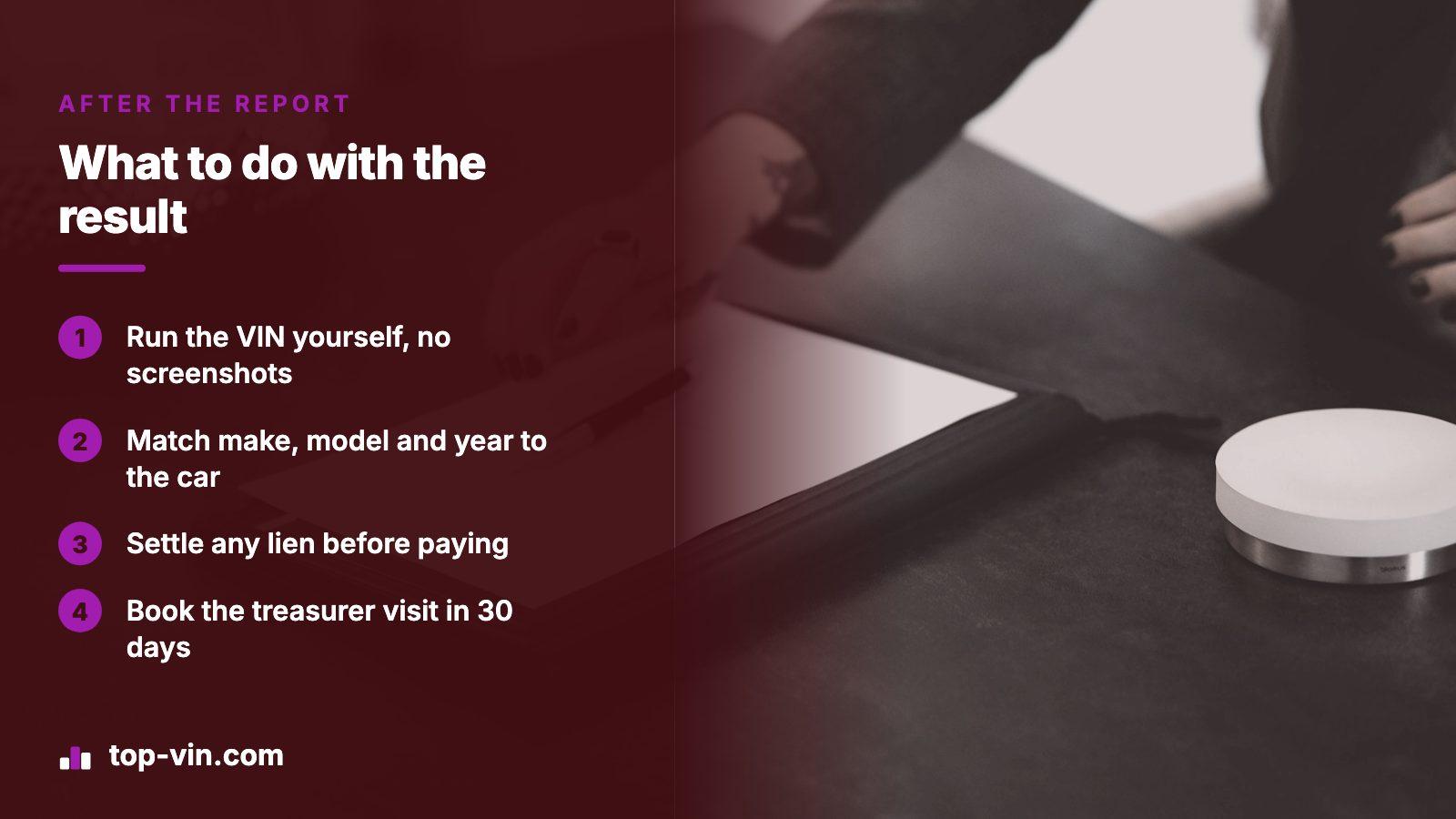
A clean report means keep looking, not sign. Add a test drive, a look underneath for rust and repairs, and a mechanic's opinion. If the report shows a brand, lien or mileage drop the seller never mentioned, ask about it in writing and watch the answer.
- Run the VIN yourself rather than accepting a screenshot from the seller.
- Match the report's make, model and year against the car in front of you.
- Settle any lien before money changes hands, and keep the lender's release.
- Book the county treasurer visit inside the 30-day window.
Where this information comes from
- Iowa Code 321.11: records of the department — Who may receive personal information when a request is made by plate number.
- Iowa Code 321.46: new title and registration on transfer — The buyer's 30-day deadline, the title papers and the seller's affidavit.
- 18 U.S.C. 2721, Driver's Privacy Protection Act — The federal limit on releasing personal information from state records and its permitted uses.
- NMVTIS for consumers — What a brand is, where title data comes from and why states differ.
Sources and photos: Facts checked against the sources above in November 2026. Photos by Richard R, Annika Wischnewsky and Justin Cron on Unsplash; diagrams by TopVIN.
Keep reading
- License plate to VIN: the lawful ways to find a car's VIN from its plateThe same question for any state, and why the answer rarely changes.
- Motor vehicle records: what a car buyer can see, and what stays closedHow a state record differs from a history report.
- Vehicle registration lookup: what it shows and which check to addWhat registration data holds and who may read it.
- How to read a VIN: a left-to-right walkthrough with a worked decodeRead the number you collected, position by position.
Frequently asked questions
Can I look up a VIN by license plate in Iowa?
Not through the state as a private buyer. Iowa Code limits plate-based requests for personal information to law enforcement, government staff on official duty and certain licensed investigators. Shoppers get the VIN from the seller, the title, the registration card or the car, then check that number.
Is there a free Iowa plate to VIN tool?
None that we could confirm from official pages. Sites that claim to return an Iowa owner from a plate are not offering what the state is allowed to release. Free tools that do exist start from a VIN, and a TopVIN preview is free to view.
Does the Driver's Privacy Protection Act stop me from checking a car?
No. The act covers personal information about people in motor vehicle records. A VIN check examines the vehicle, not the owner. You are free to run any VIN you hold, which is why getting the number from the seller is the usual route.
What is the deadline to title a newly bought car in Iowa?
The buyer gets 30 calendar days from purchase under Iowa Code 321.46, and the application goes to a county treasurer. Bring the title signed over by the previous owner, and confirm current fees with the treasurer, because the statute's fee amounts can change.
Is the TopVIN report free?
No, just the preview carries no charge. The complete report is paid for once and does not rebill. Look at the pricing page for what each option covers before you pay.
Now check the car itself
The guide explains what to look for. The report shows what this VIN has on record.