THE SHORT ANSWER
Run the number on the US title first, then the one on the car's chassis plate. In test decodes, a 17-character VIN returned a make, model and year, while hyphenated Japanese chassis numbers returned errors and almost no fields. A search can show US title brands, odometer entries, insurer losses and theft reports filed under the number. It cannot see the car's years in Japan, so ask the seller for the export paperwork.
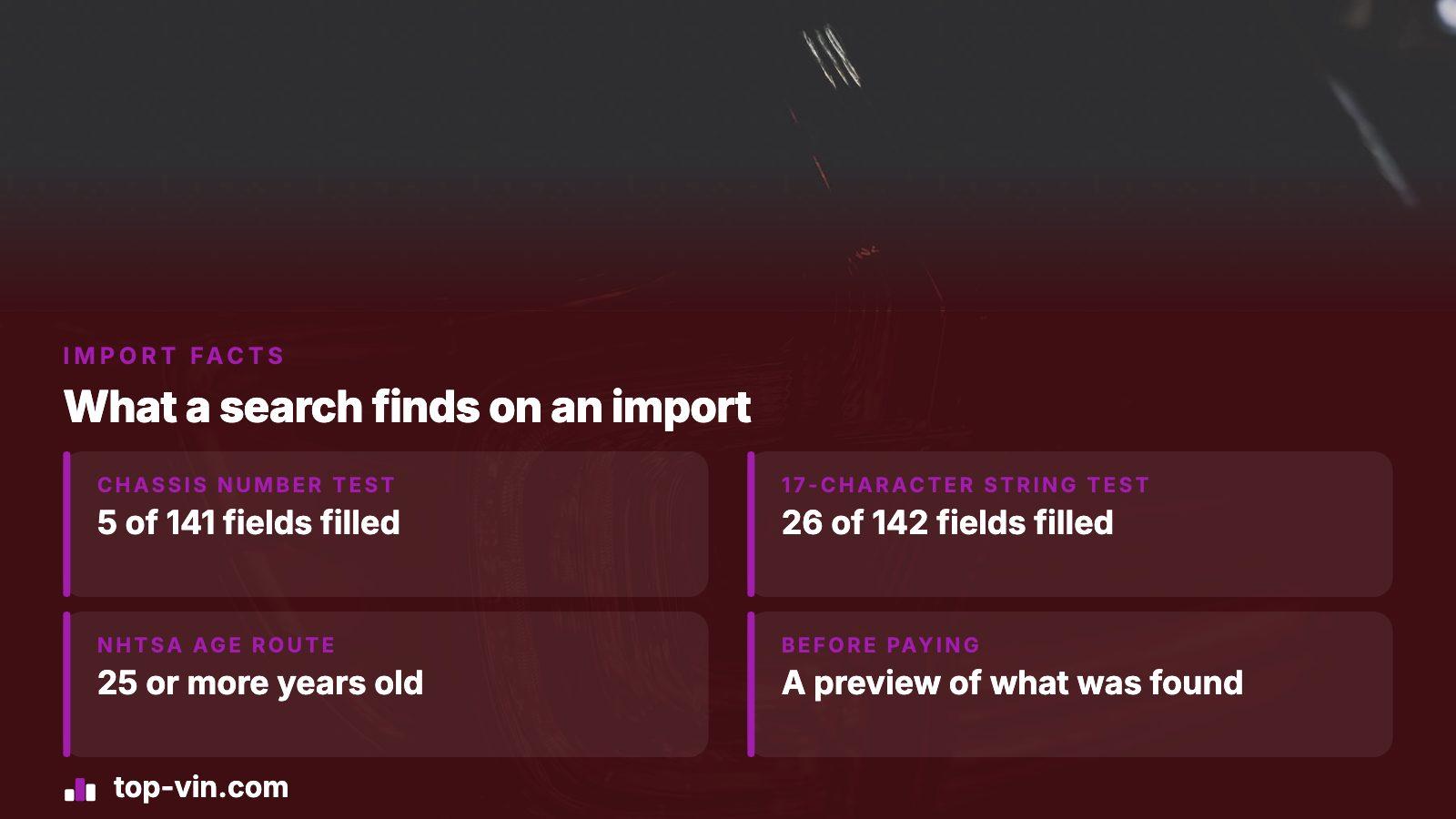
- Chassis number in NHTSA's decoder
- 5 of 141 fields filled
- 17-character string in the same test
- 26 of 142 fields filled
- NHTSA's age route for imports
- 25 or more years old
- Before you pay anything
- A free preview
Which numbers a JDM VIN search can read
A search matches what you type against records filed under that same string, so first work out what you are holding. Test decodes run through NHTSA's public API show the split.
| Number you hold | What NHTSA's decoder did | What it means for a search |
|---|---|---|
| A Japanese chassis number, like BCNR33-043101 | Errors 6, 7 and 400. No make, model or year. 5 of 141 fields filled | A US record exists only if someone filed one under this exact string |
| A 17-character VIN in the standard pattern | A made-up Toyota-style string read as a 1994 Supra built in Japan. 26 of 142 fields filled | Enough structure for a decoder to read and for records to attach to |
The decoder's seventh error reports that the manufacturer has no registration with NHTSA covering US sales or imports. That describes the number, not a fault in the tool, and it is the first sign you hold a chassis number rather than a VIN.
Choosing the number to type
Federal rules tell importers to keep the number the original maker assigned, so the paperwork and the car should agree. Work through these in order.
- Read the US title or registration first. A state record is most likely filed under whatever number is printed there.
- Find the plate on the car, check it against the title character by character and keep a photo.
- Look through the windshield at the left pillar for a label beginning SUBSTITUTE FOR U.S. VIN. A registered importer attaches it when the maker's number does not follow the US pattern, and the maker's number follows the words.
- Count the characters. Seventeen suggests a standard VIN. A short code with a hyphen is usually a chassis number.
- Run every candidate through the preview. If one returns nothing, that tells you about the record, not only about your typing.

What a record on an import can show
After a car has a US title history, a search can retrieve what American record systems hold under its number. NMVTIS, the Justice Department's title database, is built around five indicators: current title state and date, brands, odometer reading, total loss and salvage history. Its data comes from state titling offices, along with insurers, salvage yards and recyclers who are required to report.
- Brands a state applied after the car arrived, such as salvage or flood. Once applied, a brand is not erased by a move across state lines.
- Odometer entries logged at US title events. A dash from Japan may read in kilometers, and 100,000 km works out to roughly 62,137 miles, so convert to the entries' unit before comparing.
- Total-loss and salvage entries from insurers and yards. A theft that goes unrecovered for 30 days can be written off by the insurer as a total loss, and that entry is not erased if the car is later found intact.
- Theft, lien and impound entries, where something was reported.
The TopVIN report adds accident and damage entries, salvage-auction photos and a market value when records exist.
What the search cannot see: the years in Japan
Every source named above is an American one. Whatever happened to the car before export, including its mileage and condition in Japan, was not reported to those agencies, so no title database will show it whichever number you type.
A short record is not a clean record
A freshly imported car can show a thin US history simply because its US life is short. NMVTIS calls a clean report a good thing, yet it also says more than half the states report data and some exempt older vehicles from titling, so a quiet result can be a false negative. Read it as unverified, not as proof.
Ask the seller for export-side papers and keep them beside the search result.
Import paperwork that no VIN search holds
Three federal bodies each set a test for bringing a car in. A search settles none of them.
- NHTSA: the importer files a declaration choosing one route. Paragraph (i)(1) is the age route, for a vehicle 25 or more years old. The conformity route needs a registered importer and a bond of 150% of dutiable value, and it is closed to salvage and reconstructed vehicles.
- EPA: the Clean Air Act covers used vehicles as well as new ones. For cars over 21 years old, the agency reads its rules as requiring an engine identical to the original. Other nonconforming cars need an Independent Commercial Importer's certification or a temporary exemption.
- Customs: the entry declaration names the body serial number or another identification number. On a conformity import, a missing NHTSA approval letter after 180 days brings a Notice of Redelivery asking for the car back.
Ask the seller which route was declared and for the documents behind it. A search adds one piece: a salvage entry matters, because the conformity route is closed to salvage vehicles.
Red flags in the listing and in the result
| What you see | Why it matters | Your next move |
|---|---|---|
| The seller offers only a hyphenated chassis number | No US record can be matched to it, and the title may carry something else | Ask for photos of the title and the cabin plate before paying |
| The cabin plate and the title show different numbers | Different cars, a transcription slip or an altered document | Hold off paying until the seller gives a written explanation |
| A salvage or total-loss entry on a car sold as clean | State brands survive a trip across state lines | Ask for repair paperwork and have a shop inspect the car |
| US odometer entries lower than the dash after converting kilometers | A rollback, a swapped cluster or a unit mix-up | Convert the dash reading and line it up against the dated entries |
| Nothing at all on a car that has been here for years | A reporting gap, or a state that does not title older vehicles | Treat the result as unverified and request the title record from the state |
Running the search on TopVIN and what it costs
Type the number into the box and a free preview appears before any payment. The report behind it is a single payment for that car, with no subscription. Anyone comparing imports can instead order 3, 5 or 10 reports at a time; the pricing page lists amounts.
With a JDM car, run each number you have. A preview that finds nothing under either one costs nothing and tells you the US record is thin, or that the number in the listing is not on the title.
After the search: papers and an inspection
- A copy of the entry declaration. It should name the car by body serial number or another identification number, matching the plate you photographed.
- For a conformity import, the NHTSA approval letter. Customs ties the release of the bond to it.
- The name of the registered importer or Independent Commercial Importer, if the car was certified.
- Your state's own title record, which holds more than NMVTIS does.
- An independent inspection, which the NMVTIS pages urge alongside any report.
Keep the search result, the papers and the inspection notes in one folder until the sale closes.
Where this information comes from
- NHTSA: VIN decoder (vPIC) — The decoder behind the error codes and field counts quoted in the tests above.
- 49 CFR 591.5: declarations required for importation — The 25-year route, the conformity route with its bond and the salvage exclusion.
- 49 CFR part 565: VIN requirements — Importers keep the original maker's number, and the substitute label wording.
- 19 CFR 12.80: safety standards at entry — What the entry declaration names, the approval letter and the 180-day redelivery notice.
- EPA: learn about importing vehicles and engines — Emission rules for used imports, the certification route and the identical-engine reading.
- NMVTIS: information for consumers — Coverage, state differences, false negatives and the total-loss label on stolen cars.
- NMVTIS: understanding a vehicle history report — The five indicators, where the data comes from and the advice to inspect.
Sources and photos: Facts checked against the sources above in November 2026. Photos by Anshul Gurjar, Owen Michael Grech and A n v e s h on Unsplash; diagrams by TopVIN.
Keep reading
- VIN search engine: what one searches and what comes backHow one number is looked up across separate record systems.
- VIN lookup by last 6 digits: what six characters can and cannot findWhat a short or worn number can still return.
- VIN verification: the four checks people mean and what each provesChecking that the stamped number is the one on the paperwork.
- Sample reportSee a finished report before you run your own.
Frequently asked questions
Can I run a VIN search on a JDM car with only the chassis number?
You can type it in, but expect little. NHTSA's decoder rejected hyphenated chassis numbers in test decodes, and a US record exists only if someone filed one under that string. Find the number on the US title and the cabin plate, and run those too.
Does a VIN lookup show a JDM car's history in Japan?
Not reliably. The title database behind US history reports draws on American sources: state agencies, insurers and salvage handlers. Mileage or damage from the car's Japanese years has to come from export-side papers, and the dash may read in kilometers.
Is a 25-year-old import automatically legal to register?
NHTSA's declaration list has an age route for vehicles 25 or more years old. EPA and Customs run their own tests, so age alone does not settle legality, and a VIN search cannot decide it. Ask for the declaration papers and the state titling office's requirements.
Why does the decoder return almost nothing for my number?
Error 7 means the manufacturer has no registration with NHTSA for US sale or import, and a hyphen adds an invalid-character error. If you copied the number correctly, the decoder is behaving as designed for a chassis number.
If the search comes back clean, is the import a safe buy?
Not on its own. The Justice Department warns of false negatives because more than half the states report data and some exempt older vehicles from titling. A short US record is normal on a recent import, so inspect the car and check the paperwork.
Now check the car itself
The guide explains what to look for. The report shows what this VIN has on record.