
THE SHORT ANSWER
Six trailing characters cannot identify a vehicle. They are mainly the factory's sequence number, and the federal rule that keeps VINs distinct applies to the whole 17-character string, not to a slice. In a test of NHTSA's decoder, six trailing digits returned nothing, while the first eleven characters returned make, model, year and plant. Recover the missing characters from the car or its papers, then run the full number.
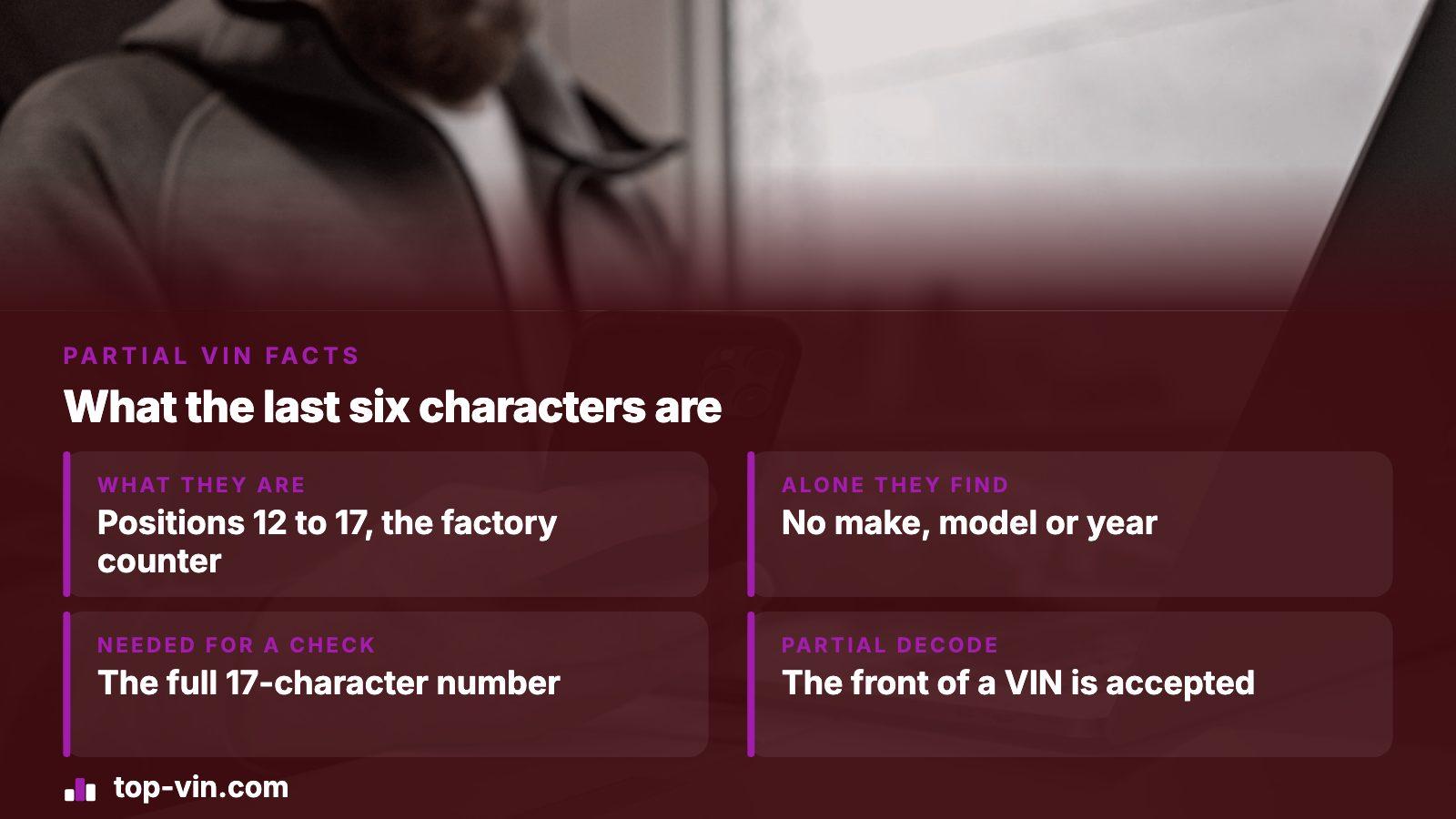
- What they are
- Positions 12 to 17, the factory's counter
- Alone they find
- No make, model or year in a decoder test
- Needed for a check
- The full 17-character number
- Partial decode
- NHTSA accepts the front of a VIN
What the last six characters of a VIN actually are
A VIN ends with positions 12 through 17. For high-volume manufacturers those six characters are a counter: the number the factory assigns, in order, as vehicles are built. Everything describing the vehicle comes before it. The maker occupies the first three characters, the build details the next five, a self-check sits in ninth place, and then come the model year and the plant.
Low-volume makers split the tail differently. For them, positions 12 to 14 pair with the first three characters to name the maker and vehicle type, and only the last three characters count off the production sequence. The same six-character stretch can therefore be a plain serial on one car and part of a maker code on another.
Why a six-character tail cannot name one car
The federal rule asks for uniqueness of the whole number. Section 565.13(d) bars identical VINs on any two covered vehicles from a 60-year stretch that opens with the 1980 model year. It makes no such promise for any slice, so a tail that matches the car in front of you proves little about the rest of the number.
What the federal decoder did with each fragment
A test run for this page used NHTSA's decode API. Eleven placeholders followed by six digits returned a blank make, model and year, even with a model year added to the request. The opening eleven characters from a 2003 Honda Accord returned make, model, year, body and plant, and the answer was identical whether the last six characters were filled in or replaced with asterisks. Only the error code changed, to Incomplete VIN. The tail added nothing.
What each amount of the number gets you
| What you hold | Federal decoder | A history check |
|---|---|---|
| Last six characters only | Make, model and year came back blank | Nothing to search on without a maker or year |
| First eleven characters | Make, model, year and plant, marked incomplete | Narrows to a model, never to one car |
| All 17 characters | Full decode, check digit tested | Title, damage, odometer and recall records can be pulled for that car |
Information in a VIN builds from the left, and the FTC's used-car page tells buyers to enter the VIN for the recall lookup, the theft and salvage lookup and the history providers. A fragment gets you the build at best. Anything about one particular car needs the whole string.
Getting the missing characters from the car itself
The characters you lack are printed on the vehicle and its paperwork, so recover them there rather than guessing.
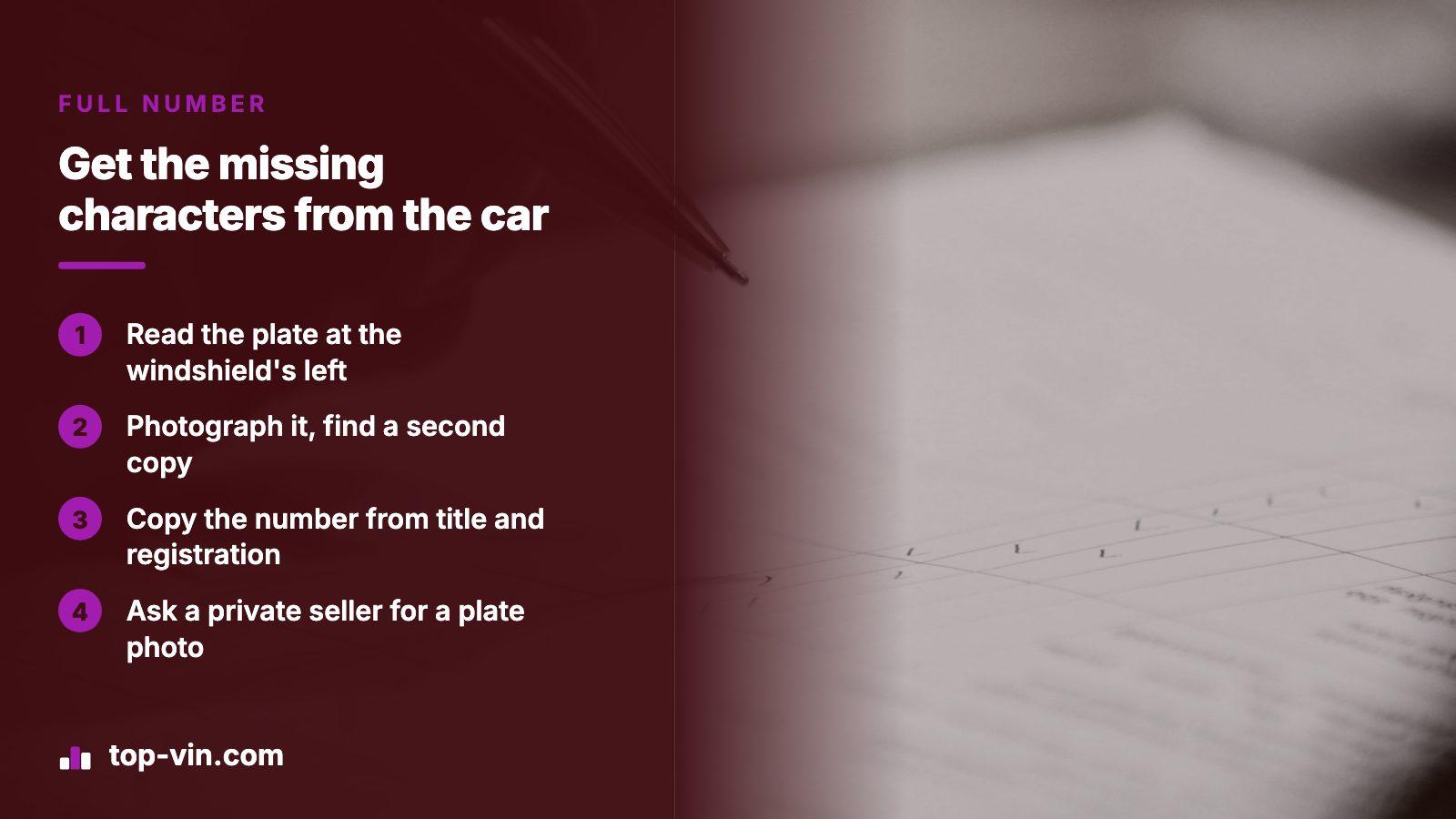
- Stand outside at the left side of the windshield and read the VIN plate through the glass. On cars and light trucks the rule requires it to be legible from there in daylight.
- Photograph the plate, then look for a second copy marked on a component that stays on the car unless it is repaired, or on a tag fixed to one.
- Copy the number from the title and registration, and compare it with the plate one character at a time.
- On a dealer lot, the FTC points to the front of the Buyers Guide for the VIN.
- From a private seller, ask for a photo of the VIN plate. If the answer is a refusal, the missing characters are a reason to look at a different car.
Misreads that waste a search
Fragments often come from worn VIN plates, glare and phone photos, where characters get misread. Federal rules let you catch some errors before typing.
- No VIN contains an I, an O or a Q. Anything that looks like an O is probably a zero.
- On a passenger car or light truck, the last five characters must be digits, so a letter anywhere in them is a misread. The sixth from the end is the one place in the tail where a letter is allowed.
- Heavier vehicles only need digits in the last four, so a letter in fifth place from the end is possible there.
- With all 17 characters in, the decoder tests the ninth against the other 16. In the test run for this page, the complete number for that Accord decoded clean, check digit confirmed.
What the federal decoder can do with the characters you have
NHTSA's decoder accepts partial VINs, and its API takes an asterisk for each unknown character. The ninth position can be skipped, and sending a model year is recommended because it steers the decode to the correct year range. A year typed into the web form overrides the one in the VIN, so enter it only when you are sure. Everything returned is what the manufacturer reported, so it describes the car as built.
That makes it a sensible sanity check when you hold the front of a number, like a listing that blanks the end. Run it and compare the make, model, year and plant with the ad. A mismatch ends the conversation before money moves. A match says only that the description fits.
Running the full check on TopVIN
With all 17 characters in hand, enter them and TopVIN puts a free preview on screen before anything is charged. The report is one payment for the one car, with no subscription. You can buy a single report or a pack; options and amounts are laid out on the pricing page. Only the preview costs nothing.
For a buyer who started from a fragment, these parts of the report carry the most weight:
- Title brands, meaning labels like salvage, junk or flood that a state put on the title.
- Accident and damage entries, plus any auction history and the photos attached to it.
- Odometer readings logged over time, to hold against the dash.
- Open recalls, plus any theft, lien or impound entries.
Reading the result against the car and the ad
Settle identity first. If the make, model and year in the preview differ from the listing or the car, either the number was copied wrong or the paperwork belongs to another vehicle, and the sale should wait until that is explained. Then read the history.
| Finding | What it suggests | Next step |
|---|---|---|
| A salvage, junk or flood brand | The title carries a state's label, and the federal program links brands to undisclosed damage | Price the car as a damaged one, or walk away |
| A total loss or salvage entry | Generally severe damage, according to the federal program | Get a body and frame inspection before any offer |
| Odometer entries that fall or clash with the dash | Possible odometer fraud, which can leave a buyer paying above market value | Ask the seller to explain it, and ask for service records |
| Nothing adverse | Nothing turned up in the records searched | Still book an independent inspection |
The federal title record calls itself intentionally concise, and the FTC says history reports typically leave out mechanical problems. A clean report lowers the odds of a hidden brand; only a mechanic checks the car.
Where this information comes from
- eCFR: 49 CFR Part 565, VIN requirements — Where the tail sits, which positions must be digits, how small makers differ, the uniqueness window and where the plate must be readable.
- NHTSA: vPIC API — Partial decoding, asterisk placeholders, the optional ninth character and the advice to send a model year.
- NHTSA: VIN decoder (vPIC) — That partial VINs are accepted, that a typed year overrides the VIN's year and that results are manufacturer-reported.
- NMVTIS: understanding a vehicle history report — What the federal title record covers, how it treats brands, total loss, salvage and odometer fraud, and its own limits.
- FTC: used cars — Where the VIN appears on a Buyers Guide, which lookups take a VIN, and why a report is no substitute for an inspection.
- FTC: buying a used car from a dealer — What history reports usually miss and what a mechanic's written findings should carry.
Sources and photos: Facts checked against the sources above in November 2026. Photos by Justin Cron, Masjid MABA and Anastasiia Nelen on Unsplash; diagrams by TopVIN.
Keep reading
- How to read a VIN: a left-to-right walkthrough with a worked decodeWhat each group of characters means, so you can see where your six sit.
- VIN check digit: how the ninth character is worked out and what it provesHow the ninth character catches a misread before you search.
- VIN search engine: what one searches and what comes backWhat a full VIN search looks through and what it hands back.
- Sample reportSee how a finished report is laid out before you run one.
Frequently asked questions
Can I run a VIN lookup with only the last 6 digits?
Not in a way that names the car. The tail is mainly a production counter, and in a decoder test it returned no make, model or year. A search of records for one vehicle needs all 17 characters. If a tail is all you hold, find the rest on the plate, title or registration before running anything.
Are the last six digits of a VIN unique?
Not as a group. The federal rule requires the whole 17-character VIN to differ between covered vehicles built in a 60-year span from the 1980 model year. It says nothing about the final six differing, so matching tails are allowed, and the earlier positions are what keep the complete numbers apart.
Why does the decoder call my partial VIN incomplete?
Because it is. NHTSA's decoder takes fewer than 17 characters, fills in what they support and labels the result incomplete, which came back as code 6 in the test run for this page. That label is not a fault to fix. It means the decode describes the build and nothing more.
How much of a VIN do I need for a history report?
The whole number, which by federal definition is 17 characters. The FTC tells buyers to enter the VIN for NMVTIS providers, the recall lookup and NICB's theft and salvage lookup, and a report is about one specific car. If characters are missing, recover them from the vehicle's paperwork.
What if a seller will only share the last six digits?
Treat it as a cue for one more request, not an accusation. A photo of the VIN plate taken through the windshield takes seconds, and without it you cannot run a history check or confirm the paperwork matches. If the seller still declines, spend your time on a different car.
Now check the car itself
The guide explains what to look for. The report shows what this VIN has on record.