THE SHORT ANSWER
You cannot look up who owns a car from its VIN as an ordinary buyer. A federal privacy statute, the DPPA, tells state DMVs to hold back names and other personal details unless the purpose is one it lists, for instance safety work, court cases, insurance claims or the person's own signed permission. The useful substitute is a title and damage history tied to the VIN.
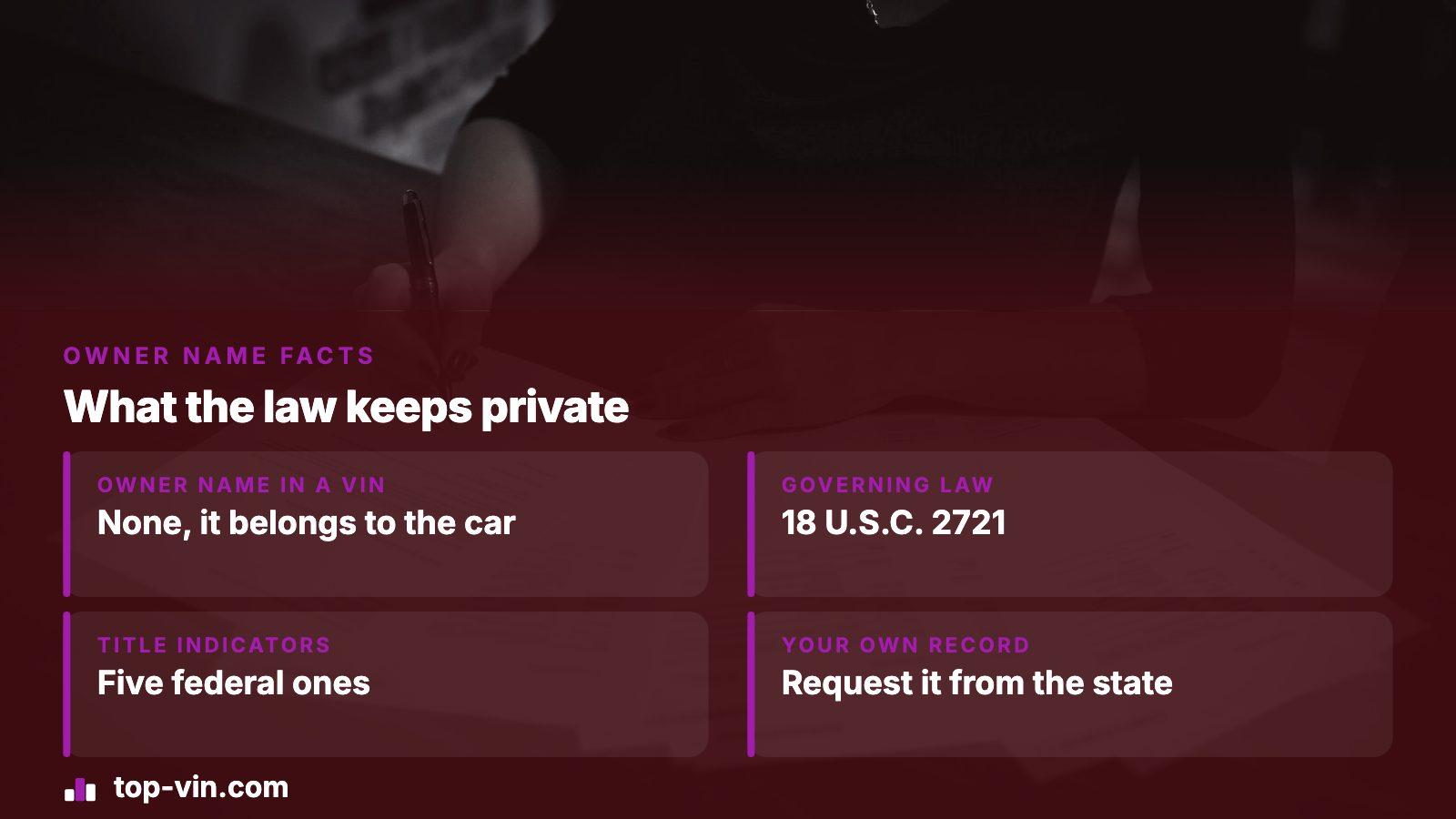
- Owner name in a VIN
- None, it belongs to the car
- Governing law
- 18 U.S.C. 2721
- Federal title indicators
- Five
- Your own record
- Request it from the state
The name is not in the number
People type a VIN into a search box hoping a person's name will come back. The number was never built for that. It identifies one vehicle, and the name of whoever holds the title sits in a state file that the VIN merely points to.
So the question changes. You are not asking what the VIN says. You are asking whether a state agency may hand over its title file to you, and for most buyers the answer is no. The sections below cover why, who does get access, and how to answer the practical question behind the search, which is usually whether this seller can be trusted with this car.
What the federal privacy law closes
Section 2721 of the federal code sets the baseline: the people who run a state's motor vehicle agency, and firms working for it, are barred from knowingly sharing personal details that come out of a vehicle or driver file. A tighter tier, labeled highly restricted, stays closed unless the person concerned says yes, with only a few carve-outs.
The law does list exceptions, and the list explains why owner names turn up in some places and never in a public search box.
- Public bodies at work, courts and police included.
- Safety, theft, emissions and recall work, plus market research.
- A business checking data a person gave it, or recovering a debt from that person.
- Civil, criminal and administrative cases, including serving court papers.
- Insurers handling claims, fraud work and underwriting.
- Tow and impound notices sent to the car's owner.
- Private investigators who hold a license.
- A requester holding that person's signed permission.
Idle interest in a neighbor's truck is absent from it, and so is plain doubt about a private seller.
Routes that are lawful, and routes that are not
| What you want | Lawful route | Why |
|---|---|---|
| Your own title or registration record | Ask the state with your ID | You are the person the record describes |
| The seller's name on the title | Ask to see the paper title in person | The seller is volunteering it |
| Proof a seller owns the car | Match title name, ID and VIN at the meeting | No lookup needed |
| A car's brands and salvage record | Title check or VIN history report | These records carry no personal data |
| An owner's identity in a dispute | A court, an attorney or an insurer | Legal proceedings are a listed use |
A site that promises the registered owner's name for a few minutes of typing is selling something the statute restricts. I could not confirm how any specific service gets its data, so this page makes no claim about them. The test is simpler: ask which permitted use you would be relying on.
Asking a state for your own record
If the car is yours and you want its title history on paper, go to the state that issued the title. Texas shows how formal it can get. The state's DMV wants Form VTR-275 whenever you ask for a title history, registration details or an inventory of vehicles under your name. Post it, or deliver it at a Regional Service Center; an emailed copy will not be accepted.
Attach a photocopy of your photo identification, a license or a passport for example. If the form prints a fee, payment goes by check or money order, or a cashier's check, written to TxDMV. Cash must stay out of the envelope. When no fee appears, staff reach out with the cost afterward. Expect some personal details to be blacked out of what comes back.
Other states differ
Form names, delivery methods and costs change by state. Use your own state's DMV page and confirm the current form and fee before you send anything.
What a title check shows instead
NMVTIS, the national title database, exists to fight title fraud and car theft, not to publish who owns what. Its consumer report stays on five points: what the current title says including past brands, the newest odometer figure, a salvage or total-loss ruling by an insurer, a sale to a recycler or a junkyard, and sometimes theft.
The brevity is intentional. The Justice Department's page treats an empty report as good news, yet it cautions that the state's own title file can contain details the national report leaves out.
Once a state applies a brand, the brand stays in the federal record. Moving the car to a state with looser rules does not erase the label, which is exactly the trick a buyer needs protection from.
Gaps that can mislead you
Coverage is wide but patchy. The federal page puts database coverage at 87 percent of vehicles nationwide. More than half the states supply data, and about 20 million salvage or total-loss entries sit on file. Reporting is uneven, so a clean answer can be wrong, a missing junk or salvage mark for example.
- Each state sets its own damage threshold, so identical wreckage may earn a salvage brand in one and nothing in the next.
- A few states never use a flood designation, which means water damage can be absent from a title file.
- A total-loss label can attach to a stolen car that goes unrecovered for 30 days, and it stays on the record even if the car comes back in good shape.
- A yard visit does not force a brand, so a salvage-yard entry can sit beside a clean title.
None of that is fixed by knowing a name. It is fixed by reading the car's own record carefully, then having a mechanic look at the metal.
Checking a seller without a lookup
Most people who search for an owner's name are really testing a seller. You can do that in the driveway. Ask for the paper title, then read the name on it against the seller's photo ID. Next, compare the VIN printed there with the one on the car and in the advert.
- Ask the seller to send the VIN before you drive out.
- Put that number through the free TopVIN preview and write down any brand, salvage entry or odd mileage.
- At the meeting, line up the title name, the ID and the VIN on the car.
- If a lender is listed or the seller says the title is held elsewhere, pause until it is cleared in writing.
- Purchase the full report only when the preview fits the car in front of you, and book an independent inspection.
A seller who dodges any of those steps has told you something no database would.

When to run the VIN check
Do this ahead of the test drive, when leaving still costs nothing. Enter the VIN at TopVIN, read the preview, and decide if the car merits the full report. Payment is once per report with nothing recurring, and the options are laid out on the pricing page.
The report speaks about the car rather than the seller. Expect brands, crash and damage lines, mileage readings and any auction or salvage appearance. A brand or a mileage rollback is grounds to haggle or leave, whoever held the car last.
Where this information comes from
- 18 U.S.C. 2721: release and use of personal information — the ban on release, the permitted uses and the reseller record-keeping rule
- NMVTIS: information for consumers — the five indicators, coverage gaps and state differences
- Texas DMV: open records — how one state handles requests for title and registration records
Sources and photos: Facts checked against the sources above in November 2026. Photos by Macro.jr, Anastasiia Nelen and Dimitri Karastelev on Unsplash; diagrams by TopVIN.
Keep reading
- Motor vehicle records: what a car buyer can see, and what stays closedwhat a state keeps on permits, titles and registrations
- Previous owners by VIN: what a check shows and what it can'twhy an owner count is hard to pin down
- License plate lookup privacy laws: what you can and cannot get from a platethe same privacy limits when you start from a plate
- Where the VIN sits on a title, and what to do nextreading the VIN on the paper title against the car
Frequently asked questions
Can I find the owner of a car with just the VIN?
No. A private buyer has no standing to ask. State departments may release names only for uses the federal law lists, such as court cases, insurance claims or the owner's own written consent. If you have a legal dispute, a court, an attorney or an insurer is the proper channel.
Does a VIN history report show the owner's name?
A buyer-facing history report covers the car's records: title brands, damage, odometer and salvage entries. It is not built to disclose a person's name or address. If a service claims otherwise, ask which permitted use under the federal law it relies on.
How do I get my own title record from the state?
Contact the state that issued the title and use its records request. Texas, for example, uses Form VTR-275 sent by mail or in person with ID. Check your own DMV for the form, delivery method and fee, since they vary by state.
How can I tell a seller really owns the car?
Ask for the paper title and a photo ID, and compare the names. Make sure the number printed on that title is the one stamped on the vehicle and posted in the listing. If a lender is named, get written confirmation the lien is cleared before you pay anything.
What should I run if I only have a VIN?
Run a title and damage check on it. The federal title system shows brands, odometer and salvage data, and a history report built on it adds more detail. Begin with the TopVIN preview, and pay for the full report when the VIN fits the car.
Now check the car itself
The guide explains what to look for. The report shows what this VIN has on record.