
THE SHORT ANSWER
Minnesota ties its registration records to a federal privacy statute, so a plate by itself opens no public VIN lookup. Ask the seller for the number, compare it with the title and registration, and read it off the car. Then type it into TopVIN, read the preview that costs nothing, and weigh whether the full report earns a single payment.
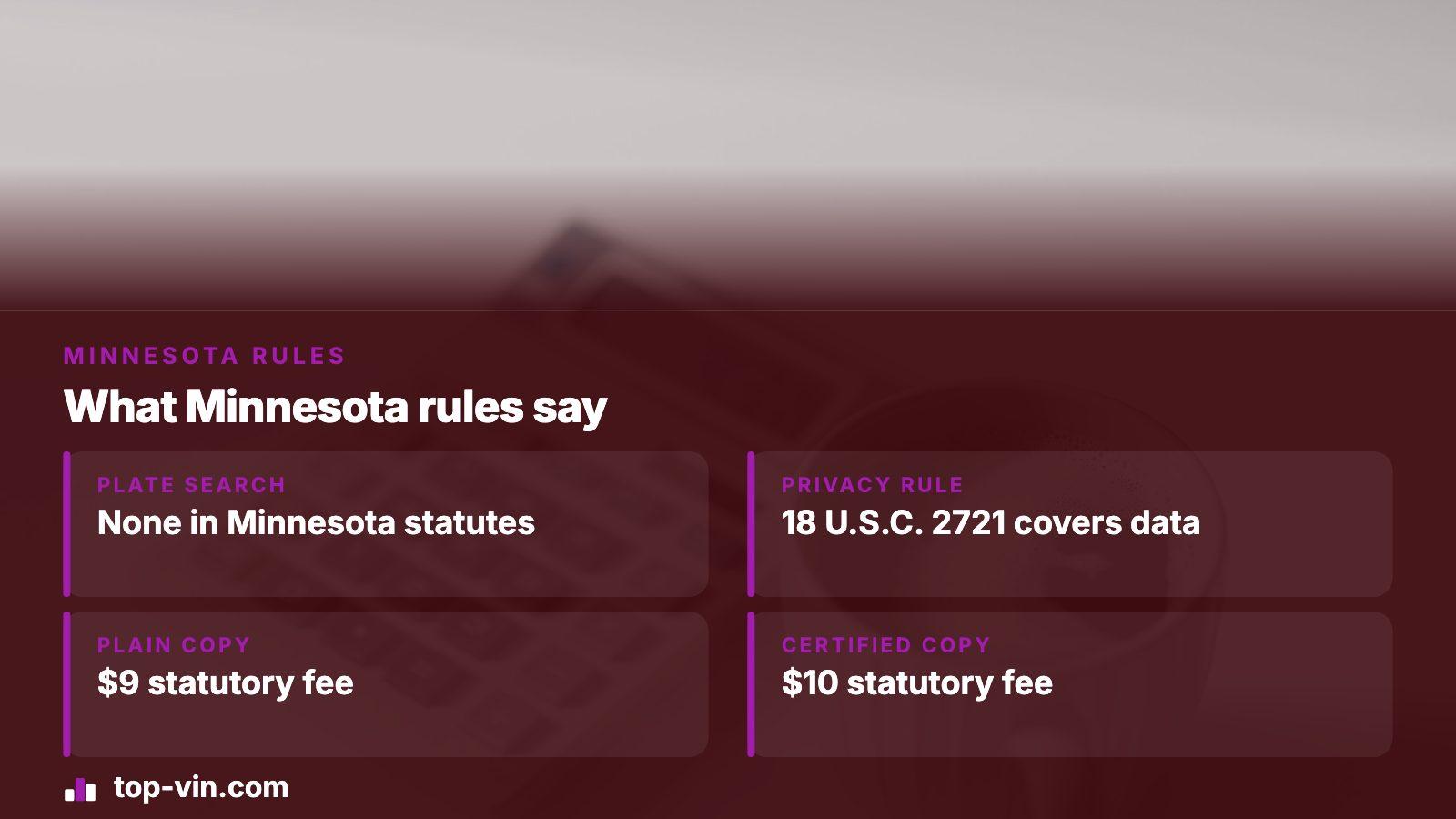
- Public plate-to-VIN search
- None named in Minnesota statutes
- Privacy rule
- 18 U.S.C. 2721 governs registration data
- Statutory record fee
- $9 plain copy, $10 certified
- TopVIN check
- Free preview, then one payment
Why the plate is the wrong end of the car to start from
Title brands, damage entries and odometer readings are filed under the vehicle identification number. A plate only says which registration a tag was issued under. In Minnesota the two can drift apart more than buyers expect: a personalized set can often be shifted onto a different qualifying vehicle for $5, and passenger-car plates get swapped out at renewal once they are seven years old.
So treat the tag in a listing photo as a hint about paperwork. What you verify is the number on the vehicle itself; every history source worth paying for begins with it.
Getting the VIN without any records request
Most shoppers never need the state at all. A seller already has the number in several places, and asking costs nothing. Go in this order and stop when two sources agree.
- Ask the seller to text the VIN before you drive anywhere.
- Compare it with the number on the front of the title.
- Check the registration card, which should repeat it.
- Ask for a photo of the insurance card, since it lists the insured vehicle.
- At the car, photograph the plate on the dash through the windshield and the sticker in the driver's door jamb.
If any pair differs by a single character, stop the deal until the seller explains why. A seller who dodges the question has told you something useful.
What Minnesota law says about releasing registration data
Minnesota Statutes section 168.346 says vehicle registration data on individuals is handled as the federal Driver's Privacy Protection Act provides. The statute obliges the commissioner to share personal details for uses tied to driving or public safety, yet lets the office turn away anyone who looks set to misuse them. A registered owner may also consent in writing to release.
Neither that section nor the fee statute, 168.327, mentions a search by plate number. They talk about registration and title records furnished on request by authorized persons.
A note on what we could not confirm
The Department of Public Safety pages that describe the request form and mailing details would not open when we tried. We therefore name no form number, address or turnaround time. Look up the current process with Driver and Vehicle Services before you file.
Who the federal law lets in
Section 2721 of Title 18 bars state motor vehicle staff from disclosing personal information from a record unless a listed exception applies. Wanting to know who owns the car in a neighbor's driveway is not on the list. Several uses are.
| Permitted user | Purpose the law recognizes |
|---|---|
| Courts, police, agencies | Official functions |
| Insurers | Claims, fraud work, rating, underwriting |
| Towers and lots | Notice to the owner of a held vehicle |
| Parties to legal cases | Service of process, investigation, enforcing judgments |
| Licensed investigators | Any purpose the law otherwise allows |
| Anyone holding written consent | The record's subject agreed |
Federal law also lets a state charge an administrative fee for a record, and anyone who resells the data has to log who received it and why, and keep that log 5 years. That is why honest sites do not promise to name an owner from a tag.
What a state copy costs, and why it rarely beats the quick routes
The fee statute sets $9 for a non-certified record and $10 for a certified one, plus $1 per page when a title history is not in electronic form. Another 50 cents is added when public registration details are requested in person, by post or online, unless the vehicle is your own.
Those are statutory amounts, and the department can publish its own procedure on top of them, so confirm the total before sending money. Against a quick phone call to the seller, a paper request is the slow road.
Once you have the number, what a TopVIN check shows
TopVIN works from the VIN, never the person. Start with the free preview: it tells you if the VIN lines up with the ad's year, make and model. If so, a one-time payment unlocks the whole report, and the pack sizes sit on the pricing page.
In a Minnesota deal, read title brands first, then accident and damage entries, odometer readings across years, salvage or auction photos, liens and theft flags. Title data in reports of this kind draws on NMVTIS, a Justice Department program meant to shield buyers from title fraud and stop thieves from reselling stolen vehicles.
- A brand that the seller never mentioned.
- Odometer readings that go down between records.
- A lien still open on a car sold as clear.
- Auction photos that show damage the ad does not.
Minnesota paperwork to watch at the handover
Under section 168A.10, at delivery the seller signs over the title with its warranty language, enters what the car really sold for, and passes the certificate straight to you. Within 10 days the seller reports the sale to the state, unless a licensed dealer was on either side. As the buyer, you have 20 calendar days to apply for a title in your name; miss it and the registration can be suspended.
- Match the title's VIN to the car before you sign.
- Preview first; pay for the full report only when the car still looks worth it.
- Get the signed title and any lien release in hand.
- Calendar the 20-day title deadline the day you pay.

Where this information comes from
- Minnesota Statutes 168.346: privacy of registration data — How registration data ties to the federal privacy law and who may receive it.
- Minnesota Statutes 168.327: record fees — Statutory fees for registration and title record copies.
- Minnesota Statutes 168A.10: transfer by owner — Seller and buyer duties at a sale.
- Minnesota Statutes 168.12: plates — Plate duration and which plates may move between vehicles.
- Driver's Privacy Protection Act, 18 U.S.C. 2721 — The rule and the permitted uses for motor vehicle records.
- NMVTIS — The federal title-information program's stated purpose.
Sources and photos: Facts checked against the sources above in November 2026. Photos by Erik Mclean, Scott Graham and Ben Wicks on Unsplash; diagrams by TopVIN.
Keep reading
- License plate to VIN: the lawful ways to find a car's VIN from its plateThe same question without a state, with the general rules.
- License plate lookup privacy laws: what you can and cannot get from a plateWhy plate searches cannot return owner details.
- Where the VIN sits on a title, and what to do nextFind and read the number printed on the title.
- Wisconsin plate to VIN: what the DMV will release and what to do insteadThe neighboring state's route from plate to VIN.
Frequently asked questions
Can I do a VIN lookup by license plate in Minnesota?
Not through a public search we could find in the state's statutes. Registration data is protected under federal privacy law. The dependable sources are the seller, the title, the registration, the insurance card and the car. Once you have the VIN, a history check can begin.
Does Minnesota release owner information for a plate?
Only for uses the law permits, such as court matters, insurance work, towing notices or when the owner gave written consent. Curiosity is not a permitted use. The state may also refuse a requester it believes will use the data improperly.
What does a Minnesota records copy cost?
The fee statute lists $9 for a non-certified record and $10 for a certified one, with $1 more per page for a title history that is not electronic. Surcharges can apply, so ask the state for the current total before you pay.
Can TopVIN find a VIN from a plate?
No. TopVIN starts from a VIN and returns no owner names, addresses or personal data. The preview is free. The fuller report is paid once, with no subscription, if you decide you want it.
What if a Minnesota seller will not give the VIN?
Treat it as a warning. The number is printed on the title and stamped on the car, so an honest seller has little reason to hide it. Offer to photograph it in person, and walk away if it disagrees with the paperwork.
Now check the car itself
The guide explains what to look for. The report shows what this VIN has on record.