
THE SHORT ANSWER
Buying a used car is not among the purposes that federal privacy law lets a state motor vehicle office serve with personal record data, so a Missouri plate will not yield a VIN to you. Ask the seller for a title photo, read the number from the vehicle or an insurance card, and run it through a TopVIN preview.
- Plate to VIN for buyers
- Not a permitted use
- Dependable sources
- Title, insurance card, vehicle
- Governing law
- Driver's Privacy Protection Act
- TopVIN
- Free preview, one payment
Why the plate and the VIN sit in different worlds
A plate identifies a registration. The registration points to a person and an address, and the vehicle number is filed alongside them. That is why sites promising an instant conversion from plate to VIN deserve suspicion: they are claiming access to a protected file, and they rarely say where their data came from.
We tried the Missouri Department of Revenue website with a plain page request and with a browser window, and both were refused. So this page prints no Missouri form name, fee or turnaround. If you believe you qualify to request records, read the department's own current instructions. What follows draws on a federal statute and a federal title database, which both opened.
Where federal privacy law draws the line
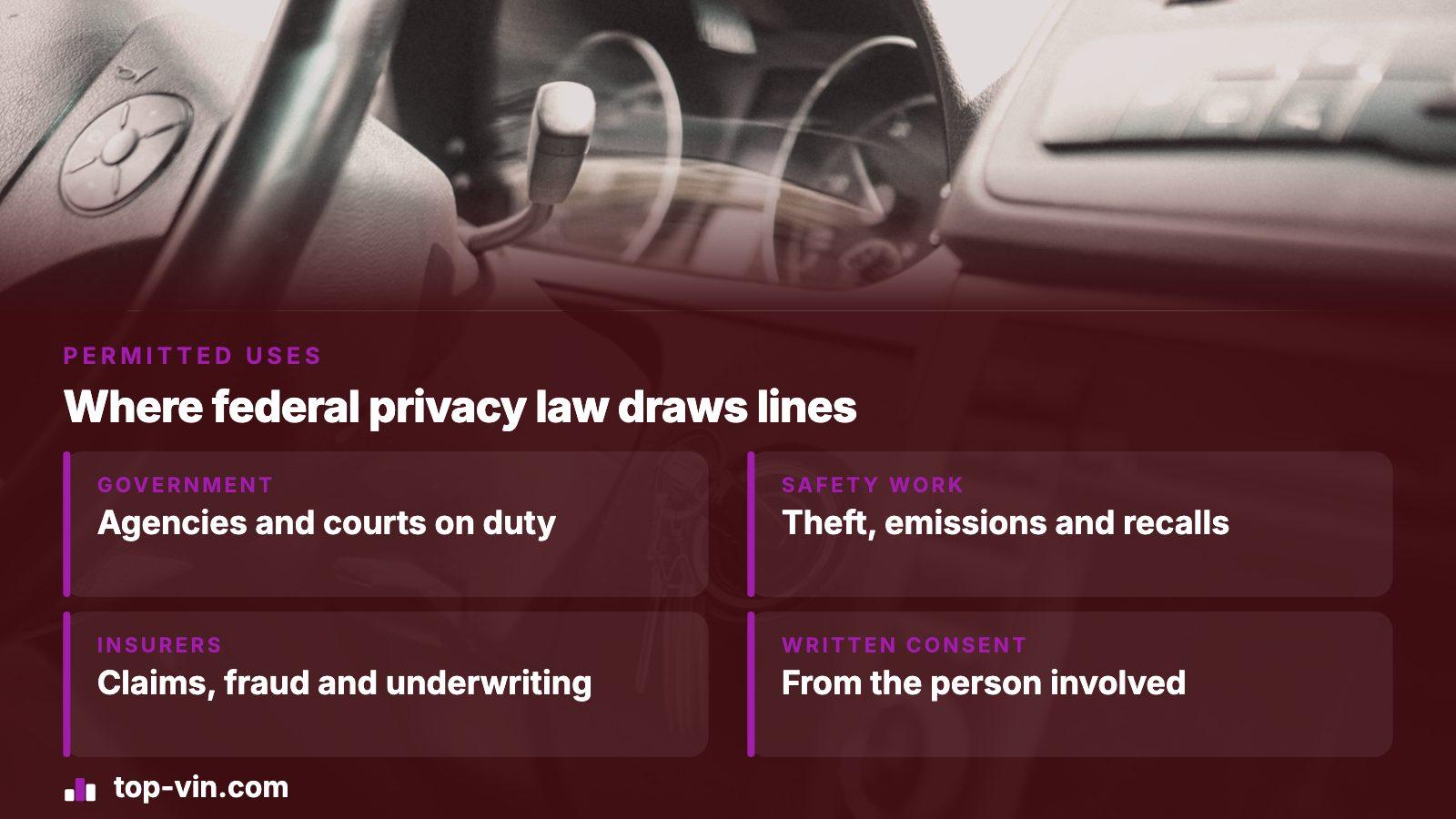
The Driver's Privacy Protection Act tells state licensing agencies, their employees and their contractors not to knowingly hand out personal details from a vehicle or driver record, with exceptions spelled out in the statute. Missouri sits under it like any state. The exceptions that matter in practice:
- Government agencies and courts carrying out their duties.
- Safety, theft, emissions and recall work.
- Insurers handling a claim, a fraud inquiry or underwriting.
- Tow operators who must notify an owner.
- Licensed investigators working inside the statute.
- Employers verifying a commercial license holder.
- Lawsuits, including serving papers and collecting a judgment.
- Anyone holding the person's written consent.
Sizing up a car for purchase is nowhere in that list. Consent is the practical door: a seller who agrees to share the number has solved your problem in one text message.
Four spots that already show the number
A records request is rarely needed. The number is printed on several documents and stamped on the metal itself, and an honest seller can text it to you in a minute.
- Request a sharp photo of the title's front side before you drive anywhere, and match the printed owner to the person you meet.
- Read the insurance card or the policy summary; the vehicle number appears beside the description of the car.
- Go to the vehicle itself. Peer in at the dash corner nearest the steering wheel, then find the label on the driver's door frame.
- Scan the listing, since dealers often post the number in the ad.
Two independent readings are better than one. When the title disagrees with the dash, the sale is over.

What TopVIN shows once you have the number
Type in the 17 characters and a preview appears, no charge. It tells you whether the vehicle's record contains anything that justifies buying the full report. The full report costs a single payment per vehicle. Nothing renews, and larger bundles are laid out on the pricing page.
| Record section | What it can reveal on a Missouri car |
|---|---|
| Title brands | Salvage, junk, rebuilt or flood marks, applied by any state the car passed through |
| Accident and damage entries | Collisions the asking price quietly ignores |
| Odometer readings | A later figure lower than an earlier one |
| Liens and impounds | A lender or tow yard that may still have a claim |
| Theft record | A stolen car dressed up with a plausible story |
| Open recalls | Maker-funded repairs still waiting |
The federal title database and its blind spots
NMVTIS, the national title information system run through the Justice Department's vehiclehistory site, aims to protect shoppers from fraud and unsafe cars, and to keep stolen ones from being resold. Its consumer page describes the report as intentionally brief, centered on five indicators: title and brand history, the latest odometer figure reported, insurer total-loss rulings, transfers into recycling or scrap yards, and in some cases theft entries.
Clean does not mean cleared
The system admits that some states and reporting entities are not yet included, which allows false negatives. Its advice is to review the state's full title record as well. Use any history report as one input beside a mechanic's inspection and the paper title.
Signs that should slow a Missouri purchase
A VIN check covers the vehicle, but the person selling it also gives off signals. Watch for these.
- Holding back the VIN until you hand over a deposit.
- A title in someone else's name, with an explanation that sounds rehearsed.
- A number on the dash that fails to match the title by a single character.
- A report showing a brand, a mileage drop or a lien that nobody mentioned.
- A price well below similar cars, plus pressure to decide today.
One of these is grounds to bargain harder or ask for proof. Several at once, leave.
Plate-search sites and what their promises imply
Results for this topic crowd with pages claiming an owner name, VIN and history from a plate alone. The federal statute says anyone who passes along this data must keep records for 5 years naming each recipient and the permitted purpose. A site that never asks why you want the information is skipping the step that makes disclosure lawful.
TopVIN does not search by plate and returns no owner names or personal data. It begins with the vehicle number and reports on the vehicle.
Once the report is in your hands
A quiet record still calls for a road test and an independent mechanic. A record with a brand, a theft entry or a mileage jump calls for answers backed by paper. File the report with your bill of sale either way.
One gap remains: the Missouri revenue department's pages would not open for us, so ask the department directly what titling and registering your purchase requires before any cash changes hands.
Where this information comes from
- 18 U.S.C. 2721 on GovInfo — Federal limits on releasing motor vehicle record data, and the list of permitted uses.
- NMVTIS: National Motor Vehicle Title Information System — The program's purpose of fighting title fraud and stolen-car resale.
- NMVTIS: information for consumers — What the title report covers and why a clean search is not a guarantee.
Sources and photos: Facts checked against the sources above in November 2026. Photos by Stephen Mabbs, Thibault Valjevac and tim on Unsplash; diagrams by TopVIN.
Keep reading
- Vehicle registration lookup: what it shows and which check to addWhat a registration record shows and what stays private.
- Motor vehicle records: what a car buyer can see, and what stays closedHow a state record differs from a history report.
- How to read a VIN: a left-to-right walkthrough with a worked decodeWhat each part of the 17 characters tells you.
- VIN search engine: what one searches and what comes backWays to search once you hold the number.
Frequently asked questions
Can I get a VIN from a Missouri plate number?
Not through the state, if you are a private shopper. A federal statute keeps owner details in vehicle files for named uses only, and used-car shopping is missing from the roster. Get the number from the seller's title photo or from the vehicle, then check that.
How does a plate search differ from a VIN check?
Searching by plate aims at a registration and its holder, whom the statute protects. Searching by VIN follows the machine: brands, odometer entries, liens, recalls. For someone about to pay, the car-side record guards the money.
Does TopVIN find owners from a plate?
No. It starts with a 17-character VIN and reports only on the vehicle, with no owner names, addresses or personal data and no plate search. The preview costs nothing to view, and the report is a single payment.
The seller will not tell me the VIN. Now what?
Take that as a warning sign. A genuine owner can read the number off the title or the dash in seconds. Refusal before payment, or a number that fails to match the title, is reason enough to look at another car.
Will a VIN check catch every problem?
No. The federal title system says coverage is incomplete across states and entities, so a clean search can still miss something. Pair the record with a mechanic's inspection, a look at the paper title and direct questions to the seller.
Now check the car itself
The guide explains what to look for. The report shows what this VIN has on record.