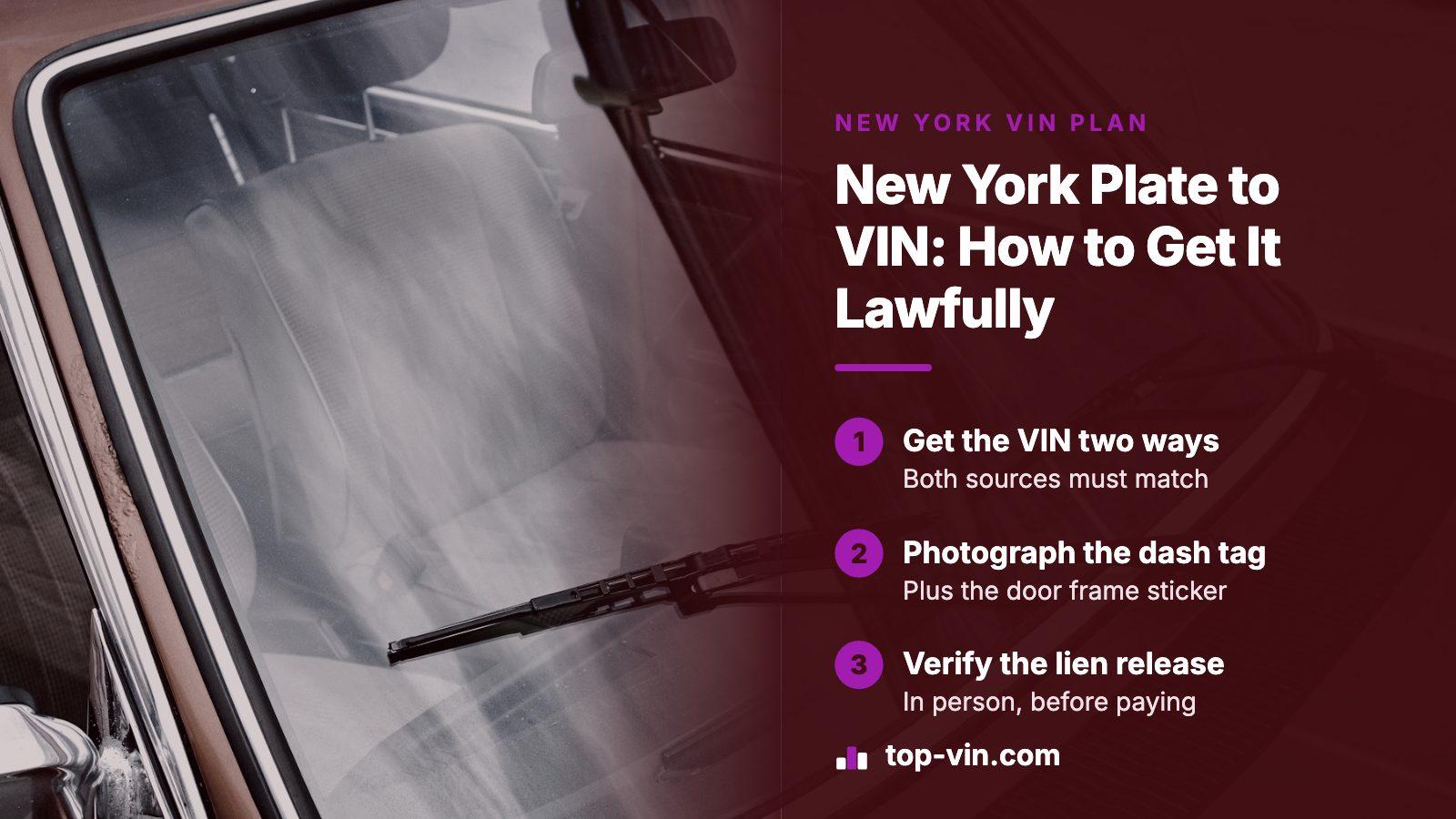
THE SHORT ANSWER
A New York plate belongs to a registration record that also holds personal details, and federal law restricts who may receive those. A private buyer is not on the permitted list. Get the seller to text you the VIN, copy it off the title, registration or insurance card, or read it on the car itself. Then run it through a VIN check and read the preview before paying.
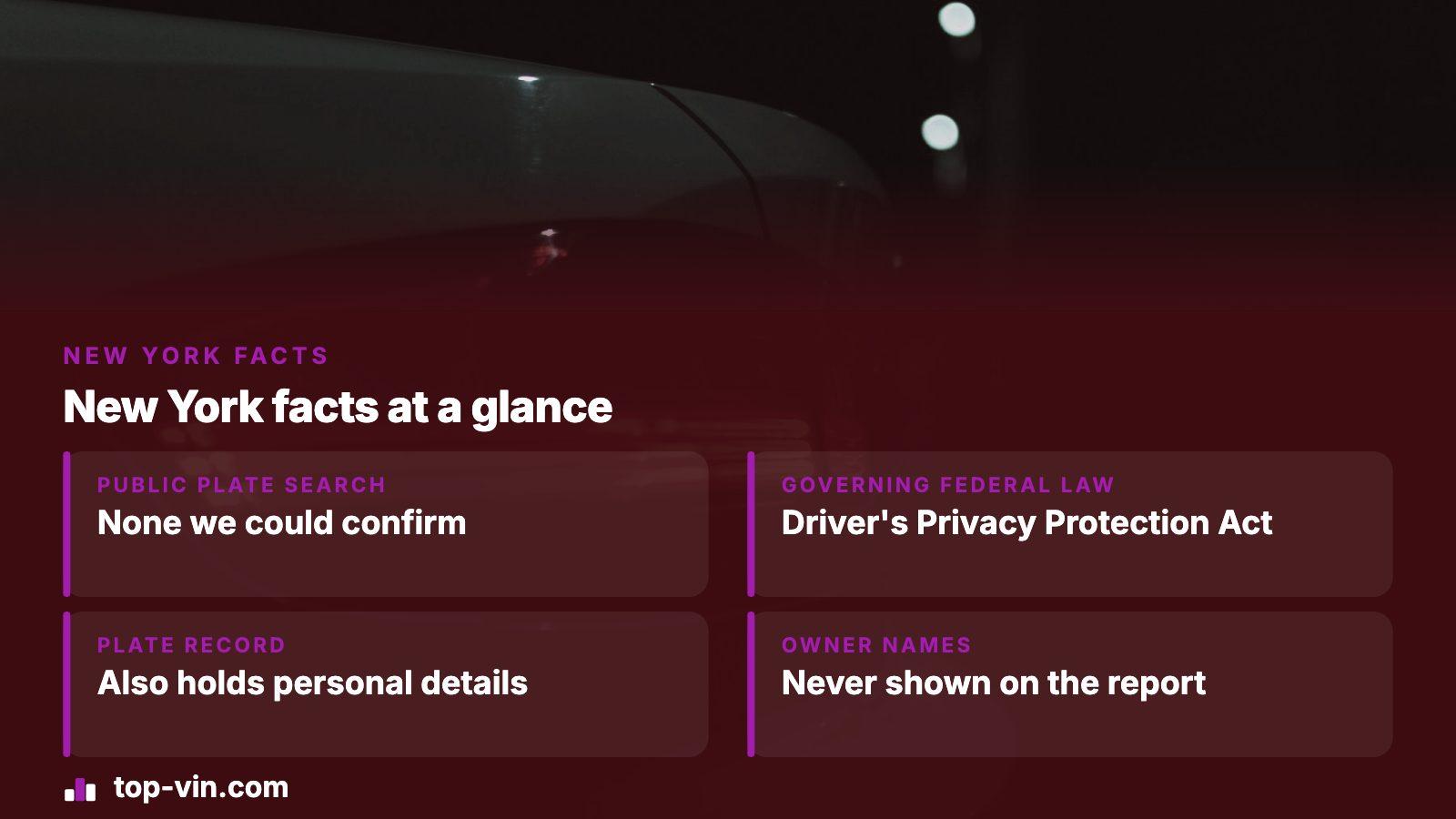
- Public plate-to-VIN search
- None we could confirm
- Governing federal law
- Driver's Privacy Protection Act
- Owner names on TopVIN
- Never shown
- TopVIN cost to start
- Free preview
What a New York plate can and cannot give you
Photographing a plate feels like progress, because it is the only identifier you can read from the curb. But a plate is a pointer into a state registration file, and that file ties a car to a person. Websites that promise to convert any New York plate into a full history are selling a promise the law does not let a state agency keep for them.
The facts a buyer wants sit under the VIN instead: title brands, damage entries, mileage readings, salvage records, liens and theft flags. So the plate is only a clue. Your goal is to reach the number stamped on the car.
Why the federal statute keeps this closed
Under the Driver's Privacy Protection Act, a DMV cannot hand over the personal details it keeps unless the requester fits a use named in the statute. There are 14 of them, and a request normally has to fit one. A few examples show the pattern.
- Courts, police and agencies doing their jobs, and contractors working for them.
- Insurers handling claims, hunting fraud or pricing policies.
- Litigants and the people who deliver court papers.
- Tow companies that must notify the owner of an impounded car.
- Licensed investigators, limited to the statute's own reasons.
- A requester with signed consent from the person in the record.
Curiosity about a used car is not on the list. If a request fits none of them, a state may even mail the person concerned and keep the data back unless that person waives the right.
Four routes to the number that do not involve the state
For a purchase you are actually considering, these are quicker than any records request and they cost nothing.
- Before you drive out, text the seller and request the VIN. Dodging a number printed on their own paperwork is itself a signal.
- Request a sharp photo of the title's face and hold it against the car's number later.
- Ask to see the registration card or the insurance card. Both name the specific vehicle.
- Standing at the car, photograph the metal tag low on the dashboard and the sticker on the door frame. Every copy must match.
When the copies disagree
A single typo happens. A mismatch between the car and its paperwork can also point to a replaced part or an altered document. Resolve it before any money changes hands.
If you really do have a permitted purpose
Insurers, litigants and tow operators do go to the state. The Justice Department's list of state record-request routes shows a New York entry called the Vehicle Registration or Title Record Abstract, and the page it links to is addressed to owners getting their own record. That tells you the abstract is not built for a stranger checking a car.
We could not open the New York DMV's own pages, because they sat behind a browser check we do not complete. So this page quotes no form number, fee or turnaround time. Read the DMV's current instructions yourself, and expect the state to ask you to state a purpose that the federal list covers.
Run the VIN check the way a careful buyer would
Type the number into TopVIN and a preview appears before any payment. Use it as a match test: does the year, make and model line up with the listing and the car you are standing beside? If so, you can buy the report once, with nothing renewing; amounts are on the pricing page.
For a car that has lived in New York, give extra attention to the title section, damage and salvage entries with photos, how the mileage steps up over time, and any lien. A lien can block a clean transfer, and a brand follows the car into every future sale.
Turning findings into a decision
| What the report shows | Your move |
|---|---|
| Salvage, junk or flood brand | Get repair documents, then value it as branded or pass. |
| Odometer reading that drops | Ask for dated service invoices and treat rollback as a live possibility. |
| Open lien | Do not pay until the lender's release is in your hands. |
| Theft record | Stop and confirm with police or the insurer. |
| Open recall | Book the free repair at a dealer for that make after you buy. |
The Justice Department describes its title system as a source of title, odometer and certain damage history, and advises pairing any report with an independent inspection and a varied test drive.
Where a VIN check stops
NHTSA's decoder returns what the maker submitted, and an empty field only reflects missing NHTSA data, not a missing feature. It cannot show that a plate on a car legitimately belongs to it, since plates move between vehicles. Trust the stamped number first.
No database holds everything either. A repair paid in cash leaves no trace. That is why the inspection and the test drive still matter.
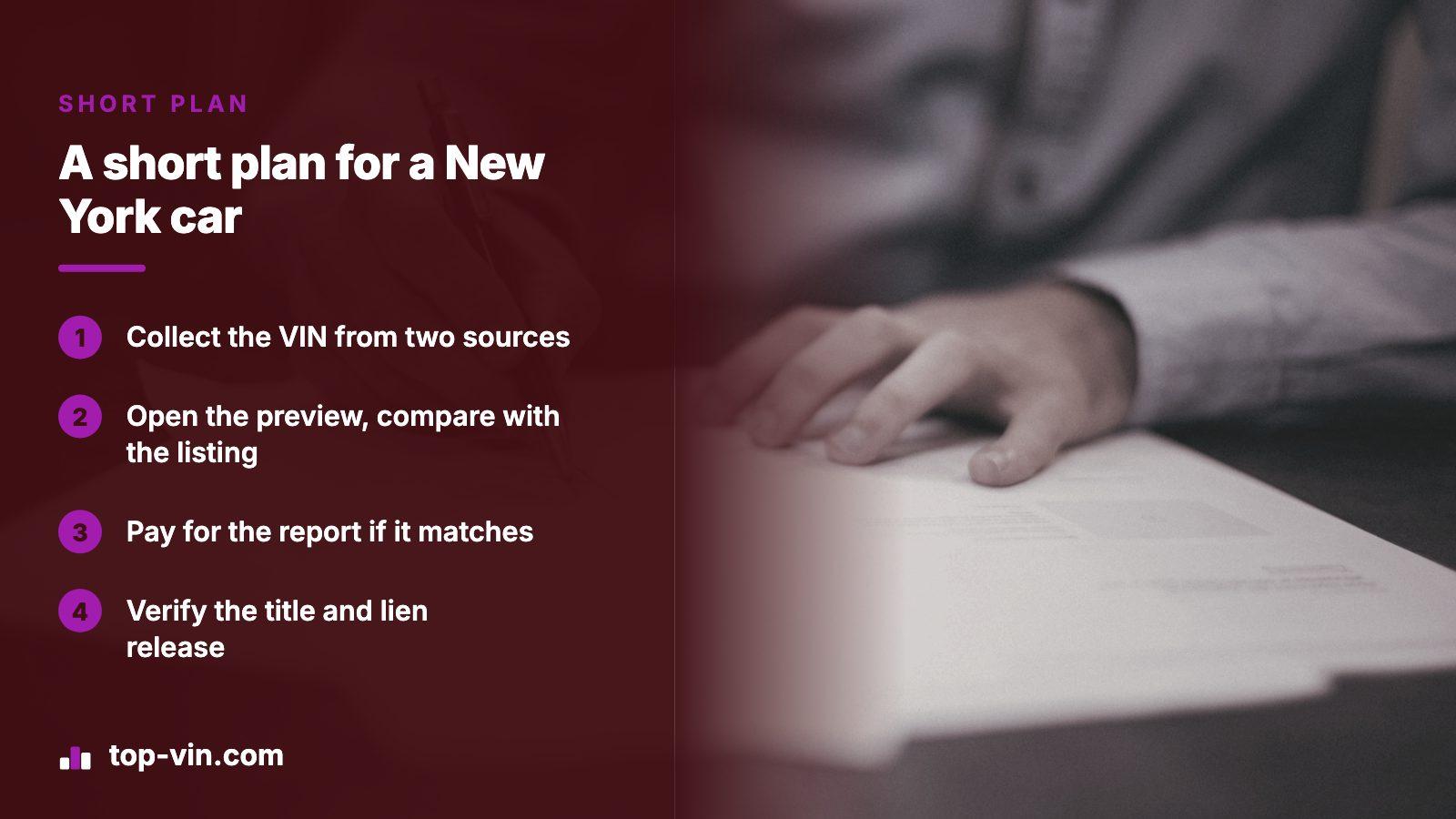
A short plan for a New York car
- Collect the VIN from two sources and confirm they match.
- Open the TopVIN preview and compare it with the listing.
- Pay for the report only when the preview matches the car.
- Verify the title and any lien release in person.
- Pay for an independent inspection, especially if damage is listed.
Where this information comes from
- Federal statute on motor vehicle record privacy (section 2721) — The ban on release and the 14 permitted uses.
- DOJ NMVTIS: State Vehicle Record Request Information — Lists the New York DMV record abstract and how states take requests.
- DOJ NMVTIS: Used Car Buying Tips — Inspection, test drive and title-history advice for buyers.
- NHTSA vPIC API — How VIN decoding works and what a missing value means.
Sources and photos: Facts checked against the sources above in November 2026. Photos by Max Tokarev, Scott Graham and Johnathan Kaufman on Unsplash; diagrams by TopVIN.
Keep reading
- License plate to VIN: the lawful ways to find a car's VIN from its plateThe national picture on plates, VINs and the law.
- Where the VIN sits on a title, and what to do nextWhere the number sits on a title and how to read it.
- Is the VIN on the insurance card? What to check before you trust itUse the insurance card as a second source for the VIN.
- Vehicle registration lookup: what it shows and which check to addWhat a registration record holds and who may see it.
Frequently asked questions
Can I get a VIN from a New York license plate number?
Not through a public tool we could confirm. Federal law limits what the DMV releases from registration files. Buyers normally get the number from the seller, the title, the registration or insurance card, or the car, and then run a VIN check.
Does TopVIN search by license plate?
No. TopVIN starts from a VIN and never reveals who owns a car. Enter the number, look at the free preview, and decide afterward whether the full report is worth buying.
Who can ask the New York DMV for records tied to a plate?
Federal law names agencies, insurers, parties to legal cases, licensed investigators and people with the record subject's written consent. Ask the New York DMV about its current process, because we could not read its pages.
The seller won't give me the VIN. Now what?
Read that as a red flag. The number is printed on the title and the vehicle, so honest reasons to withhold it are rare. Offer to read it at the car and leave if it differs from the paperwork.
Is the TopVIN report free?
The preview is the free part. The whole report is bought once, never as a subscription, with options on the pricing page. Begin with the preview to see whether the VIN matches the right car.
Now check the car itself
The guide explains what to look for. The report shows what this VIN has on record.