
THE SHORT ANSWER
Do not expect a plate search to hand a private shopper a VIN. The state's registration files are shielded by the Driver's Privacy Protection Act, and releases are limited to listed purposes. Ask the seller for the number in writing, compare it with the title and the car, and then open a TopVIN preview before deciding on a report.
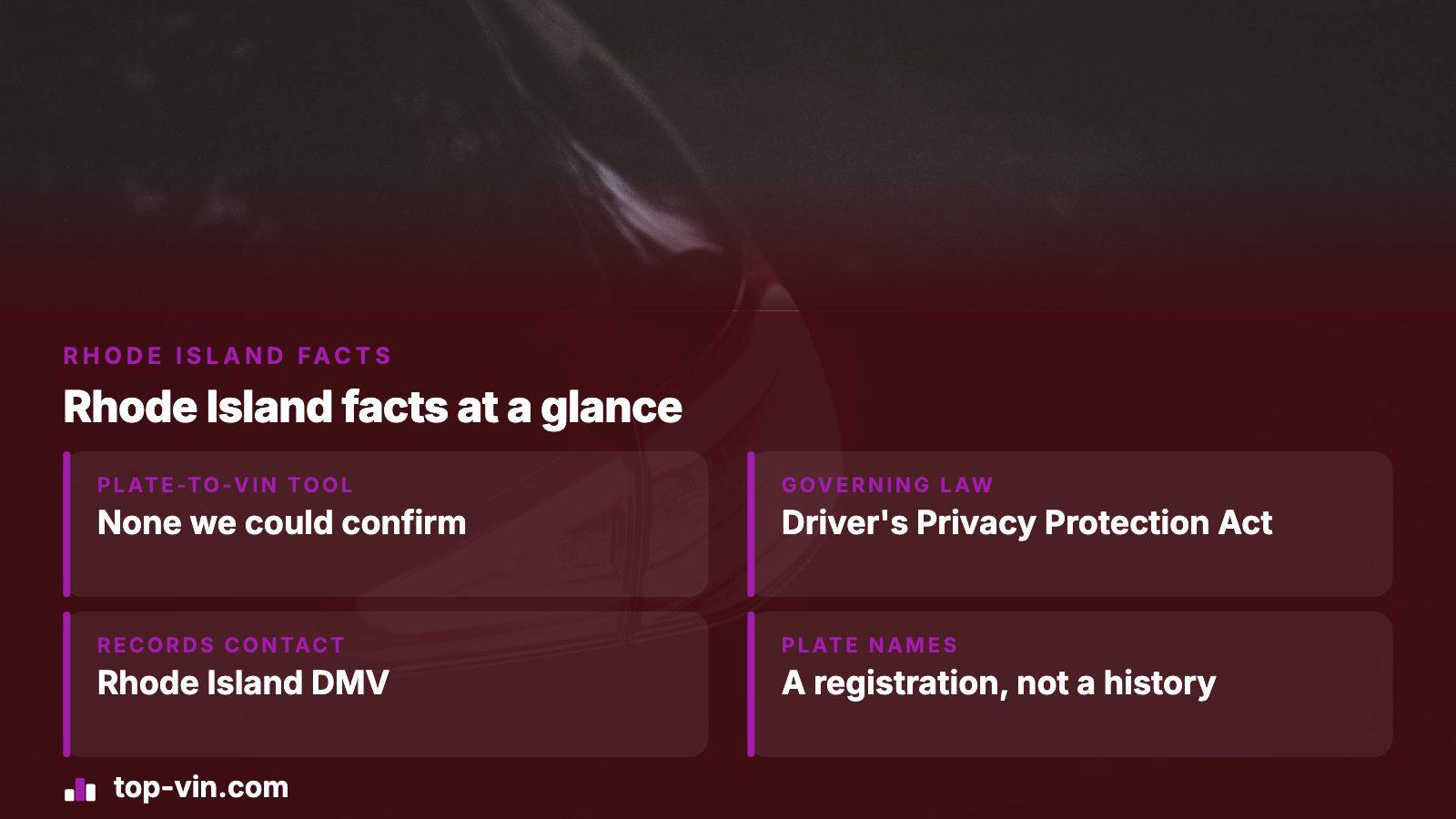
- Public plate-to-VIN tool
- None we could confirm
- Governing federal law
- Driver's Privacy Protection Act
- Records contact
- Rhode Island DMV
- TopVIN
- Free preview, then one payment
A plate names a registration, not a car's history
You spot a car on a Providence side street, or an ad shows only a photo with the plate visible, and the natural thought is to type those characters into a search box. The trouble is what sits behind them. A plate belongs to a registration file at the DMV, and that file ties the vehicle to a person. Everything a careful buyer wants, from title brands to odometer readings, is organized by the vehicle identification number instead.
TopVIN follows that same logic. It does not search by plate, it does not reveal who registered a car, and it will not hand back an address. You supply the VIN; it describes the vehicle. That split is deliberate, and it is also the reason a legitimate shopper rarely needs the registration file at all.
The federal rule that closes the file
Section 2721 of Title 18 forbids every state DMV, along with its staff and contractors, from knowingly handing over identifying details found in a vehicle or license record unless one of the listed exceptions fits. Section 2725 defines those details: a person's name, street address, phone number, driver ID number or photo. Accident, ticket and driver-status data fall outside that definition.
The exceptions are narrow. These are the ones that come up most:
- Government bodies, courts and police doing their work.
- Insurers handling claims, fraud screening or underwriting.
- Lawyers and parties in court or administrative cases, including those serving papers.
- Businesses and towing firms with a narrow task, such as notifying the owner of a towed car.
- Licensed private investigators who have an allowed reason.
- A requester who can show the named person agreed in writing.
- Uses a state itself authorizes when they relate to driving or public safety.
Looking over somebody's used car before you make an offer does not appear on the list.
Getting the VIN the ordinary way
Most purchases never require a records request. The number travels with the car, so the quickest sources are the people and papers already in the transaction. Try them in this order:
- Message the seller and ask for the VIN in writing before you drive out. A seller who stalls over a printed number has told you something.
- Ask for a clear photo of the title and read the number on it.
- Request the registration document, which carries the same number.
- Ask for the insurance card or policy page, since coverage is written against a specific vehicle.
- Standing next to the vehicle, photograph the stamped number where the dash meets the glass, plus the sticker inside the driver's door, then hold both against the title.
When the paper and the car disagree
A single swapped character can be a clerk's typo. A real mismatch can also point to a replaced part or an altered document. Settle it in writing before money moves, and leave if the answer sounds thin.
If you are unsure the characters you were handed even make sense, the check digit page explains how to test them.

If you really do have a permitted purpose
Some readers are not casual shoppers: an adjuster on a claim, a party in a lawsuit, a tow operator who has to notify an owner. For them the state is the correct door. The Justice Department keeps a list of where to request each state's vehicle records for NMVTIS purposes. Its entry for this state simply sends you to the DMV's registrations, plates and titles section of the agency website, with no form name and no fee attached.
We tried to open the agency's pages and were stopped by a browser check, so we cannot tell you which form to use, what it costs or how long a response takes. Read the DMV's current instructions before sending anything, expect to be asked for your reason, and keep in mind that a private buyer weighing a car does not fit the permitted categories.
Running the check once you hold the VIN
Type the number into TopVIN and a preview comes up first. Use it as a quick sanity test: does the model year, make and model fit both the listing and the vehicle you are standing beside? If they do, you can open the full report by paying once. Amounts are on the pricing page, and no subscription follows.
Rhode Island is small, and cars cross its borders constantly, so a vehicle titled here may have spent years elsewhere. That makes the national title picture more useful than local assumptions. Pay attention to brands on the title, damage entries, how the mileage climbs from one reading to the next, auction or salvage photos, and any open lien.
What to do with what the report shows
| What you find | Reasonable next step |
|---|---|
| Salvage, junk or flood brand | Request repair paperwork and value it as a branded vehicle, or pass. |
| A mileage figure lower than an earlier one | Suspect rollback and ask for dated service invoices. |
| Open lien | Insist on the lender's written release before paying. |
| Theft record | Stop and confirm with police or the insurer. |
| Open recall | Book the free repair with a brand dealer after you buy. |
The federal title system, NMVTIS, was built to shield shoppers from fraud and dangerous vehicles, and to stop thieves reselling stolen ones. Brands a state reports follow the vehicle, though states define damage differently, so one state's label may not match another's.
What a VIN decode cannot prove
NHTSA's vPIC decoder reads a VIN against data that manufacturers submitted, and the agency advises including the model year when you ask. It decodes numbers, not plates, so it cannot confirm that the plate on a car belongs to it. Plates move between vehicles; the stamped number is the one to trust.
No report captures a repair paid for in cash or a problem nobody wrote down. Pair the history with a test drive and a look from an independent mechanic.
A short plan for a Rhode Island buyer
- Get the VIN from two different places and compare them.
- Open the TopVIN preview and match it to the listing.
- Spend on the full report once the preview matches the car.
- Check the title and any lien release in person.
- Schedule an inspection, especially if damage shows up.
Where this information comes from
- Federal statute: release of motor vehicle record data (18 U.S.C. 2721) — The general bar on release and the list of permitted uses.
- Federal statute: definitions (18 U.S.C. 2725) — What counts as a motor vehicle record and as personal information.
- Justice Department NMVTIS: state vehicle record request information — Where the Rhode Island entry sends requesters.
- NMVTIS for consumers, vehiclehistory.gov — The purpose of the national title system.
- NHTSA vPIC API — How VIN decoding draws on manufacturer submissions.
Sources and photos: Facts checked against the sources above in November 2026. Photos by Mustafa Sheikhmouss, Alejandro Escamilla and Maurice Sahl on Unsplash; diagrams by TopVIN.
Keep reading
- Vehicle registration lookup: what it shows and which check to addWhat a registration record holds and who may see it.
- Motor vehicle records: what a car buyer can see, and what stays closedHow a state record differs from a history report.
- VIN Lookup by License Plate in Massachusetts: What Works and What Doesn'tThe same question for the neighboring state.
- VIN check digit: how the ninth character is worked out and what it provesTest whether the number you were given is valid.
Frequently asked questions
Can I get a VIN from a Rhode Island license plate?
Not through a public search we could confirm. Federal law restricts what the DMV releases from registration files. Buyers usually take the number from the seller, the title, the registration or insurance paperwork, or the vehicle itself, and check that.
Does TopVIN search by plate number?
No. TopVIN starts from a VIN and never shows who owns a vehicle. Enter the number, read the preview that costs nothing, then judge if the full report earns its price.
Who can ask the Rhode Island DMV for records tied to a plate?
Federal law names agencies, insurers, parties to legal cases, licensed investigators and people holding written consent from the person in the file. Ask the Rhode Island DMV about its present steps and costs, which we could not read.
What should I do if the seller refuses to give the VIN?
Take that as a warning. The number is printed on the title and on the car, so honest reasons to withhold it are scarce. Offer to read it at the vehicle yourself and skip the deal if it differs from the paperwork.
Is the TopVIN report free?
No, just the preview. A full report is bought once, with no recurring fee, and the pricing page has the amounts. Start with the preview so you know the VIN matches the right car.
Now check the car itself
The guide explains what to look for. The report shows what this VIN has on record.