THE SHORT ANSWER
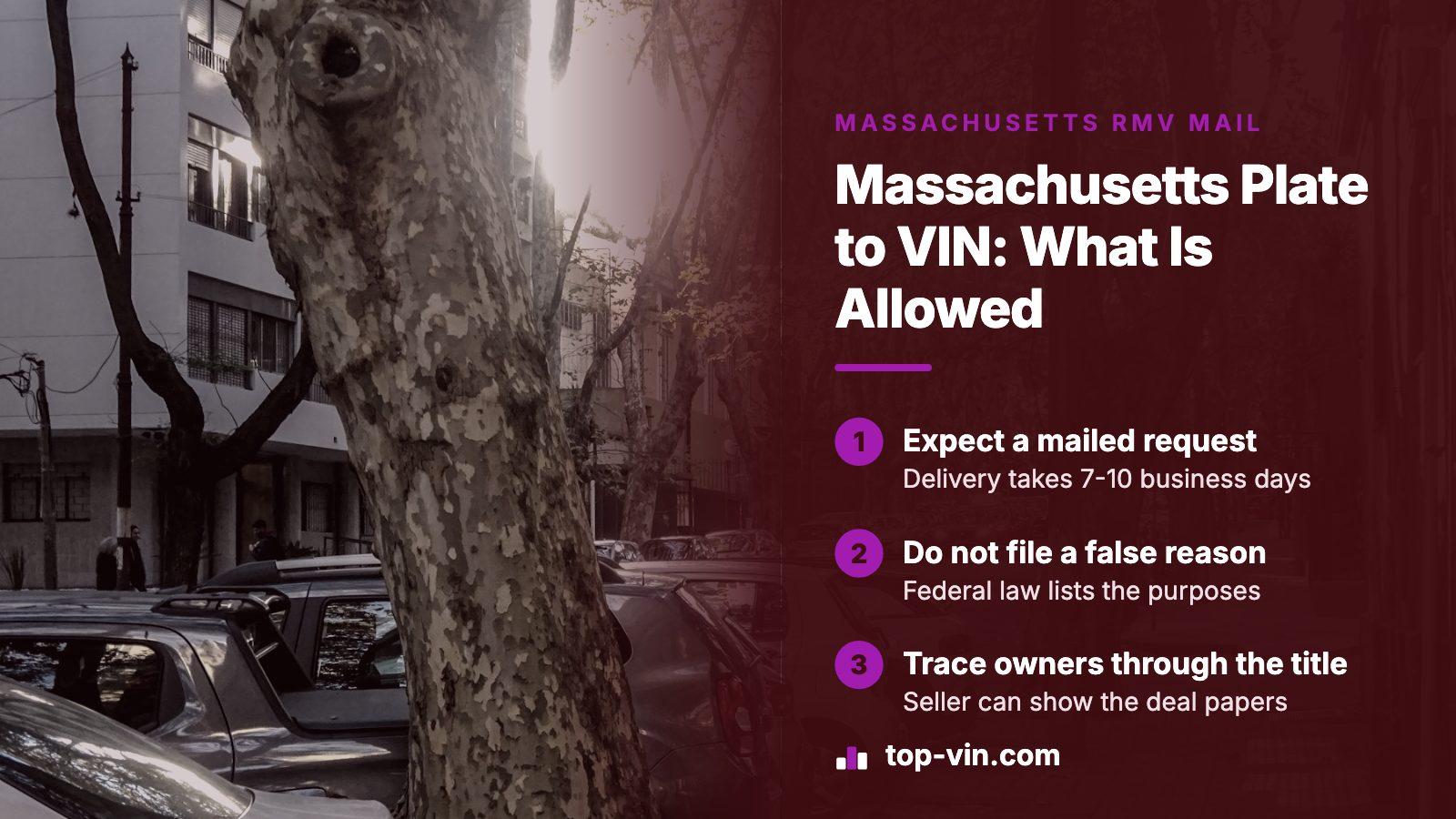
A Massachusetts plate cannot be exchanged for a VIN through an open lookup. Registry staff may share personal details only when the federal privacy statute lists your reason, and the request goes in by post. A shopper is better served by getting the 17 characters from the person selling, from a title or policy page, or from the car, and then running the check.
- Open plate lookup
- None we could confirm
- RMV copy fee
- $5 per record
- RMV turnaround
- 7-10 business days by mail
- TopVIN
- Free preview, then one payment
What a Massachusetts plate actually points to
A plate is the only identifier you can read from the curb, so it is natural to start there. The trouble is what sits behind it. The registration record ties the car to a named person and an address, and that is the part the law guards. The history a buyer cares about lives somewhere else: it is filed against the VIN.
TopVIN works from the VIN for that reason. It never searches by plate, and it never returns who owns or drives the car. It describes the vehicle and what has happened to it.
How the RMV treats record requests
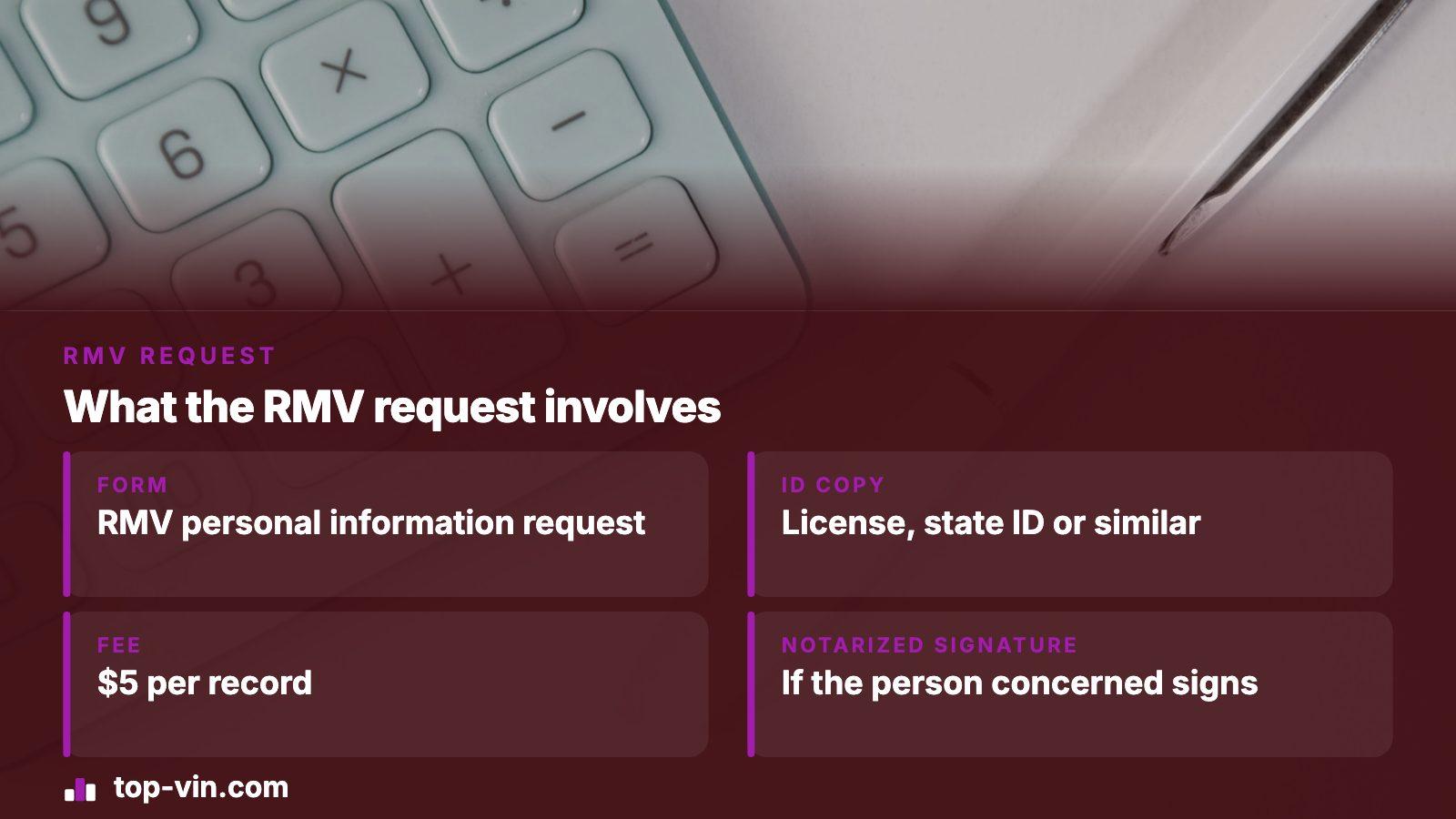
According to the RMV, most of its records are open to the public, though privacy rules narrow what a given person can get. It names the federal Driver's Privacy Protection Act as the law controlling release of personal details. Its request page spells out a mailed application.
- The RMV's own personal-information request form, downloadable from its page.
- A photocopy of your license, state ID or professional license.
- The per-record fee, which the page puts at $5, paid by check or money order to MassDOT.
- A notarized signature from the person concerned if you want highly restricted data such as a photo, Social Security number or medical details.
Results come back by post to the address you wrote on the application, in 7-10 business days. That page offers no instant online plate search.
Who can legitimately ask, and who cannot
Congress wrote a short menu of reasons a state may release personal details from a vehicle record. Most are professional, and only a few reach ordinary people, and then narrowly.
| Requester | Reason the law allows |
|---|---|
| Courts, agencies, police | Carrying out official duties |
| Insurers | Claims work, fraud review, rating |
| Litigants and their agents | Court or agency proceedings, serving papers |
| Tow and impound operators | Notifying owners of towed cars |
| Licensed investigators | Any purpose the statute otherwise permits |
| Anyone with written consent | The person in the record agreed in writing |
Sizing up a stranger's car before buying is absent from that menu, so such a request should not be sent.
Why a false request is a bad idea
What the RMV spells out
Taking or using personal data from a vehicle record for a reason the law does not list can cost $2500 per violation in liquidated damages, plus punitive damages and legal fees. Misstating your identity to get it can lead to prosecution, with a fine up to $5000, up to a year in jail, or both.
A website advertising an instant plate-to-owner search either invites that risk or hopes you will not ask where its data comes from. Shoppers gain nothing here, because ordinary channels supply the VIN.
Getting the VIN from the deal itself
In a live purchase the number is nearly always within reach. Work through these in order.
- Text the seller and get the VIN in writing before making the trip.
- Request a photo of the title's front and compare it against the listing.
- Ask for the registration, which repeats the number.
- Get the insurance card or a policy page naming the insured car.
- Standing at the car, photograph the metal tag visible through the windshield and the label in the driver's door jamb, and check each against the documents.
If any two sources disagree by even one character, stop and sort it out. One wrong character could be a typing slip; it could equally point to a replaced component or a doctored page.

Using the title to trace a car's past owners
The RMV offers a separate service for tracing a vehicle: either a computer record of previous owners or photocopies of the title application and its supporting papers. Owners and license holders send a history search or photocopy form. Authorized recipients and permitted users send the personal information application instead.
Fees on that page are $10 each for copies of title applications such as the RMV-1, and $5 each for an RMV record copy, with 7 - 10 days for processing. It is slow and by mail, which makes it a tool for disputes and paperwork, not for a car you are looking at this afternoon.
Running the VIN through TopVIN
Enter the VIN and you get a free preview before anything else. Should the car still look worth chasing, the full report costs one payment, never a subscription, with amounts on the pricing page. For a Massachusetts purchase, a few sections deserve your attention first.
- Title brands, since a brand from any state travels with the car.
- Salvage and auction history, including photos where they exist.
- Odometer readings over the years, in case a figure drops.
- Liens, so you do not inherit a lender's claim.
- Open recalls, which are still waiting for a repair.
Massachusetts details that change how you read a report
Per the RMV, a car becomes salvage once its insurer calls it a total loss, whether from fire, vandalism, collision, theft, flood or another cause, and once applied, the label never comes off the record. If a report shows that word, the price should reflect it, and the RMV lists separate paths for salvage, owner-retained, and reconstructed titles.
Titling rules matter too. The state expects a purchase to be titled within 10 days, and the RMV says electronic titles begin on October 26, 2026. A seller who cannot produce a clean title promptly deserves hard questions.
Cost, and your move after the preview
Looking at the preview costs nothing. Going further means one payment, with no recurring billing, for this car alone, or as a bundle if you are comparing candidates. Amounts are on the pricing page.
With a clean preview, schedule an independent inspection. With a brand, a lien or a mileage drop, get the seller's explanation on paper, and walk away if the answer is thin.
Where this information comes from
- Massachusetts RMV: Request personal information in RMV records — form, fee, ID and penalties for misuse
- Massachusetts RMV: Request a history search or photocopies — title trail service and its fees
- Massachusetts RMV: Salvage Vehicles and Titles — how salvage status is defined and kept
- Massachusetts RMV: Vehicle Certificate of Title — titling deadline and the E-Title date
- Driver's Privacy Protection Act, 18 U.S.C. 2721 — list of permitted uses
- DOJ NMVTIS for consumers — federal title information system overview
Sources and photos: Facts checked against the sources above in November 2026. Photos by Nikolai Kolosov, Tigran Shishmanyan and Sasun Bughdaryan on Unsplash; diagrams by TopVIN.
Keep reading
- License plate to VIN: the lawful ways to find a car's VIN from its plateThe national picture of plate lookups and the privacy law.
- Where the VIN sits on a title, and what to do nextWhere to find the number on the paperwork.
- Is the VIN on the insurance card? What to check before you trust itA quick way to confirm the VIN from the insurer's document.
- How to find a VIN without the car in front of youWays to get the number while the car is elsewhere.
Frequently asked questions
Can I find the VIN from a Massachusetts license plate online?
Not through a public, lawful tool that we could confirm. The RMV treats plate records as protected and takes mailed requests that need identification and a stated eligibility. Shopping for a car, the seller or any of the car's papers can give you the VIN.
How much does an RMV record request cost?
The RMV pages list $5 per record for a copy and $10 for each copy of a title application. Payment goes by check or money order to MassDOT. Fees can change, so confirm on the RMV's own page before you mail anything.
How long does the RMV take?
The RMV pages ask for 7-10 business days after it receives a mailed request. Too slow for a car on the lot today, so take the VIN from the seller and check it right away.
Does TopVIN search by plate?
No. It starts from the VIN and never returns an owner's name or address. Previews are free; the report is a single charge whose current amount is shown on the pricing page.
Does a salvage brand ever go away in Massachusetts?
Per the RMV, the salvage label is permanent and stays on record. A repaired car can be re-titled, but the record remains, which is why a history report matters before you pay.
Now check the car itself
The guide explains what to look for. The report shows what this VIN has on record.