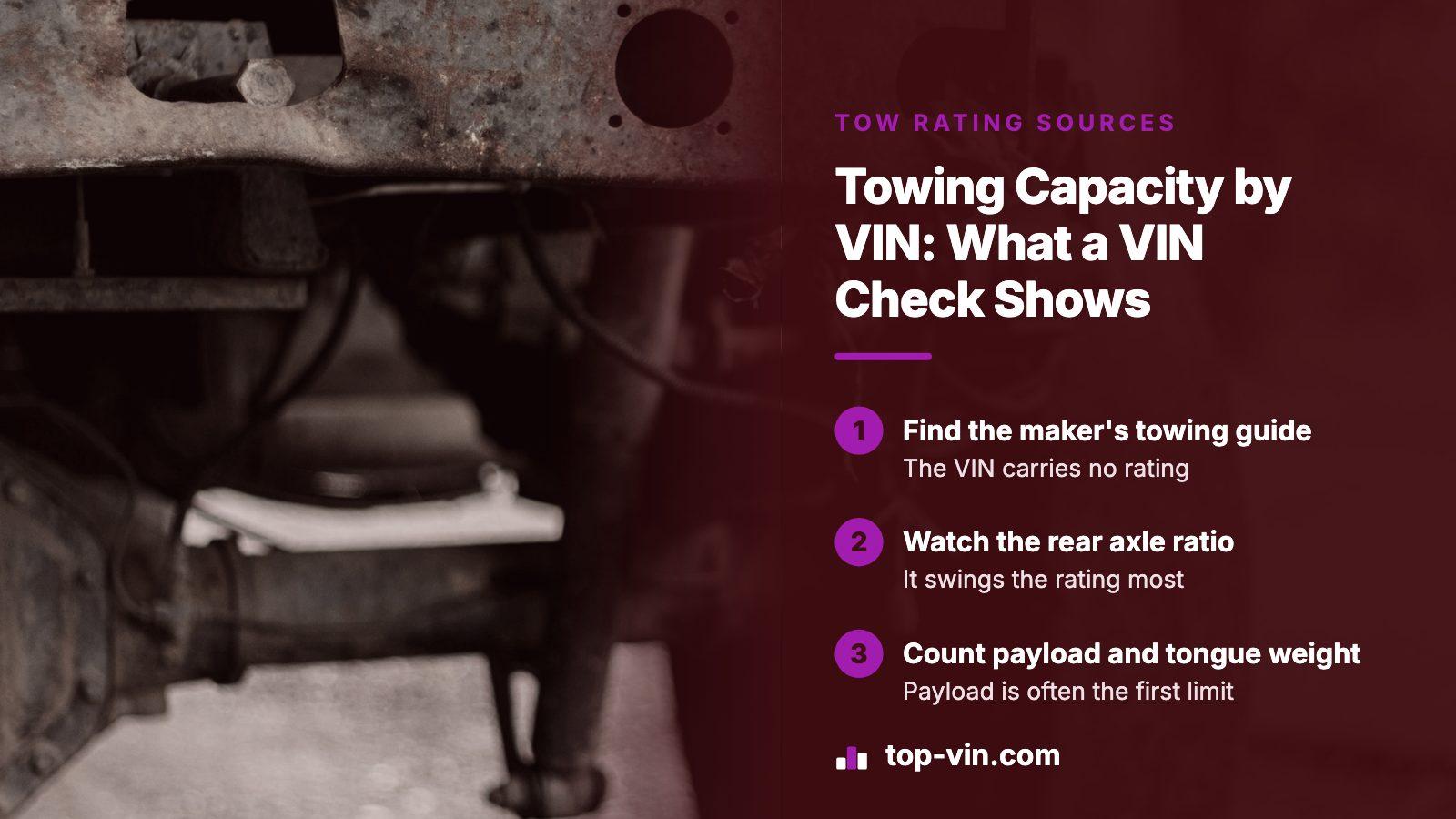
THE SHORT ANSWER
No. A VIN gives the year, make, engine and body style of a truck, and it carries no tow rating. The rating sits in the maker's towing guide, in the row that matches the engine, drivetrain, cab, bed and rear axle ratio. Then compare it with payload, combined weight and hitch limits, because the lowest figure in that chain is the one you can actually use.
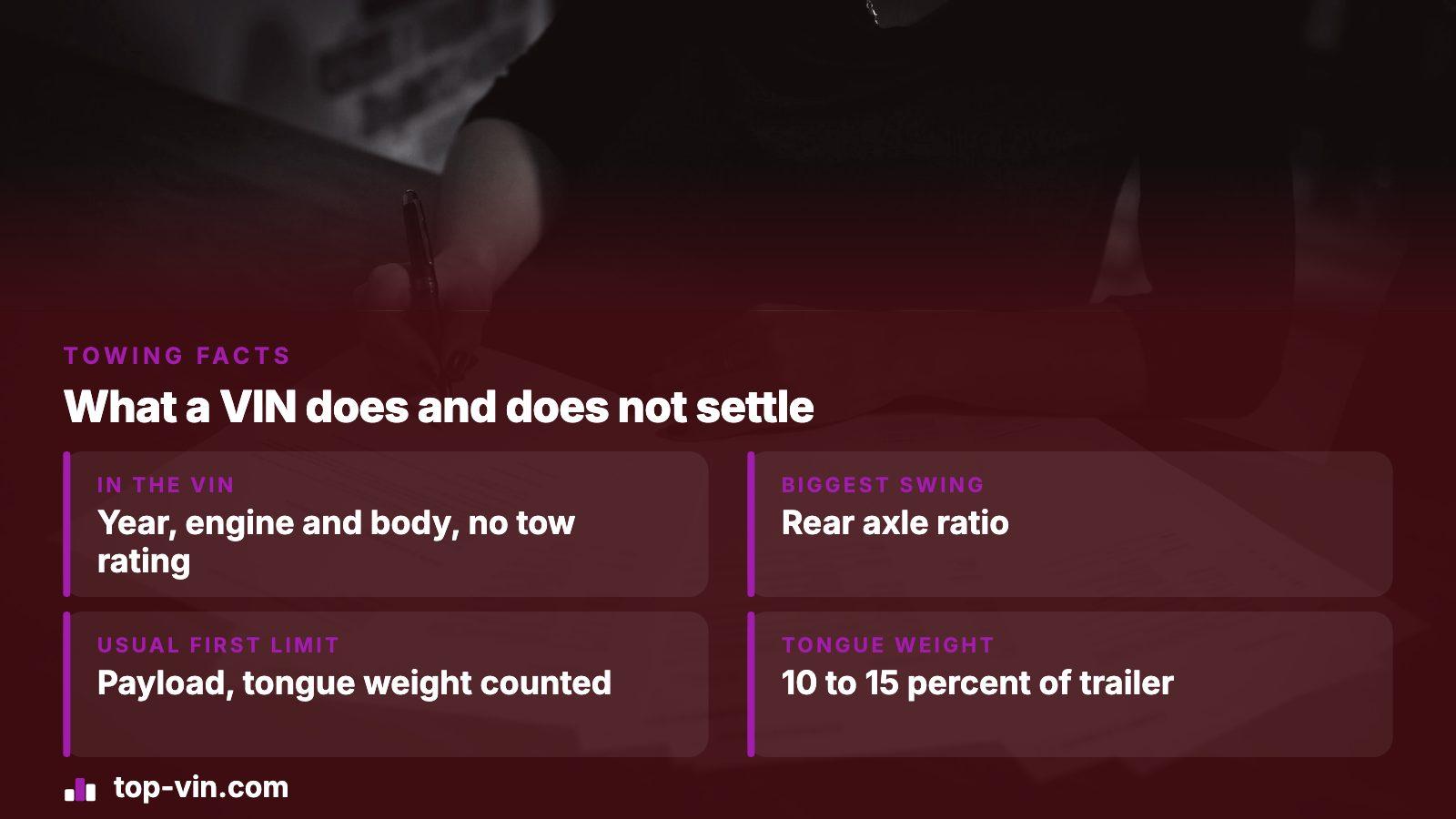
- In the VIN
- Year, engine and body, but no tow rating
- Biggest swing
- Rear axle ratio, such as 3.55 against 3.73
- Usual first limit
- Payload, with tongue weight counted
- Tongue weight
- 10 to 15 percent of trailer weight
What the VIN pins down about a tow vehicle
Seventeen characters is not much, yet the middle of the code does real work. Characters 4 to 8 describe the vehicle line, body and engine, position 10 holds the year and position 11 the plant. A towing chart filters on exactly those, so a decode has already thrown out most rows of a maker's guide.
What the code cannot hold is a rating. A VIN is an identity, while a tow figure is a performance number published per configuration. On many trucks it also omits the two details that finish the job, rear-axle gearing and tow equipment, so confirm both on the truck.
What a check settles and what stays open
Searches for towing capacity by VIN and for a VIN check run together, but the tools answer different things.
| Question | Does a VIN check settle it? | Where the final answer lives |
|---|---|---|
| Model year | Yes, from position 10 | Pick that year's towing guide |
| Engine and body style | Yes, from the model and engine positions | Cuts the guide to a few rows |
| Two- or four-wheel drive | Often, depending on the make | Confirm it on the truck |
| Rear axle ratio | Not reliably | Option label in the glovebox, door sticker or the axle |
| Factory tow package | Not reliably | Bumper wiring, receiver and cooler on the truck |
| Tow rating | No | The maker's guide for that year and setup |
Six things that move a tow rating
Two pickups can look identical in a driveway and sit far apart on the rating sheet. These variables explain why.
- Rear axle ratio: gearing is the largest single swing, and a 3.55 rear end against a 3.73 can mean thousands of pounds between two otherwise matching trucks.
- Engine: its torque and its cooling set the starting ceiling.
- Cab and bed: a longer wheelbase tends to raise the rating, while a crew cab adds weight.
- Drivetrain: four-wheel drive adds mass, and the rating usually gives up a bit for it.
- Tow package: bundled cooling, wiring, a receiver and, on some trucks, a different axle.
- Model year: after the industry moved to SAE J2807 testing, makers restated their figures.
The advertised number is the best case, not your truck
Makers advertise the highest figure any version of a model can reach, and few buyers own that version. The gap turns up in complaints that owners file with NHTSA.
From an NHTSA owner complaint
Writing about a 2008 Ford F-150, an owner said the truck was bought to haul a travel trailer weighing 7,000 pounds, since the maker's booklets and website promised 9,000. After three trips the owner reported that the truck "struggles and sways" badly, even with a sway bar fitted, and that towing the trailer caused some fear. No axle ratio, engine or package is named, so the truck's row of the guide is unknown.
This is an owner's account, not a verdict, since sway can also come from loading and hitching. The lesson stands: a headline figure is not the rating for your row. Find that row before you buy a trailer.
From VIN to the row that applies to you
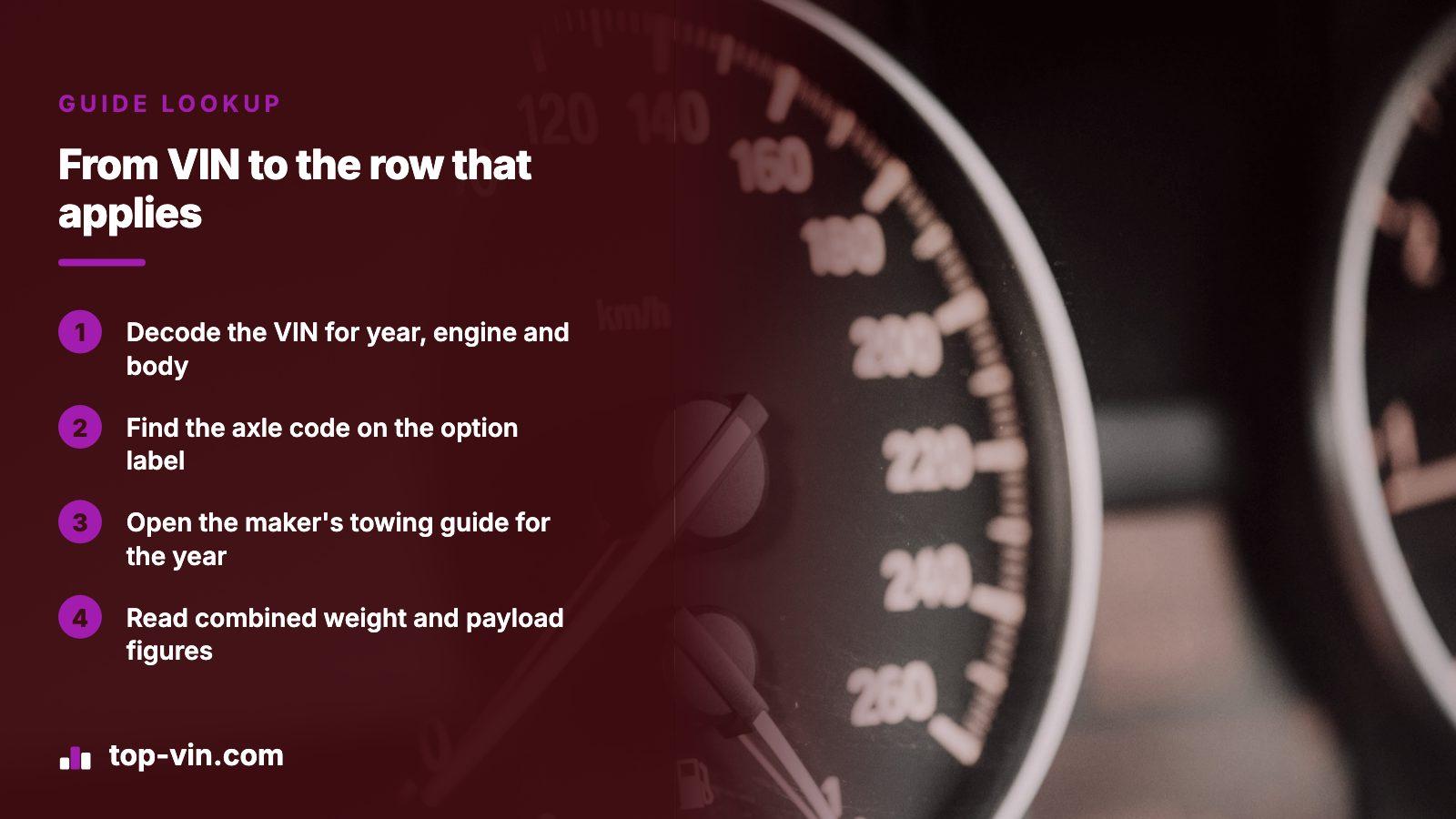
- Decode the VIN to lock in year, engine and body. The TopVIN preview does this before any payment.
- Find the axle code on the glovebox option label or the door sticker. On General Motors trucks it appears as an RPO code.
- Open the maker's towing guide for that model year and look for the single row where engine, cab, bed, drivetrain and axle all match.
- Read the combined-weight and payload figures from the same guide, because they usually bind before the tow figure does. If two rows still fit, plan around the lower one.
The door label sets weight limits, not a tow rating
Federal rules make a maker put a certification label on each vehicle, normally on the hinge pillar, the latch post or the door edge beside the driver. It states the gross vehicle weight rating, a gross axle rating for every axle listed from the front axle back, the month and year of manufacture and the VIN.
A tow rating is not on that list. Many trucks add a payload figure on the label or a sticker nearby. Treat those numbers as the limits that govern how you apply the rating from the guide.
Why payload is the first limit most drivers hit
Expect a trailer to press 10 to 15 percent of its own weight down on the hitch. That tongue weight rides on the truck, so it is spent from payload, along with passengers, fuel, tools and whatever sits in the bed. Take the 7,000-pound trailer from the complaint above: at 12 percent, 840 pounds lands on the ball before anyone climbs in.
From an NHTSA owner complaint
A 2011 Ford F-250 Super Duty owner said a new diesel crew cab was chosen because the brochure's payload chart showed 2,210 pounds, then the real capacity proved lower. The owner said the maker blamed options, that standard parts such as the spare tire were left off when payload was figured, and that the loading label was mounted low on the body where only a person kneeling could read it.
Whatever the merits of that dispute, take payload from the label on the exact truck you are buying, not from a chart, and subtract tongue weight and your load before you think about the trailer.
Combined weight and the hitch set their own ceilings
GCWR, the gross combined weight rating, caps what truck and trailer may weigh as a pair, each carrying the load you will really haul. Subtract your loaded truck's real weight from it, and what is left over is the trailer weight you can legitimately tow. A stop at a public scale is cheap, and it swaps a guess for a figure.
The hitch is a limit of its own. Every link in it, from the receiver and mount to the ball itself and any weight-distribution bars, carries a stamped rating, and your working ceiling is the lowest among them. A pickup rated for 9,000 pounds that wears a 5,000-pound ball is a 5,000-pound tow vehicle until that part changes.
Before you pay for a used tow truck
- Decode the VIN before you drive out, so the engine and body match the advert.
- Photograph the option label and door sticker, so the axle code can be checked against the maker's guide later.
- Look for tow-package evidence: factory wiring at the bumper, a transmission cooler and a brake controller wired into the dash.
- Read the receiver's stamped rating, and price a replacement into your offer if it is low.
- Check for signs of heavy work, such as a worn hitch, sagging rear springs and tired rear tires.
The record side matters more on a truck that has pulled loads. The TopVIN preview is free and confirms the decode. The full report is a single payment, not a subscription, with current rates on the pricing page. It adds title brands, accident and salvage records with photos, odometer readings, open recalls and use type, which shows whether a work truck came from a fleet. It does not print a tow rating or an axle code, so the maker's guide stays part of the job.
Where this information comes from
- NHTSA owner complaint 10240608 — owner experience, paraphrased
- NHTSA owner complaint 10919659 — owner experience, paraphrased
- 49 CFR 567.4: certification label — Sets what the door label must state, where it must sit and how readable it must be, with no tow rating among the entries.
- NHTSA: recalls lookup — Public recall search by VIN, worth running on any truck you plan to load.
Sources and photos: Facts checked against the sources above in November 2026. Photos by Zoshua Colah, CHUTTERSNAP and Dimitri Karastelev on Unsplash; diagrams by TopVIN.
Keep reading
- Axle ratio by VIN: which checks can answer it and which cannotThe ratio can move a tow rating by thousands of pounds, and the VIN does not carry it.
- Specs by VIN compared: what each lookup returns and what it leaves blankWhich factory specs a decode returns, the starting point for finding your row.
- Body style by VIN: what the check shows for a car, an MPV or a truckCab and bed layout is one of the variables that changes the rating.
- How to read a VIN: a left-to-right walkthrough with a worked decodeWhat each of the seventeen positions fixes, and what none of them do.
Frequently asked questions
Can I find a truck's towing capacity from the VIN alone?
Not the number itself. The VIN identifies year, engine and body, which tells you where to look in the maker's towing guide. Gearing and tow equipment usually need a look at labels on the truck, and both can move the rating by thousands of pounds.
Where is the towing capacity printed on a truck?
On no single sticker. The driver's door label shows weight limits such as gross vehicle weight and axle ratings, while the tow figure comes from the maker's guide for your year and configuration.
Will a VIN check tell me whether a used truck has the tow package?
Do not count on it. A decode confirms engine, body and often drivetrain, but tow equipment is optional. Look at the truck for bumper wiring, a transmission cooler and a brake controller, then run the title and recall checks.
Does the hitch change how much I can tow?
It caps it. Each part of the hitch, from the receiver and ball mount to the ball and any weight-distribution gear, has its own rating, and the lowest one is your limit, whatever the truck is rated for. On a used truck, a low part is a replacement cost to price in.
Which limit should I check first, payload or towing?
Payload. Tongue weight counts against it, along with passengers, fuel and cargo, and that sum stops more tow plans than the headline capacity does. After payload, check combined weight, then compare every figure with the label and guide row for your truck.
Now check the car itself
The guide explains what to look for. The report shows what this VIN has on record.