THE SHORT ANSWER
A VIN usually leads you to the trim, but it does not spell the trim out. Federal rules make a maker's VIN key reveal the line and series, and the trim name is matched to those afterward, so decoders can disagree or leave the field empty. Run the VIN on TopVIN to confirm the car's identity in a free preview, then weigh the badge against the decode and the seller's paperwork. A mismatch is something to put to the seller before you pay.
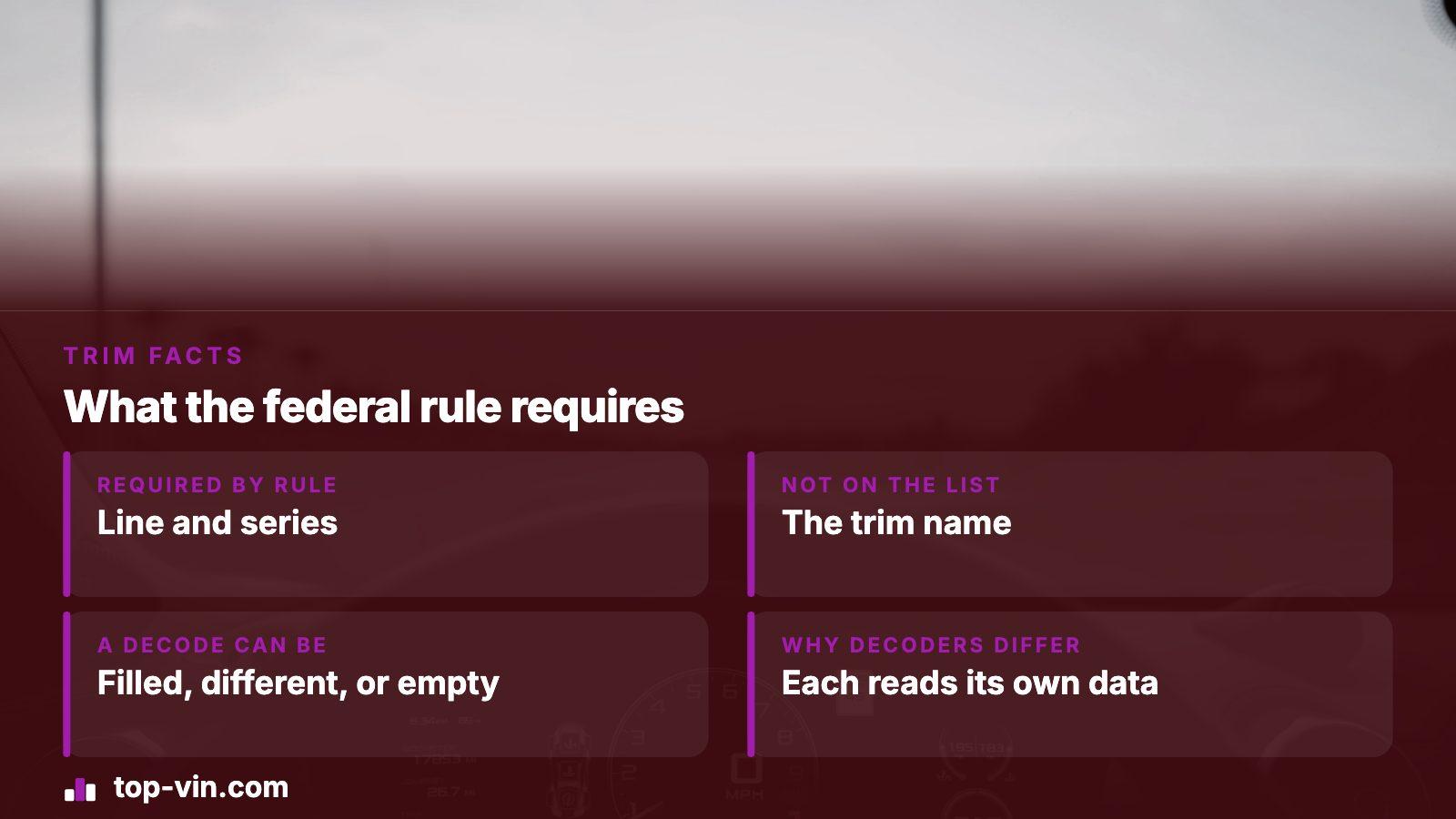
- Required by federal rule
- Line and series
- Not on the required list
- The trim name
- A decode can be
- Filled, different, or empty
- TopVIN check
- Free preview, then one payment
What a trim lookup by VIN gives you
A decoder hands back one tidy line: year, make, model, trim. Two steps sit behind it. The VIN carries the maker, the model line and the series, packed into characters four through eight. A reference table then converts that series into the name shoppers know, and that second step is where lookups part company.
For passenger cars, federal rules list six items a VIN must make decipherable: engine type, body type, restraint devices, plus make, line and series. The sales name for a trim level is missing. Makers rename badges at will, so regulators asked for the line and series instead, which a maker must declare and then stand behind.
Why two decoders can give two trims
Inside positions four through eight, each manufacturer picks its own characters and placement, provided the attributes can be worked out from the key it gives NHTSA. No universal map exists. Character six can carry a different attribute from one brand to the next, so a chart promising trim from a fixed position is wrong for most makes.
Each maker files that key at least 60 days before the first car with new coding is offered for sale, and amends it when the coding changes. A decoder built on a current filing returns the series dependably. Naming the trim from that series is an editorial choice, so two sites using identical data can print different badges, particularly where one series spans several.
Four lookups compared on the trim question
Searches for VIN check, VIN lookup and trim by VIN overlap, yet the tools behind them answer different questions. Sorted by what each hands you about trim, the choice gets simpler.
| Lookup | What you learn about trim | Where it falls short |
|---|---|---|
| NHTSA's public decoder | The series the maker filed and, for some cars, a trim field | The trim field can be empty or worded oddly |
| A third-party decoder site | A friendly trim name matched to the series | The matching is that site's own judgment, so two sites can disagree |
| A TopVIN preview and report | The preview confirms the VIN fits the advertised car; the report prints factory specs beside title, damage and odometer records | Trim follows the maker's data, and a history report is not a build record |
| The factory build record | The trim as the car was sold, with its packages | Held by the maker and its dealers, not by any history report |
Two real decodes, two shapes of answer
NHTSA's decoder accepts any VIN, so try it. A Chevrolet Malibu came back with LT (1LT) in the trim field and only a notchback body note in its series fields. A BMW sedan returned 5-Series as its series and left trim empty. Both decodes were clean.
An empty field is not a verdict
NHTSA attaches a caution to every result: a blank value only means the database has nothing on that field. It never means the feature is missing from the vehicle. So an empty trim field is a reason to inspect the car, not a finding about it.
Reasons the badge and the decode part ways
A mismatch does not prove deceit. Ordinary causes come first. One series can span several badged trims that differ only in appearance or options. A maker may rename a badge from one model year to the next while the series is unchanged. A package ordered new, like a sport or appearance group, can alter wheels, seats and the badge on the rear without moving the series.
Less innocent causes exist too:
- A badge or wheel set added later by an owner or a seller
- A listing typed up from the wrong model
- A car described as the higher trim and priced to match, though it decodes to the one beneath
The driveway cannot separate the two groups. Paperwork can.
Run the check in four steps
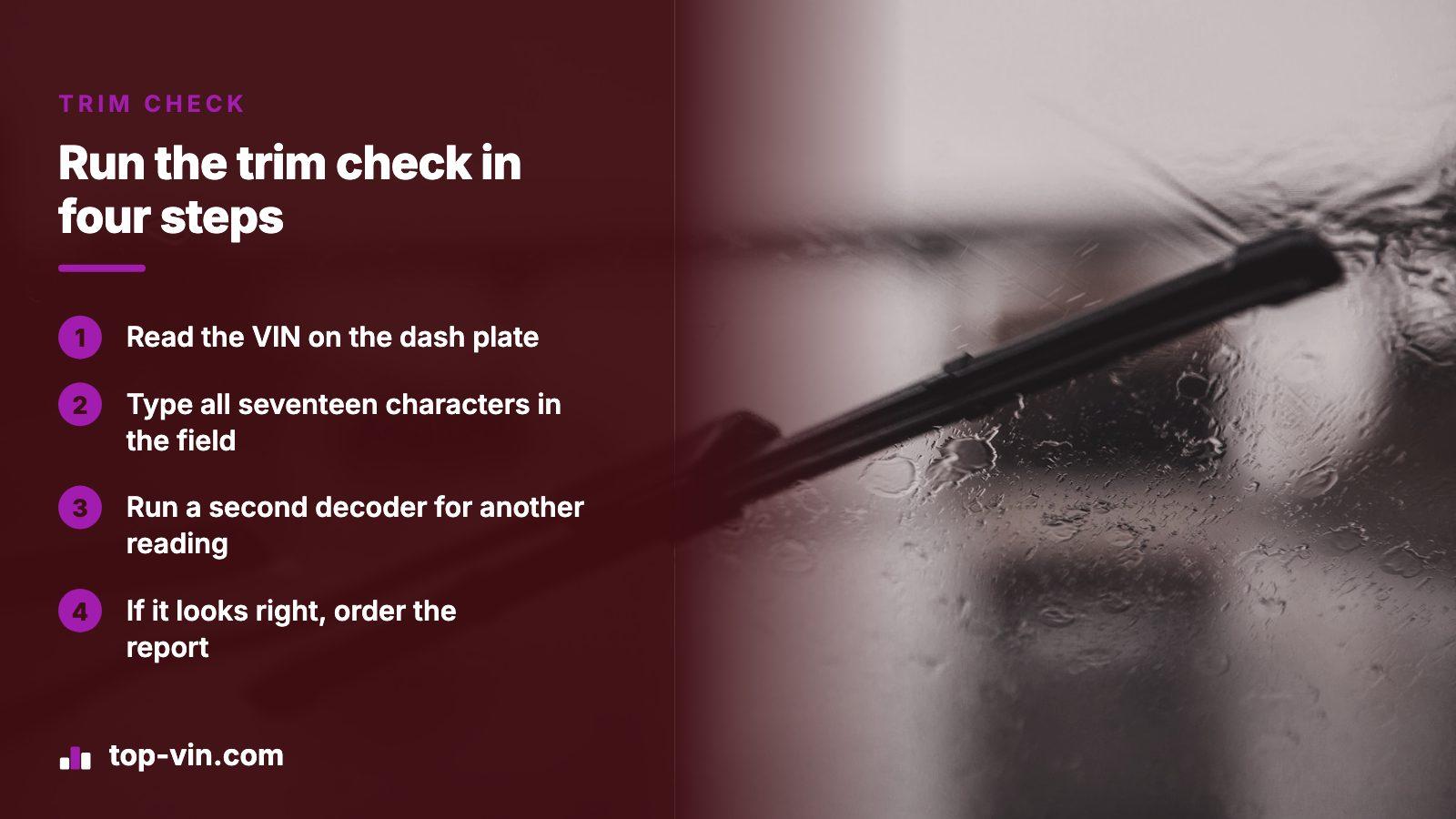
- The VIN appears on the dash plate (look through the windshield) and again on the door-pillar label. The two must read alike, or trim is the least of your problems.
- Type the seventeen characters into the VIN field. The preview carries no charge, so use it to check that the VIN matches the year, make and model in the ad.
- Put the same VIN through NHTSA's decoder for a second reading, then line up the ad's trim against both. Mark each as match, mismatch or silent.
- If the car still looks right, order the report to see the title, damage and odometer records behind the build.
Trim findings and what to do about each
| What you find | Likely reason | Your next move |
|---|---|---|
| The ad names a higher trim than the decode does | An overstated listing, or a package the decode never names | Ask for the original paperwork and price the car as the lower trim until shown otherwise |
| Same series, different badge | A package, or a badge renamed between years | Ask the seller what was ordered and check that the equipment matches |
| The decode leaves trim empty | Nothing came back for that field | Read it as a gap, then ask a dealer's parts desk to look the VIN up with the maker |
| Plate VIN and door-pillar VIN disagree | A swapped part, a repair, or a mislabeled car | Walk away unless the paperwork explains it |
| Badges and wheels look newer than the rest of the car | A cosmetic upgrade | Ask when it was done, by whom, and why |
Why a minute on trim moves the price
Trim shifts the price of a mainstream used car more than most single attributes, and a listing can inflate it for almost nothing. Badges are cheap to buy and stick on, wheels come off in minutes, and a salvage yard sells matching interior parts. A car dressed and priced as the top trim can still decode to the series below it.
Trim is the first question, not the last. A right trim on a wrecked car is still a wrecked car, which is why a TopVIN report sets title brands, accident and damage records and odometer readings beside the factory specs.
Cost, recalls and the next move
NHTSA's decoder is a free government tool, and the TopVIN preview carries no charge either. One payment covers the report for one car, and nothing renews afterward. Buyers weighing several cars can take a pack of three, five or ten, with current amounts on the pricing page.
NHTSA also runs a recall search by VIN. Open recalls deserve a line in your notes next to the trim. Then decide: if the ad, the decode and the paperwork line up, the report is the next step. If they do not, put the questions to the seller first.
Where this information comes from
- 49 CFR 565.15: VIN content requirements — Lists what a passenger car VIN must make decipherable and lets each maker choose its own characters and placement.
- 49 CFR 565.16: reporting requirements — Explains the decoding key makers must send to NHTSA before a new coding reaches buyers.
- NHTSA: vPIC public VIN decoder — The federal decoder behind the two example results and the notice about missing values.
- NHTSA: recalls lookup by VIN — A government check for open recalls to run alongside the trim lookup.
Sources and photos: Facts checked against the sources above in November 2026. Photos by Johnathan Kaufman, Thibault Valjevac and Dennis Eusebio on Unsplash; diagrams by TopVIN.
Keep reading
- How to read a VIN: a left-to-right walkthrough with a worked decodeWhat each stretch of the seventeen characters stands for, and what none of it spells out.
- Specs by VIN compared: what each lookup returns and what it leaves blankThe other facts a decode returns, and the fields it tends to leave blank.
- VIN verification: the four checks people mean and what each provesHow to confirm that the VIN on the paperwork matches the vehicle itself.
- Sample reportSee how the factory specs sit beside the history in a finished report.
Frequently asked questions
Can I find the trim level with only the VIN?
Often, though the VIN does not state it outright. A decoder reads the line and series from the VIN and matches a trim name to them. Treat that name as a strong lead rather than proof, and confirm it against the car and the seller's paperwork before you price a deal around it.
Which character of the VIN shows the trim?
None does across all makes. Positions four through eight carry the model line, series, body and engine, but each maker chooses what its characters mean. A table that points to one position for trim fits the brand it was built from and misleads on the rest.
Why does the badge on the car not match the VIN check?
Usually the series covers more than one badge, a package changed the lettering on the rear, or a badge was swapped later. Less often the listing is wrong. Ask the seller what was ordered when the car was new, and ask to see anything that backs the answer.
Does a vehicle history report include the window sticker?
No. A TopVIN report covers records such as title brands, damage, odometer readings and open recalls, plus the factory specs. A window sticker or build record is a separate document held by the maker and its dealers, so ask a dealer's parts desk if the trim stays in doubt.
Does it cost anything to check trim by VIN?
NHTSA's decoder is free to use, and the TopVIN preview is free as well. The full report is a single payment per car, never a recurring charge, with packs for three, five or ten cars. Current amounts sit on the pricing page.
Now check the car itself
The guide explains what to look for. The report shows what this VIN has on record.