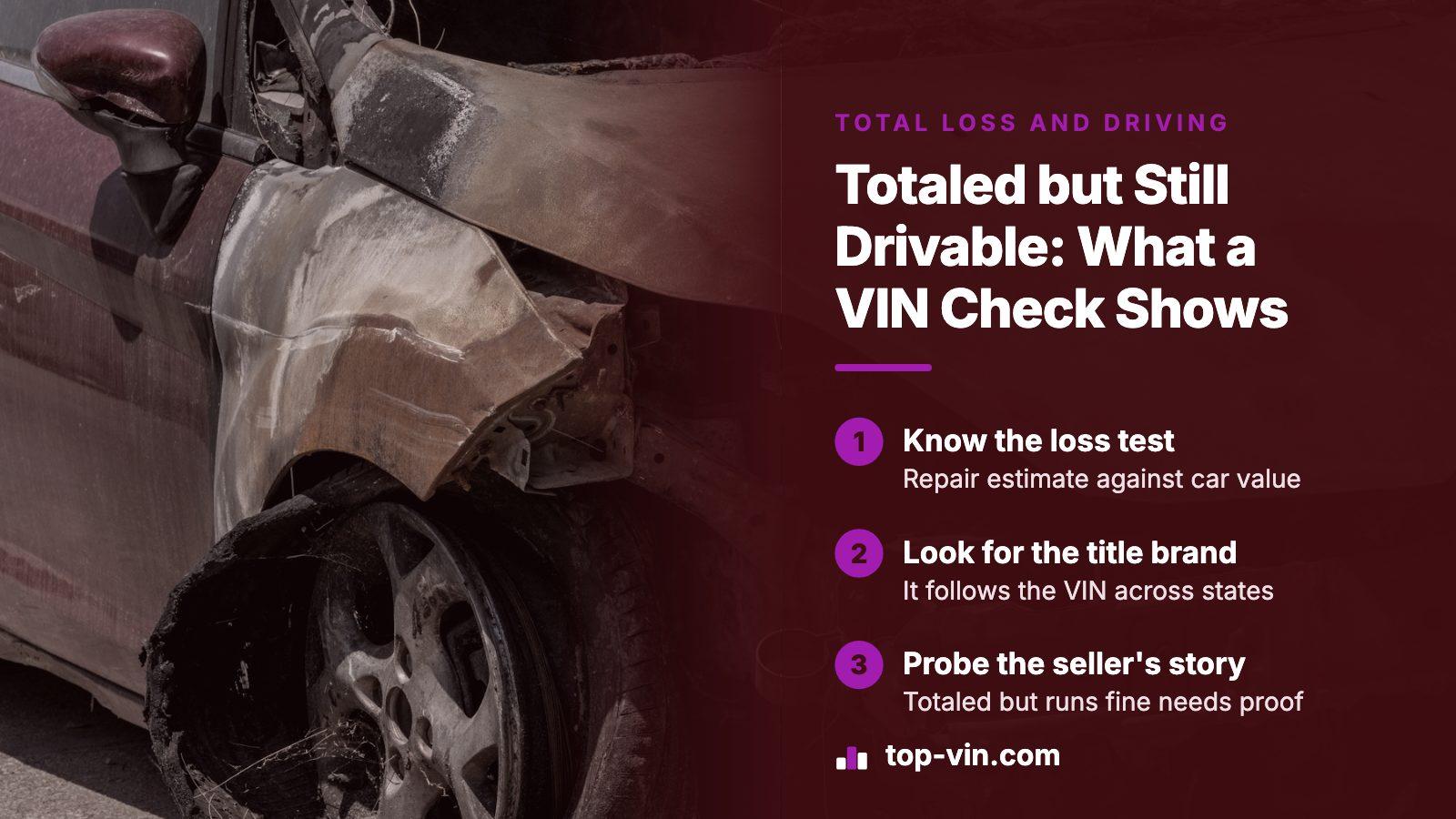
THE SHORT ANSWER
Yes. An insurer declares a total loss when the repair estimate crosses a threshold that differs from state to state, measured against the car's value before the crash. Whether it runs never enters the sum. After a claim settles that way, the title gets a salvage brand, or the state's own variant, and the brand follows the VIN through every later sale. A VIN check shows the brand, the damage and the salvage history.
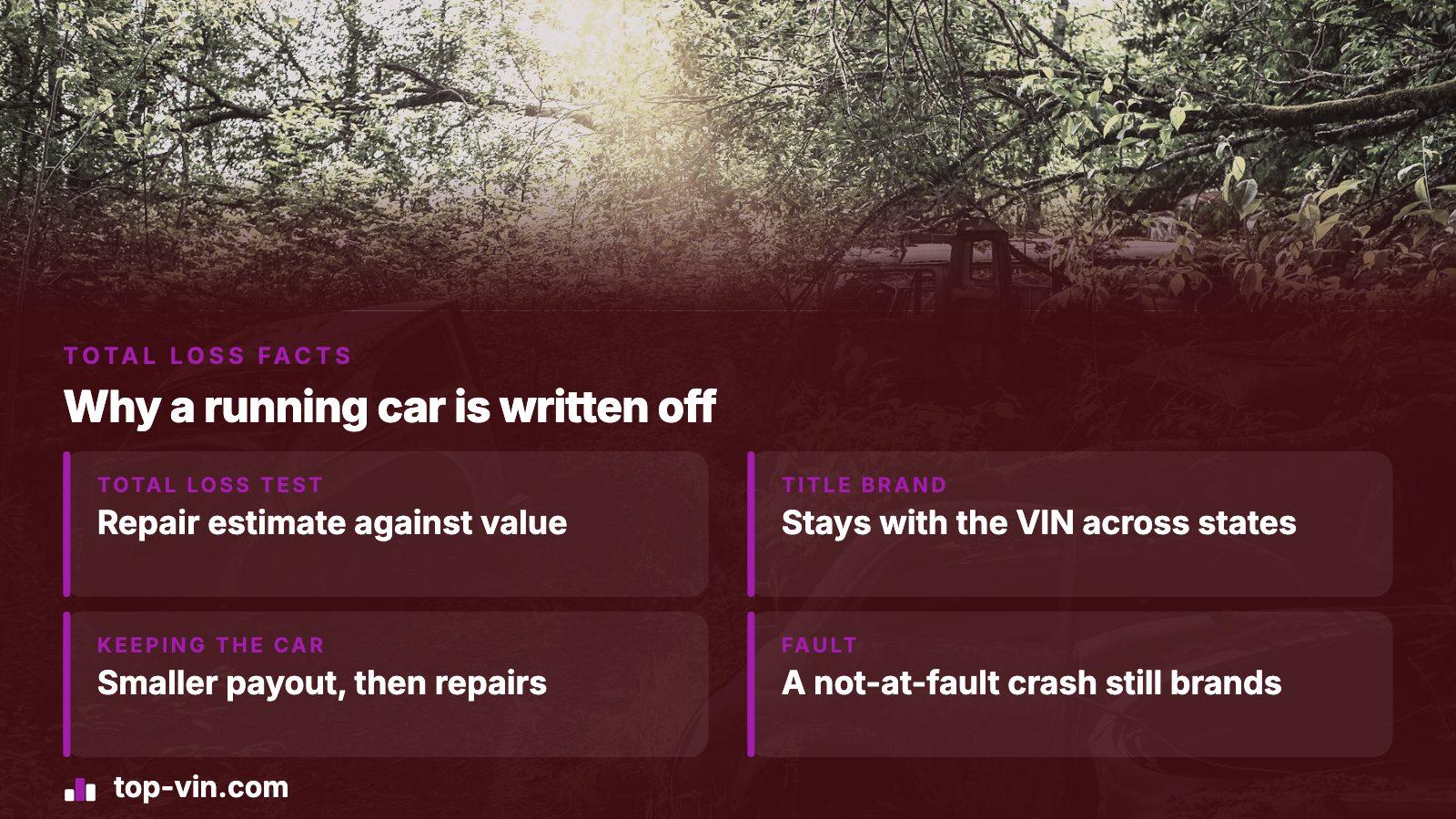
- Total loss test
- Repair estimate against value, not whether it runs
- Title brand
- Stays with the VIN across states and sales
- Keeping the car
- Smaller payout, then repairs and an inspection
- TopVIN check
- Free preview, then one payment
Why a running car gets written off
An insurer does not test-drive a damaged car. It writes a repair estimate, sets that beside what the car was worth the day before the crash, and declares a total loss when the estimate crosses the line its state draws. Whether the car starts or steers is not in the formula.
So a sedan with a healthy engine ends up totaled. Deployed airbags are costly to replace, a quarter panel eats labor hours, and an older car is worth little to begin with, so cosmetic damage alone can use up the margin. The line moves by state: the share of value differs, the meaning of repair cost differs, and a few states apply another test altogether.
What the settlement does to the title
The insurer reports the settlement, and the title takes a brand. The label is a state matter, with salvage the most common, but the meaning is shared: this vehicle was once written off. Nobody has to file anything for that to happen, and driving on quietly does not clean the record.
The federal title system exists so a brand set in one state travels with the car to the next. A good repair does not erase it either, so a well-fixed car still carries the brand years later.
Salvage and rebuilt are different brands
Salvage describes a car that is waiting for repair. Rebuilt describes one that passed inspection and may be registered. The second does not remove the first from the history.
What a VIN check shows about a total loss
A buyer needs to know whether the car on the driveway has been through this. The TopVIN preview confirms identity from the VIN first, and the paid report adds the history. These records bear on a write-off:
| Record in the report | What it tells you about a total loss |
|---|---|
| Title brands | The brand itself, under whatever label the issuing state used |
| Salvage and auction history | Whether the car sold as a wreck, with damage photos where they exist |
| Accident and damage records | Reported collisions and damage areas, to hold against the repair you can see |
| Insurance records | Insurer entries that can sit behind a write-off |
| Odometer readings | A mileage trail, so a rollback during or after the repair stands out |
| Open recalls | Safety work still owed, worth finishing before any rebuild |
No report sees an event that was never recorded. A clean result shrinks the risk but never zeroes it, so add a mechanic's inspection.
Running the check on a car you are considering
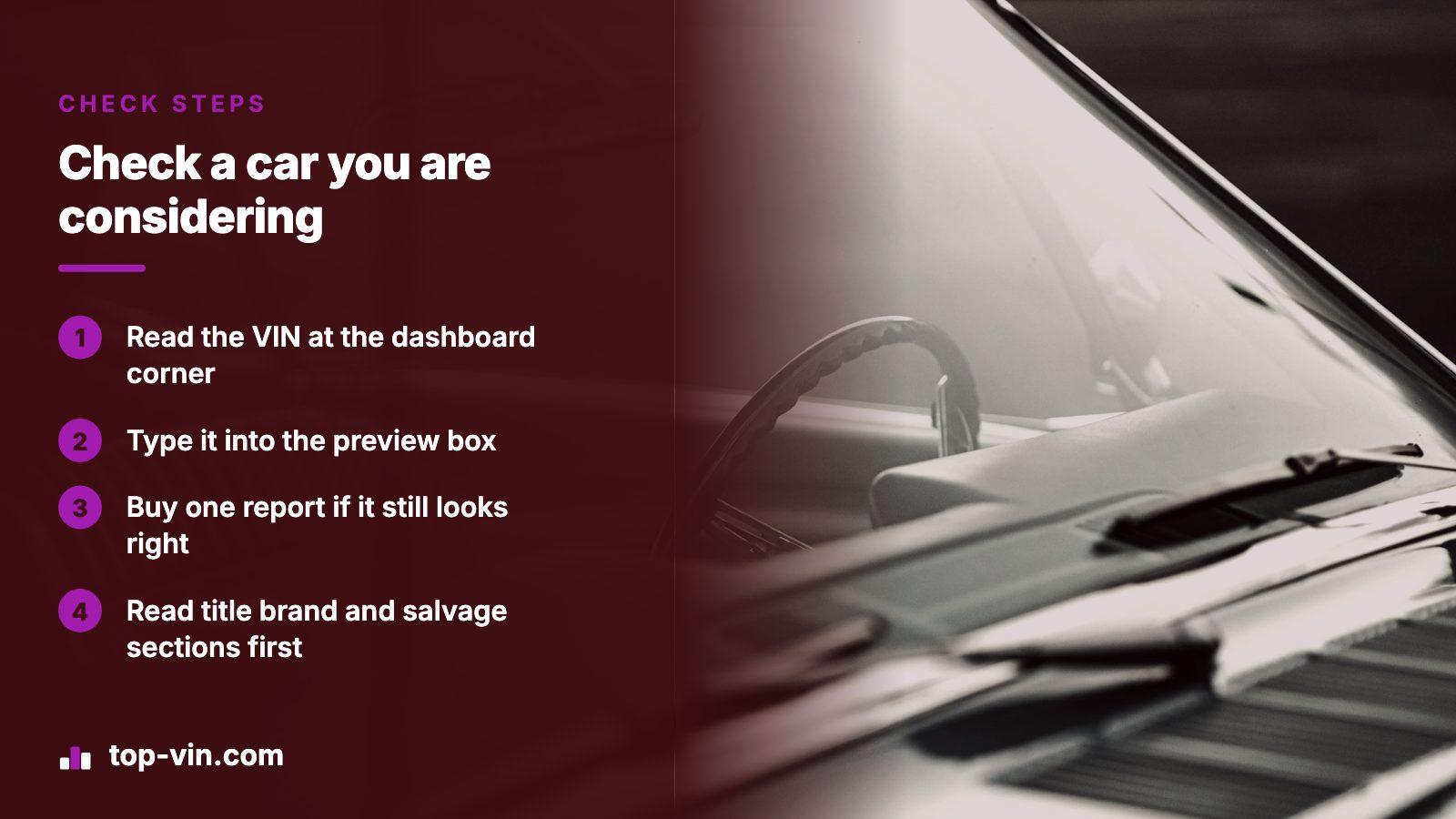
- Read the VIN off the dashboard corner by the windshield and off the sticker in the driver's doorway, then off the title. Every character should agree, and if they do not, stop there.
- Type it into the preview box. It decodes the year, make, model and factory build; the tenth character is the model year, which should match the listing.
- Buy one report if the car still looks right. Anyone comparing several cars can buy a pack instead.
- Read the title brand and salvage sections first, then damage, then mileage.
Red flags when a seller says it was totaled but runs fine
- The seller describes a total loss but the report shows a clean title. The story and the record disagree, and one of them is wrong.
- The repair has no paper trail. Inspectors ask where major parts came from, so missing receipts point to a skipped or failed inspection.
- Auction photos show damage the seller never mentioned.
- Structural or frame damage, water, or several deployed airbags in the history. Repair quality is hardest to verify there, and a flooded car's electrical faults follow no schedule.
- A salvage title still on the paperwork. It describes a car awaiting repair and in general does not allow road use.
- A sale that depends on you financing the car, since lenders tend to decline branded vehicles.
If it is your own car: take the payout or keep it
An owner told the car is totaled has two options, and they are less even than they look.
| Path | What you receive | What you carry |
|---|---|---|
| Take the settlement | The car's pre-crash value, less your deductible | Nothing further: the insurer takes the car and sells it to a salvage buyer |
| Keep the car (owner retention) | The same figure, minus the salvage value the insurer gave up | A branded title, plus the repair, the inspection and the re-registration |
The second row is a smaller payment and a car worth less than yesterday, not the settlement plus a car. Weigh four numbers: the gap between the two offers, a repair quote from a shop willing to do the job, the cost of retitling, and the permanent dent in resale value. Keeping can win on a newer car with light damage. On an older, modest one it rarely does.
Getting a kept car road-legal and insured
The sequence is similar in most states, though the paperwork and the inspector differ. Your state motor vehicle agency publishes the current rules, and that page beats any summary.
- The salvage title is issued and records the write-off.
- Repairs are finished and documented, with receipts for parts.
- A state-authorized inspection checks that the car is roadworthy and that no part came from a stolen vehicle.
- A rebuilt title is issued, and the car can be registered and driven. The brand stays on the record.
Before agreeing to a buyback, ask your insurer what it will write on the rebuilt car. Liability cover is generally available. Cover for damage to the car itself is where insurers get selective, since valuing a car with a write-off in its past is harder.
A crash that was not your fault still brands the title
Fault decides who pays, not whether the car is a total loss. If the other driver's insurer settles, it applies its own estimate and valuation under the same state test, and the title is branded the same way. The brand reflects the settlement, not who caused the crash.
Fault does affect the money, and those are claim questions for a lawyer. Whoever pays, run the VIN before you accept a figure, because a brand from an earlier event was already part of what the car was worth.
Cost of the check and your next move
TopVIN lets you look before you pay. The preview is free, then the report is a single purchase for one car or a bundle of cars, with no subscription. Current amounts sit on the pricing page.
Free tools from others cover narrower ground: the federal recall lookup finds open recalls for a VIN, and the NICB screen flags theft and salvage entries. Use them beside a history report, not instead of one.
Buying: read the brand and salvage sections first, and ask the seller to explain any gap between story and record. Keeping your own car: get the settlement and buyback figures separately, plus a shop's estimate and your insurer's coverage answer, before signing.
Where this information comes from
- NMVTIS: National Motor Vehicle Title Information System — The federal title record that states report brands into, which is how a brand from another state shows up.
- NHTSA: Recalls — The federal lookup for open safety recalls by VIN.
- NHTSA: vPIC VIN decoder — Returns the factory build for a VIN, including the restraint systems a rebuild has to restore.
- FTC: Buying and owning a car — Federal consumer guidance on vehicle purchases and what sellers must disclose.
Sources and photos: Facts checked against the sources above in November 2026. Photos by engin akyurt, Dylan Michaud and Patrick von der Wehd on Unsplash; diagrams by TopVIN.
Keep reading
- VIN check with photos: what a report shows and what it can'tSee the salvage and auction photos that show what the damage looked like.
- Insurance lookup by VIN: which checks answer it and which do notWhat insurance records on a VIN can tell you about a past claim.
- VIN verification: the four checks people mean and what each provesThe in-person inspection that often comes with registering a rebuilt car.
- Sample reportLook at a full report before you run one.
Frequently asked questions
Can a car be totaled and still be drivable?
Yes. A total loss comes from a cost comparison, so a car can be written off while it runs fine. The repair estimate against the pre-crash value decides it, and airbags plus body panels can tip the balance alone. The title then carries a brand, which matters more to resale than whether the engine turns over.
Is it legal to drive a car with a salvage title?
Not as a rule. A salvage title describes a car waiting for repair, and a rebuilt title, issued after inspection, is what allows registration. Steps and inspectors differ by state, so ask your motor vehicle agency before moving the car anywhere.
Will a totaled car show up on a VIN check?
A settlement reported as a total loss produces a branded title, and that brand sits in federal title records that cross state lines. A VIN check built on those records, plus salvage and auction history, should surface it. Nothing catches an unreported event, so add a mechanic's inspection.
Can I buy back my totaled car from the insurer?
Usually, and it is called owner retention. The insurer subtracts the salvage value it gave up from your payment, and you keep the car with a branded title. Ask for both figures separately: the gap is the true cost of keeping the car, before a dollar reaches the shop.
Does a totaled car lose value even after a good repair?
Yes. Expect a lower price than a clean-titled twin would bring, since many buyers screen brands out and lenders hesitate. Workmanship and age do not shrink the gap. It matters little if you will drive the car until it is scrapped, and a great deal if you may sell soon.
Now check the car itself
The guide explains what to look for. The report shows what this VIN has on record.