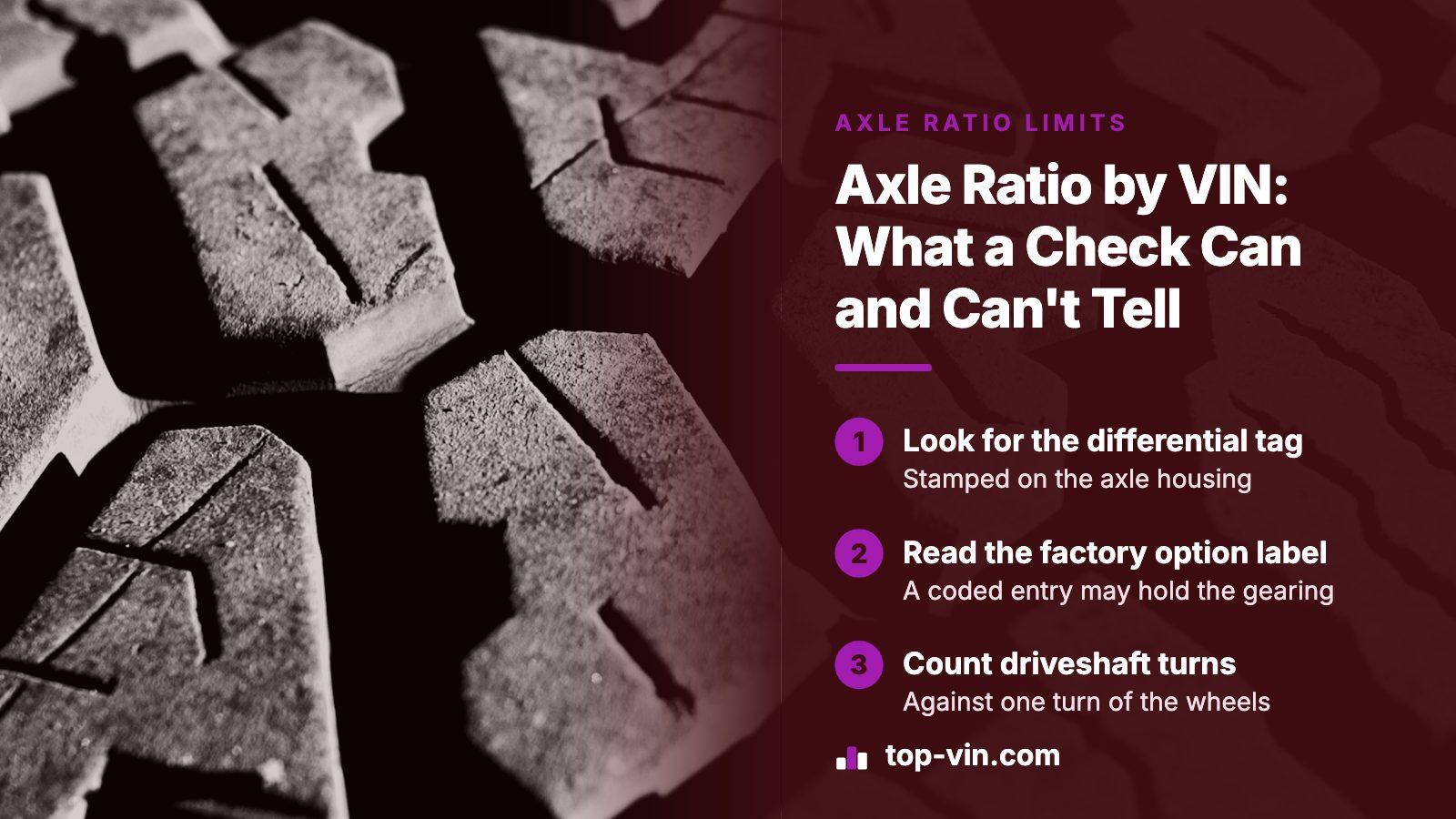
THE SHORT ANSWER
No. The axle ratio is not part of a VIN, and a decoder has nothing to read it from. The federal VIN rules require axle information for trailers only, and just the configuration at that. On a car or pickup, find the ratio on the differential tag, in a coded entry on the factory option label, or by counting driveshaft turns against one turn of the wheels.
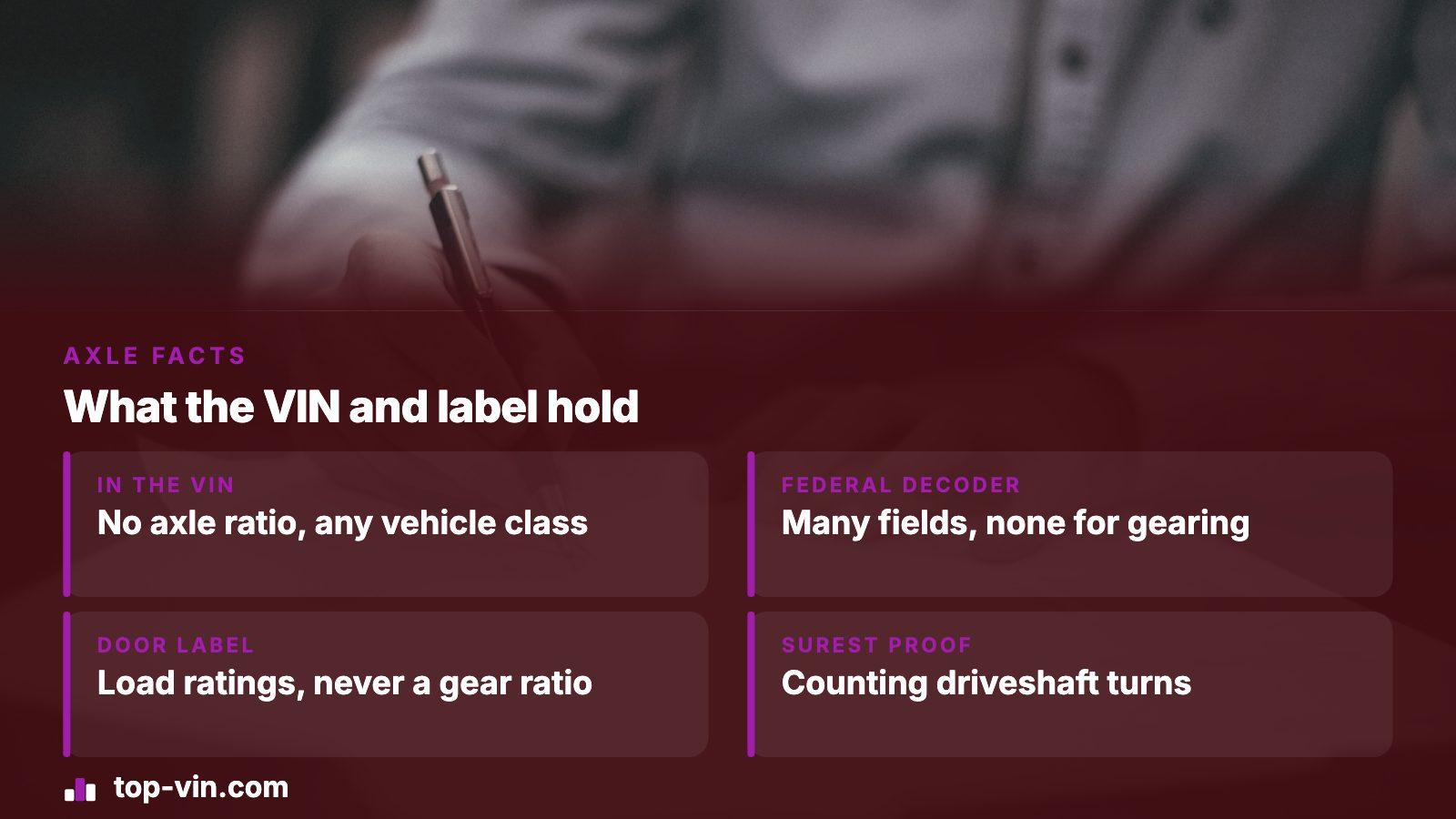
- In the VIN
- No axle ratio for any vehicle class
- Federal decoder
- 144 fields, none for gearing
- Surest proof
- Counting driveshaft turns
- TopVIN check
- Free preview, then one payment
What the seventeen characters leave out about axles
Start with the rule behind every VIN. 49 CFR 565.15 lists, for each vehicle type, what a maker must be able to express in the middle characters. Read the entries for cars, pickups, SUVs, buses and motorcycles and axles never come up. The word appears once, in the trailer line, and it asks for axle configuration: how the axles are arranged, not how the gears inside them are cut.
That makes the search unfair to the VIN. The truck in front of you may have a 3.73 or a 3.55 under it, and the code has no position where that choice could be written. Some makers may fold axle content into a code of their own, but no rule requires it. A site quoting a ratio from the VIN alone is guessing from the model name.
Which check answers which axle question
Terms like axle ratio by VIN, VIN lookup and VIN check blur together, yet each tool answers a different question. For a truck you might buy, they sort out like this.
| Source | What it tells you about the axles | What it cannot tell you |
|---|---|---|
| Federal VIN decoder (NHTSA vPIC) | Axle count and axle configuration, where the maker filled them in | Any gear ratio, since none of its 144 fields holds one |
| TopVIN preview | Whether the VIN decodes to the year, make, model and engine in the ad | The gearing; it confirms the truck, not the axle |
| TopVIN full report | Factory specs beside title, damage, odometer and ownership records | A gear ratio, which the report does not list |
| Door certification label | A weight rating for each axle and the tire size it assumes | How the gears are cut |
| Differential tag or option label code | The ratio itself, or a code that translates to it | Whether the axle is still the one the truck left the plant with |
| A driveshaft turn count | The ratio the hardware has today | Anything about the truck's past |
The door label has axle numbers, and none is a ratio
Plenty of buyers stop at the first axle figure they meet, and it is usually on the label at the driver's door pillar. That figure is a weight limit. Federal rules make the label state weight ratings, one per axle, listed front to rear and paired with a tire size. An example in the rule reads 2,400 kg (5,290 lb) on light truck tires.
- A large figure followed by kg or lb is a load capacity, never a gear ratio.
- One big total for the whole vehicle, such as 8,500 lb, is the gross vehicle weight rating.
- A small decimal such as 3.08, 3.55 and 4.10 is a gear ratio. Road vehicles run from about 2.7 to 4.9.
- Phrases such as two-axle or rear-wheel drive describe configuration, the arrangement.
Why the ratio is worth pinning down on a used truck
The ratio counts driveshaft revolutions per wheel revolution. With a 3.73, the shaft spins 3.73 times while the wheels spin once. A higher number multiplies engine torque more, which helps launching and pulling and raises engine speed at any road speed. A lower number suits quiet highway miles. Neither is better in the abstract.
The catch is that two trucks with the same engine and cab can carry different ratios and look identical online. If towing is why you are buying, put the number on your checklist beside the engine. The tow rating a seller quotes depends partly on it.
Reading the differential tag and the factory code
Many axle housings carry a small plate held by one of the bolts on the differential cover. It belongs to the assembly, not the truck, and may show the ratio outright or a tooth count that divides out to it. It also goes missing easily. Rust, undercoating and a cover swapped during a fluid service can all remove it, so an absent plate says only that the truck has been maintained.
- A code stamped into the axle tube, on some designs
- A cast part number that a parts counter can translate
- An axle choice listed as a short code on the option or parts label
Handle label codes carefully. They mean nothing until matched to the table for that make, model and year, and the panels that hold labels get replaced. When the label and the axle disagree, believe the axle.
Counting driveshaft turns, the test that settles it
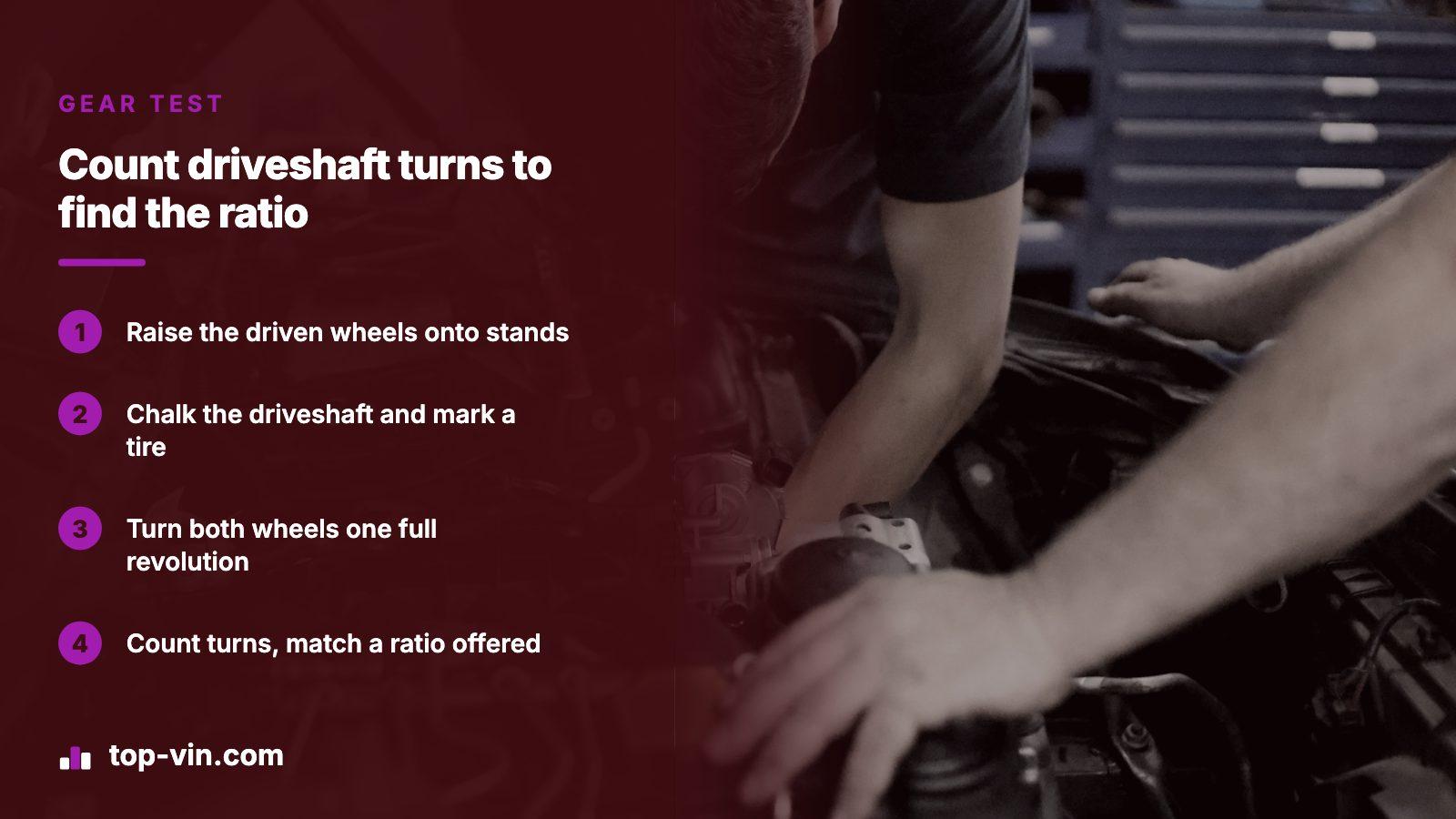
Measuring beats reading a record. You need jack stands, chalk and about ten minutes.
- Raise both driven wheels and rest the truck on stands. Put the gearbox in neutral and release the handbrake.
- Chalk a stripe across the driveshaft, and put a matching mark on one tire and on the ground beside it.
- Turn both wheels together, in the same direction, through exactly one revolution.
- Count how often the driveshaft stripe comes around. Just over three turns points to a 3.08, and nearly four points to a 3.73.
- Compare the count with the ratios that maker offered for the model. A rough count still lands on one of them.
With a single wheel lifted, turn it through two revolutions instead. On an open differential the driveshaft moves at half speed when one wheel does the spinning.
A thirty-second test for the differential type
While the wheels are in the air, spin one by hand and watch its partner. On an open differential the other wheel turns the opposite way. A limited-slip unit usually drags it along the same way, and a locked axle ties the pair together. Limited-slip was often an extra-cost option and its clutches wear, so a seller's claim of one is easy to verify on the spot.
When the differential has changed since the plant
Differentials get swapped. Owners regear for larger tires or heavier towing, and a failed unit is often replaced with a used one that brings its own ratio. After either change, a build record describes the day of assembly and stays silent about everything since.
A regear touches the odometer too. If the speedometer was not recalibrated afterward, it reads wrong and the mileage you are paying for drifts with it. A truck on oversize-looking tires deserves that question. Odometer readings logged over the years, title brands and damage records show whether the seller's story about the rear end fits the truck's past.
Where a TopVIN check fits before you pay
TopVIN starts from the head term: a VIN check you can run on any 17-character code. The preview is free. It confirms the VIN decodes to the year, make, model and engine in the listing, which gives any axle code something to be read against. If the truck still fits, you pay once with no subscription, for one report or a pack of three, five or ten. The pricing page lists amounts.
Behind the preview, the report adds the records a decoder cannot: brands on the title, accidents and damage, odometer readings over time, auction and salvage pictures, lien, impound, theft and insurance records, recalls still open, owners and use, market value and factory specs.
Order of work
Run the preview, find the plate, read the label code, count the turns if anything disagrees, then buy the report. The gearing comes from the axle, and the history comes from the report.
Where this information comes from
- 49 CFR 565.15: VIN content requirements — The table of what each vehicle type must convey, where axle configuration appears for trailers only.
- 49 CFR 567.4: certification label — Sets the per-axle weight ratings on the door label, the figures often mistaken for a ratio.
- NHTSA: vPIC VIN decoder — The public decoder with axle count and configuration fields but no gear ratio variable.
Sources and photos: Facts checked against the sources above in November 2026. Photos by Marvin Sagisi, Mustafa Sheikhmouss and Scott Graham on Unsplash; diagrams by TopVIN.
Keep reading
- Towing capacity by VIN: what a VIN check can and cannot tell youThe ratio is one input to a tow rating, and the VIN carries none of it.
- Specs by VIN compared: what each lookup returns and what it leaves blankWhich factory specs a decode returns and which it leaves blank.
- How to read a VIN: a left-to-right walkthrough with a worked decodeWhat each of the seventeen positions tells you, and what none of them do.
- Tire size by VIN: which lookups can answer it and which cannotTire size sits on the door label beside the axle ratings and affects gearing.
Frequently asked questions
Can a VIN decoder tell me my axle ratio?
No. A decoder reads fields that makers file under federal rules, and those rules never ask for a ratio on a car or pickup. A few makers may add axle content to their own codes, so treat a lone result as a clue to confirm on the axle.
Is the axle ratio on the door sticker?
No. That label gives weight ratings for each axle, which are capacities. If a maker printed an axle code, it sits on a separate option or parts label, and you need that make's table for the year to translate it.
How do I find the ratio with no paperwork?
Look for the plate on the differential cover first, since it may state the ratio. If it is gone or you doubt it, lift the driven wheels, mark the driveshaft and a tire, turn the wheels one full revolution and count driveshaft turns.
Does a vehicle history report show the axle ratio?
No. A TopVIN report shows what records exist on the vehicle, such as title brands, damage, odometer readings and recalls. Gearing is a hardware fact, so it never appears there. The free preview confirms the VIN matches the truck.
Does the axle ratio change what a truck can tow?
It is one input to the rating the maker publishes. Two trucks with the same engine can carry different ratios and different tow limits. Confirm the ratio on the axle, then look up the maker's figure for that exact configuration.
Now check the car itself
The guide explains what to look for. The report shows what this VIN has on record.