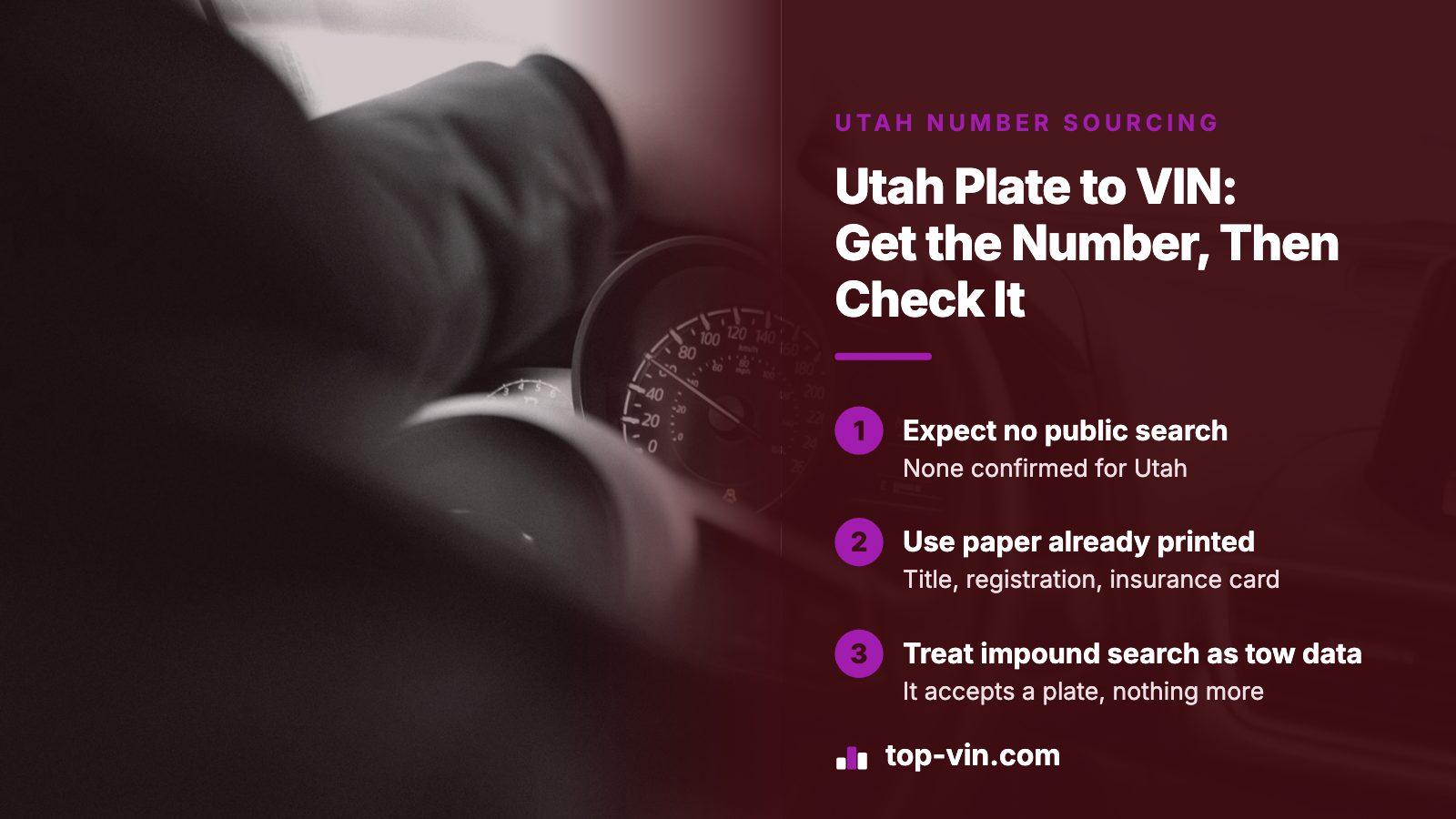
THE SHORT ANSWER
Utah's own motor vehicle pages refused our automated requests, so we could not confirm a public plate-to-VIN search there. Federal law limits what a state may release from its records. Get the VIN from the seller, the title, the registration card, an insurance card or the car, then run a TopVIN preview on that number.
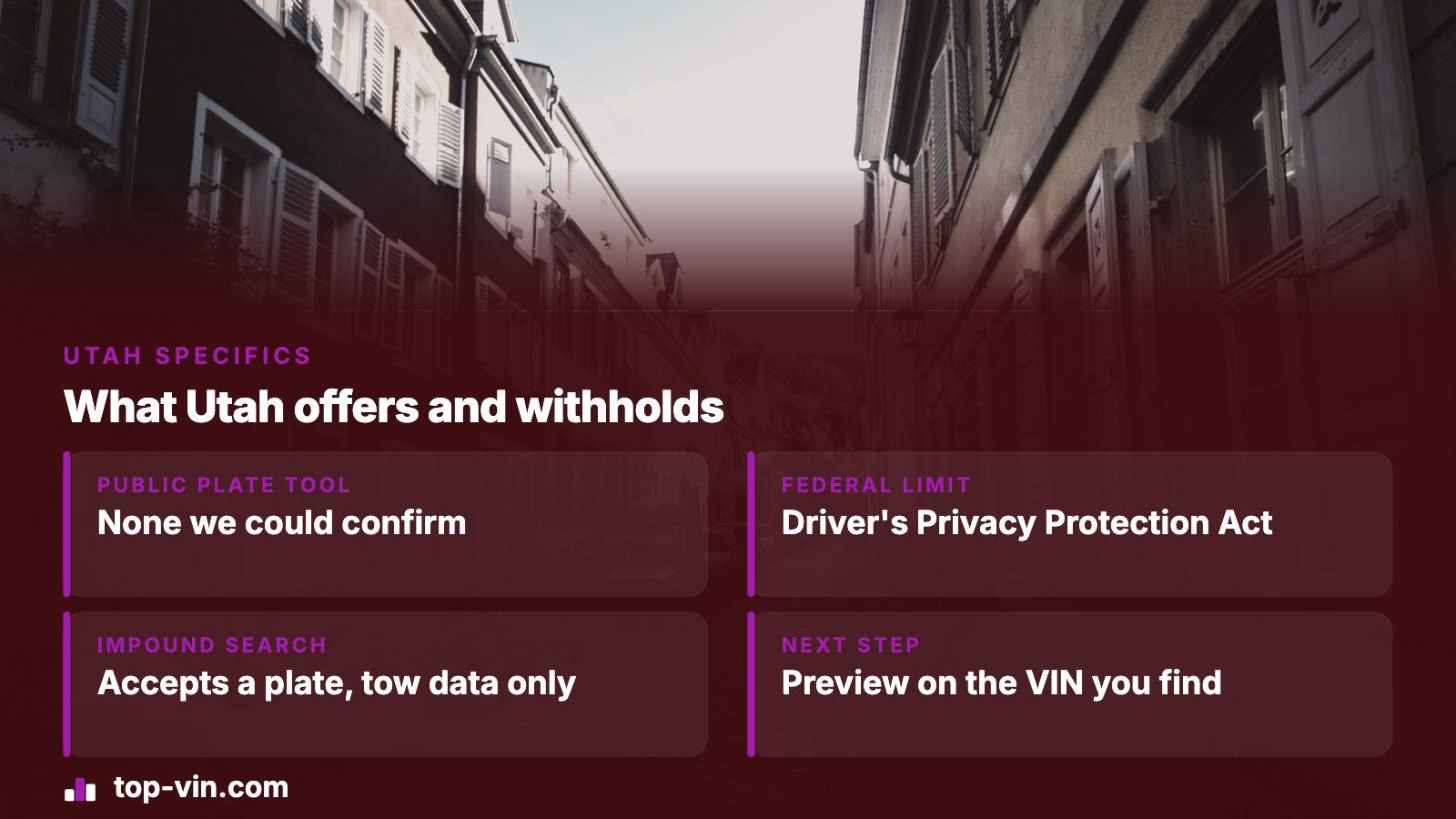
- Public plate-to-VIN tool
- None we could confirm
- Federal limit
- Driver's Privacy Protection Act
- Utah impound search
- Accepts a plate, shows tow data only
- TopVIN step
- Free preview, then one payment
What a Utah plate number can and cannot tell you
TopVIN is built around the vehicle number, so a request that starts with a plate is a detour. Utah keeps the link between a plate and a vehicle inside its motor vehicle records, and the pages that would describe public access to those records, on dmv.utah.gov and tax.utah.gov, stopped our research tools with a bot-check wall. We did not push past it, which means we cannot tell you that Utah offers or lacks a self-service plate search.
What we can say is how the rules around those records work, and that nothing a consumer site sells should be described as a window into them. Any page promising an owner's name from a plate deserves suspicion.
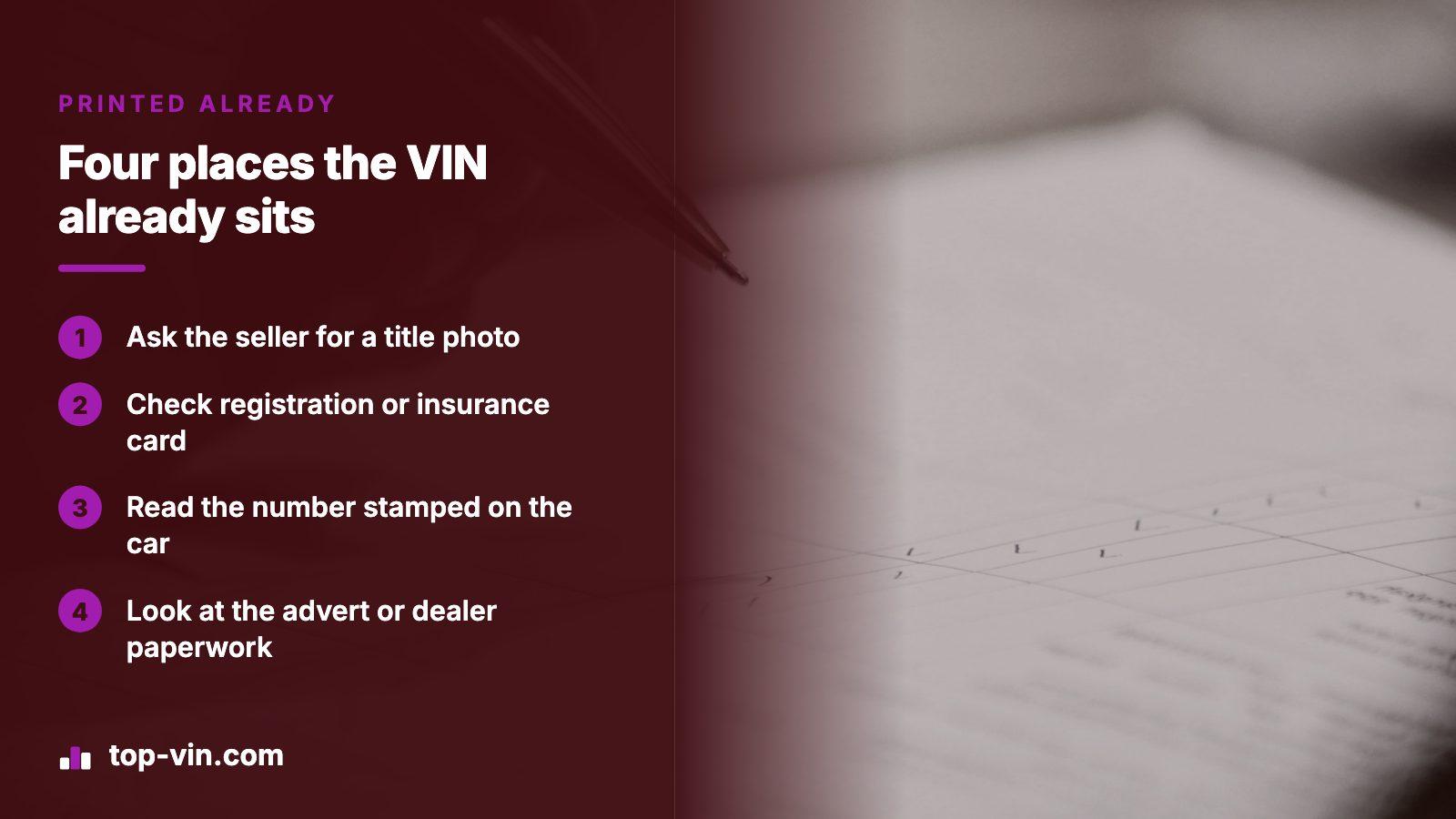
Four places the VIN is already printed
Most people searching this phrase are standing in front of a listing or a driveway. In that case the number is closer than any state office.
- The title. Ask the seller for a photo before you meet, and compare the name on it with the ID the seller shows you.
- The registration card or an insurance card, which carry the vehicle number next to the plate number.
- The car itself, where the number is stamped near the dashboard glass or sits on a sticker by the driver's door latch.
- The advertisement or the dealer's paperwork, if a lot is selling it.
A quick sanity test
Photograph the dashboard number, the jamb sticker and the title in one sitting, then read all three side by side. A single mismatched character means you stop and demand a written explanation.
The federal rule that shapes every state's answer
Congress set the ground rules in 18 U.S.C. 2721, the statute usually shortened to the DPPA, and Utah must follow it. Subsection (a) bars the state's licensing office from knowingly releasing personal details held in those records, unless a listed exception applies.
Section 2725 defines protected personal information as whatever identifies a person: a name, street address, phone number, photo or Social Security number. Crash and traffic violation details fall outside that definition. So facts about the vehicle can travel widely, while facts about whoever owns it stay locked down.
Who the law lets in, and who it does not
Subsection (b) names the allowed purposes. Idle curiosity about someone's car does not appear. Entries a buyer may meet are below.
| Permitted use under 2721(b) | Who it fits |
|---|---|
| Government agency functions | Courts and law enforcement |
| Safety, theft, recalls and advisories | Recall and safety programs |
| Claims and antifraud work | Insurers and their support organizations |
| Tow-yard owner notification | Tow and storage operators |
| Court and administrative proceedings | Parties to a legal case |
| Written consent of the individual | A requester holding that consent |
Anyone who resells the data must keep a record of each recipient and purpose for 5 years. Federal law lets a state charge an administrative fee for a record. Check Utah's current form and charge with the Tax Commission before you send anything.
The one Utah tool that does take a plate
The State Tax Commission runs an Impound Vehicle Search on its official secure.utah.gov site. An owner types in a VIN, a plate, or the number on a state impound form, and a match returns tow details and the storage lot.
It is built for owners recovering a towed car. It is not a history report and its instructions do not describe returning a VIN to the public. If you are unsure of either number for a car of your own, the page points to the Motor Vehicle Division at 801-297-7780 or 800 DMV UTAH.
Run the VIN through TopVIN
Enter the 17 characters in the TopVIN search box. A preview appears before any payment, and from it you judge whether this particular car merits the full report. Buying is a single payment, never a subscription, and the options are listed on the pricing page.
NHTSA's vPIC service decodes a VIN into make, model and factory specifications, and it warns that a blank field does not prove a feature is missing. Use a decode to confirm the car matches its listing before you spend time on a drive.
What to look for in the results
The Justice Department says its NMVTIS database can show a buyer the title record, the newest mileage entry, any brands and occasionally stolen-vehicle history. States attach a brand, for example junk, salvage or flood, to mark what a car has been through. The feed comes from titling agencies, recyclers, junkyards and insurance carriers.
- A salvage or flood brand that the seller never mentioned.
- An odometer reading higher than what the dash shows.
- A theft record with no recovery noted.
- Specs that differ from the listing, such as another engine or trim.
A Utah wrinkle on branded cars
Since January 1, 2018, most Utah passenger vehicles need no safety inspection to renew registration, according to the Utah Highway Patrol. Salvage vehicles are an exception: they must pass an inspection the first time they are registered as salvage. A branded car that appears in the report may therefore have passed one, but a clean-looking one has usually had none.
Either way, an independent mechanic's look matters more here than the paperwork suggests.
What to do next
Collect the number from two independent places, run the preview, and compare it against the listing. If the car passes, book an inspection. If the seller will not share the title photo or the VIN, treat that refusal as the answer and move on to the next listing.
Where this information comes from
- Utah State Tax Commission: Impound Vehicle Search instructions — Shows the tool takes a plate and what it returns.
- 18 U.S.C. 2721, permitted uses of motor vehicle records — The federal limit and its list of exceptions.
- 18 U.S.C. 2725, definitions — What counts as personal information.
- DOJ NMVTIS: for consumers — What federal title data covers and where it comes from.
- Utah Highway Patrol: vehicle owner safety inspection information — Which Utah vehicles still need an inspection.
Sources and photos: Facts checked against the sources above in November 2026. Photos by Miles Loewen, Masjid MABA and Karwin Luo on Unsplash; diagrams by TopVIN.
Keep reading
- License plate to VIN: the lawful ways to find a car's VIN from its plateThe same question without a state attached.
- Motor vehicle records: what a car buyer can see, and what stays closedHow a state record differs from a history report.
- Vehicle registration lookup: what it shows and which check to addWhat registration data shows and who may see it.
- How to read a VIN: a left-to-right walkthrough with a worked decodeRead the number you collected, position by position.
Frequently asked questions
Can I find a VIN from a Utah license plate for free?
We could not confirm a public tool that does it. Utah's pages blocked our research tools, and federal law restricts what the state releases from its records. Free routes start with the seller, the title, the registration card or the car.
Does Utah's impound search give out a VIN?
Its instructions describe a plate or VIN going in and tow details and a storage location coming out, for owners recovering a vehicle. Nothing there says it hands a VIN to the public.
Why won't a state just give me the owner's name?
The Driver's Privacy Protection Act bans release of personal details from these records outside listed uses. Curiosity before a purchase is not one of them.
What does a TopVIN preview show before I pay?
Viewing the preview costs nothing. Should you want the whole report, you pay once, with nothing recurring. The pricing page lists the options.
Is a VIN check useful if the seller is a private party?
Yes. Private sales have no dealer paperwork to lean on, so the brand, odometer and theft history on the report give you something to compare with what the seller says.
Now check the car itself
The guide explains what to look for. The report shows what this VIN has on record.