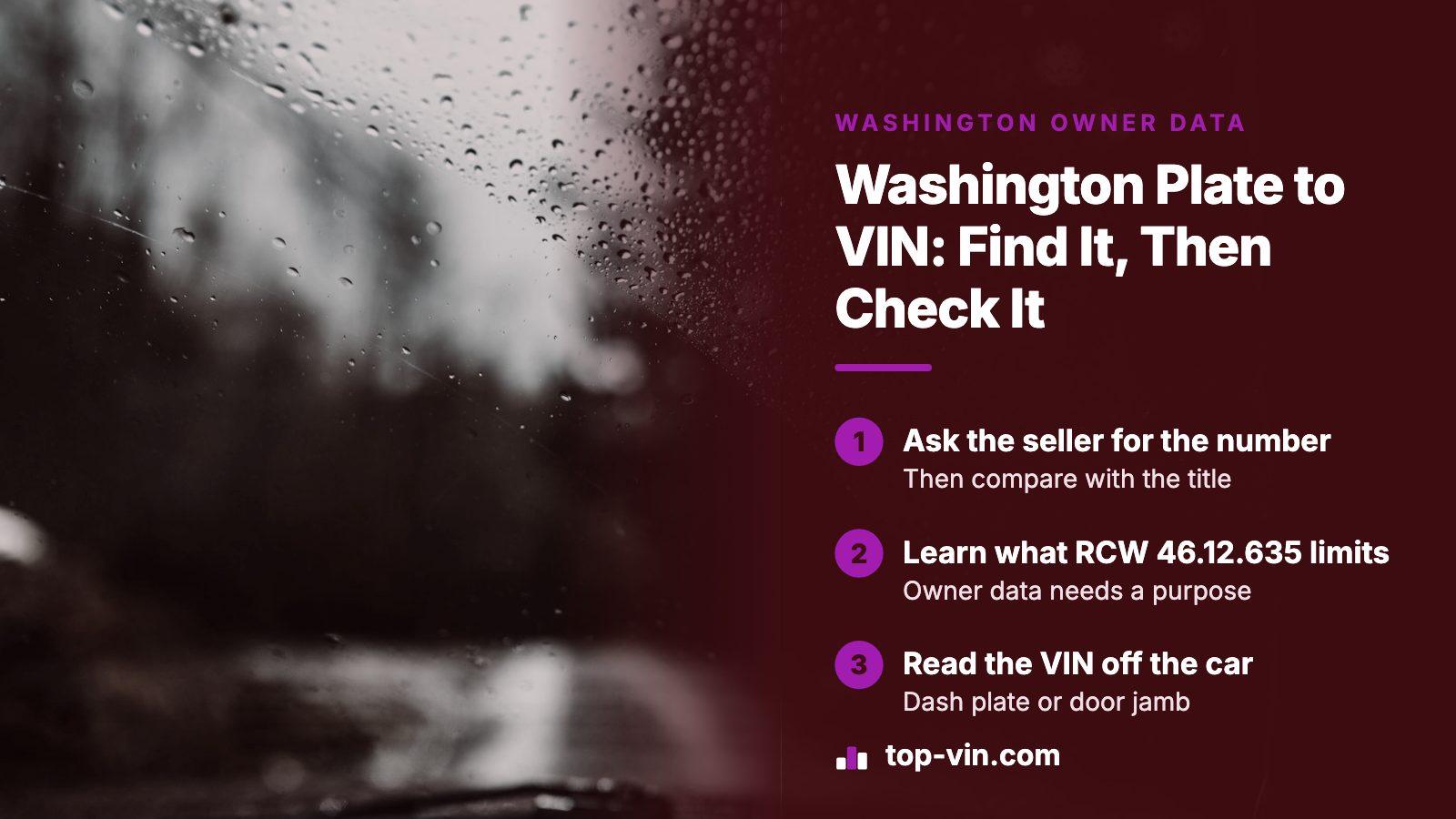
THE SHORT ANSWER
No public Washington tool converts a plate into a VIN for a private buyer. Ask the seller for the number, compare it with the title, registration or insurance card, and read it off the car. Records requests to the Department of Licensing need a qualifying purpose. After you have the VIN, enter it for a free TopVIN preview and decide on the full report from there.
- Public plate-to-VIN search
- None we could confirm
- State rule on owner data
- RCW 46.12.635
- Federal rule
- Driver's Privacy Protection Act
- TopVIN step one
- Free preview, then one payment
Why a Washington plate is the wrong key
A plate is a tag the state ties to a registration. Everything a buyer wants to know about the car, from a branded title to an odometer rollback to an insurer's total-loss file, is stored under the vehicle identification number instead. So a search that starts from the plate is really a request to reach into a state record, and that is exactly the step the law guards.
TopVIN works the other way round. It reads the VIN, describes the vehicle, and never returns a name, an address or any other personal detail. If a site promises the owner behind a Washington plate for a small fee, treat that promise as a warning about the site.
What Washington law says about releasing owner data
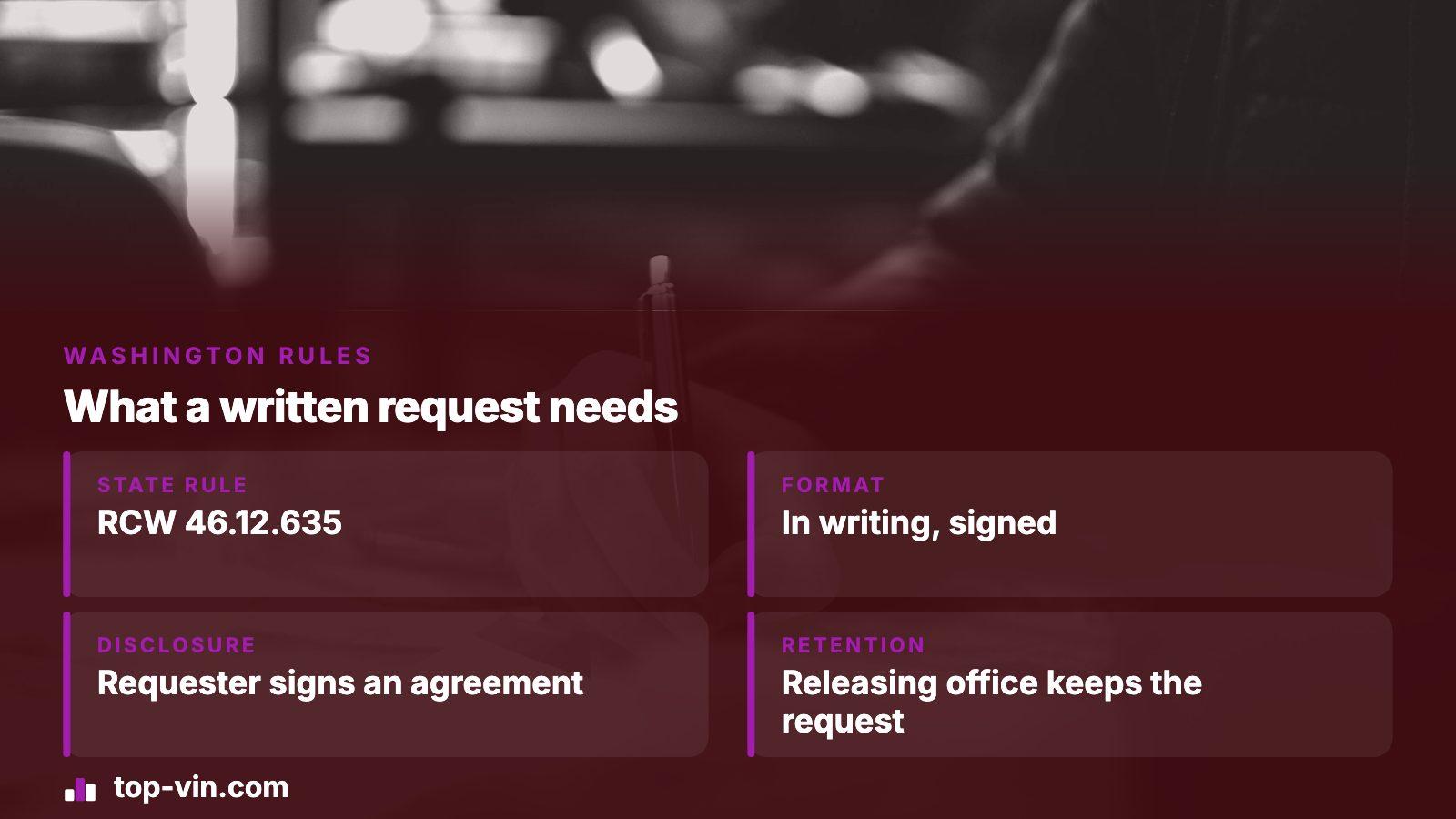
The state rule sits in RCW 46.12.635. Under it, a private owner's name and address stay locked inside the licensing department, its county offices and any firm they authorize, unless one of a few exceptions applies. The usual exception is a company asking for a use the department has spelled out in its rules, as part of doing business.
- Requests go in writing, with a signature from whoever is asking.
- They carry the requester's full legal name and address.
- They name the intended use.
- The requester signs a disclosure agreement, agreeing to that use only and to no cold sales contact.
- The releasing office retains the request for three years.
A shopper with a listing photo does not fit that description, so a clerk or phone agent will not read out an owner file for a plate.
The federal layer on top
Above the state statute sits a national floor: Title 18 of the U.S. Code, section 2721, better known by the name of the privacy act for drivers. A state licensing agency can hand over personal details only for purposes written into that section, and most of them are professional rather than personal.
| Permitted use under the federal act | Who it fits |
|---|---|
| Official duties of an agency, court or police | Officials acting in their role |
| Claims, fraud work, rating or underwriting | Insurers and their support organizations |
| Court and arbitration cases, including serving papers | Parties and their lawyers |
| Telling owners their car was towed or impounded | Tow operators and authorities |
| Signed consent from the person in the record | Anyone holding that signed consent |
Both layers apply at once, so a Washington request must satisfy each. Weighing a purchase is not a reason either one recognizes.
If you do have a qualifying purpose
Insurers, lawyers, licensed investigators and similar requesters can approach the Department of Licensing for a vehicle record. The statute also protects the owner: if a lawyer or investigator is granted data, the owner is told that a release happened, on what date, and what the requester does for a living.
We were not able to open the department's own records request pages, because its site refused our automated read. That means we cannot tell you the current form name, the fee or the turnaround time. Look those up on the Department of Licensing site before you plan around a request, and expect the answer to depend on the purpose you state.
A shopper is not a qualifying requester
Wanting to confirm a used car before paying does not turn into a permitted purpose. Use the seller and the paperwork instead, and keep the formal request for the situations the statute describes.
Four places the VIN is already sitting
A buyer almost never needs the state to supply it. The number is on documents and on the vehicle itself, and a sensible seller will share it before you drive across town.
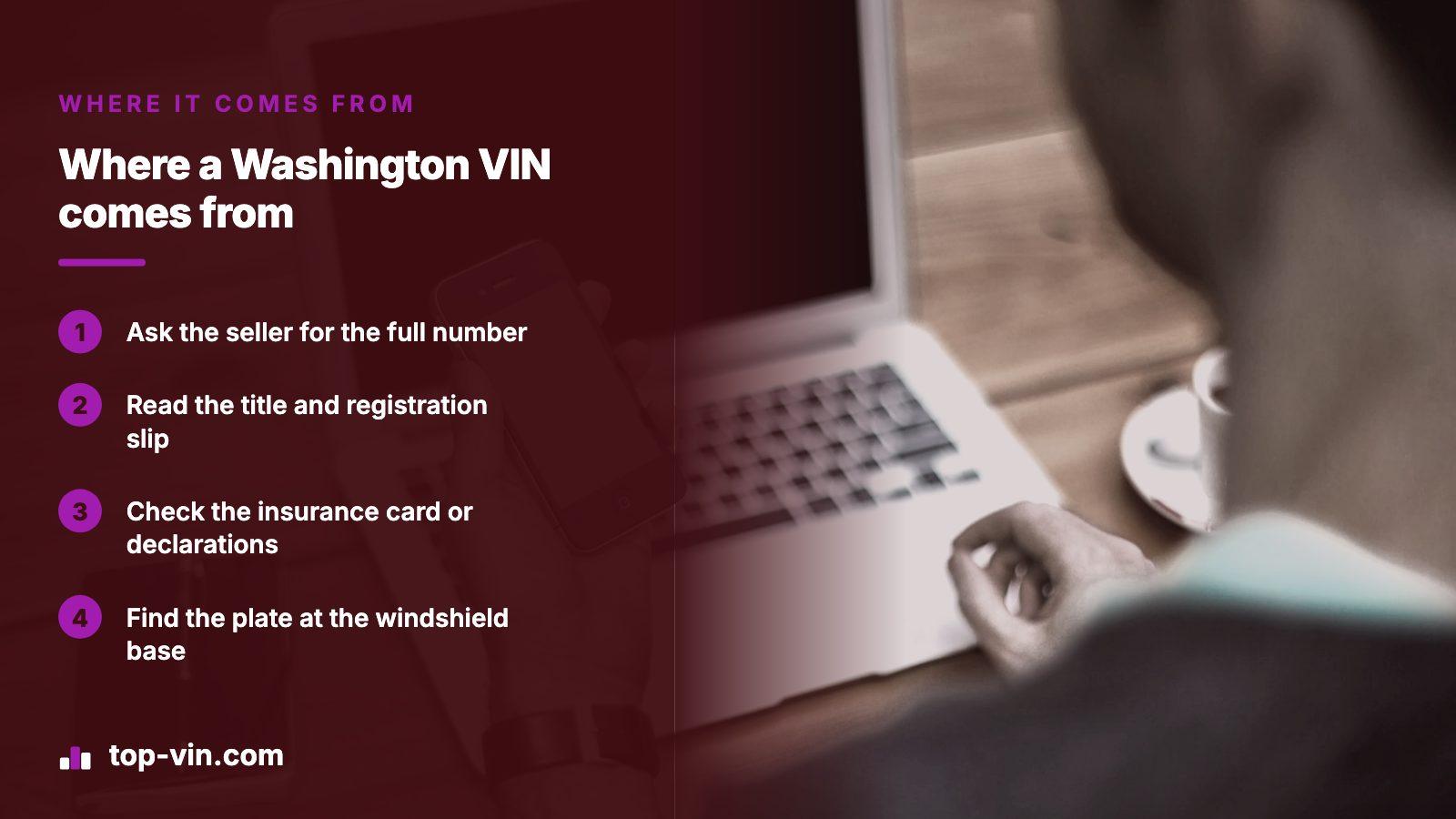
- The seller. Ask for the full 17 characters in writing before you visit. A refusal tells you something.
- The certificate of title and the registration slip, both of which carry the number.
- The insurance card or declarations page for the car.
- The vehicle: a metal plate at the base of the windshield on the dash, and a label on the driver door frame.
Collect it from at least two of these and read each character against the others. A mismatch between the dashboard and the paperwork is a reason to stop the deal, not to hunt for an explanation.
Decode it before you spend anything
NHTSA's vPIC decoder returns factory values for a VIN. A blank field is NHTSA admitting it holds nothing for that item, which is different from the car lacking the feature. Decoding gives you a quick sanity check: the model year, make and body style should agree with the listing and with what you see in the driveway.
If the decoded description contradicts the vehicle you are standing next to, you may be looking at a mistyped number, a swapped part or a vehicle whose identity has been altered. Settle that before you read any history, because history attached to the wrong number is worthless.
Run the TopVIN check
Type the VIN into TopVIN and you see the free preview before anything else. Going further means paying once for that car, or buying a pack if you are weighing several. Prices live on the pricing page, and nothing renews automatically.
In a report on a Washington car, read the title brands first, then damage and accident entries, mileage history, auction or salvage listings, liens, theft and any open recalls. Each one catches a different kind of bad deal.
NMVTIS, run under the Department of Justice, exists to shield buyers from fraud and dangerous cars, and title data from it underpins brand checks. The preview tells you whether this car has a record worth buying.
Red flags to act on
- The VIN on the paperwork differs from the dashboard by even one character.
- The seller will not give the number until you hand over a deposit.
- A preview that shows a brand, a total loss or theft entry the listing never mentioned.
- A title held by someone other than the person selling, or a lien that has not been released.
- Odometer readings that go down between entries.
A single item justifies slowing down. Two at once call for walking away, or at minimum a mechanic's inspection and a look at the physical title before any cash moves.
What to do next
- Get the VIN from the seller and confirm it against two other places.
- Decode the number and hold the output up against the advert.
- Run the TopVIN preview, then open the full report if it lines up.
- Inspect the title and any lien release yourself before paying.
- Book an independent inspection if anything in the report is a brand or damage entry.
Where this information comes from
- RCW 46.12.635: owner name and address disclosure — Washington's conditions for releasing owner details and the notice to owners.
- Driver's Privacy Protection Act, 18 U.S.C. 2721 — The federal list of permitted uses for motor vehicle record data.
- NMVTIS consumer information, vehiclehistory.gov — What the federal title information program is meant to prevent.
- NHTSA vPIC VIN decoder API — How NHTSA treats empty decoded values.
Sources and photos: Facts checked against the sources above in November 2026. Photos by Justin Cron, Alejandro Escamilla and Owen Michael Grech on Unsplash; diagrams by TopVIN.
Keep reading
- Vehicle registration lookup: what it shows and which check to addWhat registration records hold and who can see them.
- Motor vehicle records: what a car buyer can see, and what stays closedHow state records differ from a history report.
- How to read a VIN: a left-to-right walkthrough with a worked decodeRead each position of the number you collected.
- VIN verification: the four checks people mean and what each provesCheck that the car's number matches its paperwork.
Frequently asked questions
Can I find a VIN from a Washington license plate number?
Not through any public search we could confirm. Washington restricts release of owner names and addresses, and federal law limits who may request records. Most buyers get the number from the seller, the title, the registration or insurance card, or the car itself.
Does the Washington Department of Licensing give out owner information?
Only in the cases RCW 46.12.635 describes, mainly business requesters with a stated use, a signed request and a disclosure agreement. Courts and law enforcement are handled separately. An ordinary buyer is not in that group.
Will TopVIN look up a plate for me?
No. TopVIN starts from the VIN and does not return owner names, addresses or other personal data. Enter the number for a free preview, and pay only if you want the full report.
What if the seller refuses to give me the VIN?
Take that as a warning sign. An honest seller can read the number off the title or dash in seconds. Without it, brands, theft and recalls stay unchecked, so most careful buyers walk.
How much is the full report?
Only the preview is free. Beyond it you pay once per vehicle or buy a pack for several, with no recurring charge. See the TopVIN pricing page for what is offered now.
Now check the car itself
The guide explains what to look for. The report shows what this VIN has on record.