
THE SHORT ANSWER
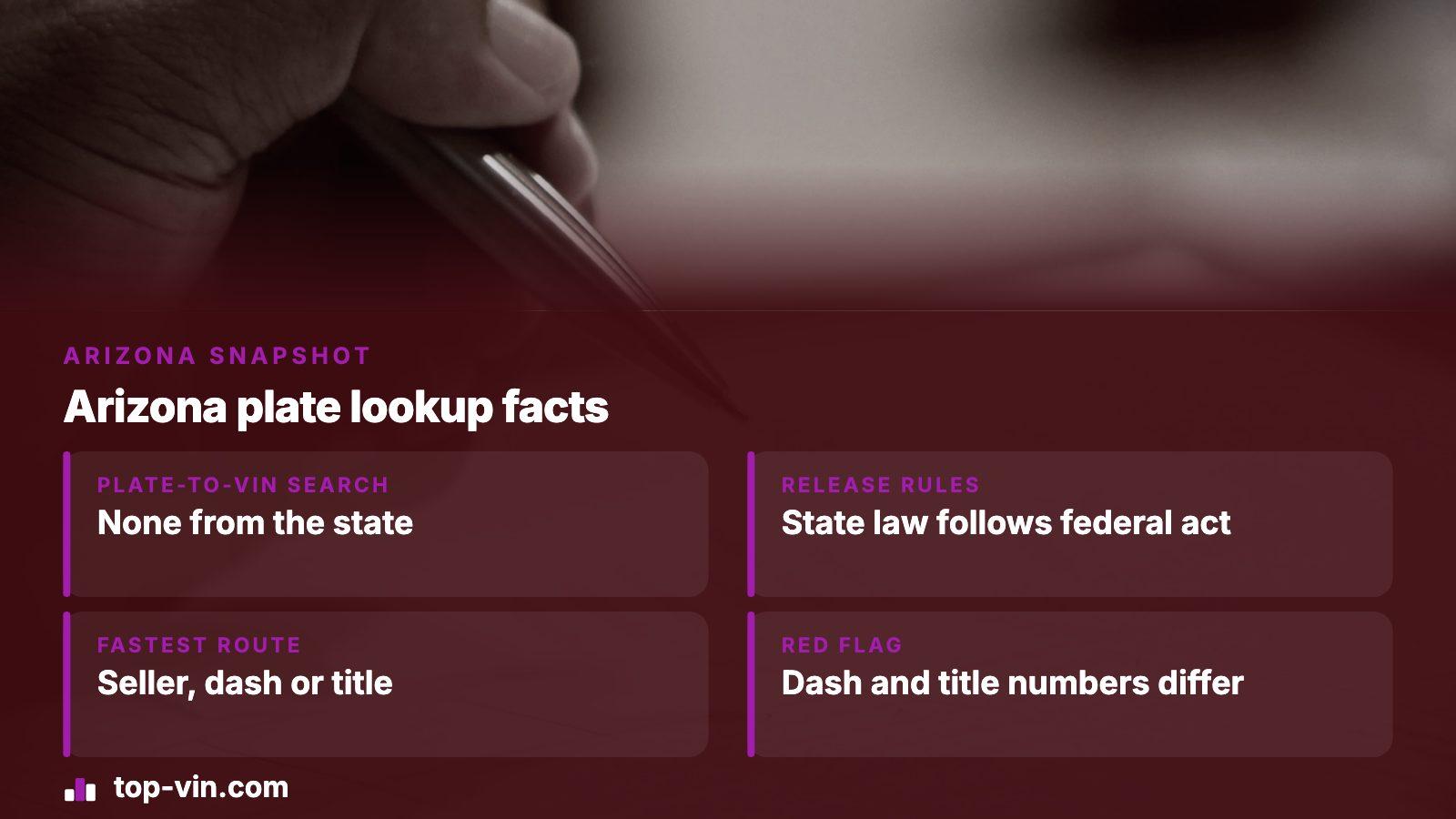
No public state service turns an Arizona plate into a VIN. Have the seller photograph the dash number and the title, read it off the car yourself, or find it on the registration or an insurance card. A person with a legal reason can apply for records under Arizona's release rules. With the number in hand, the preview here costs nothing.
- Public plate-to-VIN search
- None from the state
- Release rules
- Arizona law follows the federal privacy act
- Fastest route
- The seller, the dash or the title
- TopVIN preview
- Free, then one payment for the report
What a plate search in Arizona can and cannot do
Plenty of sites advertise a VIN for any Arizona tag. Behind the promise sits a state record that carries the owner's name and address, and Arizona law tells its transportation department to withhold that kind of detail from whoever asks. The statute leans on a federal privacy act passed in the mid-nineties, so the limit is national as well as local.
TopVIN starts from the other end. A VIN belongs to one vehicle for its whole life, and every brand, odometer reading and auction sale is filed under it. A plate belongs to a registration and can move to another car. Getting the VIN honestly is the real task, and it is usually quicker than people expect.
Five lawful ways to get the VIN
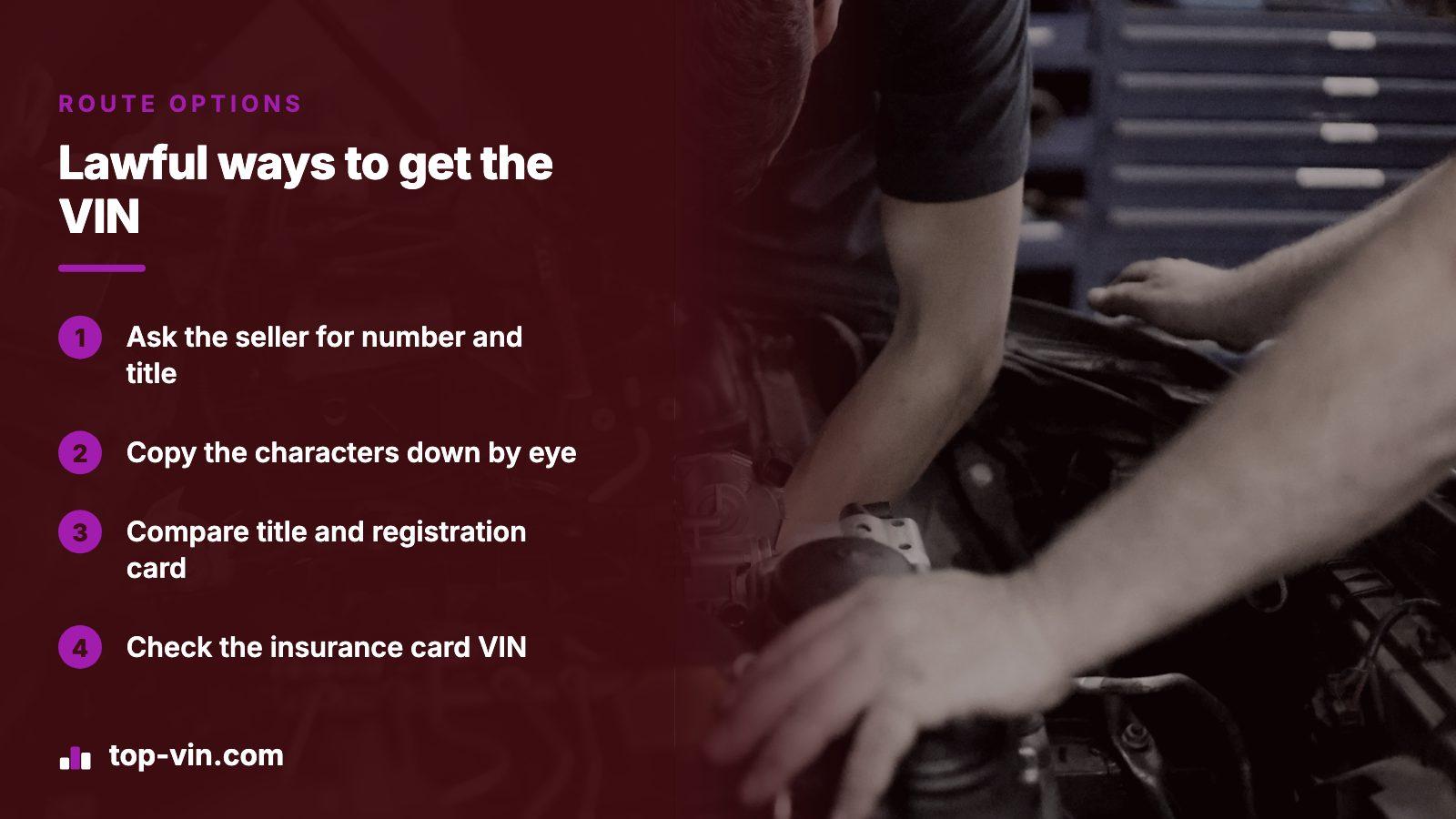
Take these in order. The first four cost nothing, and most Arizona buyers are done before the last.
- Ask the seller for a sharp picture of the number visible through the windshield, plus the title. Hesitation over either is worth noting.
- Stand at the car and copy the characters down by eye, then set them beside the documents.
- Check the title or the current registration card, where the number sits beside the make and model year.
- Open the insurance card or the policy page, which usually prints the VIN under each insured vehicle.
- Where you hold a legal reason, apply to the state for the record, as the next section explains.
Copy the number twice and compare. A single misread character sends the lookup to another vehicle or returns nothing.
When Arizona will release a record
The release statute separates uses the state must serve from uses it may serve. Safety and theft matters, emissions, recalls and manufacturer monitoring fall in the first group. The second group is longer, and every item in it is tied to a job: a government agency, an insurer working a claim, a lawyer or licensed investigator in a legal proceeding, a tow operator notifying owners, a toll operator, or a business correcting information a customer gave it.
- Someone in an accident, or the owner of a car in one, who submits proof of involvement
- A licensed and bonded dealer
- A storage operator holding the vehicle to enforce a lien
- A requester with signed permission from the individual named in the record
Wanting to vet a used car you have not bought yet appears nowhere on that list. If a request fits no exception, the department may mail the owner a copy of it, and nothing is released unless the owner waives privacy.
How a request is judged, and what the statute says about fees
Arizona sends applications for motor vehicle records information to a review panel chosen by the department director. The panel verifies what the applicant states and decides whether the purpose is one the law authorizes. Expect a person to read the request rather than a search box to answer it.
Under the fee statute the department can charge no more than $3 an item for copies or information, and $5 when the request is for a vehicle's title history. Those numbers come from the law itself, not from the Motor Vehicle Division's posted fee table, which we could not open. Confirm the current form and charge with the division before applying.
A thing to keep straight
Arizona title history is a state record with its own request terms. Calling it a plate lookup would be wrong, and it needs the VIN first.
Run the VIN check once you have the number
Enter the VIN in the search field here. The preview tells you whether records exist before you spend anything. Should you continue, you pay once for the report, nothing recurs, and the options sit on the pricing page.
| What you want to know | Where it shows up |
|---|---|
| Salvage, flood or rebuilt brand | Title brand records |
| Wrecks and repair damage | Accident and damage records |
| Rolled-back mileage | Odometer readings over time |
| Stolen or unpaid-on | Theft records and liens |
| Unfixed safety defects | Open recall listings |
Reading the results on an Arizona car
A history is only a list of what got reported. A clean one is encouraging, but a repair paid in cash or a flood loss never claimed will not appear. Compare the report with what you see in person and with what the seller says.
- A title brand, from any state, lowers what the car fetches and can complicate insuring it
- Mileage that drops between two entries points to a rollback or a clerical error to explain
- A lien means a lender still has a claim, so ask how the payoff will be handled before you hand over money
- A theft record on a car for sale means stop and phone the police, not haggle
Out-of-state cars matter here, because Arizona attracts many buyers from elsewhere. A brand created in another state follows the VIN, so run the check even when the car looks locally owned.
The federal title database as a second opinion
The Department of Justice operates a national title database, a federal effort against title fraud, dangerous vehicles and stolen cars returning to market. Its consumer pages say a search may show the title, the last odometer figure, the brand record and occasionally theft history. A list of approved data providers on the site names the companies that offer this to the public.
Its warning is aimed at people about to buy a flood or junk or salvage car: check before you buy. That is the same reason to run a VIN check on any used vehicle, whichever state's plate is on the back.
Red flags during the plate-and-VIN step
- The seller will not share the VIN until you send a deposit
- The number on the dash and the number on the title differ in any character
- A website promises owner names or addresses for a plate in exchange for a fee
- The seller has no title in their own name, whether or not a plate is on the car
Any one of these deserves a pause. A seller with nothing to hide can show you the number in under a minute.
What to do next
- Collect the VIN from whichever source is easiest
- Confirm every copy of it agrees
- Run the free preview on TopVIN
- Decide on the full report after you see what the preview finds
- Walk away if the history and the seller's story disagree
If the purchase later turns into a dispute or a legal claim, that is when a formal records request to the state may be appropriate.
Where this information comes from
- Arizona Legislature: ARS 28-455, release of personal information — The required and permitted uses, and what happens to requests that fit neither.
- Arizona Legislature: ARS 28-458, records release review panel — How applications for motor vehicle records are reviewed.
- Arizona Legislature: ARS 28-446, fees for copies — The statutory ceiling on charges for record copies and title history.
- 18 U.S.C. 2721, federal privacy act on motor vehicle records — The federal rule the Arizona statute follows.
- NMVTIS: information for consumers — What the national title system can show a buyer.
Sources and photos: Facts checked against the sources above in November 2026. Photos by Dennis Eusebio, Mustafa Sheikhmouss and Masjid MABA on Unsplash; diagrams by TopVIN.
Keep reading
- License plate to VIN: the lawful ways to find a car's VIN from its plateThe nationwide view of what a plate can and cannot reveal.
- Where the VIN sits on a title, and what to do nextWhere to read the number on a paper title and what to compare it against.
- Is the VIN on the insurance card? What to check before you trust itA fast way to pull the number from a policy card.
- License plate lookup privacy laws: what you can and cannot get from a plateWhy owner data stays protected and who can lawfully ask.
Frequently asked questions
Can I find a VIN from an Arizona license plate?
Not through any public state search. Get the number from the seller, the car, the title, the registration or an insurance card instead. Someone with a lawful purpose that Arizona's release statute lists can apply for records, and the state decides each application on its merits.
Does Arizona give out an owner's name from a plate?
Only for uses the law permits, such as a government agency, an insurer handling a claim, or a licensed investigator in a legal case. Checking out a car you might buy is not among them, so a private buyer should work from the VIN.
What does an Arizona records request cost?
The fee statute sets a $3 ceiling per item and $5 for title history, but that is only the legal limit. The Motor Vehicle Division sets the actual charge and the form, and we could not open its page, so confirm both with the division.
Is the TopVIN preview really free?
Yes. Enter a VIN and see whether records exist without paying. Buying the whole report is an optional step, billed once, and the pricing page lays out what is offered.
What if the seller refuses to share the VIN?
Treat it as a warning sign. The number is printed on the car and on the title, so a legitimate seller can send a photo quickly. If the excuses continue, move on to another listing instead of paying for a plate search.
Now check the car itself
The guide explains what to look for. The report shows what this VIN has on record.