THE SHORT ANSWER
No VIN lookup can read a build month out of the code itself. Character ten holds the model year and character eleven names the assembly plant, but the month and year of manufacture are recorded on the maker's label inside the driver's door. Use the VIN to identify the car and its open recalls, then take the date from the label, because a recall can cover only part of a model year.
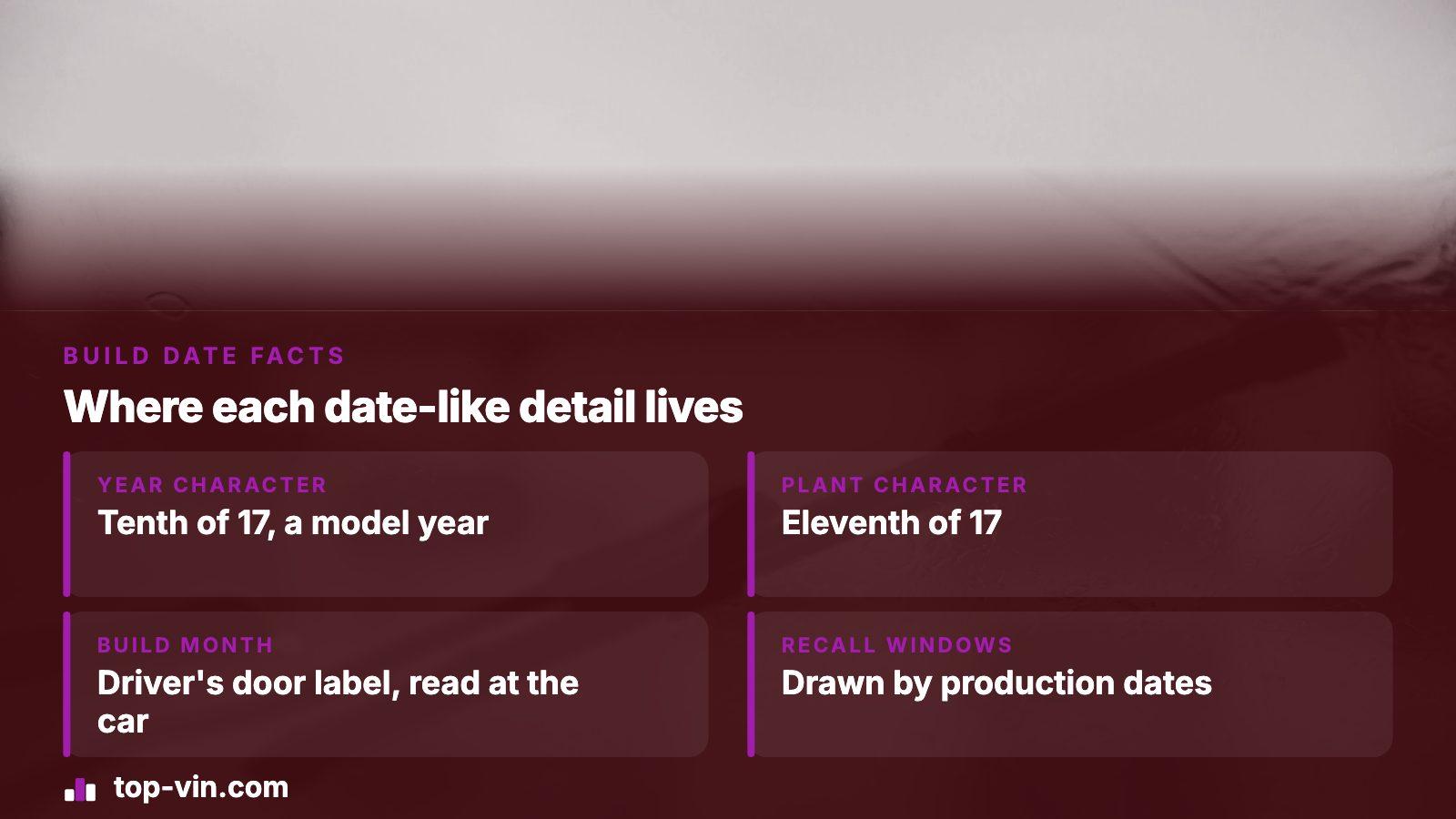
- Year character
- Tenth of 17, a model year
- Plant character
- Eleventh of 17
- Build month
- Driver's door label, read at the car
- TopVIN
- Free preview, then one payment
What a VIN search hands back when you ask for the build date
Ask any decoder for a build date and the honest answer is a model year and a plant. Under the federal VIN rule, the model year is encoded at position ten, the plant that fixed the VIN to the car at position eleven, and a production sequence number at positions twelve to seventeen. None of those slots counts months.
NHTSA's public decoder shows how this plays out. Run on a 2012 BMW 535i, it returned the year, maker, plant city and country, and a clean check digit, but no output field held a month of manufacture. The agency's API guide names model year as its only date-related input, and the data comes from what makers file about how they assign VINs.
Where each date-like detail lives
Several different dates get called the build date. Only one is the month the car was put together.
| Detail | Where it sits | How to get it |
|---|---|---|
| Model year | Tenth VIN character | Decode the VIN or use a year chart |
| Assembly plant | Eleventh VIN character | A decode names the plant city and country |
| Month and year of assembly | Maker's label, driver's side | Read it at the car |
| Production window of a recall | The maker's recall filing | Have a dealer or the maker match your VIN |
A model year is the label a maker gives a design, and it may legally differ from the calendar year of assembly provided production stays inside 24 months. So the year character alone never settles a build date question.
Reading the build month at the car
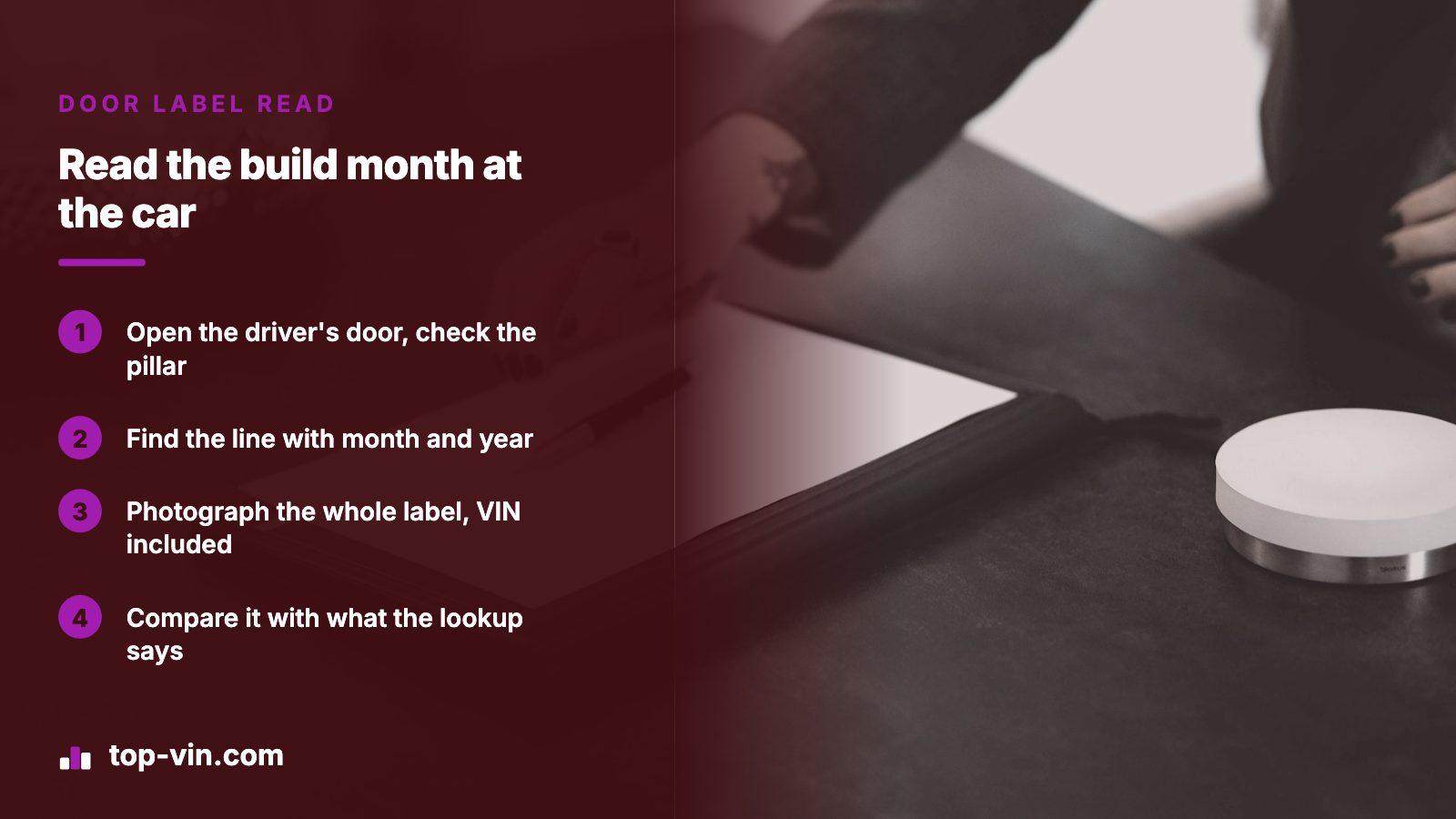
- Open the driver's door and check the hinge pillar, the latch post and the door edge that meets it. Where a maker could not use those spots, the rule allows the left side of the instrument panel.
- Find the line with the month and year. It may be spelled out or written in numerals like 6/00, and it records when work finished at the main assembly point.
- Photograph the whole label, VIN included, then compare that VIN with the one at the windshield and on the title.
The label has to be riveted or fixed so that removing it destroys or defaces it. A door with no label, or one that looks painted over or simply stuck on, calls for a direct question to the seller.
Why the month matters: recalls drawn by production dates
A recall notice names model years, but the maker's filing with NHTSA often narrows the group to a window of production dates. Ford's 2020 rearview camera recall covers model year 2020 trucks, yet its filing dates the F-150 production window from October 26, 2019 to May 18, 2020, so the window, not the year code alone, defines the group. Across every model in that filing Ford counted 620,246 potentially involved vehicles and put the share with the defect at 47 percent. Two plants even had different start dates for the camera part, October 26 and November 2, 2019, which gives the plant character a job.
Ram's 2025 recall for a gear display delay is narrower. Its 2500 and 3500 pickups were built between January 10 or 13 and February 21, 2025, 778 trucks in all. Similar pickups built outside that stretch are not included, according to the filing.
Neither filing gives a usable VIN range. Both report it as not sequential, and Ford says its trucks were not produced in VIN order, so owners are told to ask Ford or a dealer, who can look up the VIN in Ford's service system.
Two owners whose build month fell outside a recall
Owner complaints filed with NHTSA show how this looks in a driveway. Both concern 2013 Ford Escapes and record what the owners were told, while the filings hold the real dates.
From an NHTSA owner complaint
The owner of a 2013 Escape with the 1.6 liter engine wrote in late 2020 that the car was assembled in February 2013. Escapes built slightly earlier had been recalled over a coolant leak, and Ford said this one was "out of that manufacture date". The owner called the car nearly mint apart from a large coolant leak whose source stayed hidden.
Write the label date down before trusting a recall lookup. A car just past the cutoff gets no recall repair.
From an NHTSA owner complaint
Another 2013 Escape owner, filing in October 2020, reported steering trouble and a shifter that displayed neutral while the car sat in park. As the owner tells it, Ford left the car out of a recall the owner linked to the problem because of an early manufacturing date, although it came from the same facility the recall names.
Both edges of a window exclude cars, so bring the label date to the dealer first.
How to judge a VIN search that promises a build date
- Ask what the date is derived from. A maker's record can name a month, while a table that maps the tenth character to a year cannot.
- Check whether the answer is a month or only a year. A year is a model year, and it can differ from the year of assembly.
- Compare it with the label. A lookup that disagrees with the driver's door label is the one to doubt.
- See whether the result names the plant, since recall windows can start on different days at different plants.
TopVIN does not promise a build month. Its preview names the year, make and model the code belongs to, and the paid report covers the car's history. The month comes from the label.
Red flags when the label and the VIN disagree
- The VIN on the label differs from the VIN at the windshield or on the title, even by one character.
- No label at all, or one that looks peeled, painted over or stuck on instead of riveted.
- A label month several years away from the year character, when a model year covers at most 24 months of production.
- A seller who quotes the build month from memory, a chart or the ad instead of showing the label.
Each of these is grounds to stop and ask, though none proves fraud. Weigh the answer against the title and damage records in a report.
Cost and next step
Start with the TopVIN preview, which is free. It tells you whether the car on the lot is the one advertised before you spend a cent. A report is a single payment, not a subscription, and a pack is there for a longer shortlist. Current amounts are on the pricing page.
Then check the report's open recall section against the date on the label, and keep the accident and damage records beside it. A car that passes both reads still deserves an in-person inspection before money moves.
Where this information comes from
- 49 CFR 567.4: certification label — Where the label goes, how the month and year are written, and what else it states.
- 49 CFR Part 565: VIN requirements — The model year definition and the positions for year, plant and sequence number.
- NHTSA vPIC: Vehicle API guide — Where the decoder data comes from and which date input it accepts.
- NHTSA Part 573 report 20V-575 (Ford) — Production windows by model and plant, and the note that the trucks were not built in VIN order.
- NHTSA Part 573 report 25V-297 (Ram) — A suspect period inside one model year, with similar trucks built outside it left out.
- NHTSA owner complaint 11384338 — owner experience, paraphrased
- NHTSA owner complaint 11364135 — owner experience, paraphrased
Sources and photos: Facts checked against the sources above in November 2026. Photos by Dennis Eusebio, Annika Wischnewsky and Thibault Valjevac on Unsplash; diagrams by TopVIN.
Keep reading
- VIN check year: read a car's model year, make and model from its VINHow the tenth character maps to a model year, and where that year can mislead.
- How to read a VIN: a left-to-right walkthrough with a worked decodeAll 17 positions in order, including the plant character.
- VIN verification: the four checks people mean and what each provesMake sure the VIN on the label, the glass and the title agree before trusting any lookup.
- Safety features by VIN: what a check shows and what the build date decidesAnother question where the date of manufacture, not the model year, sets the answer.
Frequently asked questions
Can I find the build date from the VIN number?
Not the month. The VIN holds a model year and a plant, and neither is a build date. The month and year of manufacture sit on the maker's label at the driver's door. A decode can confirm the year and plant, and the label supplies the date.
Where on the car is the manufacture date printed?
On the label the maker fixes beside the driver's seating position: the hinge pillar, the latch post or the edge of the door. It reads as a month and a year. Where those spots do not work, the rule allows the left side of the instrument panel.
Does the model year match the year a car was built?
Sometimes, not always. Federal rules define a model year as the year a maker assigns to a design, whatever calendar year the car came off the line, provided production does not exceed 24 months. A car can be assembled in one calendar year and carry another year's code.
Does a recall depend on the build date?
Often it does. A maker's filing with NHTSA can limit a recall to vehicles produced between two dates, sometimes by plant, and the VIN range may be listed as not reported. Have a dealer run the VIN and bring the label date, since two cars sharing a model year can land on opposite sides.
Does a TopVIN report show the build date?
TopVIN does not promise a build month. The free preview names the year, make and model, and the paid report covers history such as open recalls, title brands and accident records. Take the build month from the label on the car, and use the report to learn what happened to it afterward.
Now check the car itself
The guide explains what to look for. The report shows what this VIN has on record.