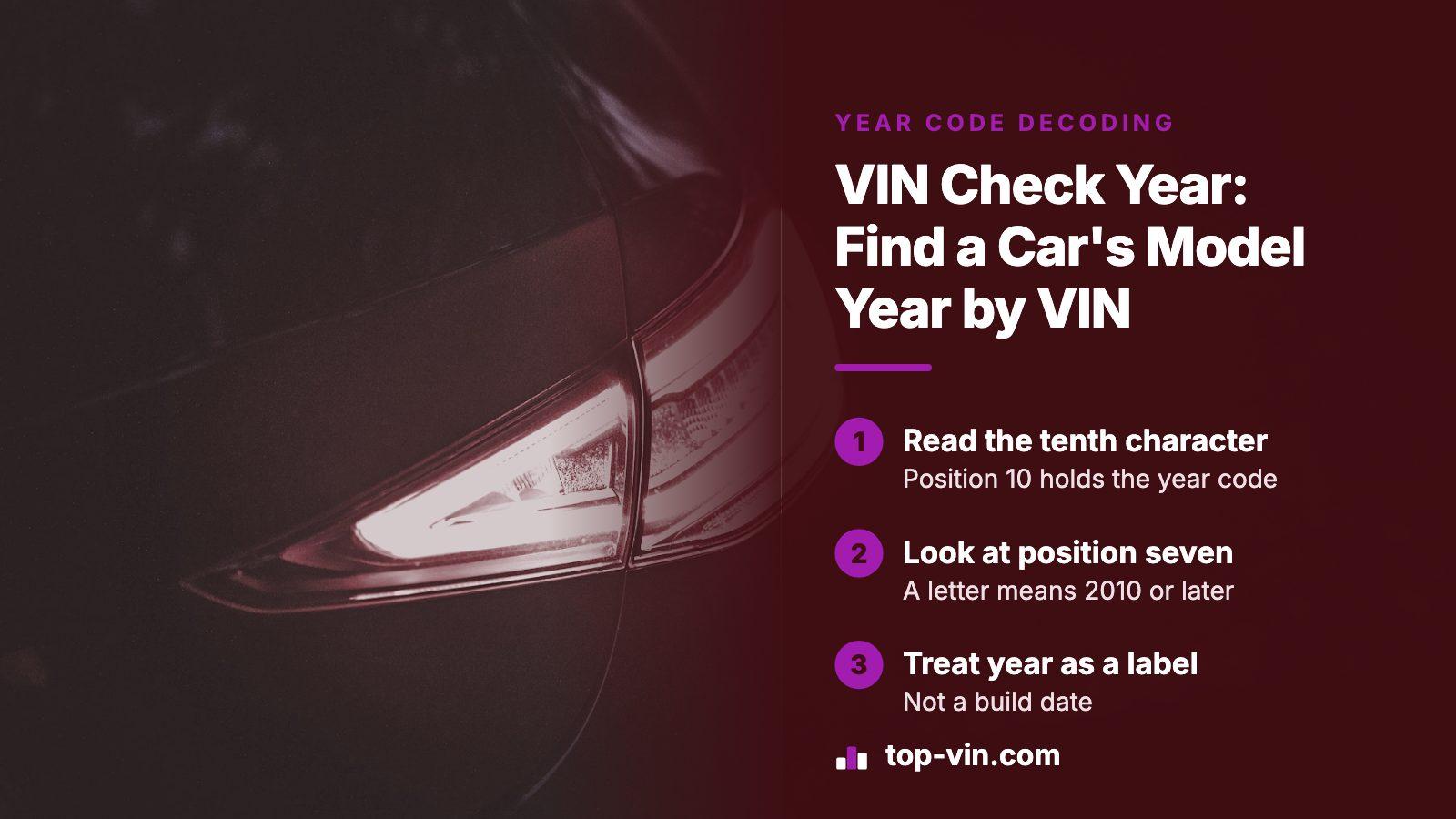
THE SHORT ANSWER
Look at the tenth character of the VIN. When the seventh character is a letter, M stands for 2021, P for 2023 and T for 2026. When the seventh is a digit, the same three letters mean 1991, 1993 and 1996. That one check separates a 2020s car from a 1990s one, and a decode adds make and model beside the year.
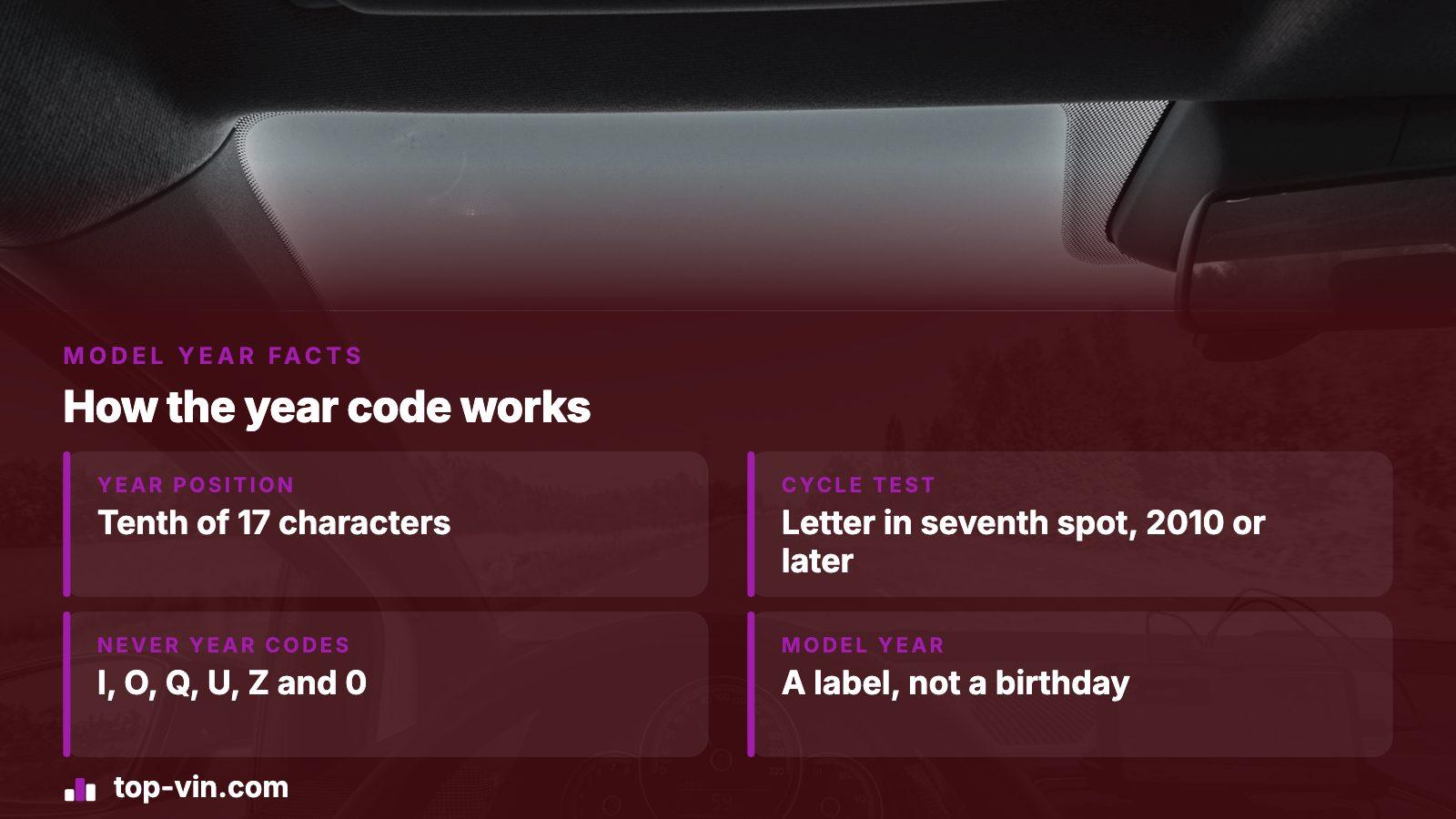
- Year position
- Tenth of 17 characters
- Cycle test
- Letter in seventh spot = 2010 or later
- Never year codes
- I, O, Q, U, Z and 0
- TopVIN preview
- Year, make, model and trim, free
The tenth character is where the year lives
Federal rules fix the layout of every 17-character VIN. Positions four to eight describe the car, with symbols each maker chooses itself. Position ten is the exception: one year chart serves every manufacturer, whatever the badge on the hood.
The word to watch is model. Regulators define a model year as the label a maker gives a design, whatever calendar year the car was assembled in, provided production does not stretch past 24 months. A car assembled in one calendar year can therefore wear the next year's code. The VIN year is a label, not a birth certificate.
Year codes for cars built in the last few cycles
| Tenth character | Letter in position seven | Digit in position seven |
|---|---|---|
| J | 2018 | 1988 |
| K | 2019 | 1989 |
| L | 2020 | 1990 |
| M | 2021 | 1991 |
| N | 2022 | 1992 |
| P | 2023 | 1993 |
| R | 2024 | 1994 |
| S | 2025 | 1995 |
| T | 2026 | 1996 |
Letters continue with V for 2027, W for 2028, X for 2029 and Y for 2030. Digits 1 to 9 appear twice in the chart, for 2001 through 2009 and again from 2031. If the tenth character is I, O, Q, U, Z or 0, no year matches, so retype the VIN before reading anything into it.
Letter or digit in position seven
Every letter in the chart is reused after thirty years, and the seventh character separates the two runs. For passenger cars, and for SUVs, vans and pickups rated at 10,000 pounds or less, a digit in position seven means the year falls from 1980 to 2009, while a letter moves it into the 2010 to 2039 run.
NHTSA's own API guide uses 5UXWX7C5*BA as its sample. The tenth character is B and the seventh is C, a letter, so the year is 2011 and not 1981. The agency's decoder agrees: it returns a 2011 BMW X3, trim xDrive35i, and flags only that the VIN is incomplete, because the asterisk stands in for the missing characters.
The federal note names those weight classes specifically. For heavy trucks and buses, lean on the full decode and the title instead of the seventh character alone.
Model year is a label, not a birthday
Two dates travel with every car. The VIN codes the model year. The certification label beside the driver's seat prints the month and year assembly work finished, and it has no model year line. A label date in one calendar year beside a VIN year one higher fits the definition above.
A factory year error on record
In August 2014 a manufacturer bulletin in NHTSA's technical service archive reported that 26 MINI Cooper and Cooper S cars, model code F56, built as 2014 models had been fitted with VIN labels showing 2015. The tenth character read F where E belonged. The error showed on the compliance label, on the VIN visible through the glass and on the front strut tower. The maker said the cars' electronics still report the right VIN.
Errors like this are rare, yet a gap between the plate and the paperwork deserves an explanation, not a guess about which one is right.
Run the year check on a real VIN
- Take the VIN from the vehicle rather than the ad. NHTSA points to the driver's-side base of the windshield, and the registration card repeats it. The certification label by the driver's door carries it too.
- Count out 17 characters. I, O and Q never appear in a VIN, so spotting one means you misread the plate.
- Submit the VIN through the form on this page. The preview that opens lists year, make, model and trim.
- Compare that year with the tenth character yourself, then with the ad. Use the seventh character to rule out the 1980 cycle.
- If the car still fits, buy one report. Shortlisting several cars? Multi-report packs exist for that.
NHTSA's decoder takes the same VIN, and its API also accepts partial VINs and skips the ninth character, which helps when a digit hides under glare or a sticker.

When the year does not add up
| What you see | What it can mean | Your move |
|---|---|---|
| The ad's year is one below the VIN year | A typo, or a build date quoted as the model year | Trust the VIN, then confirm on the title |
| Tenth character is I, O, Q, U, Z or 0 | A misread character, since no year uses them | Re-read the plate and retype |
| Dash VIN and door label show different years | A factory labeling slip, or a part that was swapped | Ask for paperwork; walk if nobody can explain it |
| A modern car with a digit in position seven | A mistyped character, since a digit points to 1980 through 2009 | Check the plate again before trusting the decode |
| Decode year differs from the title year | A clerical slip, or a VIN that belongs to another vehicle | Pause until the seller explains the gap on paper |
Why the year steers your next lookups
- Recalls: NHTSA's VIN search answers for your exact car but skips repaired recalls and, generally, safety recalls more than 15 years old. A year, make and model search returns results for the whole model instead.
- Mileage paperwork: since 2021 a seller must disclose the odometer reading at every transfer for the first 20 years, starting with the 2011 model year. Cars from 2010 and earlier stay under the older ten-year rule, so the VIN year decides which applies.
None of these pages says what has happened to the car since it left the factory.
Which check settles what
| Check | What it settles | What it leaves open |
|---|---|---|
| NHTSA VIN decoder | Year, make and model as the maker filed them, at no charge | Crashes, titles and mileage |
| NHTSA recall search | Whether this VIN has an unrepaired recall | Repaired recalls and most recalls past 15 years |
| Approved title-data provider | Title, insurance loss and salvage information, for that provider's fee | The FTC notes accident and repair detail often comes from other providers |
| TopVIN preview, then report | Preview: year, make, model, trim, open recall count and record counts. Report: the full history | Condition today, which needs an inspection |
Cost, and what to do once the year checks out
A matching year says the VIN fits the car, not that the car is clean. Title brands, damage records and the odometer trail are what a year cannot show. The TopVIN preview costs nothing. A single payment buys the full report, or a pack of three, five or ten for comparing cars, and there is no subscription. Prices sit on the pricing page.
Three years that should match
The year on the VIN, in the ad and on the title should agree. If they do, run the preview and decide on the report. If not, settle the gap before money moves.
Where this information comes from
- 49 CFR Part 565: Vehicle identification number requirements — The year chart, the seventh-character rule and the legal meaning of model year.
- 49 CFR 567.4: Certification label for manufacturers — Shows the label states month and year of manufacture beside the VIN.
- NHTSA vPIC: Vehicle API — Source of the partial-VIN sample and the decoding behavior described here.
- NHTSA: Check for recalls — What a VIN recall search shows and leaves out.
- NHTSA: Odometer disclosure changes from January 2021 — Ties the odometer disclosure period to model year.
- NHTSA technical service archive: MINI VIN label bulletin, 2014 — A manufacturer's record of VIN labels with the wrong model year.
- FTC: Used cars — What approved title-data providers cover and where history reports fall short.
Sources and photos: Facts checked against the sources above in November 2026. Photos by Maurice Sahl, JavyGo and Sander Jeurissen on Unsplash; diagrams by TopVIN.
Keep reading
- How to read a VIN: a left-to-right walkthrough with a worked decodeWhat every one of the 17 positions encodes, beyond the year.
- VIN search build date: where the month lives and what a lookup can returnFind out when the car was assembled, which can differ from its model year.
- VIN check digit: how the ninth character is worked out and what it provesTest whether a VIN you copied is valid before you trust any decode.
- Old car VIN number lookup: what comes back for an older carWhat to do when the car predates the modern year chart.
Frequently asked questions
How do I find the year of a car from its VIN?
Read the tenth character and match it to the federal chart, for example M for 2021 or P for 2023. Then check the seventh character: a letter confirms 2010 or later. NHTSA's decoder and the TopVIN preview run the same lookup and also return make, model and trim.
Is the model year in a VIN the same as the build year?
Not always. The tenth character gives the model year, a label that need not match the calendar year of assembly. The build month and year are printed separately on the certification label by the driver's seat. Often both land in one year, yet they can fall in different calendar years.
Why does my VIN decode to a different year than the listing?
Usual causes are a typo in the ad, a build date quoted as the model year, a misread character, or a VIN that belongs to another car. Re-read the plate, retype the VIN and ask the seller for the title before going further.
Can I check the year with a partial VIN?
NHTSA's decoder accepts partial VINs and uses whatever characters you give it, with an asterisk marking each missing one. The seventh and tenth characters are enough to read the year, though the result is flagged as incomplete. A TopVIN report needs the full 17 characters.
Does the year chart work for cars older than the 1980s?
The federal chart starts at the 1980 model year, and TopVIN is built for 17-character VINs from the 1981 model year on. NHTSA's API documentation describes a separate pre-1980 range, reached by supplying the model year with the VIN, so start there for an older car.
Now check the car itself
The guide explains what to look for. The report shows what this VIN has on record.