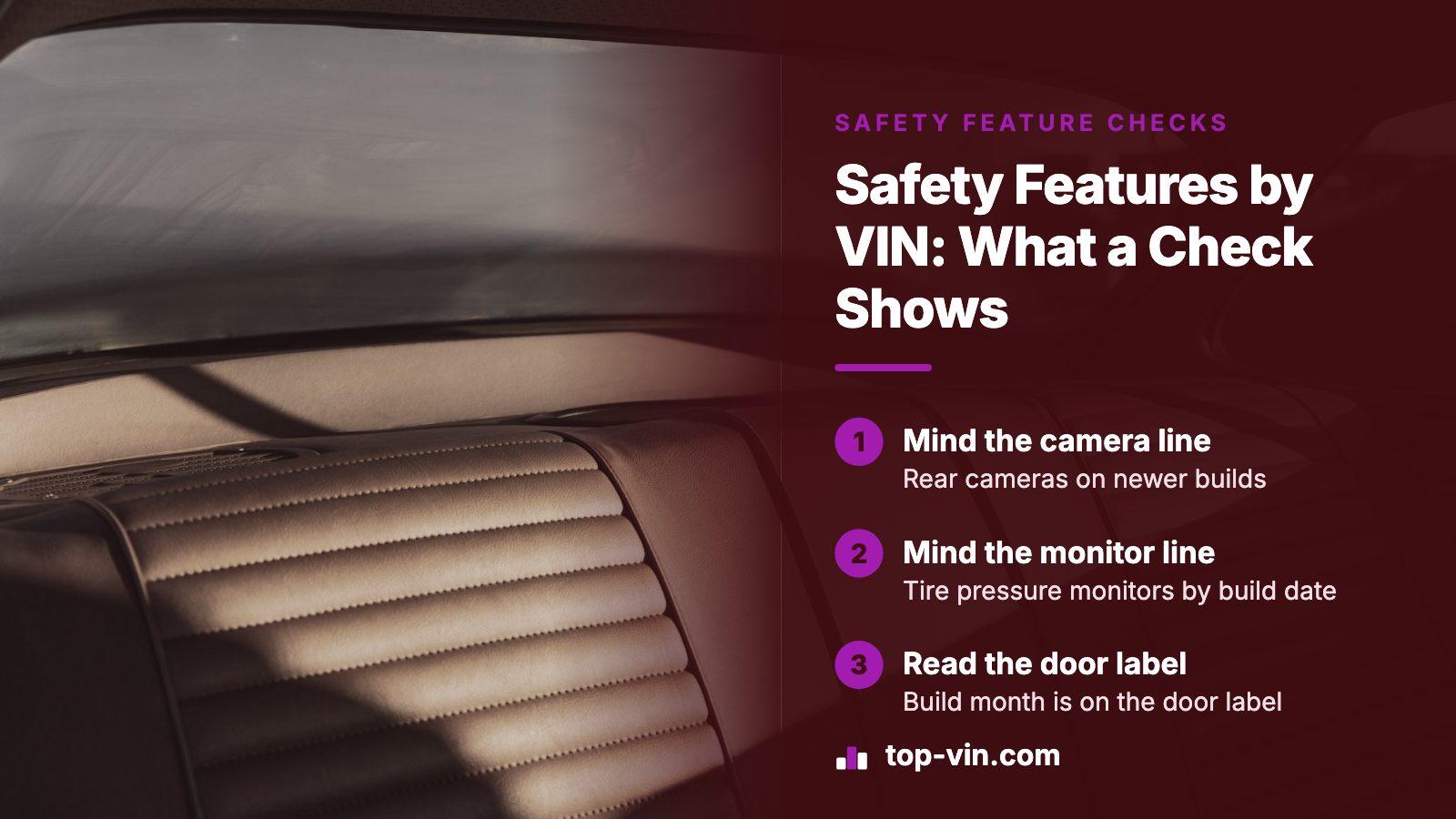
THE SHORT ANSWER
A VIN gives the model year, and NHTSA's decoder may add safety fields the maker filed, such as airbag positions or tire monitor type. An empty field means no data, not missing equipment. The federal rules run on build date: rear cameras from May 1, 2018, tire pressure warning systems from September 1, 2007. The TopVIN preview is free, and one paid report adds the car's history.
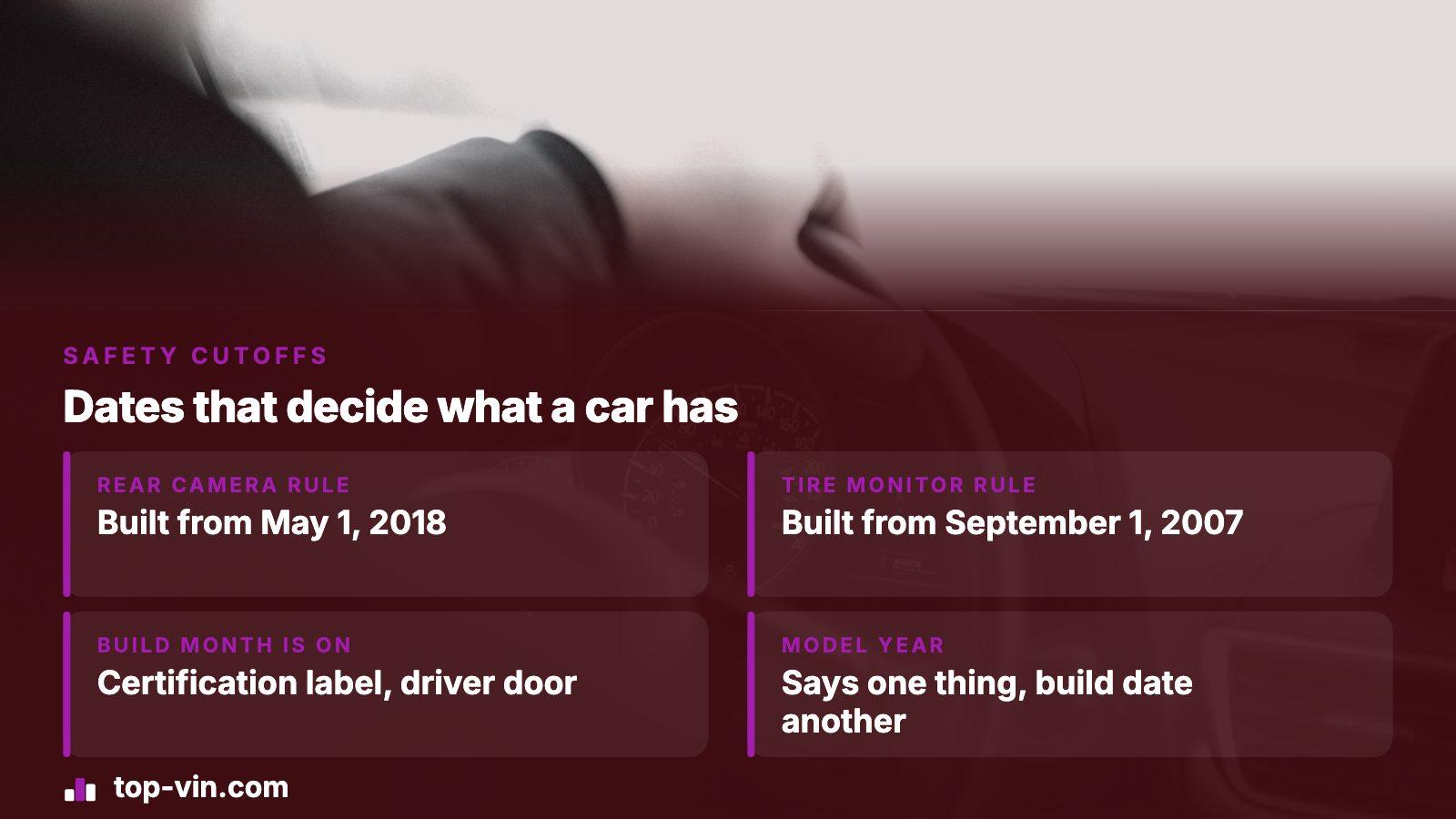
- Rear camera rule
- Built from May 1, 2018
- Tire monitor rule
- Built from September 1, 2007
- Build month is on
- The certification label, driver door
- TopVIN check
- Free preview, then one payment
What a safety features by VIN check shows for your car
Type the VIN into TopVIN and the preview names the car the code belongs to: year, make and model as the manufacturer declared them. Every safety question after that assumes you are looking at the right vehicle, so a mismatch ends the search right there.
A paid report covers the history side of safety: open recalls, accident and damage records, and salvage or auction photos where a lot existed. A car can have every required feature and still have been hit hard. An equipment list says nothing about that.
Which lookup answers which safety question
Several tools get offered for this one search, and each answers something different.
| Question | Where to look | Cost |
|---|---|---|
| Which airbag, stability and tire monitor fields did the maker file? | NHTSA vPIC decoder | No charge |
| Was the car built before a rule began? | Door label on the car | A visit |
| Is a recall open on this VIN? | NHTSA lookup, also in the report | No charge at NHTSA |
| Is this the car in the ad? | TopVIN preview | Free |
| Was it crashed, branded or stolen? | TopVIN report | One payment |
Nothing on that list tells you whether a camera or monitor works today. Only a test on the car does.
Model year says one thing, build date another
The tenth character of the VIN records the model year. The safety standards ignore it and count from the month the vehicle was assembled. Makers often start a model year early, so a 2018 could have been built in March or in July of that year, and a rule that began on May 1, 2018 treats the two differently while the title shows no difference.
Where to find it
Read the month and year on the certification label around the driver's door, and photograph it to keep with the listing.
Rear cameras: the May 1, 2018 line
The rear visibility rule is FMVSS 111, found at 49 CFR 571.111. It applies to passenger cars, multipurpose vehicles, trucks and buses weighing up to 4,536 kg gross. Body style does not move the dates.
| Built | What the maker had to do |
|---|---|
| May 1, 2016 to April 30, 2018 | Equip a set share of its output |
| May 1, 2018 onward | Equip every covered vehicle |
During the phase-in the duty was a share of production, not each car, so two cars of the same model year could differ and both comply. A missing camera from those years is not proof of tampering.
From an NHTSA owner complaint
A 2018 Honda Accord owner wrote that the backup camera kept turning on and off, then went black while reversing. At an approximate failure mileage of 98,179, the dealer said the car fell outside the recall campaign for camera visibility, and nothing was repaired.
The lesson: factory equipment can fail, and a recall helps only the VINs it names. Check recalls, then test the image.
Tire pressure monitors: the September 1, 2007 line
Tire pressure monitoring falls under FMVSS 138, at 49 CFR 571.138. Phase-in began with vehicles built on October 5, 2005, and every covered vehicle built from September 1, 2007 must meet it. Earlier cars may or may not have a system.
The rule stops at 4,536 kg, or 10,000 pounds, and skips vehicles running twin wheels on one axle. A dually pickup can sit under the weight limit and still be exempt.
The low-pressure lamp is no gentle nudge. It lights when a tire sits 25 percent or more under the recommended cold pressure, and the system may take up to 20 minutes to say so.
Two dash lights that mean different things
The standard also requires a separate warning when the monitoring system itself fails. One lamp says a tire is low; the other says the watcher is broken.
- A lamp that flashes at start-up, then stays lit, commonly points to the system and not the air.
- Ask whether it was lit before the last tire change, since fitters can damage sensors.
- "It just needs a reset" describes the low-pressure lamp, not this one.
From an NHTSA owner complaint
A 2009 Ford F-150 owner reported a tire pressure sensor fault that kept coming back. A dealer replaced 3 wheel sensors and the fault returned on a 1600 mile trip. A second dealer blamed the installation, a claim the owner rejected after checking with the first. The owner added that the manual warns the system might not work during that fault.
The lesson: a lamp that keeps returning deserves repair receipts from the seller.
Run the check on a car, step by step
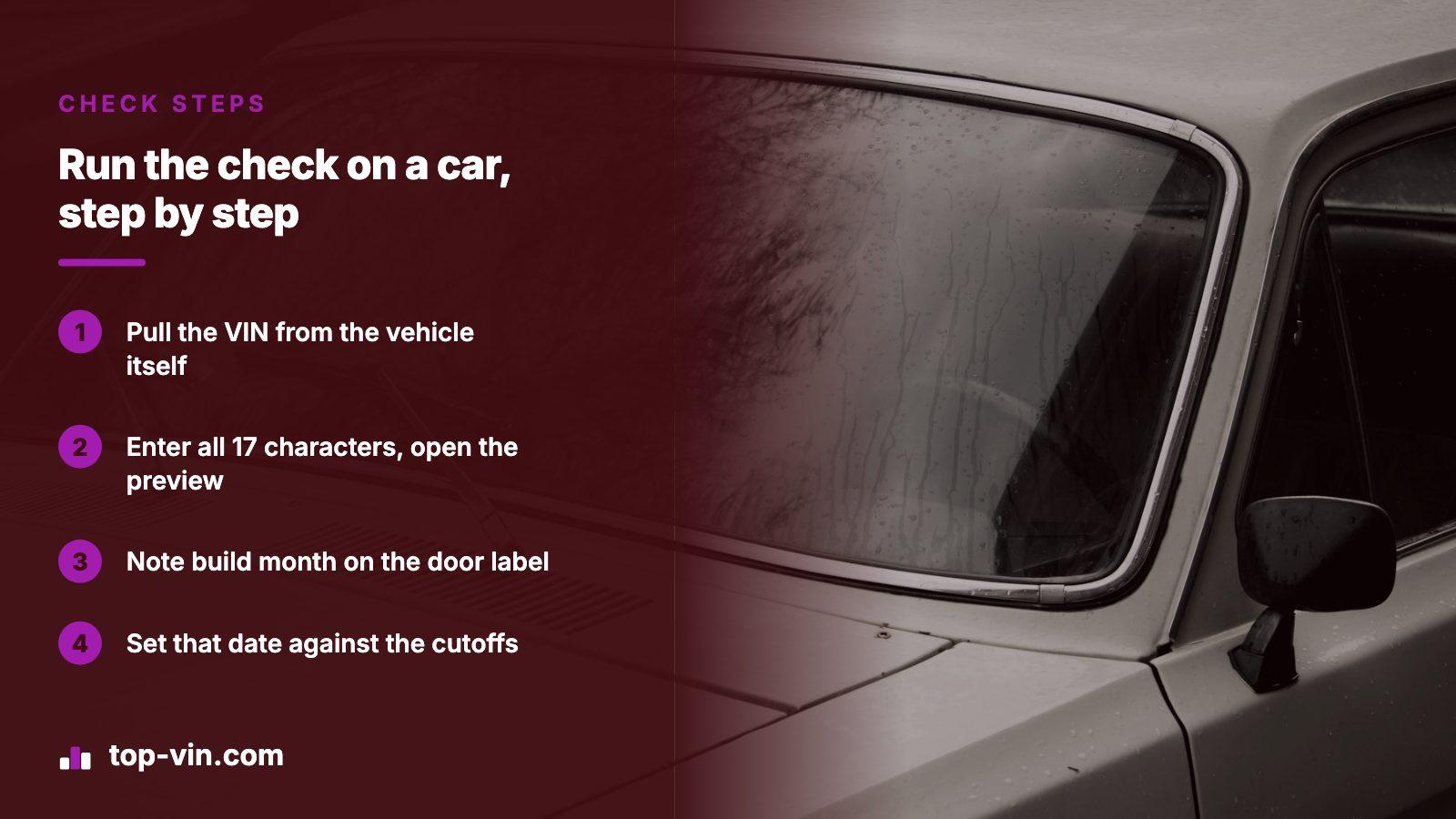
- Pull the VIN from the vehicle rather than the listing. The metal tag seen through the windshield and the door-pillar label should agree.
- Enter all 17 characters in TopVIN and open the preview to confirm the year, make and model.
- At the driver's door, note the build month and year on the certification label.
- Set that date against the cutoffs above, then select reverse and count: the camera image should appear in about two seconds.
- If the car still fits, buy one report. Shortlisting several cars? Multi-report packs exist for that.
Reading the results: when to slow down
Sort what you find by its likeliest cause before you react.
| What you see | What it can mean | Your move |
|---|---|---|
| An open recall | A safety repair not yet done | Confirm the repair is booked at a dealer |
| Accident, damage or salvage photos | A hit that may have reached safety systems | Ask for repair invoices and get a shop inspection |
| No camera or tire monitor after the cutoff | An unmentioned repair or a disconnected part | Ask for an explanation in writing |
What no VIN check can promise about equipment
No lookup, this one included, can promise from the VIN alone that a car has a working camera or monitor. A decode returns the model year and whatever the maker filed; the build date sits on the car.
That makes a fair test when comparing VIN checks: does the tool separate what comes from the number, what comes from the car and what it cannot know? One claiming every safety feature from 17 characters is guessing.
A TopVIN report holds no build sheet or window sticker, so the door label, the manual and a test drive fill the gap. A rule that applied is also no proof the part works now, since cameras and sensors are easy to leave unplugged after a cheap repair.
Cost and next step
The preview costs nothing. Reports are paid once, with no subscription. Current amounts for a single report and for the larger packs are listed on the pricing page. Preview each car on your list, read build months at the ones that match, and buy a report only for the finalists.
Where this information comes from
- 49 CFR 571.111: FMVSS 111, rear visibility — The phase-in window, the May 1, 2018 final date and the 4,536 kg weight limit.
- 49 CFR 571.138: FMVSS 138, tire pressure monitoring — The schedule to September 1, 2007, the 25 percent trigger, the 20 minute limit and the dual wheel exclusion.
- NHTSA vPIC VIN decoder — The public federal decode, where safety fields appear only if the maker filed them.
- NHTSA: recalls lookup by VIN — A no-charge check for open safety recalls on a specific VIN.
- NHTSA owner complaint 11632643 — owner experience, paraphrased
- NHTSA owner complaint 10336676 — owner experience, paraphrased
Sources and photos: Facts checked against the sources above in November 2026. Photos by Brandon Russell, Tigran Shishmanyan and Miles Loewen on Unsplash; diagrams by TopVIN.
Keep reading
- Specs by VIN compared: what each lookup returns and what it leaves blankWhat else a decode returns, and which fields come back blank.
- How to read a VIN: a left-to-right walkthrough with a worked decodeThe tenth character, and why it gives a model year and not a build date.
- VIN verification: the four checks people mean and what each provesCheck that the VIN stamped on the car agrees with the title before you rely on any decode.
- Car seat LATCH check: what a VIN check shows and what only a test fit canAnother equipment question where the build date decides what a car must have.
Frequently asked questions
Can a VIN tell me what safety features a car has?
Only in part. The VIN gives the model year, and the federal decoder may list fields the maker filed, such as airbag positions. A blank means no data, not no equipment. Confirm anything that matters on the car, starting with the build month on the door label.
Does a VIN check show a backup camera?
Not reliably. A decode may include a rear visibility field if the maker filed one. The federal rule reached light vehicles built from May 1, 2018, so the build date tells you whether one was required. Reverse the car and watch the screen.
When did tire pressure monitors become standard?
Phase-in began in October 2005, and covered vehicles built from September 1, 2007 had to comply fully. Dual-wheel vehicles and those over 10,000 pounds gross weight rating fall outside the standard. A pre-2007 car may still have one, but the law did not demand it.
What does the TopVIN preview show about safety?
It confirms which car the VIN describes, with its year, make and model. The paid report adds open recalls, accident and damage records, and salvage or auction photos where they exist. Equipment fields reflect what the maker filed, so verify them at the car.
Why would a 2018 car have no backup camera?
Model years can start early, and the final rule took hold for vehicles assembled from May 1, 2018 onward. Before that, only part of each maker's production needed one. Read the build month on the door label before assuming a camera was removed.
Now check the car itself
The guide explains what to look for. The report shows what this VIN has on record.