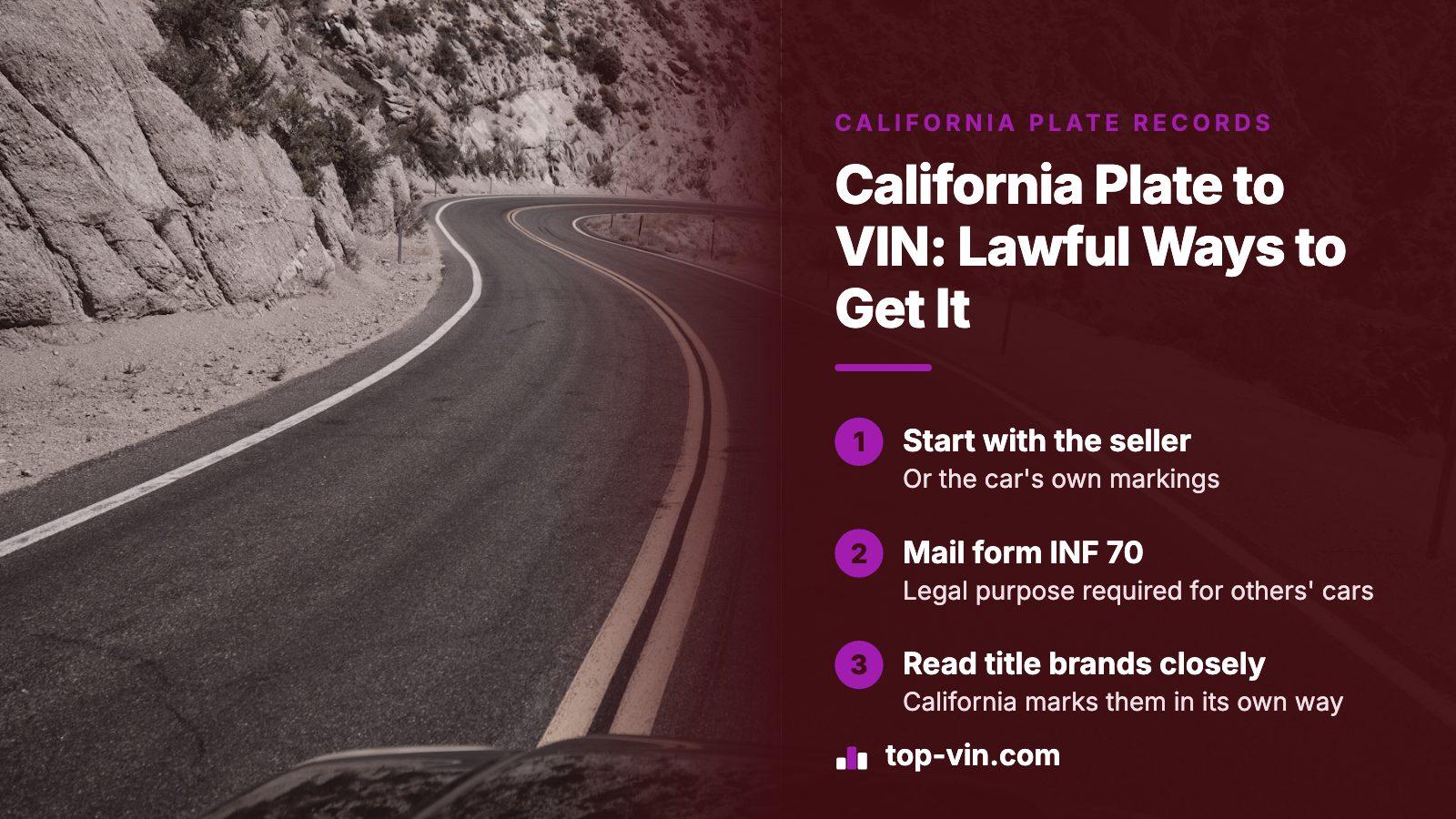
THE SHORT ANSWER
No public California tool turns a plate into a VIN. The seller, the car's own markings, the title, the registration card and the insurance card are the usual places to find it. Anyone with a legal purpose recognized by federal privacy law can mail the DMV form INF 70. Once you hold the VIN, a TopVIN preview costs nothing.
- Public plate search
- None from the California DMV
- Records form for another vehicle
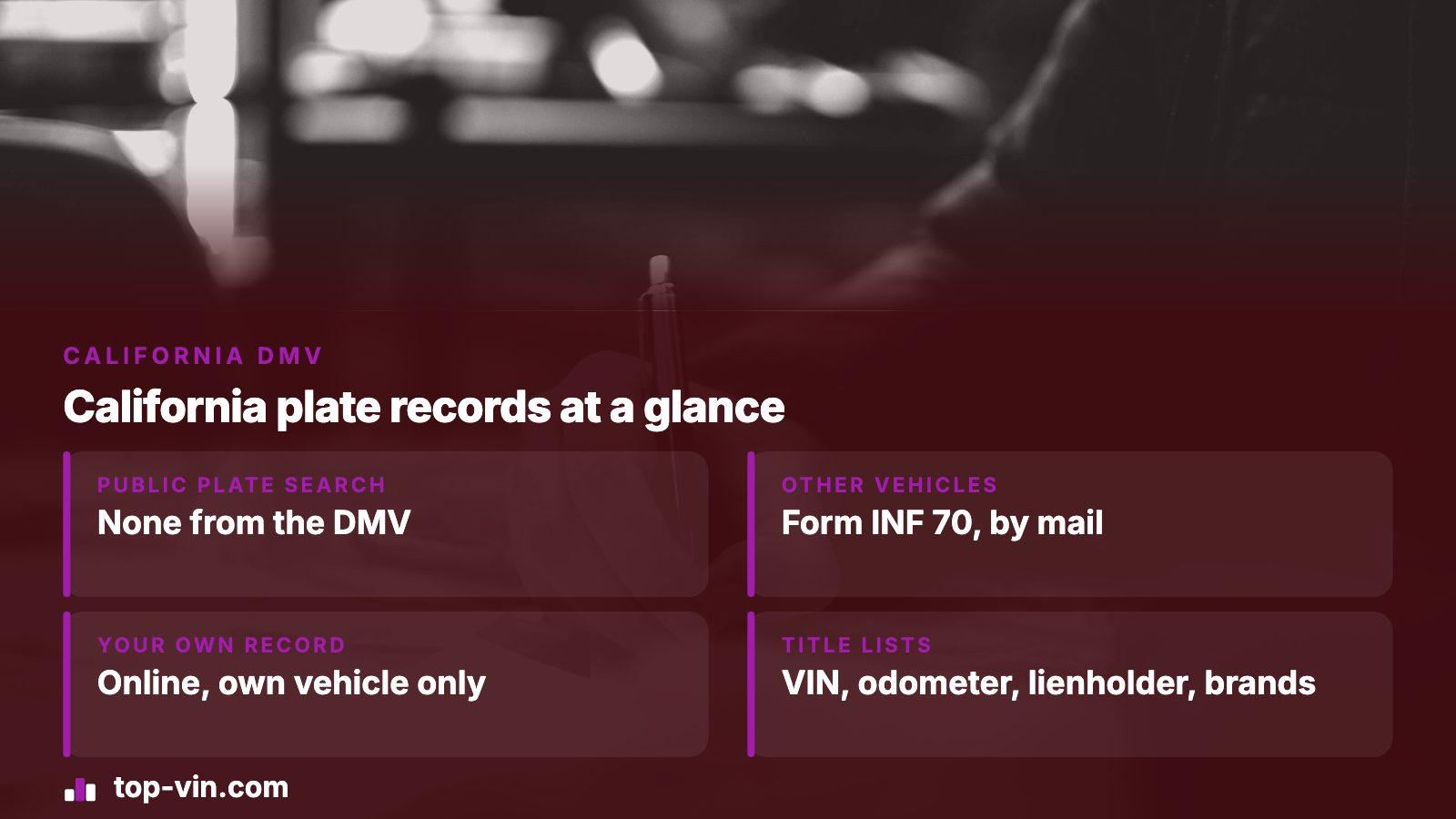
- INF 70, mailed, $5 per record
- Your own record online
- $2, own vehicle only
- TopVIN check
- Free preview, then one payment
What California gives you for a plate number
Searches for a California plate tend to promise a VIN, an owner and sometimes an address. The state offers none of that as a public service. Its DMV keeps registration records, but home addresses, phone numbers and Social Security numbers are treated as confidential, and DMV says it does not share them as public records.
The DMV does run an online vehicle record request, but it prints only the record for a vehicle you own. A buyer standing in a driveway with a plate photo is not the audience for it. Anything about another person's vehicle goes through a paper form and a stated reason, covered further down.
TopVIN works from the other side. A plate is only a registration tag. Title brands, damage files and odometer entries are filed under the VIN, so the job is to obtain that number by honest means and check it.
Ways to get the VIN without a records request
Buyers rarely need the state for this. The number appears in several spots, and whoever is selling can usually read it out in a minute.
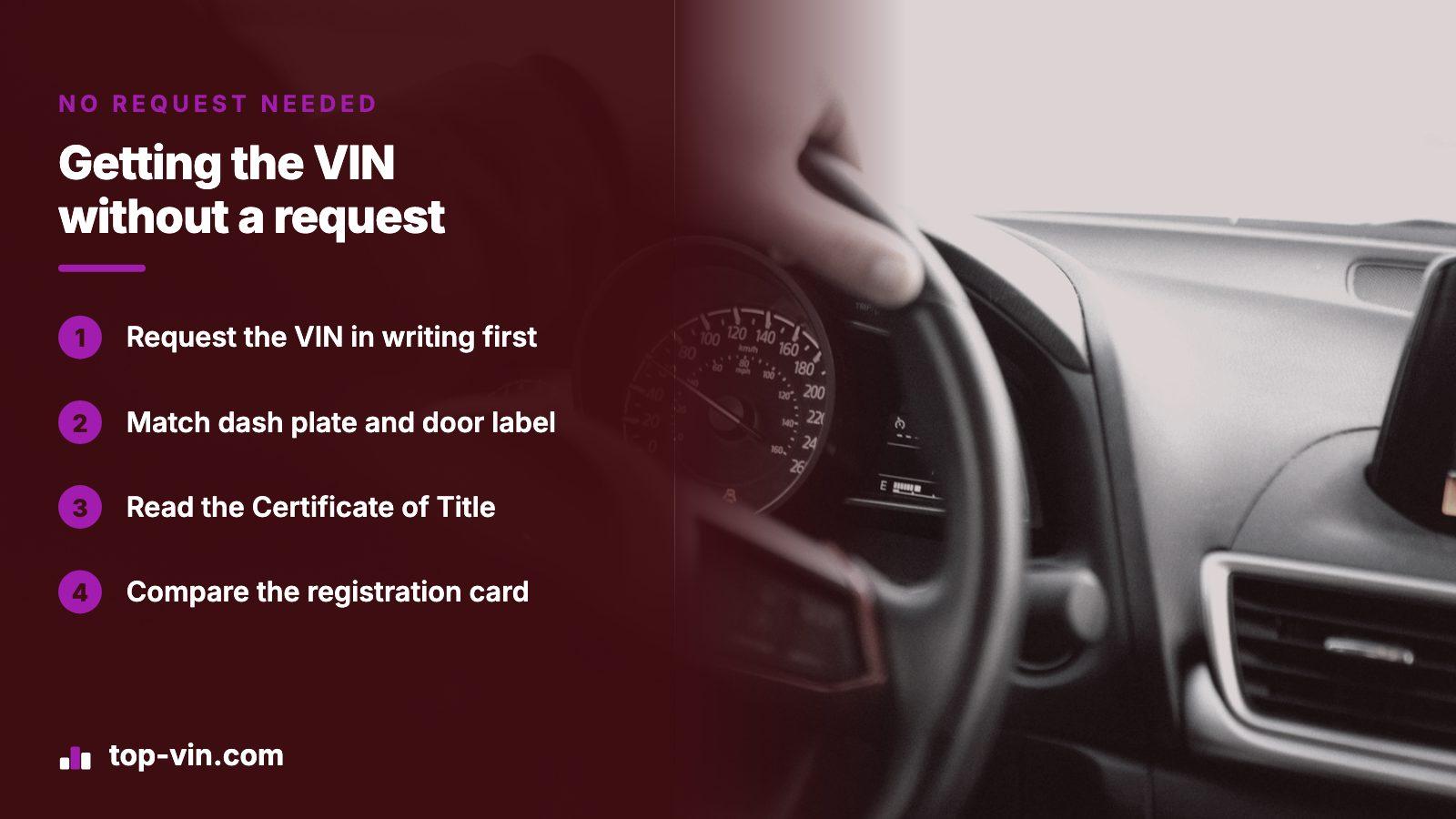
- Request the VIN in writing before you travel to see the car. Hesitation over a number stamped on the vehicle itself tells you something.
- Inspect the car. The plate on top of the dashboard and the label inside the driver's door should show the same characters.
- Read the California Certificate of Title. It lists the VIN along with make, model, year, odometer mileage, any lienholder and title brands.
- Open the registration card in the glovebox and compare.
- Ask for the insurance card or a screenshot of the policy page, which names the covered vehicle.
Mismatches between any two of these are the early warning. A number that differs between the dash and the title needs an explanation before money moves.
The DMV records request for someone else's vehicle
When there is no seller to ask, as with an abandoned car or a dispute, California's route is form INF 70, Request for Record Information. It is mailed to the DMV in Sacramento. DMV prefers that you fill it in on a screen, print it, sign it and send both parts.
| Item | What the DMV form says |
|---|---|
| What you must supply | Either a California plate or a VIN, with make and model year left optional |
| Cost | $5 for each automated record, $20 per year for photocopies of paper documents |
| Record choices | Today's record, ownership as of a chosen date, or the ownership trail |
| Limit | One vehicle per form |
| Who is told | DMV sends the record subject a copy of the request |
| Sworn statement | You sign under penalty of perjury and give your own license or ID number |
The current record is described by DMV as covering the registered owner, the legal owner, a vehicle description and registration status. I could not confirm from the form that the VIN is printed on what comes back, so do not plan a purchase around this route. It exists for people with a legal reason, not as a convenience for shoppers.
The federal privacy rule behind the form
The form makes you declare a reason that federal law accepts, under the Driver's Privacy Protection Act. DMV lists the categories in its instructions, and a curious shopper fits none of them cleanly.
- Motor vehicle or driver safety and theft, including recalls and market research
- A legitimate business verifying what a person submitted, to prevent fraud or collect a debt or security interest
- A civil, criminal, administrative or arbitral proceeding, including serving process
- Insurance work such as claims investigation, anti-fraud efforts, rating and underwriting
- An employer checking a commercial driver
- Any further use California law specifically authorizes where it relates to driving or public safety
Bending the rule carries a price. DMV calls lying to get a record, or using it for something other than your stated reason, a misdemeanor: a fine as high as $5,000, a year in the county jail, or both. Separately, the person whose record was pulled can sue in federal court, and damages start at $2,500.
Why a California plate says more than most
In California the plates mostly belong to the vehicle, not the seller. Personalized, special recognition and special interest sets are the exception, and an owner can pay to have those reassigned.
What this means in a driveway
Standard plates have usually stayed with a California car through its sales. Fresh plates on an older car deserve one question, since standard sets get issued after loss, theft or damage, or when special interest plates are handed back. Seeing a personalized plate in the ad photos and a standard one in person usually means the seller kept the original.
The plate still tells you nothing about the car's damage or title status. It is a pointer to the registration, and the VIN is what opens the history.
Running the check once you have the number
Type the VIN into TopVIN and the preview indicates whether any records exist for it. Read it with these pieces in mind.
- Title brands, since California records salvaged, taxi, police, gray market and lemon buyback history on the title
- Accident and damage entries with dates, and any salvage or auction photos
- Odometer readings over time, to compare with the mileage in the ad
- Liens that a seller has not paid off, and any theft record
- Open recalls, which the maker repairs at no charge
Match what the report says against the paper title you are shown. If the title and the report disagree about brands or mileage, stop and ask why before you sign anything.
Reading California title brands
On the current California title, brand information sits in a red panel headed VEHICLE HISTORY, top right. A salvaged brand marks a car that was wrecked or damaged enough that repair looked too costly, and it includes cars that were once dismantled.
DMV advises caution with a revived salvage car, one repaired and registered again. Some are expertly rebuilt. Others were not properly repaired or tested, and DMV notes that if the CHP or the DMV finds stolen parts on one, it cannot be registered and the vehicle or parts are seized.
Brands also travel. The national title system keeps a brand as a permanent part of a vehicle's record once a state assigns it, and each state keeps its own terms. A car arriving from out of state can carry a label California words differently, which is one reason a VIN-based check beats judging by appearance.
Cost and what to do next
The preview can be viewed without paying. Going deeper means a single payment per VIN, with bundles offered if you are shortlisting several cars, and nothing ever renews on its own. Figures are on the pricing page. A DMV request charges by the record and moves at the speed of the mail.
In order: collect the VIN, cross-check it against the car and the papers, run the preview, and hold the report next to the paper title before any money changes hands.
Where this information comes from
- California DMV: records requests — Which records stay confidential and how requests are made by mail or online.
- California DMV: form INF 70 — What the form asks for, its fees, the permissible uses and the penalties.
- California DMV: online vehicle record request — The online option covers your own vehicle only.
- California DMV: license plates — Plates generally stay with the vehicle; which plates can be reassigned.
- California DMV: branded titles — Brand types and where the history box sits on the title.
- NMVTIS for consumers — What the national title system records and how brands persist.
Sources and photos: Facts checked against the sources above in November 2026. Photos by Will Truettner, Miles Loewen and Owen Michael Grech on Unsplash; diagrams by TopVIN.
Keep reading
- License plate to VIN: the lawful ways to find a car's VIN from its plateThe national picture of what a plate can and cannot reveal.
- Where the VIN sits on a title, and what to do nextWhere the number sits on a paper title and how to compare it.
- Is the VIN on the insurance card? What to check before you trust itA quick way to read the number from a policy card.
- License plate lookup privacy laws: what you can and cannot get from a plateWhy owner data stays protected and who can lawfully ask.
Frequently asked questions
Can I find a VIN from a California license plate?
Not through any public California tool. Seller, car, title, registration card and insurance card cover nearly every case. Someone with a lawful purpose can send the DMV form INF 70, and the department reviews it before releasing anything.
Can the DMV tell me who owns a plate?
Only to someone who states a permissible use under federal law, and home address stays confidential in nearly every case. The DMV also sends the record subject a copy of the request. A buyer who just wants the car's history is better served by the VIN.
How much does a California plate record request cost?
For another person's vehicle, the INF 70 form lists $5 for each automated record and $20 per year of photocopied paper documents. Your own record online is $2, plus a card processing fee. Check the DMV page for current amounts before mailing a check.
If I buy a car in California, does the plate come with it?
Mostly, since the DMV treats standard plates as attached to the car. Owners can pay to move personalized, special recognition and special interest plates, so a seller may keep one of those sets.
Is the TopVIN preview really free?
Yes, the preview is free: key in a VIN and see what exists. Only the preview carries no fee. The complete report is paid once for that VIN, at the price on the pricing page, and no subscription is attached. TopVIN does not search plates or return owner details.
Now check the car itself
The guide explains what to look for. The report shows what this VIN has on record.